

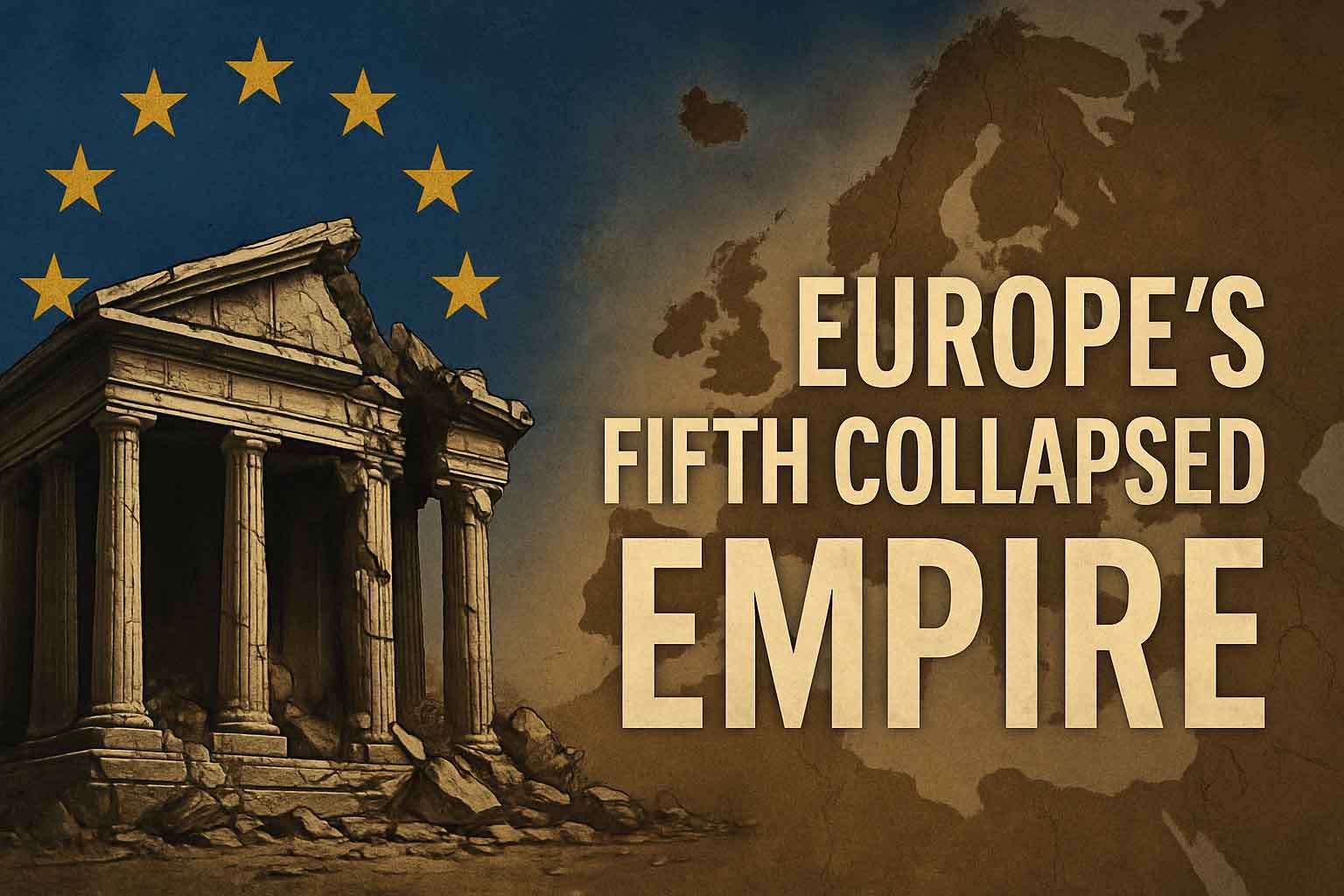
Europe’s Slow Unravelling
Why the European Union Is Drifting Towards Imperial Decline
For much of the post-war era, Europe appeared to have solved the great questions of modern political economy. Prosperity was broadly shared, social stability was strong, and the European project itself was widely regarded as one of the most successful experiments in peaceful integration in human history. Yet beneath this appearance of continuity, the foundations of Europe’s economic and political model have been eroding for decades. What is now unfolding is not a sudden crisis, but the delayed reckoning of long-accumulating structural weaknesses.
Two decades ago, the European Union generated roughly a quarter of global economic output. Today, that figure has fallen to around 14 per cent. Over the same period, the United States expanded its economy by approximately 85 per cent, while Europe managed growth of barely 30 per cent. This divergence is not cyclical, nor is it narrowing. On the contrary, it is accelerating. The gap between Europe and its global peers is widening in ways that increasingly resemble the historical trajectories of past empires entering long-term decline.
This is not a story of imminent collapse, nor of a single catastrophic failure. Rather, it is the story of stagnation, rigidity, and slow loss of relevance. Europe remains wealthy by global standards, yet millions of Europeans feel poorer each year. Living standards that once seemed secure now feel fragile. The contradiction between Europe’s apparent richness and the daily experience of its citizens lies at the heart of the current malaise.
The Illusion of Stability
At first glance, Europe’s economic position appears strong. It boasts advanced infrastructure, generous welfare systems, world-class universities, and high levels of human capital. In many quality-of-life rankings, European countries continue to dominate the upper tiers. However, these indicators increasingly mask a deeper reality: Europe is consuming the dividends of past success without generating sufficient new growth to sustain them.
Debt levels across the continent tell a revealing story. Italy’s public debt has climbed above 140 per cent of GDP. France is approaching 115 per cent and continues to add hundreds of billions of euros in new borrowing each year. Spain and Greece remain heavily indebted, while even Germany — long regarded as the guardian of fiscal discipline — has suspended its own debt constraints to prevent economic contraction. These figures are not merely accounting abstractions. They reflect a continent increasingly reliant on borrowing to maintain living standards that its productive base struggles to support.
Yet sovereign debt is only the most visible symptom. Beneath it lies a more pervasive erosion of economic dynamism. Productivity growth has slowed dramatically. Business investment remains weak. New global champions are rare. Europe still produces excellent engineers and scientists, but it struggles to translate innovation into scalable, globally dominant firms.
Housing: The Crisis Everyone Feels
Nowhere is this disconnect between macroeconomic wealth and lived reality more evident than in Europe’s housing markets. Across the continent, property prices and rents have surged far beyond wage growth. In major cities, housing has become a source of chronic insecurity rather than stability.
In Amsterdam, average house prices rose by nearly 90 per cent over a decade. In Lisbon, prices more than tripled. In Dublin, rents doubled. In Paris, a studio apartment barely larger than a parking space can command over €1,200 per month before utilities. Similar patterns are visible in Berlin, Milan, Barcelona, and countless other urban centres.
The critical issue is not simply price levels, but the mismatch between housing costs and incomes. Over the past decade, real wages in countries such as Italy and Spain rose by less than three per cent, while housing costs increased by 30 to 80 per cent. Even in wealthier economies like Germany and France, households now devote record shares of income to rent, energy, and food. The result is a widespread sense that hard work no longer guarantees security.
Europe has become richer on paper while feeling poorer in practice. This erosion of economic confidence has profound political and social consequences.
The Vanishing Engines of Growth
The global economy has entered a new phase defined by high-value innovation. Artificial intelligence, advanced computing, biotechnology, and next-generation energy systems now sit at the core of geopolitical and economic power. In this environment, scale, speed, and risk-taking matter more than ever.
Here, Europe’s weaknesses are stark. Among the world’s ten most valuable companies, the United States accounts for seven. Europe accounts for none. American technology firms alone added trillions of dollars in market value in recent years — sums exceeding the entire economic output of major European nations.
This is not merely a matter of prestige. Market capitalisation reflects future expectations. It determines where capital flows, where talent migrates, and where technological ecosystems form. Europe’s absence from the commanding heights of the modern economy signals a deeper problem: it is no longer setting the pace of global innovation.
European industry remains heavily concentrated in mature sectors such as traditional manufacturing, transport, and legacy services. These sectors are valuable, but they grow slowly and face intense competition. Meanwhile, the industries capable of delivering rapid productivity gains and strategic leverage increasingly cluster elsewhere.
Cities Under Strain
The consequences of these trends are most visible in Europe’s cities, where economic pressure is concentrated. In Berlin, waiting lists for affordable housing stretch for years. In Barcelona, entire neighbourhoods have been transformed by short-term rentals, hollowing out local communities. In Dublin, young professionals with full-time jobs remain trapped in childhood bedrooms because rent consumes half their income. In Milan, average prices per square metre exceed levels that would once have seemed implausible.
Even countries often held up as models of prosperity are struggling. In the Netherlands, homelessness has reached record levels, the highest since data collection began. In Portugal, locals are priced out of towns they have inhabited for generations. These developments are not anomalies; they reflect a continent-wide recalibration of living standards downward.
If current trajectories persist, Europe will struggle not only to grow, but to maintain the social settlement that defined its post-war success.
Demography: The Silent Emergency
The most fundamental constraint on Europe’s future is demographic. The continent is ageing faster than almost any other region in the world. Fertility rates across Southern and Eastern Europe hover around 1.2 to 1.3 children per woman, far below the replacement level of 2.1. Spain and Poland record some of the lowest figures globally.
Without immigration, many European populations would already be shrinking. Even with migration, the working-age population is set to decline sharply. By mid-century, Europe is projected to lose the equivalent of Germany’s entire working-age population. Today, roughly 29 working-age adults support every ten retirees. By 2050, that figure will fall to around 16.
An economy cannot grow sustainably when its labour force is contracting at this pace. Ageing populations reduce productivity growth, increase pension and healthcare costs, and shrink the tax base. They also dampen risk-taking and innovation, reinforcing stagnation.
Energy and Industrial Decline
For decades, Europe built its industrial competitiveness on a foundation of cheap energy and globalised supply chains. Reliable Russian gas powered factories, while just-in-time logistics kept costs low. This model delivered stability — until it did not.
When gas supplies collapsed, Europe’s energy system was exposed as brittle and expensive. Electricity prices surged. Gas prices multiplied. Energy-intensive industries faced immediate losses. Chemical plants shut down. Steel production was curtailed. Aluminium smelters closed altogether. Energy, once a quiet input, became a decisive competitive disadvantage.
Meanwhile, other regions moved faster. The United States combined cheap domestic energy with large-scale industrial subsidies. Asia continued expanding manufacturing capacity. Europe found itself squeezed between higher costs and slower decision-making.
Industrial output reflects this reality. German manufacturing has fallen significantly from its peak. Chemical production has declined sharply. Automotive exports, long the backbone of Europe’s industrial model, have dropped as global competition intensifies and the transition to electric vehicles accelerates.
Political Fragmentation and Inertia
Compounding these economic pressures is Europe’s political structure. The European Union comprises 27 member states, dozens of major parties, and near-constant elections. Governments rise and fall quickly. Coalitions shift. Policy direction is frequently reversed.
This environment makes long-term reform extraordinarily difficult. Demographic challenges require sustained investment over decades. Energy transitions demand coherent industrial policy. Competitiveness depends on regulatory clarity and strategic focus. Yet Europe’s political system is optimised for consensus and stability, not speed and adaptation.
For years, these weaknesses were concealed by cheap money and benign global conditions. Low interest rates allowed governments to borrow without immediate pain. Globalisation masked declining productivity. But successive shocks — the pandemic, supply chain disruptions, inflation, and geopolitical conflict — stripped away these buffers.
Self-Reinforcing Decline
Europe now finds itself trapped in a series of reinforcing feedback loops. Slow growth leads to rising debt. Rising debt encourages higher taxes. Higher taxes suppress private investment. Reduced investment further slows growth. Demographic ageing increases public spending, which raises debt and reduces competitiveness, depressing wages and discouraging family formation. High energy costs drive industry abroad, weakening exports and innovation capacity.
Politically, economic stress fuels polarisation. Polarisation weakens governments. Weak governments avoid reform. The absence of reform worsens economic conditions. The cycle repeats.
These dynamics are visible in daily life. Youth unemployment remains high in parts of Southern Europe. Some economies have yet to recover output levels reached before the global financial crisis. Public services strain under staffing shortages. Infrastructure ages. Rural areas hollow out as schools close for lack of children.
A Narrowing Window
None of this implies inevitability. Europe retains immense strengths: a skilled workforce, deep capital markets, strong institutions, and a vast internal market. It remains one of the safest and most liveable regions on earth. But these advantages alone are no longer sufficient.
The coming decade will be decisive. Without confronting demographic decline, restoring industrial competitiveness, addressing energy costs, and overcoming political fragmentation, Europe’s relative position will continue to deteriorate. The risk is not sudden collapse, but gradual marginalisation — the fate of empires that fail to adapt to changing realities.
History suggests that decline is rarely recognised in its early stages. It is often rationalised as temporary, cyclical, or externally imposed. By the time it becomes undeniable, the capacity for decisive action has already narrowed. Europe still has time. But that time is no longer abundant.