

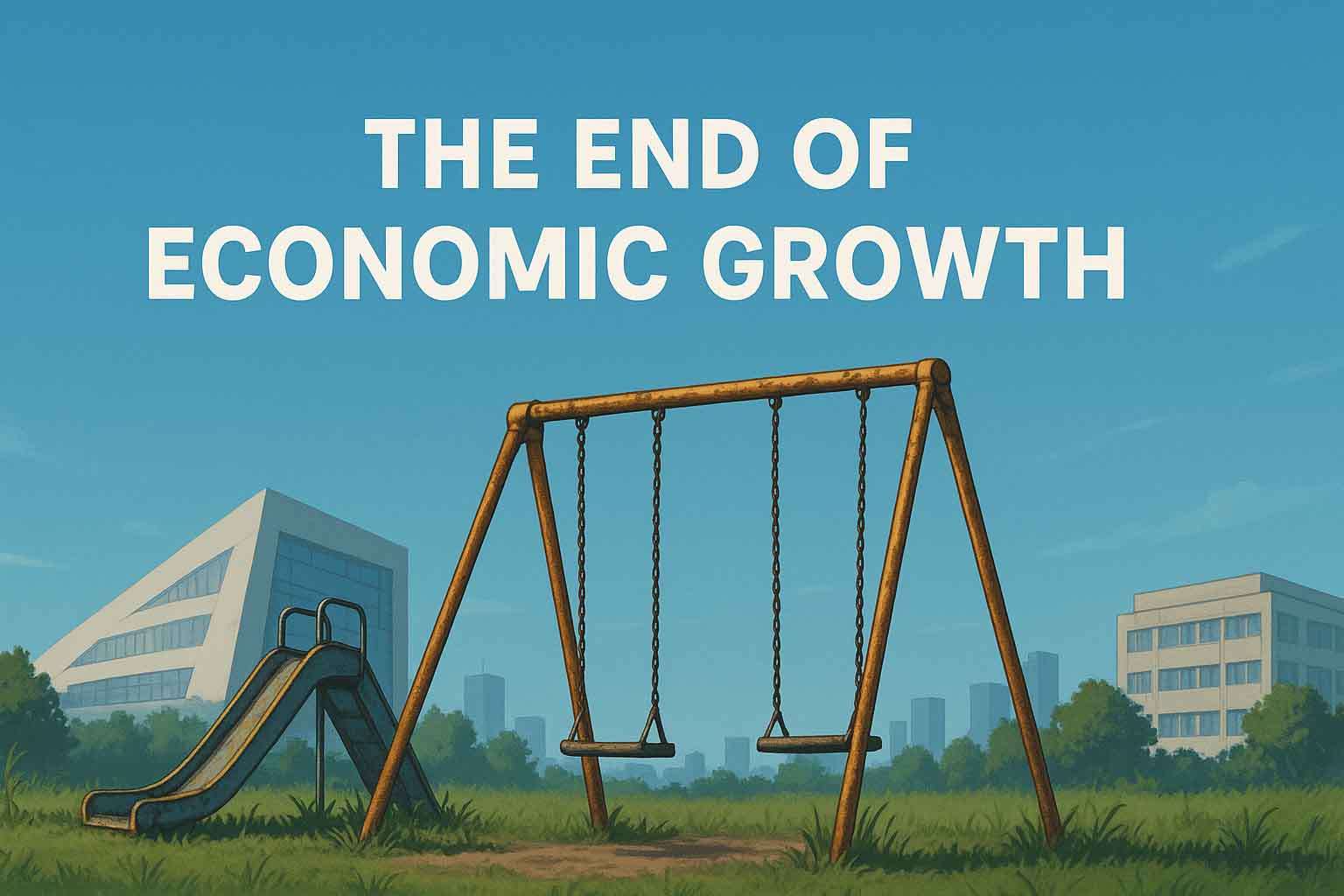
The End of Economic Growth
How Population Collapse Is Reshaping the Global Economy
Introduction: A Silent Future
Imagine a city at the end of the twenty-first century. The skyline remains impressive, the infrastructure intact, and the technology sophisticated. Yet something fundamental is missing. There is no laughter echoing from playgrounds, no morning rush of parents shepherding children to school, no youthful energy animating the streets. Schools have been converted into care homes. Public transport runs quietly, carrying mostly elderly passengers. The defining sound of human civilisation for millennia – the noise of children – has faded.
This vision is not science fiction. It is the logical destination of demographic trends already underway across much of the developed world. For decades, public debate was dominated by fears of overpopulation. Governments, economists and environmentalists warned that unchecked population growth would overwhelm resources, devastate ecosystems and ultimately collapse civilisation. That fear shaped policy, culture and economic thinking throughout the twentieth century.
Yet the reality unfolding before us is the opposite. The so-called population bomb did not explode outward. It imploded inward. Birth rates have collapsed across advanced economies and are now falling rapidly even in many developing ones. The result is not merely a demographic curiosity. It is a structural shock to the global economic system, which has been built on a single, rarely questioned assumption: that the number of people participating in the economy would always increase.
What happens when that assumption fails? What happens when customers are no longer born, workers become scarce, and the population pyramid turns upside down? The answer is not a short-term recession or a cyclical downturn. It is a profound transformation – and potential breakdown – of the economic, social and political order that has defined modern life.
This article explores the mechanics and consequences of population collapse. It examines how declining birth rates undermine pensions, property markets, innovation, labour supply, geopolitics and consumer capitalism itself. It also confronts the human and psychological costs of a shrinking, ageing society, and considers why many proposed solutions have failed. Finally, it asks whether a smaller world must necessarily be a worse one, or whether humanity can adapt to an era of contraction.
1. The Demographic Arithmetic No One Can Escape
Demography is governed by simple, unforgiving mathematics. To maintain a stable population over time, each woman must have, on average, around 2.1 children. Two children replace the parents; the additional fraction accounts for mortality before reproductive age. Anything below this level results in long-term population decline unless offset by immigration.
Today, much of the world is far below that threshold. South Korea’s fertility rate has fallen below one child per woman. China, even by its official figures, sits around one, with many analysts believing the true number is significantly lower. Across Europe, fertility rates hover between 1.2 and 1.6. Even the United States, long buoyed by immigration and comparatively high birth rates, has slipped well below replacement.
This is not a temporary anomaly caused by a single recession or cultural fad. It is a sustained, multi-decade trend driven by urbanisation, rising education levels, increased female labour participation, high housing costs, delayed family formation, and changing cultural expectations around parenthood. Once fertility rates fall to very low levels, they have historically proven extremely difficult to reverse.
Biologically, this creates ageing societies. Economically, it creates something far more destabilising: a shrinking base of workers supporting a growing population of retirees. The consequences of this imbalance ripple outward through every major institution of modern capitalism.
2. The Pension Illusion: When the Numbers No Longer Work
Modern pension systems were designed in a very different demographic world. In the mid-twentieth century, populations were young, life expectancy was lower, and the ratio of workers to retirees was extraordinarily favourable. In many countries, more than a dozen workers contributed taxes for every one person drawing a pension.
This structure made state pensions appear stable, generous and politically untouchable. A relatively small contribution from each worker could comfortably fund retirement payments for the elderly. The system functioned smoothly because it resembled a pyramid: a wide base of contributors supporting a narrow peak of beneficiaries.
That pyramid is now inverting. In several advanced economies, the ratio of workers to retirees is approaching two to one. In some regions, it is drifting towards parity. At the same time, retirees are living longer and consuming more healthcare and social services than any previous generation.
The uncomfortable truth is that most state pension systems are not savings schemes. They are transfer mechanisms. Contributions from today’s workers are used immediately to pay today’s retirees. There is no personal pot set aside, no guaranteed future claim independent of demographics. The sustainability of the system depends entirely on the existence of a larger working generation behind it.
As populations age and shrink, governments face a brutal choice. They can cut benefits, provoking political backlash from an older electorate that reliably turns out to vote. Or they can raise taxes on a smaller, poorer working population already struggling with high housing costs, student debt and stagnant wages. Either option risks deep intergenerational conflict and economic stagnation.
Once the dependency ratio tips too far, the system becomes mathematically unsustainable. No amount of political rhetoric can change the underlying arithmetic. When there are more people drawing from the system than paying into it, the promises made in the past can no longer be honoured in full.
3. Property Markets in a Shrinking World
For much of the twentieth and early twenty-first centuries, residential property was the cornerstone of middle-class wealth. Rising populations, expanding cities and easy credit combined to push house prices steadily upwards. Home ownership became both a social aspiration and a retirement strategy.
This model assumes a continuous flow of new buyers. Younger households buy starter homes, move up the property ladder, and eventually sell to the next generation. Prices rise because demand consistently outpaces supply.
In a depopulating society, that dynamic breaks down. As large generations age, they attempt to sell family homes at the same time. The cohorts following them are smaller in number and often less affluent. The result is a structural surplus of housing.
Japan offers a preview of this future. Millions of homes now stand empty, not because they are uninhabitable, but because there is no one left who wants or needs them. In rural areas and smaller towns, houses can be purchased for nominal sums or are simply abandoned, as the cost of maintenance exceeds their market value.
When vacancy spreads, property values collapse not gradually, but abruptly. A few neglected homes on a street can depress prices across an entire neighbourhood. For households that relied on property as their primary store of wealth, this represents a devastating loss. Equity evaporates. The ability to borrow against housing disappears. Funding long-term care through downsizing becomes impossible.
Commercial property faces similar pressures. Shopping centres, office parks and industrial facilities were built to serve growing populations. In a shrinking economy, a modest decline in footfall can render entire developments unviable. Once demand falls below a critical threshold, these assets lose much of their value, contributing to widespread balance-sheet distress.
4. Innovation in an Ageing Society
Economic growth is not driven solely by labour and capital. It is driven by ideas. Innovation – technological, organisational and cultural – is the engine that increases productivity and raises living standards. Historically, periods of rapid innovation have coincided with youthful populations.
This is not because older individuals lack intelligence or experience, but because risk-taking, experimentation and radical thinking are more common earlier in life. Younger people tend to have fewer obligations, greater cognitive flexibility and a higher tolerance for failure. These traits are essential for breakthroughs that disrupt existing systems.
As societies age, preferences shift. Capital flows away from speculative ventures and towards preservation. Investment favours stability over transformation. Research budgets are redirected from long-term projects to immediate healthcare needs. Political priorities reflect the concerns of older voters, who naturally focus on security rather than disruption.
The result is what economists describe as secular stagnation: a prolonged period of low growth, low innovation and muted productivity gains. Technology advances incrementally rather than dramatically. Cultural output becomes repetitive and nostalgic. Risk aversion becomes the dominant ethos.
In a world facing complex challenges – from climate adaptation to energy transition – this loss of innovative capacity is particularly dangerous. Fewer young minds mean fewer fresh approaches to unprecedented problems. The collective problem-solving ability of humanity declines just as the stakes rise.
5. The Labour Shortage Becomes Structural
For decades, globalisation masked demographic pressures. When labour became scarce or expensive in one country, production shifted elsewhere. Manufacturing moved from Europe and North America to East Asia, then to Southeast Asia and beyond. The global labour pool appeared effectively infinite.
That illusion is ending. Many of the countries that once supplied abundant young workers are now ageing rapidly themselves. China’s working-age population has already peaked and is declining by millions each year. Similar trends are emerging across Latin America and parts of Southeast Asia.
As labour becomes scarce globally, shortages cease to be cyclical and become structural. Essential services that rely on physical presence and human judgement – healthcare, construction, maintenance, care work – are particularly vulnerable. Automation can assist, but it cannot fully replace human labour in complex, unstructured environments.
The economic consequence is persistent cost inflation in services. Wages rise not because of productivity gains, but because there are too few workers to meet demand. Prices increase accordingly. Everyday services that were once affordable become luxuries. Convenience, long subsidised by cheap labour and venture capital, becomes rare.
Societies accustomed to abundance must adjust to scarcity. Tasks once outsourced return to the household. Standards of service decline. Expectations formed during the growth era prove unsustainable.
6. Population Decline and Geopolitical Instability
Throughout history, population size has been a foundation of power. Large, youthful populations provide soldiers, workers and taxpayers. They underpin industrial capacity and military strength. When populations shrink and age, states lose strategic flexibility.
Ageing nations face a dilemma. As their demographic base erodes, their relative power declines. This can incentivise risk-taking, as leaders perceive a closing window in which to assert influence. History suggests that periods of demographic decline often coincide with geopolitical volatility.
At the same time, competition for human capital intensifies. Immigration, once politically contentious, becomes economically essential. States compete to attract young, skilled workers to sustain their tax bases and care systems. This can exacerbate inequality between regions, draining talent from poorer countries and deepening global imbalances.
The ethical and political implications are profound. Migration shifts from humanitarian concern to strategic necessity. National identities, welfare systems and social cohesion are tested by the need to import people to replace those no longer born.
7. The End of Mass Consumerism
Modern capitalism is built on consumption. Economic growth assumes that each year more goods and services will be sold than the year before. Stock markets price companies based on expected future growth in sales and profits.
Ageing societies consume differently. Younger households drive demand for housing, furnishings, transport, clothing, entertainment and technology. Older households spend more on healthcare, utilities and basic necessities, and less on discretionary items. Money circulates more slowly.
As populations age and shrink, aggregate demand weakens. Companies struggle to grow. Markets stagnate. Long-held assumptions about perpetual equity returns are challenged. Japan’s experience, where stock indices took decades to recover after demographic decline set in, offers a cautionary example.
Deflationary pressures emerge as firms compete for a dwindling customer base. Consumers delay purchases in anticipation of lower prices, reinforcing the downward spiral. Entrepreneurship becomes less attractive in a shrinking market, further dampening dynamism.
8. The Human Cost: Loneliness and Social Fragmentation
Beyond economics, population collapse carries a heavy psychological toll. Smaller families mean weaker informal support networks. The extended family, once the primary source of care and companionship, withers away. Responsibility concentrates on fewer individuals, increasing stress and burnout.
Ageing alone becomes more common. Social isolation rises. Phenomena once associated with specific cultures – such as dying unnoticed at home – spread more widely. Mental health strains intensify across all age groups.
Technology fills some gaps but creates others. Artificial companionship, digital entertainment and virtual interaction substitute for human connection, often reinforcing withdrawal rather than alleviating it. Loneliness becomes self-perpetuating, feeding back into declining fertility and social disengagement.
9. Why Financial Incentives Fail
Governments have attempted to reverse declining birth rates through financial incentives: cash payments, tax breaks, subsidised childcare. The results have been underwhelming. In many cases, fertility rates continue to fall despite substantial expenditure.
The reason is that childbearing decisions are not purely economic. They are shaped by lifestyle expectations, career structures, housing markets and cultural norms. In highly competitive, urbanised societies, raising children is perceived as a profound sacrifice of time, status and flexibility.
There is a fundamental tension between the demands of modern capitalism and the requirements of family life. Systems optimised for productivity, mobility and individual achievement often undermine the stability and support structures that make parenthood viable. Monetary incentives alone cannot resolve this contradiction.
10. Environment, Degrowth and the Difficult Transition
From an environmental perspective, population decline offers clear benefits. Fewer people mean lower resource consumption, reduced emissions and space for ecosystems to recover. Evidence from depopulated areas shows rapid ecological regeneration.
The challenge lies in the transition. Economies built for growth struggle to function in contraction. Debt-based financial systems, welfare states and global supply chains all assume expansion. Adjusting to a stable or shrinking population requires redesigning institutions at every level.
This transition is likely to be turbulent. Living standards may fall. Inequality may rise. Political instability may increase. The long-term environmental gains come at significant short- to medium-term human cost.
Conclusion: Learning to Live Without Growth
Humanity stands at a turning point. For centuries, progress was synonymous with expansion: more people, more production, more consumption. That era is ending, not by choice, but by demographic reality.
Population collapse does not mean extinction, but it does mean transformation. The institutions, expectations and economic models of the growth era are ill-suited to a world of contraction. Clinging to them risks prolonged instability and disappointment.
Adapting requires a new framework: one that values resilience over expansion, care over consumption, and quality over quantity. It requires accepting that prosperity may no longer be measured by rising GDP, but by social cohesion, environmental stability and human wellbeing.
The transition will be difficult. There will be losses as well as gains. But within this challenge lies an opportunity to build a society that is smaller, slower and more sustainable.
As the noise of constant growth fades, humanity faces a choice. It can mourn the end of the party, or it can learn to listen to what comes after. The silence may yet hold the possibility of renewal.
Frequently Asked Questions
1. Why is population decline considered such a serious economic threat?
Population decline undermines the basic structure of modern economies, which rely on a growing workforce to support retirees, fund public services, and sustain consumer demand. When fewer people are born, the ratio of workers to dependants deteriorates, placing severe pressure on pension systems, healthcare provision, housing markets and public finances. Unlike a recession, demographic decline is structural and long-term, making it far harder to reverse through conventional economic policy.
2. Can immigration solve the problem of population collapse in developed countries?
Immigration can mitigate the effects of population decline, but it cannot fully solve the problem on a global scale. Many countries are experiencing falling birth rates simultaneously, reducing the pool of young workers available to migrate. Large-scale immigration may also create political, social and infrastructural challenges if it outpaces a country’s ability to integrate newcomers. Over time, migrant populations also tend to adopt the same low-fertility patterns as host societies.
3. Why do government financial incentives fail to raise birth rates significantly?
Financial incentives fail because decisions about having children are driven more by lifestyle, time constraints and social expectations than by direct costs alone. In highly urbanised, competitive economies, parenthood often conflicts with career progression, housing affordability and personal autonomy. Cash payments and tax breaks may slightly change the timing of births, but they rarely lead to a sustained increase in family size.
4. How does an ageing population affect innovation and productivity?
Ageing populations tend to be more risk-averse, directing capital towards preserving existing wealth rather than funding new ideas. Younger generations are statistically more likely to drive radical innovation due to greater cognitive flexibility and willingness to take risks. As the proportion of young people shrinks, economies experience slower productivity growth, reduced entrepreneurial activity and a cultural shift towards stability over experimentation.
5. Is population decline beneficial for the environment?
In the long term, population decline can reduce pressure on natural resources, lower carbon emissions and allow ecosystems to recover. However, the transition to a smaller population is economically and socially disruptive. Institutions built around continuous growth struggle to function during contraction, potentially causing hardship for those living through the adjustment. The environmental benefits are real, but they come with significant human and economic trade-offs.