

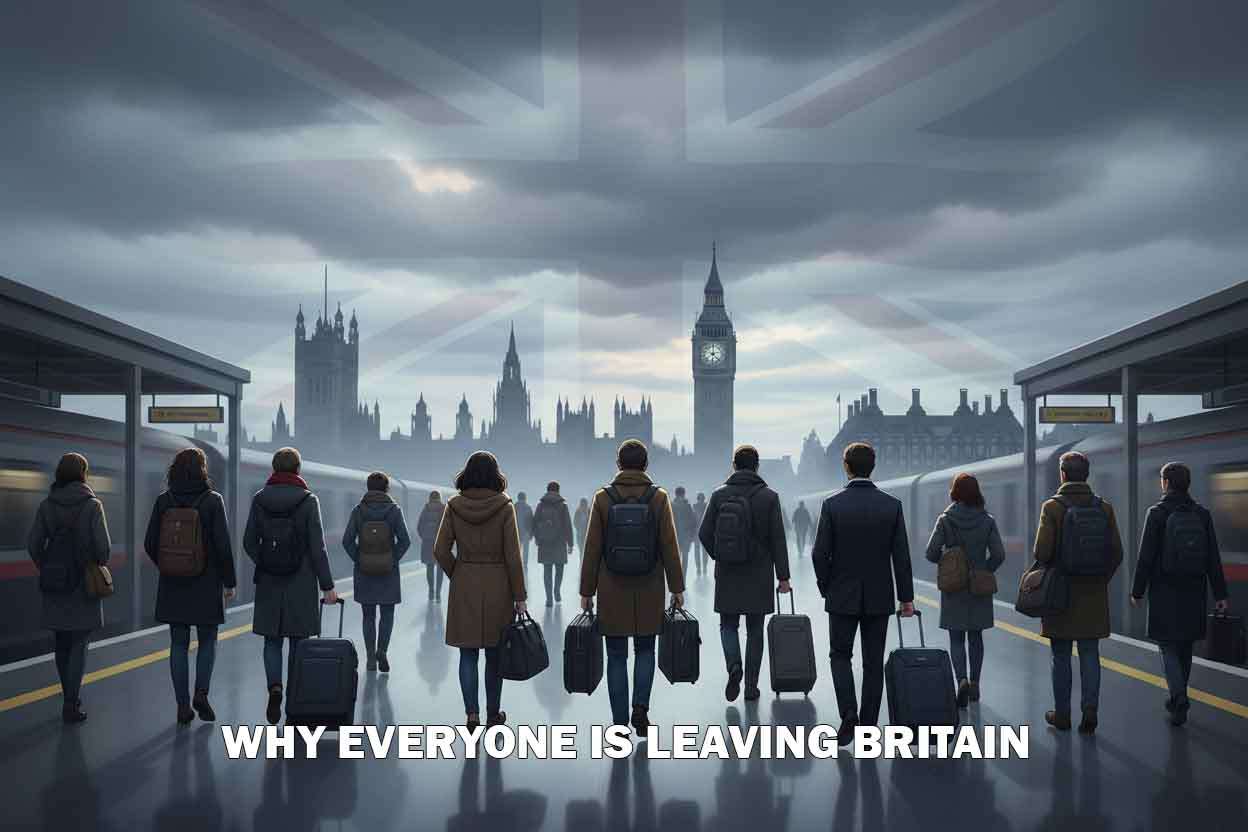
Why everyone is leaving Britain
Britain at a Crossroads: Structural Decay, Cultural Denial, and the Question of National Renewal
Britain stands today at a moment of profound uncertainty. Public discontent is palpable, trust in institutions is strained, and a sense of national decline hangs in the air. A year into the current Labour government, there is already a widespread perception that the country’s problems are not being addressed with the seriousness or candour they demand. Beneath the daily churn of headlines and partisan point-scoring lies a deeper reality: many of Britain’s challenges are structural, not superficial, and no government can hope to make meaningful progress without first being honest about their nature and scale.
This article examines two interlinked themes. The first is the economic and social trajectory of Britain: a stagnant or faltering economy, an overburdened and arguably unsustainable welfare state, and an exodus—both real and prospective—of the very people most capable of generating jobs, wealth and innovation. The second is the country’s failure to confront, promptly and truthfully, some of its most disturbing social crises, in particular the scandal of grooming gangs, which has revealed not only a catastrophic breakdown of local and national governance but also a deep cultural reluctance to face uncomfortable truths.
Taken together, these themes point to a nation under strain: economically, morally and culturally. The question is no longer simply whether a particular party is up to the job of governing, but whether Britain is willing to face hard realities, accept that some past choices were wrong, and undertake the difficult work of structural reform.
A Government of Limited Relevance?
The first striking observation about the current political situation is the sense that the government itself is of diminishing relevance to the real direction of the country. A year into its term, the Labour administration has already attracted criticism for underperformance in several key areas: migration, housing, and the general stewardship of the economy.
Public sentiment reflects an impression that the government is not delivering on expectations, and that in areas where decisive leadership is most needed, the response has been timid, reactive or procedurally focused rather than visionary. The problem, however, is not simply one of competence or talent—though critics often highlight an apparent lack of both on the front bench, particularly in roles like the Chancellor. More fundamentally, the criticism is that this government, like its predecessors, is engaged in surface-level activity: “rearranging the deck chairs on the Titanic”, as the familiar metaphor has it.
This metaphor is not used lightly. It suggests that the underlying trajectory of the country is one of decline or impending crisis, and that without radical honesty and serious structural reform, no amount of policy tinkering or rhetorical repositioning will alter that course. The state of the economy, the tax regime, the welfare system and the broader cultural climate are all implicated in this diagnosis.
An Economy Driving Its Wealth and Talent Abroad
One of the starkest indicators of Britain’s malaise is the steady departure of wealthy individuals and entrepreneurs. By some measures, Britain is losing more millionaires than any country in the world except China. When these figures are considered on a per capita basis, the situation appears still more alarming. A modern economy depends heavily on those who create businesses, generate jobs, and invest capital. To drive out such people is to undermine the productive base on which public services and social support systems ultimately depend.
Equally concerning is that it is not only today’s wealthy who are leaving, but tomorrow’s. Anecdotal evidence suggests that many ambitious, highly capable individuals who are not yet wealthy—but who are likely to become the next generation of business founders and job creators—are also planning their futures elsewhere. Instead of building companies, employing people and paying taxes in Britain, they are choosing places such as Dubai, the United States and other jurisdictions where the business environment is seen as more favourable, the regulatory burden lighter, and the tax regime less punitive.
The impact of such an exodus cannot be overstated. A nation’s long-term prosperity is intimately connected to its ability to retain and attract those who are willing and able to take risks, innovate and build enterprises. If the message they receive from the British state is that success will be met with ever-higher taxation, suspicion and bureaucratic obstacles, then the rational response for many will be to leave. The cost of this loss is not solely financial; it is also psychological. A country that haemorrhages its most dynamic citizens risks undermining its own confidence and sense of future possibility.
The Illusion of Endless Public Spending
Closely linked to the departure of wealth and talent is the question of public spending. Britain has, over time, constructed an extensive and expensive system of state support covering health, education, welfare and a variety of social benefits. While many of these programmes have moral and practical justifications, the central question is whether the current level of public spending is sustainable given the state of the economy and the trajectory of the tax base.
There is, according to critics, a deep dishonesty at the heart of the political conversation about this. Voters are frequently reassured that the current arrangements can be maintained indefinitely, perhaps with marginal adjustments or minor efficiency gains. Yet the hard arithmetic suggests otherwise. If the pool of productive taxpayers, entrepreneurs and job creators is shrinking—both through demographic trends and through emigration—the burden on those who remain becomes ever more unsustainable.
This dishonesty becomes particularly clear when examining the growth of long-term welfare dependency among young people. Hundreds of thousands of young adults in Britain are now receiving unemployment or incapacity benefits on the grounds of depression, anxiety or related conditions. There is no question that genuine severe mental illness exists, and that some individuals are incapacitated to the point that getting out of bed is a significant challenge. Those people deserve, and must receive, serious support and compassion.
However, the reality is more complicated than a simple binary division between the able and the disabled. Many people experience periods of depression, anxiety or profound dissatisfaction, particularly when working in low-paid, unfulfilling or precarious jobs. In the past, such difficulties were often seen as part of the struggles of life—problems to be managed or worked through while continuing to participate in the labour market. Today, a growing proportion of young people are being encouraged, implicitly or explicitly, to exit the workforce entirely when they feel mentally unwell, sometimes for long stretches of their early adult life.
The result is a growing population of working-age adults detached from employment, often adrift and demoralised, supported by a state that can increasingly ill afford to fund such arrangements. The cultural framing of this trend—as an expression of compassion or kindness—obscures its long-term consequences, both for public finances and for the individuals concerned. Being told that one is too fragile to work can itself be a form of cruelty, trapping people in a self-conception of incapacity and robbing them of the dignity and structure that meaningful work can provide.
Compassion, Cruelty and the Meaning of Support
The debate over welfare, mental health and work is not simply economic. It is also moral and cultural. Contemporary Britain has, in many ways, elevated the language of emotional vulnerability and psychological fragility into a dominant framework for understanding human experience. Anxiety, depression and discomfort are treated as conditions that should, almost by default, be accommodated through withdrawal from demanding environments, including the workplace.
Yet many who have experienced such states while continuing to work—whether in poorly paid jobs or under high stress—would argue that part of becoming a functioning adult involves learning to manage difficult emotions, unpleasant tasks and existential distress. The suggestion that feeling low, fearful or out of place is, in itself, a sufficient reason to opt out of work indefinitely is a relatively new and arguably dangerous cultural idea.
Critics argue that Britain has gone too far in this direction, confusing short-term emotional comfort with long-term wellbeing. By allowing large numbers of people to remain on benefits because they “do not feel comfortable”, the country is sending a message that discomfort is intolerable and must be avoided at all costs. Yet life inevitably involves discomfort: social embarrassment, failure, insecurity, and periods of unhappiness. A society that treats these as insurmountable barriers to participation in work risks infantilising its citizens and undermining their resilience.
Moreover, the country simply cannot afford to maintain such a large pool of working-age people outside the labour force. No matter how compassionate the intention, the resources to fund this level of support are finite. If those who generate wealth and pay substantial taxes are leaving, and if more people are drawing on state support rather than contributing to it, the fiscal equation becomes untenable.
In this sense, the refusal to be honest about what is and is not sustainable becomes its own kind of cruelty. It encourages illusions in the present that will be shattered in the future, likely in a far harsher and less controlled manner than if the truth were confronted now.
A Political Class Short of Talent and Courage
Overlaying these structural problems is a political class that appears, to many observers, unequal to the task. There is frequent criticism of a “dearth of talent” on the front benches, a sense that many senior figures in government lack the intellectual seriousness, experience or courage needed to grapple with the magnitude of the challenges at hand.
The Chancellor, for example, is sometimes portrayed as lacking the competence and gravitas required to reframe Britain’s economic trajectory. The leadership more broadly seems constrained by internal party pressures and ideological commitments that make it difficult to embrace the kinds of reforms that would likely be necessary: reducing the overall tax burden on enterprise, reforming welfare to encourage greater participation in work, and confronting culturally sensitive issues without flinching.
This internal constraint is most evident when the government even tentatively attempts to rein in public spending or reform aspects of the welfare system. Almost immediately, factions within its own base react with hostility, accusing the leadership of cruelty or betrayal. The result is paralysis: knowing that change is needed but being unable to pursue it without incurring severe political cost among one’s own supporters.
In this environment, dramatic structural reforms appear unlikely. Instead, the government projects an air of managerial caution while the underlying problems deepen. For those who see Britain as drifting towards long-term decline, this inability to act decisively reinforces the sense that the current political configuration is not capable of delivering the necessary course correction.
Structural Problems, Not Temporary Missteps
It is tempting in political debate to treat national difficulties as consequences of specific parties, policies or leaders. Yet the most serious critics argue that Britain’s challenges are structural. They stem from deeper trends in demographics, culture, economics and governance that have been developing over many years and across multiple administrations, both Labour and Conservative.
Some commentators warned long ago that the wave of enthusiasm accompanying political change—such as a new government coming into office—would be short-lived. Once the initial excitement wore off, the stubborn reality of structural problems would reassert itself. Economic stagnation, long-term welfare dependency, cultural fragmentation and declining trust in institutions are not issues that can be solved with a few headline policies or symbolic gestures. They require a fundamental rethinking of what the country expects of itself and of its citizens.
If this diagnosis is correct, then the question becomes not simply whether the current government is up to the task, but whether the political system as it stands is even capable of generating the kind of radical honesty and courageous leadership that meaningful reform would require.
The Logic of Acceleration: Crisis as Catalyst
Faced with what appears to be a slow-motion national decline and a political system unable or unwilling to correct course, some observers find themselves drifting—reluctantly or otherwise—toward a kind of political “accelerationism”. The idea is unsettling but straightforward: if moderate or gradualist attempts at reform are constantly blocked or diluted, perhaps only a deeper crisis will force the country to confront reality.
From this perspective, each policy failure, each evident breakdown in governance, is not merely a disappointment but also a potential catalyst. If things continue to deteriorate, the hope is that voters will eventually insist on a genuine alternative, rather than oscillating between slightly different versions of the same managerial politics.
Under such a scenario, a future election could present a stark choice: either a party or movement committed to radical reform—perhaps something like the emerging Reform party—or a continuation of the existing approach, with all its compromises and evasions. If, at that point, the electorate chooses continuity, then the implication is that the country has effectively accepted its trajectory and will “carry on like this forever”, with all that entails.
This is a bleak view, but it arises from a genuine concern that Britain, as currently governed and culturally understood, cannot sustain its current path indefinitely. Economic decline, social fragmentation and cultural self-contempt, critics argue, are not the foundations on which a stable and prosperous nation can be built. Without decisive change, Britain risks becoming a “joke country”—a place more easily mocked than respected, more capable of posturing than of serious action.
The Grooming Gangs Scandal: A Case Study in Moral Failure
If the economic and welfare issues expose Britain’s structural weaknesses, the scandal of grooming gangs—and the official response to it—reveals something still more troubling: a profound moral and cultural failure at the heart of the state and its institutions.
For years, organised groups of men, often sharing particular ethnic or cultural backgrounds, engaged in the systematic sexual exploitation, abuse and rape of predominantly young, often disadvantaged, English girls in towns and cities across the country. Reports, whistle-blowers and journalists raised the alarm repeatedly. Some people spoke out early and paid a heavy price in terms of their careers and reputations for doing so. Yet for a very long time, the response of authorities—from local councils and police forces to national politicians—was characterised by denial, minimisation and, in many instances, active suppression of the truth.
Even today, after extensive media coverage, prosecutions and public outcry, the issue feels unresolved. While official inquiries have been proposed or initiated, and while it is no longer automatically dismissed as a “far-right” concern simply to raise the subject, there is still a sense that the country has not engaged in a full and honest reckoning with what happened, and why.
Denial, Suppression and the Politics of Reputation
Why was it so difficult for Britain’s institutions to confront the grooming gangs scandal head-on? The answer, in large part, lies in the culture of officialdom. There appeared to be, in many of the affected areas, a systemic reluctance to acknowledge the scale and nature of the crimes. Authorities worried about being accused of racism or Islamophobia; they fretted about community relations; they feared the reputational damage that would ensue if it emerged that these atrocities had been allowed to continue under their watch.
This culture manifested in several damaging ways: victim-blaming, minimising accusations, failing to properly investigate reports, and, in some cases, actively discouraging complaints or obstructing those attempting to bring the issue to light. The protection of institutional reputations—and, in some cases, of the reputations of particular communities—was implicitly treated as more important than the safety and dignity of vulnerable girls.
The result was a grotesque moral inversion. Those entrusted with safeguarding the young and upholding the law either looked the other way or selectively downplayed evidence for fear of the political and social consequences of acting. The cost of this cowardice was borne almost entirely by victims who lacked power, status or public voice.
It is telling that even now, with years of exposure behind the country, the political class remains nervous and evasive on the topic. That hesitation speaks volumes. If, after all this time and all this evidence, a government still finds it difficult to confront the grooming gangs scandal with full candour, it suggests that the cultural forces that enabled the original failure—fear, cowardice, ideological blindness—remain deeply embedded within the system.
The Need for Truth, Reconciliation and Justice
Addressing such a profound failure requires more than token gestures or half-hearted inquiries. It demands a process as serious and far-reaching as those seen in countries emerging from periods of political repression or mass abuse—a form of truth and reconciliation.
This would mean, first and foremost, a complete and unvarnished account of what happened: how many victims there were, how long the abuses went on, which institutions failed, and who specifically made decisions that allowed the crimes to continue. Such a process cannot be selective or constrained by political sensitivities; it must be driven by a commitment to the truth, wherever it leads and whatever reputational damage it causes.
However, reconciliation cannot exist without justice. For a scandal of this magnitude, justice has several dimensions. There must be justice for the victims through proper support, recognition and, where possible, restitution. There must be justice applied to the perpetrators themselves: those directly responsible for rape, trafficking, coercion and violence should face the full weight of the criminal law, including severe sentences that reflect the gravity and systematic nature of their crimes.
Beyond that, there should be accountability for those who colluded, covered up or wilfully ignored what was happening. This might involve criminal charges in some cases, disciplinary proceedings in others, and the removal of honours or positions from those whose failures made the scandal possible. Officials who knowingly suppressed information, dismissed legitimate concerns or prioritised political convenience over child safety should not be allowed to retain positions of influence and authority.
For offenders who are not British citizens, or who hold dual nationality, there is a strong argument for deportation and the stripping of British citizenship, where legally permissible. This is not an expression of vindictiveness but of a principled stance: those who commit such grave crimes against vulnerable children in their host country have forfeited any claim to the protection and privileges that citizenship confers.
Finally, there is a need for legal reform. New criminal offences may be necessary to address specific patterns of grooming, coercion and organised exploitation that were not adequately captured by existing statutes. Laws must be crafted and enforced in such a way that similar networks of abuse cannot again operate with impunity under the noses of police and social services.
A Cultural Reckoning: Identity, Fear and the Limits of Tolerance
The grooming gangs scandal also raises uncomfortable questions about culture, identity and the limits of multicultural tolerance. Many of the perpetrators shared certain backgrounds, and some authorities admitted, after the fact, that they were hesitant to take action for fear of inflaming racial tensions or confirming negative stereotypes.
Britain’s desire to be an open, tolerant, non-racist society is, in many respects, laudable. However, when that desire becomes so rigid that it prevents honest discussion of culturally specific patterns of wrongdoing, it becomes dangerous. Tolerance cannot mean turning a blind eye to organised sexual exploitation simply because the perpetrators belong to minority groups. Nor can anti-racism mean refusing to recognise the reality of grooming networks whose dynamics are shaped, in part, by cultural attitudes toward women, sexuality and power.
To navigate this terrain responsibly, a mature country must be able to distinguish between treating individuals fairly and honestly acknowledging patterns that may exist within particular communities or cultural contexts. Failure to do so does a disservice not only to victims but also to the many law-abiding members of those communities who do not wish to see their reputation shield abusers from scrutiny.
The reluctance to engage in this level of honest conversation is symptomatic of a wider cultural malaise. Britain often seems more afraid of being seen as intolerant than it is of allowing injustice to continue unchecked. It will need to overcome this fear if it is to rebuild public trust and ensure that “this must never be allowed to happen again” is more than just a slogan.
Britain’s Future: Decline or Renewal?
Taken together, the exodus of entrepreneurs, the unsustainable expansion of welfare, the erosion of work culture, the failure of institutions in the grooming gangs scandal, and the timidity of the political class all point to a country in deep trouble. It is not yet a failed state, nor is it beyond recovery. But the direction of travel is worrying, and the sense of drift is increasingly hard to ignore.
Britain faces a stark choice. It can continue along its current path: losing wealth creators while expanding welfare rolls; avoiding difficult truths in the name of sensitivity; prioritising institutional self-protection over moral clarity; and cycling endlessly between governments that differ more in tone than in substance. Or it can confront reality.
Confronting reality would mean acknowledging that not all forms of “support” are sustainable or even genuinely compassionate, that work and responsibility are essential to human dignity, that public services cannot be funded indefinitely by an ever-smaller productive minority, and that some cultural practices and institutional habits are incompatible with a just and secure society.
It would also mean embracing the possibility of structural reform on a scale that current political discourse barely contemplates: tax reform to attract and retain talent and capital; welfare reform to restore the centrality of work; institutional reform to ensure genuine accountability; and legal reforms to protect vulnerable people from exploitation.
Such changes will not come easily. They will require courage, honesty and a willingness to endure short-term discomfort for long-term gain. They will challenge deeply embedded assumptions and provoke fierce resistance from those whose identities, careers or political strategies depend on maintaining the status quo.
Yet if Britain is to avoid becoming a country that is “a bit of a joke” in the eyes of its own citizens as well as the world, it has little choice. The alternative is a slow, demoralising decline: industries shrinking or relocating, social cohesion fraying, and trust in institutions eroding to the point where democratic legitimacy itself comes into question.
The hope—perhaps faint, but not yet extinguished—is that the accumulation of crises will eventually jolt the country into self-awareness and action. Whether that moment comes through electoral upheaval, institutional collapse or a more gradual awakening remains to be seen. But the stakes could hardly be higher. Britain must decide whether it wishes to be a serious country again—one that attracts talent, protects its vulnerable, confronts wrongdoing without fear, and expects adults to shoulder responsibility—or whether it will continue to drift, rearranging the deck chairs while the water rises.
A year into the present government, that decision has not yet been made. The clock, however, is still ticking.
Frequently Asked Questions
Why is Britain currently experiencing a significant exodus of wealth creators and entrepreneurs?
The departure of millionaires and aspiring business founders is driven by a combination of high taxation, a restrictive regulatory environment, and a perceived lack of support for enterprise. Many individuals who would otherwise generate jobs and tax revenue in the UK are choosing to relocate to jurisdictions such as Dubai or the United States, where the business climate is more favourable. This loss of talent undermines the country’s long-term economic productivity and its ability to fund essential public services.
What are the primary concerns regarding the rise in welfare dependency among young people?
There is growing concern that a significant number of young adults are exiting the labour market due to mental health conditions such as anxiety and depression. While genuine, severe incapacity requires compassionate support, critics argue that the current system often confuses manageable emotional discomfort with total incapacity. This trend risks infantilising citizens and creating a self-perpetuating cycle of dependency that the state can no longer afford to sustain as the productive tax base shrinks.
Why is the current government described as being of “limited relevance” to Britain’s problems?
The government is often seen as being of limited relevance because it focuses on surface-level policy adjustments rather than addressing the deep-seated structural issues facing the nation. Critics suggest that the administration lacks the intellectual depth and political courage to confront the fundamental causes of economic stagnation and social fragmentation. Consequently, much of its activity is viewed as “rearranging the deck chairs” while the country’s underlying trajectory remains one of decline.
What factors contributed to the institutional failure surrounding the grooming gangs scandal?
The failure to address the systematic abuse of vulnerable girls was largely a result of institutional cowardice and a culture of denial. Authorities often prioritised their own reputations and the maintenance of perceived community cohesion over the safety of victims. A fear of being accused of racism or intolerance led many officials to suppress information and ignore whistle-blowers, allowing organised criminal networks to operate with impunity for years.
What is meant by the suggestion that Britain’s problems are “structural” in nature?
Describing Britain’s challenges as structural means they are not merely the result of temporary mismanagement or specific policy errors, but are embedded in the nation’s economic, legal, and cultural systems. Issues such as long-term welfare dependency, a declining work ethic, and a political class that avoids uncomfortable truths have developed over decades. Solving these problems requires a fundamental rethinking of the relationship between the state and the individual, rather than minor legislative tweaks.