

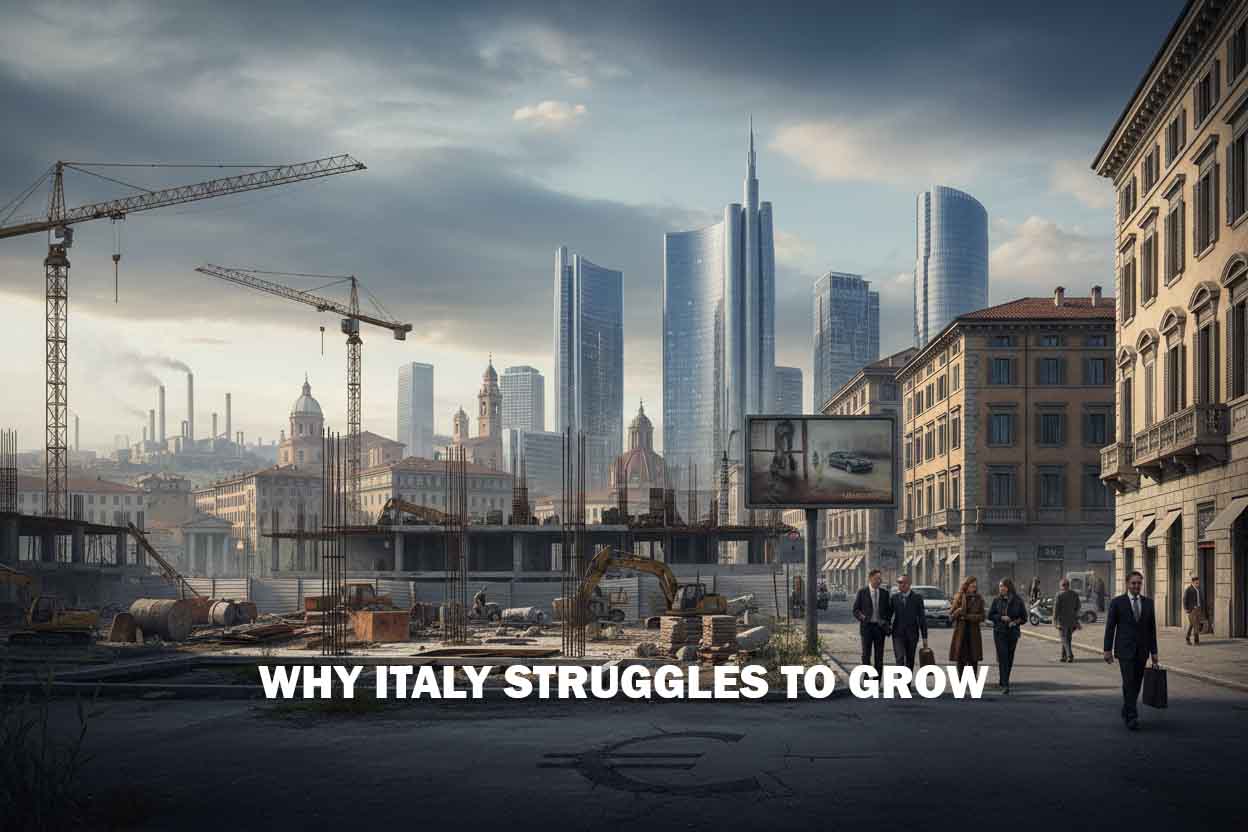
Why Italy Struggles to Grow
The Legacy of the Lira and a System Stuck in Time
In the late 1980s, Italy appeared to embody the European dream. The economy was booming, fashion and design dominated global trends, and the country had just overtaken the United Kingdom to become the world’s fifth-largest economy. Milan’s cafés and piazzas buzzed with confidence. It felt as though the good times would last forever.
Yet fast-forward to the mid-2020s, and the contrast could scarcely be more stark. Italy has become the only major developed economy that has barely grown over more than two decades. While the United States has roughly doubled its GDP per head since the turn of the millennium, Italy’s income per person has stagnated close to late‑1990s levels. Behind the postcard beauty and cultural prestige lies an economy that has, in many respects, flatlined.
Italy’s current malaise is not simply the product of bad luck, globalisation or even the euro alone. Many of the roots lie in choices made during its supposed golden age. The country became addicted to a powerful but ultimately destructive economic drug: competitive currency devaluation under the old lira. When that drug was taken away with the advent of the euro, Italy found itself structurally unprepared to compete in a modern, high‑productivity global economy.
What follows is an examination of seven interlocking weaknesses that together help explain Italy’s long stagnation: the legacy of the lira, a chronic productivity problem, demographic decline, overwhelming bureaucracy, the flight of talent, a deep regional divide, and a crushing public debt burden. None of these issues is simple, and all are politically explosive. But without understanding them, it is impossible to see why Italy has struggled – and why change is so hard.
1. The Addiction to Devaluation: How Italy Faked Competitiveness
To understand Italy’s current failures, it is necessary first to understand its earlier “successes” – successes that were, to a significant degree, artificially manufactured.
From the 1970s through to the early 1990s, Italy possessed what might be called a macroeconomic superpower. It was not outstanding efficiency, technological leadership, or German‑style engineering precision. It was the ability and willingness to repeatedly devalue its currency, the lira.
The mechanism was straightforward. If an Italian manufacturer struggled to compete with rivals in Germany or elsewhere, the government and central bank had an easy solution. They would allow – or trigger – a fall in the value of the lira against currencies such as the Deutsche Mark. Overnight, Italian goods would become cheaper in foreign markets without any improvement in their quality or productivity. A washing machine produced in Turin could suddenly undercut a German equivalent, not because the factory had invested in robotics or automation, but because the currency in which its costs were denominated had been weakened.
This strategy of competitive devaluation underpinned much of the country’s export success for decades. It allowed thousands of small, often family‑run businesses to survive and even thrive without needing to invest seriously in modernisation. When margins were squeezed, many firms did not turn to innovation or restructuring; they waited for the next devaluation.
However, this approach came with a heavy hidden cost. Devaluing a currency may help exporters, but it also makes imports more expensive. Oil, gas, raw materials and high‑tech components all rise in price when the currency falls. The result is higher inflation at home.
Italy attempted to compensate for this imported inflation through a system known as the scala mobile – an automatic wage indexation mechanism. As prices rose, wages were adjusted upwards in line. In theory, this protected workers’ purchasing power. In practice, it created a vicious circle. Currency devaluation pushed up import prices, which raised inflation. Inflation triggered automatic wage rises, which increased business costs, eroding competitiveness, and prompting further calls for devaluation.
By the early 1990s, the lira’s reputation had been severely damaged. During the 1992 currency crisis, it collapsed so dramatically that it was forced out of Europe’s Exchange Rate Mechanism. The constant recourse to devaluation had destroyed both domestic price stability and international trust.
This history matters because of what happened next. When Italy joined the euro in 1999, it effectively surrendered its old economic crutch. Membership of the single currency meant that the familiar lever of devaluation no longer existed. Italy could no longer rely on a printing press to disguise underlying structural weaknesses. Its industries now had to compete on the basis of real productivity, quality and innovation.
Decades of dependence on the cheap‑currency fix had left Italian industry structurally weak. Too many firms had become accustomed to competing through price rather than performance. When the euro locked exchange rates, the country found itself exposed. Its metaphorical muscles – investment, innovation, organisational efficiency – had atrophied. The loss of the lira’s flexibility was not the source of Italy’s problems, but it brutally revealed them.
This is the essence of what might be called the “curse of the lira”: a lingering, economy‑wide dependence on a policy tool that no longer exists. Italy is left with the phantom pain of a vanished instrument, reaching for a lever it can no longer pull.
2. The Productivity Flatline: The Peter Pan Syndrome of Italian Business
If the era of the lira fostered complacency, the post‑euro era has exposed an even more serious issue: a near‑total stagnation in productivity.
Total factor productivity – a broad measure of how efficiently an economy uses labour and capital – has barely moved in Italy since the late 1990s and has actually declined in some sectors. While workers in Germany, France and even Spain have been producing more output per hour over time, Italy’s productivity has essentially flatlined.
One central reason lies in the structure of Italian business. The country is famous for its small and medium‑sized enterprises: family‑run leather shops in Florence, artisanal ceramic makers in Sicily, and countless other firms that embody craft and tradition. This romantic image is a key part of Italy’s cultural identity. Yet in the hard realities of the global economy, it poses serious problems.
More than 90 per cent of Italian firms have fewer than ten employees. These micro‑enterprises, while often skilled in their niche, tend not to innovate in a systematic way. A five‑person firm, with family members filling most of the key roles, is unlikely to invest millions of euros in advanced logistics software, data analytics, or research and development. It is more focused on day‑to‑day survival than long‑term transformation.
The decision to remain small is not merely cultural; in many respects it is a rational response to Italy’s regulatory environment. A crucial threshold exists at 15 employees. Once a firm crosses this line, a substantially more onerous set of labour protections and obligations come into force. Dismissals become more complex and more costly, union obligations expand, and administrative burdens increase.
For a small business owner considering taking on a 15th worker, the potential penalties of growth can appear daunting. Many firms therefore choose to remain below this threshold, employ additional staff informally, or even split their operations into multiple legal entities to avoid triggering the tougher rules. The result is an economy full of firms that are deliberately and artificially kept small. They do not scale, they rarely reach international markets in a meaningful way, and they struggle to achieve the efficiencies that larger enterprises enjoy.
Compounding this structural problem is the way many Italian firms are managed. In much of the Anglo‑Saxon world, successful family businesses frequently bring in professional managers once they reach a certain size. Ownership and management can be separated: the founder’s children might retain shares, but an experienced external chief executive runs the company.
In Italy, dynastic management is far more common. Companies are often passed directly from parent to eldest child as a matter of tradition, irrespective of comparative competence. Research has found that firms run by heirs, rather than by professional outsiders, tend to underperform on various metrics, from profitability to growth. When leadership positions are allocated by bloodline rather than by merit, potential is constrained.
The combination of micro‑scale enterprises, disincentives to grow, and hereditary management has left much of Italian business trapped in a kind of economic adolescence. Like Peter Pan, it refuses to grow up. While other countries have seen the rise of large, globally competitive champions in technology, manufacturing and services, Italy’s economy remains dominated by small, often under‑capitalised firms. They may produce excellent leather belts or ceramics, but they cannot carry the weight of a G7 economy.
3. The Demographic Death Spiral: A Country Growing Old
If the productivity problem is a chronic illness, Italy’s demographic trajectory is a terminal threat. No advanced economy can grow sustainably without a reasonably healthy demographic base. Workers are needed to produce goods and services; consumers are needed to buy them. In Italy, both are becoming scarcer.
The country has one of the lowest fertility rates in the developed world. To maintain a stable population without immigration, each woman needs to have, on average, about 2.1 children. Italy’s rate has fallen to around 1.2. Population shrinkage on this scale is not merely gentle decline; it is demographic evaporation.
The consequences are visible in many parts of the country, particularly in rural areas and smaller towns. Local authorities sometimes offer abandoned houses for symbolic sums, such as one euro, in an attempt to attract newcomers. These are not acts of generosity but distress signals. Often, the previous residents have died, their children or grandchildren have long since moved to large cities or abroad, and there is simply nobody left locally who wishes to buy or inherit.
This collapse in births has produced an inverted population pyramid. Instead of a broad base of young people supporting a relatively small number of pensioners, Italy has a large and growing cohort of retirees resting on the shoulders of a shrinking workforce. This has profound fiscal and social implications.
One of the most immediate is the pressure on the pension system. Italy spends close to 17 per cent of its GDP on pensions, one of the highest shares in the OECD. This diverts vast sums of public money into sustaining the incomes of older citizens, leaving comparatively less to be spent on education, infrastructure, research, or tax reductions that might stimulate growth.
The political dynamics are equally problematic. Older citizens form the most powerful electoral bloc, and they understandably resist any attempts to cut benefits or raise retirement ages. Efforts at pension reform are often met with intense opposition. In recent years, policies have even been introduced that allow some workers to retire earlier than before, despite the mounting demographic pressures. Such measures may make political sense in the short term, but economically they are perverse. In an ageing society already short of workers, encouraging earlier retirement only deepens the problem.
For younger Italians, the situation is dispiriting. They face high tax burdens, in part to finance pensions, combined with low wages and limited opportunities for advancement. Buying a house and raising a family becomes financially daunting. Many couples therefore postpone having children or decide to have fewer than they might otherwise wish. This further accelerates the demographic decline, which in turn increases the fiscal burden on the remaining workers, creating a feedback loop that is hard to break.
Walking through many Italian towns today, one is struck by the sense of a country oriented towards its past rather than its future. Streets bustle with tourists admiring monuments and churches, but there are fewer young families than in previous generations. Italy risks becoming more like a vast open‑air museum than a dynamic, forward‑looking economy – beautifully preserved, but not renewing itself.
4. The Bureaucratic Inferno: A System that Smothers Initiative
Even for those willing to confront the currency legacy, the productivity malaise and the demographic headwinds, Italy presents another formidable barrier: a dense and often dysfunctional bureaucracy.
International comparisons of the ease of doing business have long ranked Italy poorly. Entrepreneurs encounter a maze of regulations, permits and procedures that can be difficult to navigate and slow to resolve. This is not just an irritation; it is a serious drag on economic activity.
One of the most damaging aspects is the performance of the civil justice system, particularly in commercial disputes. If a firm supplies goods or services and is not paid, the ability to enforce a contract swiftly is crucial. In countries such as the United Kingdom or Germany, civil cases typically move relatively quickly. In Italy, the average time to resolve a commercial dispute can exceed 1,000 days – nearly three years. Complex cases can stretch far longer, especially when appeals are involved.
For small businesses, this is catastrophic. Many do not have the financial reserves to survive for years while awaiting a court decision. Knowing this, unscrupulous actors can exploit the system, delaying payment in the expectation that their creditors will simply collapse or settle on unfavourable terms. Over time, such experiences breed a culture of non‑compliance and mistrust.
Beyond the courts, the sheer volume of regulation is daunting. It is estimated that Italy has well over 100,000 laws currently in force – an order of magnitude more than some of its neighbours. While not all are directly relevant to business, the overall effect is one of complexity and opacity. Navigating planning rules, tax provisions, labour law and sector‑specific regulations often requires specialised advice, increasing costs and discouraging new entrants.
Recent policy initiatives have sometimes exacerbated this unpredictability. One example is the so‑called “superbonus” scheme, which offered generous tax incentives for energy‑efficiency renovations and similar works. Although well‑intentioned, the programme’s rules were changed dozens of times in a short period. Professionals in construction, finance and architecture struggled to keep up with the constantly shifting requirements. Projects were delayed or cancelled, and the scheme’s credibility suffered.
For foreign investors, such instability is a major deterrent. Large multinational firms weighing locations for new factories, research centres or data hubs look closely at regulatory reliability and the predictability of policy. The prospect of needing years to obtain permits, navigating opaque labour regulations, or facing an unreliable court system if things go wrong makes Italy significantly less attractive than other EU member states. Countries such as Poland, Ireland and Spain have often appeared more straightforward by comparison and have benefited accordingly in terms of inward investment.
In modern economies, speed and adaptability are crucial. Bureaucracies that are slow, inconsistent, or overly complex act as a tax on time and initiative. Italy’s administrative structures frequently move at a pace incompatible with the demands of global competition. For many would‑be entrepreneurs, the bureaucratic inferno is enough to extinguish the spark before the business is even born.
5. The Brain Drain: Losing a Generation of Talent
Layered on top of these structural problems is a painful human reality: many of Italy’s brightest young people are leaving.
The country has a strong educational tradition. Its secondary schools, especially academically oriented institutions, provide rigorous instruction. Universities such as the Polytechnic University of Milan or leading economics faculties produce graduates in engineering, science, and finance who are highly valued internationally.
The state invests significantly in this human capital – funding healthcare, schooling, and heavily subsidised university education. Yet when graduates enter the labour market, they frequently find limited prospects at home. Entry‑level salaries for highly qualified roles in Italy can be strikingly low when compared with equivalent positions in northern Europe or the English‑speaking world. By contrast, a short‑haul flight to Germany, the United Kingdom, Ireland or elsewhere can offer multiples of the pay, often with clearer career progression.
Remuneration is only part of the story. Many young Italians also speak of a deeply entrenched gerontocracy and patronage culture, in which advancement is tied more to seniority and connections than to merit. Hierarchies are rigid, and it is not uncommon for talented individuals to feel that meaningful responsibility and decision‑making power are reserved for those several decades older, regardless of relative ability.
Faced with slow advancement, insecure contracts and high taxes, many choose to emigrate. Over the last decade, hundreds of thousands of educated Italians have sought opportunities abroad. In aggregate, this represents a substantial outflow of human capital. These are precisely the individuals who might start innovative companies, file patents, reform institutions, or contribute new ideas to public life. Instead, they contribute to the growth and dynamism of other countries.
Those who remain often struggle with precarious employment – short‑term contracts, freelance arrangements and part‑time work lacking stability. This precarity makes long‑term planning difficult, delaying decisions about home‑ownership and family formation, and reducing overall demand in the domestic economy.
Paradoxically, this exodus also functions as a pressure valve for Italy’s political system. In another context, a large, frustrated, under‑employed youth population might drive major protest movements or electoral upheaval. In Italy, many of the most frustrated simply depart. Their absence diminishes the urgency of reform in the eyes of political elites, and the status quo persists.
The country thus finds itself caught in a vicious circle. Economic stagnation and rigid hierarchies push talented youth to leave. Their departure further weakens the country’s innovative capacity and reformist energy, which in turn perpetuates stagnation. It is, in many respects, a tragedy of wasted potential.
6. The North–South Divide: Two Economies in One State
The Italian economy is not uniform. A glance at a satellite image of the country at night illustrates a sharp contrast. Northern Italy, from Milan across to the industrial heartlands of the north‑east, glows brightly – a dense web of cities, factories and infrastructure. If this region were a separate country, it would rank among Europe’s richer economies, comparable to parts of Germany or Switzerland.
Travelling southwards, the lights thin. Beyond Rome and Naples, into regions such as Calabria, Basilicata and parts of Sicily, development becomes more intermittent. This is the long‑standing questione meridionale – the southern question – a socio‑economic divide that has dogged Italy since unification.
GDP per head in many southern regions is roughly half that of the north. This is not a marginal gap; it is the difference between advanced industrial Europe and, in some respects, middle‑income economies on the Mediterranean’s southern shore. Yet both halves share a currency, a fiscal system and a central government.
Several factors underpin this disparity. One is infrastructure. Promised upgrades to roads, railways and ports in the south have often proceeded slowly or been beset by delays and cost overruns. Some major projects became notorious examples of inefficiency, taking decades to complete. For logistics‑intensive businesses, unreliable infrastructure adds enormous costs and uncertainty. It is far harder to operate a modern export‑oriented manufacturing plant if lorries are forced to use congested single‑carriageway roads or if rail freight is limited.
Another is the persistent influence of organised crime. Groups such as the mafia, ’Ndrangheta and Camorra do not merely engage in illicit activities; they also act as parasitic quasi‑governments, extracting rents from legitimate businesses. In some areas, it is an open secret that firms must pay protection money simply to operate. This acts as a private, unproductive tax on commerce, discouraging both local entrepreneurs and outside investors.
The weakness of the private sector in much of the south has, over time, led to a heavy reliance on public sector employment. In some provinces, a large share of the working population is employed by the state or by state‑linked entities. While public employment is not inherently problematic, in these contexts it often becomes intertwined with clientelism. Jobs are sometimes perceived to be allocated based on political loyalty or personal connections rather than merit. This fuels cynicism and can undermine efficiency.
From the perspective of many in the north, the south is seen – fairly or not – as a permanent drain on public resources, sustained through transfers funded by taxes on the more productive regions. This perception has fuelled political movements advocating greater autonomy or even secession, especially during times of economic strain. Such tensions complicate national policymaking and weaken the sense of shared purpose.
Until Italy finds ways to integrate the south more effectively into its productive economy – through infrastructure, education, the rule of law, and genuine private‑sector development – the country will, in effect, be attempting to compete globally with one leg tied down. A nation so internally divided in prosperity struggles to generate cohesive, country‑wide growth.
7. The Debt Trap: Living on Borrowed Time
Binding all these issues together is Italy’s vast public debt. At nearly one and a half times annual GDP, it represents a burden that constrains almost every policy choice.
To grasp the scale, imagine spreading the national debt across every resident of the country. Each person – from a newborn to a centenarian – would notionally carry tens of thousands of euros of public liabilities. In practice, of course, the state rather than individuals is responsible, but the analogy conveys the weight of the obligation.
Servicing this debt consumes an enormous sum each year. Tens of billions of euros are spent solely on interest payments, not on reducing the principal. That is money that could otherwise fund hospitals, schools, digital infrastructure, tax relief or support for innovation. Instead, it goes largely to bondholders in return for past borrowing decisions.
High debt levels also make Italy acutely sensitive to movements in interest rates and financial market sentiment. Investors compare the yield offered on Italian government bonds with that of safer benchmarks such as German bonds – the difference is known as the spread. When global conditions are favourable and confidence is high, the spread can remain manageable. But in times of uncertainty – whether due to global crises, domestic political instability, or doubts about long‑term sustainability – investors may demand higher yields to compensate for perceived risk.
A sharp rise in borrowing costs can quickly make debt dynamics unsustainable. This nearly occurred in the eurozone crisis of the early 2010s, when fears of default spread, and Italian yields surged. Only decisive intervention by the European Central Bank steadied the system. The episode exposed a troubling reality: Italy is too systemically important to be allowed to fail without jeopardising the entire eurozone, yet its sheer size makes a conventional bailout extraordinarily difficult.
The high debt burden constrains fiscal policy in a more subtle way as well. In theory, governments can use deficit‑financed investment to help transform their economies – investing in modern infrastructure, education, green technology and digitalisation. In Italy’s case, every additional euro of borrowing must be weighed against market reactions and long‑term sustainability. There is far less room for manoeuvre than in lower‑debt countries. Thus, just when Italy most needs to invest in its future, its past choices limit its options.
Combined with low growth, the debt acts like a chain around the country’s ankles. Without stronger expansion, the ratio of debt to GDP remains stubbornly high, and periodic crises threaten to push it higher still. Yet many of the reforms that could foster growth – simplifying bureaucracy, reforming pensions, encouraging larger and more productive firms – are politically painful. The temptation for governments to postpone tough decisions and hope for favourable external conditions is strong.
Can Italy Change Course?
Taken together, these seven factors paint a bleak picture: a country that became accustomed to an easy monetary fix, failed to build a high‑productivity economy, is ageing rapidly, suffocated by bureaucracy, losing its brightest young people, fragmented internally, and weighed down by enormous public debt.
Yet it would be wrong to consider Italy a hopeless case. History shows that the country can, under the right circumstances, transform itself with surprising speed. In the decades following the Second World War, Italy rose from devastation to become an industrial power, closing much of the gap with wealthier European neighbours. That achievement was driven by entrepreneurship, hard work, social compromise and, crucially, a willingness to modernise.
Italy also still possesses considerable assets. Private wealth remains high by international standards; many families and firms retain significant savings. The country’s cultural and creative industries are world‑leading. Design, fashion, food, tourism and luxury goods all command a global premium. The “Made in Italy” label continues to carry immense prestige and commercial value.
However, relying on heritage, tourism and small‑scale craftsmanship will not be enough to sustain a major advanced economy in the 21st century. What is required is less a single policy reform than a broad cultural and institutional shift.
Several themes stand out:
- Empowering the young. Breaking the grip of gerontocracy and patronage in both politics and business is essential. A more open, meritocratic system, in which younger generations can rise based on talent rather than connections, would help stem the brain drain and harness the energy of those currently leaving.
- Taming bureaucracy. Simplifying regulations, digitising public administration and accelerating justice would reduce the heavy transaction costs faced by businesses and investors. This does not mean abolishing protections, but making them clear, consistent and navigable.
- Encouraging scale and professionalism. Creating incentives for firms to grow beyond micro‑scale – for example by reforming labour thresholds and corporate governance norms – could foster more globally competitive enterprises. Encouraging professional management, without destroying the strengths of family ownership, would also help.
- Revitalising the south. A sustained, credible effort to improve infrastructure, enforce the rule of law, and nurture a genuine private sector in the Mezzogiorno is vital. Without narrowing the north‑south gap, Italy will continue to underperform its potential.
- Rebalancing intergenerational commitments. Pension systems and social spending need to be reformed in a way that remains just to older citizens while freeing resources to invest in children, education and young families. Without some shift in priorities, the demographic slide will worsen.
None of this is easy. All of it involves trade‑offs that are politically risky. Short‑term pain, whether through reduced benefits, deregulation, or institutional shake‑ups, is hard to sell in a country where many already feel fragile. The temptation to postpone difficult decisions, particularly when markets are calm, is understandable.
Yet the alternative is a slow drift into irrelevance – a comfortable but stagnant future in which Italy becomes more museum than nation, admired for its beauty but lacking dynamism. The challenge is not so much one of economic theory as of collective will. Italy has the talent, the culture and the resources to chart a different course. Whether it can overcome the weight of its institutions and the legacy of the lira is a question that will shape not only its own future, but that of Europe as a whole.
Frequently Asked Questions
1. What was the “curse of the lira” and how did it affect Italy’s economy?
The curse of the lira refers to Italy’s decades-long reliance on competitive currency devaluation to maintain export competitiveness. From the 1970s through the early 1990s, whenever Italian manufacturers struggled to compete internationally, the government would devalue the lira, making exports artificially cheaper without requiring genuine improvements in productivity or quality. This created a dependency that prevented Italian businesses from investing in modernisation, innovation and efficiency. When Italy joined the euro in 1999 and lost the ability to devalue its currency, the country’s underlying structural weaknesses were suddenly exposed. Italian firms found themselves unable to compete on merit alone, having spent decades relying on the “easy fix” of a weak currency rather than building genuine competitive advantages.
2. Why is Italy’s productivity so much lower than other European countries?
Italy’s productivity stagnation stems primarily from its business structure. Over 90 per cent of Italian firms employ fewer than ten people, and many deliberately remain small to avoid regulatory thresholds. Once a company reaches 15 employees, significantly more burdensome labour protections and administrative requirements come into force, discouraging growth. These micro-enterprises typically lack the resources to invest in research and development, advanced technology or professional management. Additionally, many Italian businesses are run dynastically, passed from parent to child regardless of competence, rather than being managed by experienced professionals. This combination of artificially small scale, hereditary management and limited investment in innovation has left Italian productivity essentially flat since the late 1990s, whilst competitors in Germany, France and elsewhere have continued to advance.
3. How serious is Italy’s demographic crisis?
Italy’s demographic situation is amongst the most severe in the developed world. With a fertility rate of approximately 1.2 children per woman—well below the 2.1 needed to maintain a stable population—Italy is experiencing rapid population ageing and decline. The country now has an inverted population pyramid, with a large and growing number of pensioners supported by a shrinking workforce. This creates enormous fiscal pressure, as Italy spends nearly 17 per cent of GDP on pensions, one of the highest rates in the OECD. The political power of older voters makes pension reform extremely difficult, whilst young people face high taxes, low wages and limited opportunities, leading many to postpone or forgo having children altogether. This creates a self-reinforcing cycle: fewer births mean higher tax burdens on remaining workers, which further discourages family formation, accelerating the demographic decline.
4. Why are so many young, educated Italians leaving the country?
The brain drain from Italy is driven by a combination of economic and cultural factors. Young graduates face significantly lower salaries at home compared to opportunities in Germany, the United Kingdom, Ireland or elsewhere—often earning two to three times more abroad for equivalent roles. Beyond pay, many cite rigid hierarchies and a gerontocratic culture in which advancement depends more on seniority and personal connections than merit. Talented individuals frequently find themselves stuck in precarious, short-term contracts with little prospect of meaningful responsibility until middle age. The combination of low pay, limited career progression, high taxes and job insecurity drives hundreds of thousands to emigrate. This exodus represents a catastrophic loss of human capital: the state invests heavily in educating these individuals, only to see them contribute to the growth and innovation of other countries, whilst Italy loses precisely the people who might drive reform and renewal.
5. Can Italy recover from its economic stagnation?
Recovery is possible but would require profound and politically difficult reforms. Italy retains considerable strengths: high private wealth, world-leading cultural and luxury industries, and the valuable “Made in Italy” brand. The country has also demonstrated capacity for rapid transformation in the past, rebuilding from wartime devastation to become an industrial power within two decades. However, reversing the current trajectory would require breaking the gerontocratic grip on politics and business, dramatically simplifying bureaucracy, reforming labour regulations to encourage firm growth, investing seriously in southern Italy’s infrastructure and rule of law, and rebalancing fiscal priorities away from pensions towards investment in the young. Each of these reforms involves short-term political pain and faces resistance from powerful constituencies. Without such changes, Italy risks continuing its slow drift towards becoming more of a museum economy—culturally rich but economically stagnant—rather than a dynamic, forward-looking nation.