

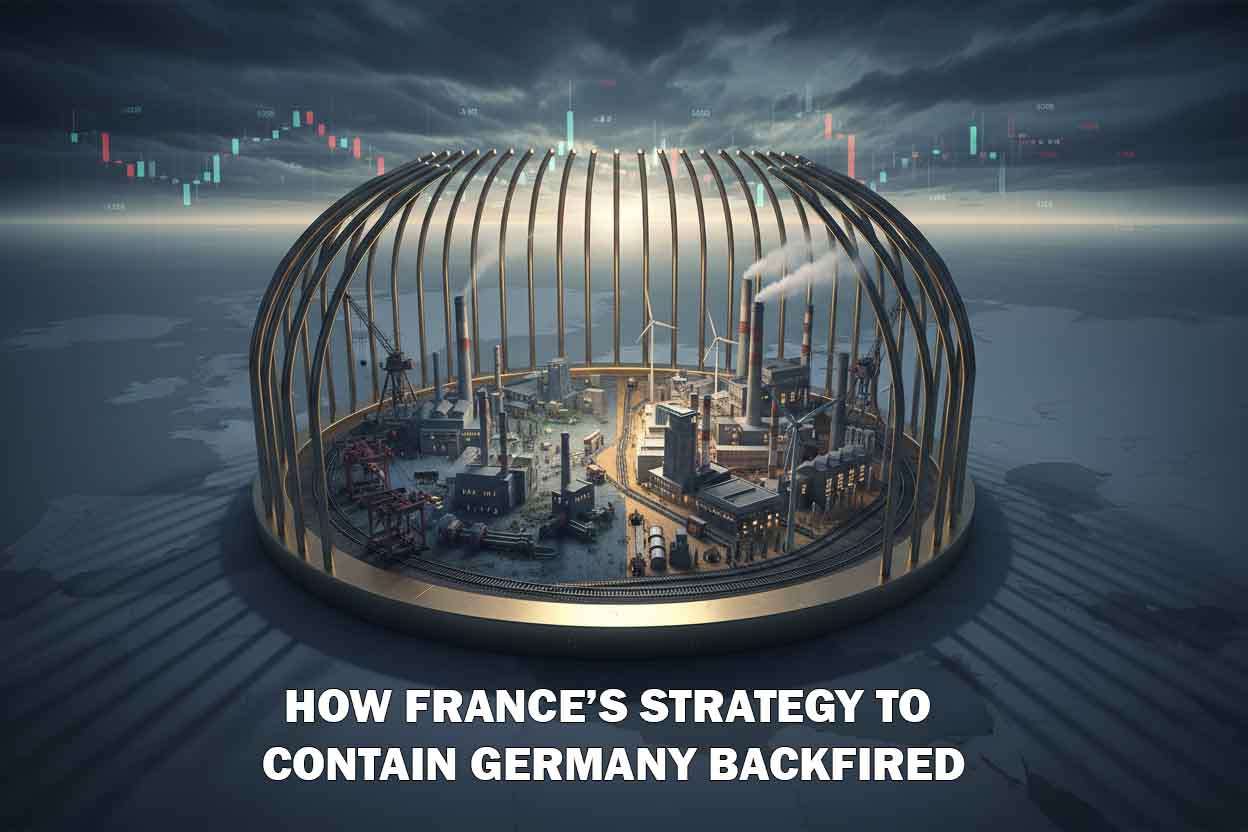
How France’s Strategy to Contain Germany Backfired
The Euro Trap
In 2010, Europe stood at what seemed like the edge of an abyss. The global financial crisis had morphed into a sovereign debt emergency inside the Eurozone, threatening the very existence of the European project. For those in the corridors of power in Brussels and Frankfurt, the atmosphere was suffocating. Market headlines questioned whether the experiment of European integration had run its course.
Greece’s economy had been exposed as a wreck of debt and mismanagement. Spain’s housing bubble was collapsing, dragging much of its banking system with it. Italy, a major industrial power, found itself struggling to service a mountainous public debt. Financial markets, acting as relentless and unforgiving arbiters of national credibility, turned their full attention to the Eurozone. They sensed vulnerability – and they pounced.
Yet amid the turmoil, attention converged on one capital, and it was not Paris, London or Brussels. It was Berlin. The pressing question for the world’s policymakers and investors was disarmingly simple: would Germany pay? Would the German taxpayer be prepared to underwrite the stability of the single currency?
At that moment, Germany was the unquestioned economic leader of Europe. It was the paymaster, the industrial powerhouse and, in effect, the vault where the money was stored. The German chancellor, Angela Merkel, functioned as the de facto head of the continent. Her decisions held the capacity to rescue or ruin national economies with a single assent or refusal.
However, if one were to zoom out from this scene of German pre-eminence and look westward, another major power could be seen – sidelined, frustrated and haunted by its own history: France. For decades, France had regarded itself as the diplomatic heart of Europe, the intellectual architect of integration, and the indispensable counterweight in the continental balance of power. It believed it ought to be co-leading any European response to crisis, acting as refuge, partner and authority in equal measure.
Instead, France’s leaders discovered that they had far less room for manoeuvre than they had assumed. They found themselves unable to oppose German demands. Publicly, they smiled for the cameras, stood beside the German chancellor and endorsed austerity measures they privately detested, all in the name of reassuring markets and keeping the Eurozone afloat.
France had slid into the role of junior partner. It was no longer driving the European vehicle; it was a passenger, while Berlin controlled the steering wheel. The most bitter irony lay in the fact that France’s impotence was not the result of misfortune or an aggressive German strategy. It was the outcome of a system that France itself had done more than anyone to construct: the single European currency.
The euro was conceived in large part as a “golden cage” for Germany—a mechanism to bind German power so tightly to Europe that it could never again dominate the continent. Yet, in a cruel twist of fate, France built this cage, helped to push Germany inside, and then discovered that it had locked itself in alongside the stronger partner. Over time, that imbalance turned the hoped‑for constraint on German power into an amplifier of German advantage.
To understand how a state as diplomatically adept and historically sensitive as France could make such a fundamental miscalculation, one must go back to a particular moment in European history: 9 November 1989, the night the Berlin Wall fell.
Fear Behind the Celebrations: France and the Spectre of a Unified Germany
For most of the world, the fall of the Berlin Wall was an unambiguous triumph. The scenes are now iconic: young people clambering onto the concrete barrier, attacking it with hammers; families reuniting after decades; the visible crumbling of the Iron Curtain. It marked the symbolic end of the Cold War and the apparent victory of liberal democracy.
In Paris and London, however, the mood in the highest offices was one of anxiety bordering on dread. The French president at the time, François Mitterrand, had lived through the Second World War, had been a prisoner of war and understood at a visceral level what European history could unleash when German power was unconstrained. Watching jubilant crowds in Berlin, he saw not simply freedom but the return of France’s oldest nightmare: a unified, resurgent Germany in the heart of Europe.
For over a century, French foreign policy had been organised around a single, overriding imperative: keep Germany weak or keep it divided. A united Germany, with a larger population, superior industrial capacity and a central geographic position, had been viewed as an existential threat to French security and influence. The diplomatic cables and private notes from that winter reveal a degree of panic that never surfaced in public. Mitterrand was not merely uneasy; he was desperate. He was convinced that a unified Germany would naturally drift back towards dominance.
Across the Channel, the British prime minister, Margaret Thatcher, a fierce ideological opponent of Mitterrand on almost every other subject, shared this fear. She and the French president agreed on very little—she a champion of liberalisation and deregulation; he a self-described socialist intellectual—but on the question of Germany, they were suddenly aligned.
Mitterrand reportedly warned Thatcher that a united Germany might come to wield more influence in Europe than Hitler had ever achieved, not through tanks and armies, but through economic and political gravity. Thatcher, for her part, famously remarked that Britain had defeated the Germans twice and “now they are back”. Her anxiety ran so deep that she is said to have carried a 1937 map of Europe in her handbag, drawing attention to the older German borders as a warning of what might follow.
Such was the intensity of the fear that France even contemplated the unthinkable: seeking Soviet help to block reunification. Mitterrand, leader of a NATO member state, considered quietly aligning with a collapsing Soviet empire to keep Germany divided. He flew to Kiev to meet Mikhail Gorbachev, urging him to refuse German unification or to keep the Red Army in East Germany. It was a last, frantic attempt to arrest the course of history.
But history did not stop. German public sentiment overwhelmingly favoured unity. The United States under President George H. W. Bush backed reunification. The Soviet Union, weakened financially and politically, lacked the capacity and will to intervene. By early 1990, it had become clear to Mitterrand that his attempt at obstruction had failed. Germany would be reunited. The long-standing French strategy of containment through division was dead.
France needed a new strategy—quickly. If Germany could not be kept small or split, it would need to be bound into a framework that would prevent it acting independently. Mitterrand and his advisers devised a bold and risky plan. France would demand the price of its assent to reunification in the one area where post‑war Germany still possessed unchallenged sovereignty and pride: its currency.
The Deutsche Mark: Sacrificing Germany’s Economic Soul
The Deutsche Mark was not merely a unit of account. It had come to symbolise the entire German post-war recovery. With the country stripped of the military trappings of power and subject to profound moral trauma after 1945, economic achievement became the sole acceptable basis for national pride. The Bundesbank, based in Frankfurt, was both guardian and high temple of this success.
In the 1980s, the Deutsche Mark dominated European monetary affairs. Through its strict anti‑inflation policies, the Bundesbank effectively set the terms for other European economies. If the Bundesbank raised interest rates to combat inflationary pressures in Germany, other states were forced to follow, or risk capital flight and currency crises. This dynamic had humiliated France in the early 1980s.
When Mitterrand was first elected in 1981, he pursued an ambitious socialist programme: nationalising banks, raising wages and lowering the retirement age, seeking to stimulate growth through public spending. The financial markets responded by exiting French assets. Money flowed to Germany, and the Bundesbank declined to adjust its policies to accommodate French domestic priorities. By 1983, Mitterrand had been forced to reverse course, abandon much of his programme and embrace austerity to stabilise the currency. The episode left a deep imprint on him. As long as the Deutsche Mark existed, and as long as the Bundesbank dictated European monetary conditions, France’s room for domestic economic policy was inherently constrained.
Thus, the idea emerged: if the Deutsche Mark could not be subordinated, it would have to be dissolved into a larger whole. A single European currency would strip Germany of its monetary autonomy and replace the Bundesbank’s singular authority with a European Central Bank where France would enjoy representation and influence. It was a geopolitical calculation masquerading as an economic project. France was prepared to wager its economic future on a political gamble.
At a summit in Strasbourg in late 1989, Mitterrand essentially linked French assent to reunification to German acceptance of monetary union. For German chancellor Helmut Kohl, this posed an agonising choice. He was committed, above all, to the historic goal of reunification. He also knew his electorate’s attachment to the Deutsche Mark. Polls suggested that a clear majority of Germans opposed abandoning their currency. They trusted the mark; they did not trust an untested shared currency with countries whose fiscal reputations were weaker.
Nevertheless, Kohl recognised that he could not achieve reunification comfortably without the blessing of France and, by extension, the rest of Western Europe. He chose to prioritise the national dream of unity. He agreed to give up the Deutsche Mark as part of a wider project of European monetary union, against significant domestic resistance and much expert advice.
However, and this is crucial, Kohl did not agree to unconditional surrender. If Germany was to accept the loss of the mark, it would insist that the new currency be structured to reflect the German monetary philosophy. Germany’s negotiators pressed for the European Central Bank (ECB) to be modelled closely on the Bundesbank: institutionally independent from political interference, with a narrowly defined mandate centred on price stability and explicitly prohibited from directly financing government deficits. The symbolic finishing touch was the location of the ECB’s headquarters in Frankfurt, not Paris or Brussels, just a short distance from the old Bundesbank.
Germany further demanded strict entry conditions for countries wishing to adopt the euro. These took the form of the Maastricht criteria: limits on budget deficits and public debt ratios, meant to prevent fiscally weaker states from exploiting the credibility of the new currency to engage in excessive borrowing and spending. Although some of these figures were chosen somewhat arbitrarily, they were treated as quasi‑sacred by German policymakers.
France accepted all these conditions. Partly out of urgency to complete the reunification bargain, partly because of an ingrained belief within sections of the French elite that politics would always trump economics in the end. From this viewpoint, the details of monetary rules and deficit criteria were seen as secondary to the broader political project. Let the Germans write the technical rulebook, the logic went; France would still lead in the political arena and shape outcomes when it mattered.
This assumption would prove disastrously wrong.
The Early Years of the Euro: A False Sense of Security
When the euro was finally launched in 1999 (initially as a book currency before notes and coins arrived in 2002), the underlying tensions were not immediately obvious. Indeed, in the early years, it appeared for a time that France’s vision had prevailed.
Germany struggled with the immense costs of reunification. Integrating and reconstructing the east placed heavy burdens on public finances. The German economy stagnated and suffered from high unemployment. Commentators dubbed it the “sick man of Europe”. In contrast, France appeared to be doing reasonably well. Growth was steady, and its position inside the new monetary framework looked secure. From the vantage point of Paris, it was tempting to conclude that Germany had been successfully “tied down” while France enjoyed relative prosperity.
Yet Germany responded in a characteristically methodical fashion. In 2003, under Chancellor Gerhard Schröder, the government launched a far-reaching package of labour market and welfare reforms, commonly referred to as Agenda 2010 and the Hartz reforms. These measures curtailed unemployment benefits, loosened labour regulations, facilitated low-wage employment and reduced union bargaining power. For many German workers, the following decade brought wage stagnation and considerable social strain.
From a macroeconomic perspective, however, these reforms sharply improved Germany’s cost competitiveness. Wages were restrained, productivity rose and unit labour costs fell relative to trading partners. Germany was essentially conducting an “internal devaluation”: instead of adjusting its exchange rate, it drove down domestic labour costs.
In France, a very different trajectory unfolded. The 35‑hour working week was introduced, and both wages and public spending continued to rise. Within the shelter of the euro, without the discipline of periodic currency crises, there appeared to be less urgency to reform. France drifted, assuming that it could rely on the political mechanisms of the European project and its historic status to maintain influence.
This divergence in labour costs and competitiveness marked the beginning of the euro trap in its practical form.
Locked Exchange Rates and Diverging Competitiveness
Before the euro, France and Germany could adjust to differences in wages and productivity through exchange rate movements. If French wages grew faster and French goods became less competitive, the franc typically depreciated against the Deutsche Mark. This depreciation made French exports cheaper in foreign markets, restoring some balance and protecting the industrial base.
The euro removed that safety valve. Once France and Germany shared the same currency, nominal exchange rates between them no longer existed. Any difference in competitiveness had to be resolved internally through changes in productivity, wages or prices—processes that are slower, politically painful and socially disruptive.
During the 2000s, France’s labour costs rose significantly more than Germany’s. By 2008, the cost of labour in France had increased by around 30 per cent from the start of the decade, while in Germany it had remained roughly flat. The euro, by eliminating exchange-rate flexibility, magnified this divergence.
For Germany, the euro proved to be undervalued relative to what a free-floating Deutsche Mark would likely have been. Germany’s success as an exporter, combined with its fiscal restraint, would probably have driven the value of an independent German currency sharply upward, making German products more expensive abroad and dampening export volumes. Within the euro, however, the currency’s value was influenced by weaker economies such as Greece, Italy and, increasingly, France, preventing a strong appreciation. The result was a structurally undervalued exchange rate for the German economy, functioning as a permanent boost to German exporters.
For France, by contrast, the common currency was effectively overvalued. Its manufacturers faced high labour costs priced in a relatively strong currency, without the compensation of exceptional productivity advantages. They could not lower their prices sufficiently to compete with German firms without eroding margins to unsustainable levels. Nor could a depreciating national currency soften the blow.
A slow but relentless erosion of French industrial competitiveness followed. Year after year, French factories closed. Year after year, France’s share of Eurozone exports dwindled, while Germany’s rose. Between 2000 and 2010, France moved from a relatively balanced trading position to persistent trade deficits, particularly vis‑à‑vis Germany. Regions that had once hosted active manufacturing sectors slid into decline.
Manufacturing’s share of French GDP fell from around 16 per cent to about 10 per cent over the first two decades of the euro. Hundreds of thousands of industrial jobs were lost. Simultaneously, Germany emerged as one of the world’s foremost exporting nations, accumulating large trade surpluses. German companies leveraged the undervalued euro to sell machinery, vehicles and chemicals across the globe at highly competitive prices.
Ironically, some of the capital generated by Germany’s surpluses flowed back into the Eurozone periphery and into France itself, in the form of loans and investments. This credit enabled deficit countries to continue importing German goods despite their weakening industrial bases. It was a self-reinforcing cycle: German surpluses financed foreign demand, which in turn supported further German surpluses, while debtor states became increasingly dependent on external capital.
By the time the sovereign debt crisis erupted in 2010, this structural imbalance had left France economically weakened and politically constrained inside the very system it had championed.
Crisis and Hierarchy: How 2010 Revealed the True Balance of Power
The Eurozone crisis stripped away illusions. Greece’s problems triggered market panic, but concerns quickly spread to other countries with high debts and fragile banking systems. France entered this storm with diminished industrial strength, significant deficits and no independent monetary tools.
For decades, politicians and commentators had spoken of the “Franco‑German motor” driving European integration—a partnership of equals at the heart of the EU. The crisis meetings in Brussels and elsewhere revealed the extent to which this metaphor had become outdated. There was, in essence, one indispensable actor: Germany.
Chancellor Merkel and her finance minister, Wolfgang Schäuble, determined the conditions of rescue packages and the shape of the Eurozone’s institutional reforms. French leaders found themselves in the unenviable position of trying to negotiate from weakness. The then French president, Nicolas Sarkozy, shuttled back and forth to Berlin, pushing for greater European solidarity and burden-sharing. Publicly, he presented a united front with Merkel, claiming full agreement on strategy. Financial markets were not persuaded.
Behind the scenes, France was pressuring Germany to protect French banks, which were heavily exposed to Greek and other southern European debt. Germany, in turn, demanded strict conditions for any support: fiscal consolidation, structural reforms and, crucially, the principle that private investors would have to shoulder part of the losses on sovereign bonds.
A pivotal moment came at the Deauville summit in October 2010. In search of a comprehensive package to deal with future crises, France accepted German insistence that private creditors should be “bailed in” and that stringent austerity requirements should accompany any financial assistance. While politically framed as a necessary step towards responsibility, the announcement shocked markets and exacerbated tensions within the Eurozone.
From a French perspective, this represented more than a policy disagreement. It symbolised the definitive loss of the strategic autonomy that Mitterrand had hoped to safeguard through monetary union. The euro, far from securing France equal leadership within Europe, had undercut its economic foundation and left it dependent on German decisions. European policies increasingly bore the imprint of German preferences, even when formally presented as collective choices.
Debt as Concealment: How France Masked Structural Weakness
Even before the 2010 crisis, French leaders had been keenly aware of the growing competitiveness gap with Germany. They could see trade figures deteriorating and industrial employment shrinking. However, acknowledging that the euro itself was part of the problem was politically unacceptable. The common currency was not merely a policy; it was a symbol of European destiny and, for France, a major diplomatic achievement.
Instead of confronting the underlying structural issues, successive governments turned increasingly to public borrowing. If the private sector could not generate enough competitive output and employment, the state would compensate. More civil servants were hired. Struggling sectors were subsidised. The welfare state remained generous, funded not so much by expanding productive activity as by tapping into cheap credit.
The presence of the euro played a crucial enabling role. Because France shared a currency with Germany, investors treated French government debt as relatively safe, on the assumption that a Eurozone core country would ultimately be backstopped. Interest rates on French bonds remained historically low, which dulled the sense of urgency and allowed the state to smooth over industrial decline with debt-financed social spending.
This created the illusion of stability, like a patient in worsening health whose pain is dulled by strong medication. Underneath, the disease – loss of competitiveness and productive capacity – was advancing.
When the Eurozone crisis made bond markets more discriminating, it became evident that the earlier calm had been deceptive. France was not Greece, but neither was it in the robust position that its leaders had once imagined it would occupy. It was now clear that in moments of acute stress, France depended on German assent, both for financial backstops and for the direction of policy.
The Social Consequences: De‑industrialisation and Discontent
The economic logic of the euro trap did not remain confined to statistics. It manifested in the lived experience of millions of citizens, particularly in the regions of France most affected by de‑industrialisation.
The car industry provides a telling example. In the early 2000s, French manufacturers such as PSA and Renault produced over three million vehicles a year domestically. By the mid‑2010s, that figure had halved. Some of this production shifted to lower-cost locations in Eastern Europe; some simply lost market share to foreign competitors, above all to German brands.
The structure of the eurozone made it extremely difficult for French mid‑range industrial products to compete. High social charges, shorter official working hours and an overvalued effective exchange rate all fed into higher unit costs. German firms, benefitting from years of wage restraint and a currency undervalued for their economic strength, dominated the premium segments. Lower‑cost countries, both inside and outside the EU, captured the budget market. France’s traditional position in the medium segment was relentlessly squeezed.
The result was a slow hollowing-out of industrial employment in many towns and smaller cities. Once-vibrant manufacturing areas saw rising unemployment, declining local tax bases and an increasing sense of abandonment. Public services, though still more generous than in many other countries, struggled to compensate for the erosion of productive activity.
This economic backdrop fed into widening social tensions. The “gilets jaunes” (yellow vest) protests that erupted in 2018 were triggered by a proposed rise in fuel taxes, but their deeper cause lay in a feeling of loss—loss of jobs, loss of status and loss of control. Protesters often came from rural or semi‑industrial areas that had borne the brunt of de‑industrialisation and now felt disconnected from decision-making centres in Paris and Brussels.
The euro trap thus had a social as well as an economic dimension. Policies designed in the 1990s by elites in Paris as part of a grand strategy to “manage” German power were now shaping everyday frustrations decades later, in ways that those elites had not foreseen.
Hidden Risks: Target2 and Mutual Entrapment
There is a further, less widely understood dimension to the euro trap, one that concerns the internal payment systems of the Eurozone. Within the architecture of the single currency, the Target2 system records cross‑border flows between national central banks. Over time, large imbalances have built up within this system, reflecting persistent trade surpluses and deficits as well as capital movements.
Germany, running large surpluses and receiving capital inflows, has accumulated claims worth hundreds of billions of euros on the rest of the Eurozone through Target2. Countries such as Italy and Spain, by contrast, have incurred large corresponding liabilities. These positions are not settled in the way cross‑border balances would have been in the pre‑euro era; they persist on the books of central banks.
In effect, Germany has ended up as a major creditor within the system, not by explicit political decision but as a by‑product of economic imbalances. If the euro were to fracture suddenly – for example, if a major country chose to leave and redenominate its debts – these claims would be extremely difficult to realise. In a radical breakup scenario, a significant portion of Germany’s Target2 assets could evaporate in real terms, inflicting enormous notional losses on the German public sector.
This creates a form of “mutually assured destruction”. France is trapped because it has lost competitiveness and cannot use devaluation to restore it. Germany is trapped because it has built up vast financial claims on its partners that would be imperilled if the system were to disintegrate. Berlin cannot easily allow Paris or Rome to fail without also accepting considerable damage to its own balance sheet and to the stability of its export markets.
Thus, a mechanism originally intended – from the French point of view – to constrain German freedom of action has evolved into a structure within which both countries are tightly bound, though in different ways. France is constrained by economic underperformance; Germany by the scale of its accumulated claims and its deep integration into the single market.
Italy: The Weak Link and a Potential Shock Point
If France was the principal architect of the euro and Germany the principal beneficiary, Italy has arguably been among the most heavily damaged by the system’s rigidities. Since adopting the euro, Italy has experienced almost no cumulative growth over two decades. Its productivity has stagnated and its public debt has remained extremely high.
Italy’s predicament matters greatly for France. The two economies are strongly interlinked, not least through the financial system. French banks and investors hold substantial Italian assets. If Italy were to face an acute crisis under the constraints of the euro—unable to devalue, struggling to grow and forced to comply with strict fiscal rules—the risk of a systemic shock would be significant.
In that scenario, the French banking sector would be at the front line of contagion. The rules and structures that France once enthusiastically endorsed, in the belief that they would underpin a stable and “disciplined” Eurozone, could contribute to a chain of events that would endanger French financial stability.
In other words, the trap is no longer purely bilateral between France and Germany. It has become a network of mutual dependencies and vulnerabilities across the Eurozone, in which France is heavily exposed on several fronts.
Possible Futures: Federal Leap, Slow Agony or Breakup
From the vantage point of today, three broad scenarios can be envisaged for the future of the Eurozone and France’s place within it.
The first is a “federal leap”. In this scenario, France eventually persuades Germany that the only durable solution to the imbalances generated by the euro is to move towards a much deeper fiscal and political union. Surpluses from stronger economies would be transferred to weaker regions not as loans, but as permanent fiscal transfers, akin to the way wealthier areas support poorer ones inside a single nation-state. This would amount to the creation of a genuine “United States of Europe”, with a common budget large enough to smooth out regional shocks.
This was close to Mitterrand’s original dream: a Europe where political solidarity and shared sovereignty could override narrow national calculations. However, the political obstacles to this vision are formidable. For decades, the German electorate has been reassured that it would not be required to underwrite the debts of other member states in perpetuity. Convincing voters to accept a fully fledged transfer union would require a profound shift in public attitudes and political narratives.
The second scenario is the “slow agony”. In this path, no decisive federal leap is taken, but nor does the system collapse outright. France continues to grapple with de‑industrialisation and sluggish growth, supporting social cohesion through high public spending and rising debt. Germany maintains its export strength but gradually faces new challenges: demographic ageing, rising energy costs and a more fragmented global trading environment.
Under this scenario, the Eurozone persists as a region of modest growth and recurring tensions. Reform efforts are partial and often contested. Political grievances simmer, occasionally flaring into protest movements but never quite forcing a fundamental redesign.
The third scenario is the “breakup”. Here, political forces in France or Italy conclude that the costs of remaining in the euro have become intolerable. They argue that reclaiming monetary sovereignty and the ability to devalue outweighs the financial and diplomatic chaos that an exit would cause. A new national currency would be introduced, existing debts might be redenominated and partial defaults could occur. The immediate consequences would be severe: capital flight, legal disputes and deep uncertainty. Yet proponents would claim that, in the medium term, restored competitiveness and regained policy tools would justify the upheaval.
It is impossible to predict with certainty which of these paths, or what combination of them, will materialise. What is clear is that the original French calculation—trading the Deutsche Mark for German reunification in the hope of securing joint leadership of Europe—has produced outcomes that diverge sharply from what was intended.
The Euro as Mirror, Not Instrument
The history of the euro underlines how seemingly technical decisions about interest rates, deficit rules and exchange-rate systems can shape the destinies of nations as profoundly as wars and treaties. Mitterrand looked at a map of Europe in 1989 and believed he was engaged in a geopolitical chess game. He imagined that a single currency could pin down German power, binding Berlin irrevocably into a European framework dominated as much by Parisian diplomacy as by German economics.
What he and his contemporaries failed to appreciate was that the euro would function less as an instrument of political control and more as a mirror of underlying economic realities. By eliminating the adjustable exchange rates that had previously shielded weaker economies, the single currency exposed structural differences in productivity, labour market flexibility and industrial organisation. Instead of masking those differences, it set them in sharp relief.
Germany, having undertaken difficult reforms and built a formidable industrial base, flourished within this environment. France, having delayed deep structural changes and relying increasingly on public spending to cushion social dislocation, found itself in a system that magnified its relative weaknesses. The very mechanism intended to ensure that no single country could dominate Europe ended up reinforcing the dominance of the most competitive economy within the bloc.
France designed the trap, set it with the best of intentions from its own strategic standpoint and stepped into it. The doors closed gradually, through years of economic divergence and political compromise. Today, the keys to reopening those doors—or at least reshaping their locks—are no longer in Paris alone. They are held collectively, but Germany’s grip remains decisive.
Meanwhile, the world beyond Europe is changing swiftly: new economic powers are emerging, global supply chains are being reconfigured and technological transformations are accelerating. The euro, and the particular way it was constructed under French–German bargaining, will continue to influence how well France can adapt to this shifting landscape.
The story of the euro from a French perspective is thus one of grand strategy colliding with hard economics. A project conceived to prevent old nightmares of German tanks rolling across borders instead empowered German engineering and accounting, backed by a currency that suited Germany more than France. What was imagined as a cage for German power became, in practice, a structure in which France finds its own freedom of action sharply circumscribed.
How France responds—whether by pushing towards deeper union, enduring incremental erosion, or ultimately questioning the foundations of the system—will shape the next chapter of European history.
Frequently Asked Questions
What was the primary motivation behind France’s push for the creation of the euro? The euro was largely a geopolitical strategy conceived by French President François Mitterrand to contain a newly reunified Germany. By forcing Germany to abandon the Deutsche Mark in favour of a shared European currency, France aimed to strip Germany of its independent monetary power and dilute its economic influence into a European framework where France would have an equal vote in decision-making.
Why is the euro described as a “cage” that France locked itself into? While the currency was intended to bind German power, it also removed the “safety valve” of currency devaluation. In the past, France could lower the value of the franc to stay competitive against German industry; inside the euro, this is impossible. Consequently, France became locked into an exchange rate that favoured German productivity while making French exports more expensive, leading to a slow-motion decline of French manufacturing.
How did Germany’s domestic reforms in the early 2000s affect the balance of power? While France maintained a generous welfare state and shorter working weeks, Germany implemented the “Hartz” reforms, which suppressed wage growth and deregulated the labour market. This “internal devaluation” made German goods significantly cheaper and more competitive. Because both nations shared the same currency, France could not adjust its exchange rate to compensate for Germany’s lower costs, allowing German industry to dominate the European market.
What role did the 2010 sovereign debt crisis play in revealing the “Euro Trap”? The crisis shattered the illusion of the “Franco-German motor” as a partnership of equals. As fiscally weaker nations faced collapse, it became clear that Germany was the only power with the financial reserves to act as a paymaster. France, weakened by industrial decline and rising debt, was forced to accept German-led austerity measures and strict fiscal rules, effectively surrendering its vision of a politically led, flexible Eurozone.
What are the “Target2” imbalances, and why do they prevent a simple breakup of the euro? Target2 is the accounting system that tracks money flows between Eurozone central banks. Over time, Germany has accumulated over a trillion euros in claims against other member states, including France and Italy. This creates a state of “mutually assured destruction”: France is trapped by its lack of competitiveness, but Germany is trapped because a Eurozone collapse would mean those trillion-euro claims would likely never be repaid, causing a catastrophic hit to the German economy.