

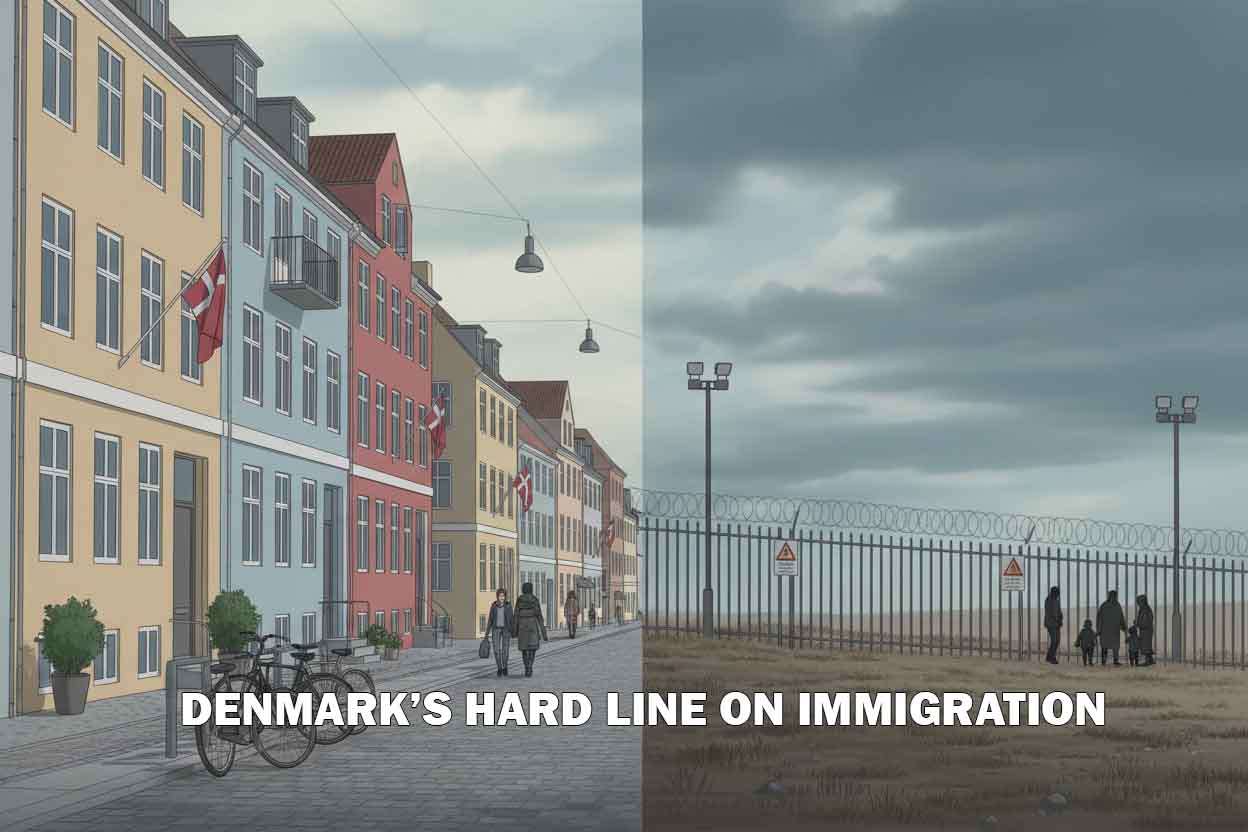
Denmark’s Hard Line on Immigration
From Humanitarian Model to Fortress State
For many years Denmark was held up as an international example of how a small, wealthy country could combine economic dynamism, a generous welfare system and strong social cohesion. It regularly appeared near the top of global rankings for happiness, equality and quality of life. Free healthcare, free education, and a society built on trust and relatively low corruption formed a model that outsiders admired and, in some cases, sought to emulate.
Today, however, Denmark is increasingly known for something very different: some of the toughest immigration and asylum policies in the democratic world. The country has moved from being an early champion of refugee protection to openly pursuing a political goal of “zero asylum seekers”. It has enacted policies that would once have been regarded as the preserve of the far right, yet many of these measures are now supported and implemented by the political centre, including the centre-left Social Democrats who historically built Denmark’s welfare state.
This article explores how and why this dramatic shift occurred, the social and economic anxieties that underpin it, and what Denmark’s trajectory may signal for other Western democracies grappling with immigration, identity and the future of the welfare state.
From Humanitarian Pioneer to Restrictive Outlier
In the decades after the Second World War, Denmark, like many European countries, prided itself on its humanitarian credentials. It was among the first signatories to the 1951 Refugee Convention, committing itself to protecting those fleeing persecution. This stance was not an abstract gesture: successive Danish governments accepted quota refugees through the United Nations system and offered strong legal safeguards for those granted asylum.
During the 1960s and 1970s, Denmark actively recruited so‑called “guest workers” from Turkey, Pakistan, Yugoslavia and other countries to address labour shortages in its growing economy. The arrangement, at least in theory, was temporary. Migrant workers would fill gaps in the labour market, earn money, and eventually return to their countries of origin.
The reality unfolded differently. Large numbers of these workers settled permanently, brought their families, and put down roots. Over time, Denmark moved beyond merely tolerating these communities. In 1983 it passed what was then considered one of the most liberal immigration laws in Europe, providing robust protections for asylum seekers and a realistic path to permanent residency and citizenship. Public discourse during this period generally celebrated diversity and international solidarity.
In 1980, immigrants represented only 2.6 per cent of the population. By 2025, that figure had risen to 12.6 per cent, with an additional 3.7 per cent consisting of Danish-born children of immigrant parents. Almost all of Denmark’s net population growth since 1980 has been attributable to immigration.
To some Danes, these changes felt manageable and in keeping with the country’s humanitarian ethos. To others, they appeared sudden and disorienting, especially as immigration increasingly came from culturally distant regions and as integration outcomes failed to meet expectations. Over time, those concerns shifted from the margins of political debate into its centre.
The 2015 Migration Crisis: A System Under Strain
The European migration crisis of 2015 marked a turning point. Conflicts in Syria, Afghanistan and Iraq, along with instability in other regions, brought more than a million asylum seekers into Europe in a single year. Denmark, a country of around six million inhabitants, received 21,316 asylum applications in 2015 alone. Just three years earlier, in 2012, the figure had been roughly 3,500. That represented a six-fold increase in a very short period – the highest number of asylum applications Denmark had ever experienced.
The Danish system was not prepared for this scale of inflow. Asylum processing structures were overwhelmed. Small towns, unused to large migrant populations, suddenly found refugee centres opening nearby. While Denmark quietly allowed many migrants to continue their journey to neighbouring Sweden, which at the time had more generous policies, a substantial number remained.
Unlike the earlier era of guest worker migration, there was no comprehensive, pre‑planned integration strategy. Many of the new arrivals had limited formal education, limited skills suited to Denmark’s advanced economy, and no knowledge of the Danish language. Expectations that they could be rapidly absorbed into the labour market and social structures often proved unrealistic.
By 2016, the political and administrative response had hardened. Border controls, previously relaxed under the Schengen framework, were reintroduced. Benefits for refugees were reduced. In an extraordinary move, the Danish government placed adverts in Lebanese newspapers explicitly announcing that welfare payments for asylum seekers had been cut by half, warning potential migrants that Denmark would not be the “paradise” some imagined.
This conveyed a blunt message: “Do not come here.” For a country once synonymous with generosity and openness, such actions were striking. But they did not arise in a vacuum – they reflected years of emerging problems and concerns that many Danes felt had been suppressed or downplayed.
Parallel Societies and the Ghetto Debate
A core worry among policymakers and the public concerned the emergence of so‑called “parallel societies” – ethnically concentrated districts where integration appeared to have stalled or failed. Over several decades, much of Denmark’s immigration had come from the Middle East, North Africa and Somalia. In a number of urban neighbourhoods, Danish was no longer the dominant language heard in public spaces. Poverty and unemployment persisted at higher levels than the national average. Educational outcomes lagged and crime became an enduring concern.
In response, the government introduced an official classification system for disadvantaged areas: neighbourhoods that met certain criteria were designated “ghettos”. To qualify for this label, an area typically needed to have more than 50 per cent of residents from non‑Western backgrounds as well as negative indicators for employment, education, income and crime. The term was presented as a technical designation rather than a pejorative, but it carried considerable symbolic weight.
By 2018, leading politicians were openly describing these districts as threats to social cohesion and national unity. The government adopted a strategy titled “A Denmark Without Parallel Societies – No Ghettos in 2030”, indicating a determination to transform or dismantle these areas within little more than a decade. The plan portrayed such neighbourhoods not merely as localised challenges but as structural risks to the functioning of the welfare state and the country’s sense of shared identity.
In a New Year speech that same year, then Prime Minister Lars Løkke Rasmussen warned that violence from these districts could spread into surrounding communities and spoke of “cracks” appearing on the map of Denmark. Official statistics gave weight to these concerns. While immigrants accounted for roughly 14 per cent of the population, they were responsible for about 29 per cent of convictions for violent crime – more than double their share of the population.
The financial dimension was equally unsettling to many voters. In 2018, the Ministry of Finance estimated that immigrants from non‑Western countries and their descendants generated a net fiscal cost of 31 billion Danish kroner in one year, equivalent to around 4.2 billion US dollars. In a small country whose political culture is deeply attached to the sustainability and fairness of the welfare system, these figures fuelled a sense that something fundamental was at stake.
Housing Pressures and “White Flight”
Housing became another major flashpoint. Denmark already had one of the most expensive housing markets in Europe. As demand increased, largely due to population growth, prices climbed steeply. Home ownership became harder to attain for younger Danes, and renters found themselves priced out of central urban areas.
Research in 2025 suggested that more than 60 per cent of the increase in housing prices since 1999 could be linked to population growth driven by immigration. In areas where the immigrant share of the population increased by just one percentage point over a five-year period, house prices were found to rise by about 11 per cent and rents by around 6 per cent.
As costs escalated, some native Danes moved out of immigrant‑heavy districts, a phenomenon described in academic literature as “white flight”. This displacement did not relieve pressure on the housing market; instead, it shifted demand into other neighbourhoods and intensified the shortage across wider urban regions. For many citizens, immigration ceased to be an abstract debate and became directly connected to whether they could afford a home or stay in their preferred communities.
Housing pressures intersected with concerns about local schools, public spaces and perceived changes in the cultural character of neighbourhoods. Together, these anxieties helped reshape public attitudes towards immigration and integration, turning what had been an issue of principle into one of personal security and economic opportunity.
Mainstreaming the Hard Line: The Collapse of the Old Consensus
For years, the Danish People’s Party, a far‑right formation, had warned of negative consequences from large‑scale immigration. It was initially treated as a fringe group and largely excluded from policymaking. That changed dramatically in the 2015 parliamentary elections when the party secured 21.1 per cent of the vote and 37 seats, making it the second largest party in the Folketing.
This breakthrough presented mainstream politicians with a stark choice: continue to marginalise the issue of immigration and risk further electoral gains for the far right, or absorb part of its agenda to reclaim the political initiative. The Social Democrats, long associated with the expansion of the welfare state and worker protections, chose the latter course.
Under the leadership of Mette Frederiksen, the Social Democrats re‑positioned themselves. Frederiksen had previously criticised Denmark’s framework as already among the toughest in Europe. By the late 2010s, however, she was explicitly campaigning to halt immigration from non‑Western countries and championed a tougher approach to asylum and integration. This strategy proved electorally successful. The Social Democrats returned to power, and the vote share of the Danish People’s Party declined sharply. For many voters seeking stricter controls, the far right became unnecessary once mainstream parties embraced similar policies.
The result has been the emergence of a broad cross‑party consensus in favour of very tight immigration rules. Both the centre‑left and the centre‑right now converge on key objectives: drastically reducing refugee numbers, enforcing rigorous integration requirements for those who stay, and safeguarding what is often labelled “Danish values” or “Danish culture”.
Within this new landscape, measures that might once have been labelled extreme are no longer considered outliers. They have become pillars of the national policy framework.
The “Jewellery Law” and the Ghetto Package
One of the most controversial measures was introduced in 2016, when the Danish Parliament passed a law allowing police to confiscate cash and valuables from asylum seekers to help cover the cost of their accommodation and support. Any assets worth more than a specified threshold, roughly equivalent to 1,500 US dollars, could be seized. International media outlets quickly dubbed this the “jewellery law” and condemned it as callous and demeaning. Critics argued that it treated people fleeing war and persecution as criminals and stripped them of their last safeguards of dignity and security.
The Danish government, however, did not back down. It defended the measure on the grounds that Danish citizens needing social assistance were also required to deplete their own assets before receiving public support. Officials framed the law as a question of equal treatment and fiscal responsibility rather than cruelty, and proceeded to implement it despite international criticism.
In 2018, a further wave of policies collectively known as the “ghetto package” was introduced. Neighbourhoods officially classified as ghettos became subject to special rules that did not apply elsewhere in the country. Crimes committed in these areas could carry double the standard punishment, under the rationale that tougher sanctions would act as a deterrent and help break cycles of localised crime.
The most contested part of the package focused on children. Families living in designated ghetto areas were required to send their children, from as young as one year old, to mandatory daycare for at least 25 hours a week. The stated intention was to ensure early exposure to the Danish language and to what policymakers described as Danish values – including democratic norms, gender equality and national cultural traditions, such as Christmas celebrations.
Parents who refused to comply risked losing welfare benefits. In effect, the state compelled participation in early childhood programmes not mainly for childcare or educational reasons, but as an integration tool and a vehicle for cultural socialisation. The policy prompted accusations of discrimination and social engineering. Denmark faced legal challenges before European institutions, including allegations of racially discriminatory practices.
Once again, however, the government maintained its course. It argued that the measures were necessary to break entrenched patterns of segregation and that failing to intervene forcefully would condemn generations of children to exclusion from the mainstream society and labour market.
Revoking Protection and Exporting Asylum
By 2020, Denmark had begun to push its restrictive approach even further. Authorities started revoking residence permits from Syrian refugees on the grounds that certain regions of Syria were now safe for return. Many of those affected had lived in Denmark for years, learning the language, entering employment and enrolling their children in schools. They suddenly faced a stark choice: leave voluntarily or remain in a deportation centre with tight restrictions on movement and limited opportunities.
This move made Denmark the first European country to formally declare parts of Syria safe enough to withdraw previously granted protection. Human rights organisations, along with many European partners, voiced strong objections, citing continued instability, repression and security risks in Syria. The Danish government, however, defended its assessment and reiterated its determination to treat asylum as a temporary status rather than a path to permanent settlement.
In 2021, Denmark took an even more radical step. Drawing explicit inspiration from Australia’s offshore detention and processing model, Parliament passed legislation enabling asylum seekers who arrive in Denmark to be transferred to a third country – widely discussed in connection with Rwanda – for processing and potential protection. The key intent was not simply to house people elsewhere, but to ensure that they would never set foot in Denmark itself, regardless of the merits of their claim.
The law was approved by a substantial majority of 70 votes to 24, underlining that this was now a mainstream policy, not the vision of a small faction. The principle was simple: anyone seeking asylum in Denmark would be relocated outside Europe, where their case would be assessed. The expectation was that, once word spread that arrival in Denmark would not lead to settlement in the country, fewer people would attempt the journey at all.
Alongside this, the Danish state pursued other cultural and religious restrictions. A ban on full face veils in public spaces took effect in 2018, joining similar measures in a handful of other European states. Authorities explored limits on the public call to prayer and increased scrutiny of foreign‑funded religious institutions, citing concerns that some external influences were promoting values at odds with gender equality, free speech and democratic norms.
Each policy, considered individually, was severe. Taken together, they formed a comprehensive deterrence strategy. The message to potential migrants and asylum seekers was unmistakable: Denmark intended to be one of the least attractive destinations in Europe for those without strong economic prospects or cultural proximity.
The Centrality of the Welfare State
To understand why these policies enjoy broad support inside Denmark, it is essential to grasp the central role of the welfare state in national identity. Danish society is deeply attached to a model in which education and healthcare are universally accessible and generous unemployment and social benefits provide a safety net. This system rests on high levels of taxation, but also on high employment and a widespread belief that everyone is contributing fairly.
When large numbers of immigrants appeared to draw more from the system than they contributed – whether because of lower employment rates, language barriers or educational deficits – many voters concluded that the economic foundation of the welfare model was under threat. Reports of billions of kroner in annual net fiscal costs associated with certain immigrant groups were not merely statistics; they were interpreted as evidence that solidarity was being stretched beyond sustainable limits.
This perception did not arise solely from numbers. It was reinforced by visible concentrations of unemployment and poverty in particular districts, stories of crime and social unrest, and high-profile cases of welfare abuse. The narrative that emerged was one of a finely balanced social contract being undermined by groups who, for various reasons, seemed unable or unwilling to integrate and contribute on the same terms as the native population.
From this perspective, strict immigration controls and demanding integration policies are not framed as cruelty but as necessary conditions for preserving a model of social protection that most Danes value intensely. Many citizens appear willing to accept significant humanitarian and reputational costs abroad if they believe that doing so preserves the integrity of their domestic system.
Security Incidents and the Politics of Fear
Economic concerns alone did not drive Denmark’s transformation. Security incidents involving immigrants or their descendants had a significant psychological impact. While Denmark remains a relatively safe country with low overall crime rates, episodes of gang violence in migrant‑dominated areas and occasional terrorist‑related attacks created a perception that immigration was linked to greater insecurity.
A particularly consequential incident occurred in 2015, when a Danish-born man of immigrant origin carried out a deadly shooting in Copenhagen. For many, this event crystallised fears about radicalisation and home‑grown extremism. It was no longer possible, in the public imagination, to confine the risk to distant conflicts; the threat now appeared to manifest within Danish society itself.
Even when such events are statistically rare, their influence on public opinion is disproportionate. The combination of violent incidents, media attention and political rhetoric can rapidly transform isolated tragedies into powerful symbols of broader threats. Refugees and migrants, previously seen primarily as victims of war and instability, began to be viewed by many Danes as potential sources of future danger.
This shift did not affect all groups equally. Migrants from predominantly Muslim countries, especially those associated in public debate with patriarchal norms, religious conservatism or political Islam, came under particular scrutiny. Concerns about radicalisation, honour-based violence, and perceived resistance to liberal values became intertwined with debates about integration and community cohesion.
Culture, Identity and the Question of Compatibility
Underlying the economic and security debates is a more emotive anxiety: the fear that Danish culture itself could be diluted or eroded. While Denmark is far from monolithic, many citizens share a loosely defined but strongly felt sense of national identity rooted in language, egalitarian norms, gender equality, secular public life and specific cultural practices.
For integration to be deemed successful, many Danes expect immigrants not merely to obey the law and participate in the labour market, but to embrace core cultural norms – or at least not to challenge them. The existence of neighbourhoods where Danish is rarely heard, where traditional dress is highly visible, and where children do not participate in mainstream traditions such as Christmas can be experienced by some as a sign of parallel societies rather than multicultural richness.
The political language used in recent years reflects this. Authorities speak not only about jobs and education, but about “Danish values” as a coherent package that must be learned and internalised. Mandatory daycare in ghetto areas is justified in part by the need to expose children early to these values, implying a lack of confidence that they would otherwise emerge through family and community life.
This concern with cultural compatibility became starkly visible during the war in Ukraine. Between 2022 and 2023, Denmark accepted more than 41,000 Ukrainian refugees, granting them rapid access to residence permits and social support. The arrival of this large group generated relatively little public controversy compared with previous inflows from the Middle East and Africa.
The contrast, while rarely described in blunt terms by officials, was widely recognised. Ukrainians were seen as European, predominantly Christian and broadly aligned with Danish cultural norms. Their flight from Russian aggression fitted comfortably within a narrative of solidarity with a neighbouring region. Many Danes concluded that they were not, in principle, hostile to refugees, but that they preferred to assist those perceived as culturally closer and more likely to integrate seamlessly.
This selective openness reinforces the idea that Denmark’s stance is not simply about numbers, but about who is considered compatible with the existing social and cultural order.
International Criticism and Domestic Endorsement
Outside Denmark, many of these policies have been met with sharp criticism. Human rights organisations describe the confiscation of asylum seekers’ valuables, the aggressive ghetto policies, the revocation of Syrian permits and the Rwanda plan as violations of humanitarian norms and, in some cases, of international law. The United Nations and European institutions have raised concerns about discrimination, proportionality and compliance with refugee protection obligations.
Within Denmark, however, there is relatively limited public outrage. Surveys indicate that large segments of the population support tighter immigration controls and more demanding integration measures. A 2018 poll by YouGov, for example, found that 65 per cent of Danes opposed admitting more migrants. By 2022, nearly half of those surveyed – 46 per cent – preferred that no more or only a very small number of Muslims be granted residency.
These attitudes help explain why governments of different political colours have not only maintained but expanded restrictive measures. Asylum applications to Denmark have collapsed, falling from over 21,000 in 2015 to just a few hundred per year by 2021. Officials present this as clear evidence that deterrence works: when it becomes widely understood that arrival will not lead to settlement – and may instead lead to offshore processing or eventual removal – fewer people attempt the journey.
Proponents of this approach argue that it also saves lives by discouraging dangerous crossings and undermining smuggling networks. Critics counter that it simply shifts responsibility onto poorer countries and undermines the very notion of asylum as a meaningful right.
Denmark as a Model for a New Restrictive Consensus?
Denmark’s trajectory has not gone unnoticed elsewhere. Its offshore processing laws and strong border controls are closely modelled on Australia’s “stop the boats” policy, which sought to deter irregular maritime arrivals by guaranteeing that they would never be resettled in Australia itself. Danish officials have studied this system in depth, including visits to offshore facilities such as Nauru.
Other European governments, most notably the United Kingdom, have looked to similar externalisation arrangements with countries such as Rwanda, directly citing the Australian experience and, implicitly, Denmark’s own path. While legal and political challenges have delayed or blocked some of these initiatives, the underlying idea – that asylum processing should be moved away from European soil to reduce pull factors – has gained traction within parts of the continent’s political class.
Denmark is thus no longer an outlier but increasingly a pioneer of a broader shift in European migration governance. The emphasis is moving from reception and integration towards deterrence, externalisation and tight state control over who enters and remains. This shift is occurring not only on the political right but across much of the mainstream.
A Deliberate Choice with Far‑Reaching Implications
Denmark’s evolution from humanitarian trailblazer to fortress state represents one of the more striking political transformations in modern Europe. The country has moved from welcoming refugees and passing some of the continent’s most liberal immigration laws to seeking “zero asylum seekers”, demolishing parts of immigrant neighbourhoods, and sending a clear message that those who come uninvited will find little comfort and perhaps no foothold at all.
From a domestic perspective, this transformation is often framed as a rational response to three intertwined fears: fear of losing the welfare state, fear of increased insecurity and violence, and fear of cultural dissolution. Many Danes believe that uncontrolled or poorly managed immigration threatens the economic foundations, social trust and shared identity upon which their model depends. For them, the measures described above are not acts of aggression, but acts of self‑preservation.
From an external perspective, however, the picture looks different. Critics see a wealthy and stable democracy turning its back on the international responsibilities it once helped define. They argue that Denmark’s approach undermines global norms on refugee protection, entrenches double standards based on ethnicity and religion, and normalises policies that treat vulnerable people as problems to be outsourced and contained.
Both views reflect real elements of the Danish experience. The welfare state does depend on contribution and trust, and integration challenges have been serious. At the same time, harsh deterrence policies can inflict significant suffering and set precedents that weaken protections for people fleeing war and persecution worldwide.
What is clear is that Denmark has made a conscious and deliberate choice. Its leaders, backed by substantial segments of the electorate, have decided that the costs of remaining a more open asylum destination outweigh the moral and reputational costs of a hard‑line approach. In doing so, Denmark has become a test case for how far liberal democracies are prepared to go when they believe their social model and identity are under strain.
Whether other countries follow this path, modify it, or reject it will help shape the future of immigration policy across the West.
Frequently Asked Questions
What triggered the dramatic shift in Denmark’s immigration policy?
The transformation was primarily accelerated by the 2015 European migration crisis, during which Denmark saw a six-fold increase in asylum applications in a single year. This sudden influx overwhelmed the national processing system and intensified long-standing concerns regarding the country’s ability to integrate large numbers of people from culturally distant regions. While Denmark had been a humanitarian pioneer for decades, the scale of the 2015 crisis led many citizens and politicians to conclude that the existing open-door approach was no longer sustainable for a small nation.
What is the “ghetto package” and how does it function?
The “ghetto package” is a comprehensive set of laws introduced in 2018 to eliminate “parallel societies” by the year 2030. It targets specific urban neighbourhoods that meet government criteria for high unemployment, crime rates, and concentrations of non-Western residents. Within these designated areas, the state applies stricter legal standards, such as doubling the punishment for certain crimes compared to the national average. Additionally, the policy mandates that children from the age of one must attend at least 25 hours of weekly daycare to receive instruction in the Danish language and national values, with families risking the loss of welfare benefits if they do not comply.
Why is the Danish welfare state so central to the immigration debate?
The Danish model is built on a high-tax, high-benefit system that requires a high level of employment and social trust to remain viable. Many Danes view the welfare state as a closed circuit where everyone must contribute to ensure that universal healthcare and education remain free for all. When official data suggested that non-Western immigration resulted in a significant net fiscal cost due to lower labour market participation, it created a sense of political panic. Consequently, many voters now view strict immigration control as a necessary defensive measure to protect the financial integrity and survival of their social safety net.
What does the “zero asylum seekers” goal entail?
The “zero asylum” objective is a policy ambition aimed at ending spontaneous asylum applications on Danish soil entirely. To achieve this, the government has pursued radical externalisation strategies, including legislation that allows for the transfer of asylum seekers to third countries, such as Rwanda, for processing and potential resettlement. The intention is to create a powerful deterrent by ensuring that no individual who arrives in Denmark to claim asylum will ever be granted permanent residency within the country, thereby discouraging migrants from attempting the journey in the first place.
How has the international community responded to Denmark’s restrictive measures?
The international response has been largely critical, with the United Nations and various human rights organisations expressing concern that Denmark is undermining global refugee protections and violating international law. Measures such as the “jewellery law,” which allows for the seizure of assets from refugees, and the revocation of residency permits for Syrians have been condemned as inhumane by external observers. However, within Denmark, these policies remain broadly popular across the political spectrum, and several other European nations are now looking to the Danish model as a potential blueprint for regaining state control over migration flows.