

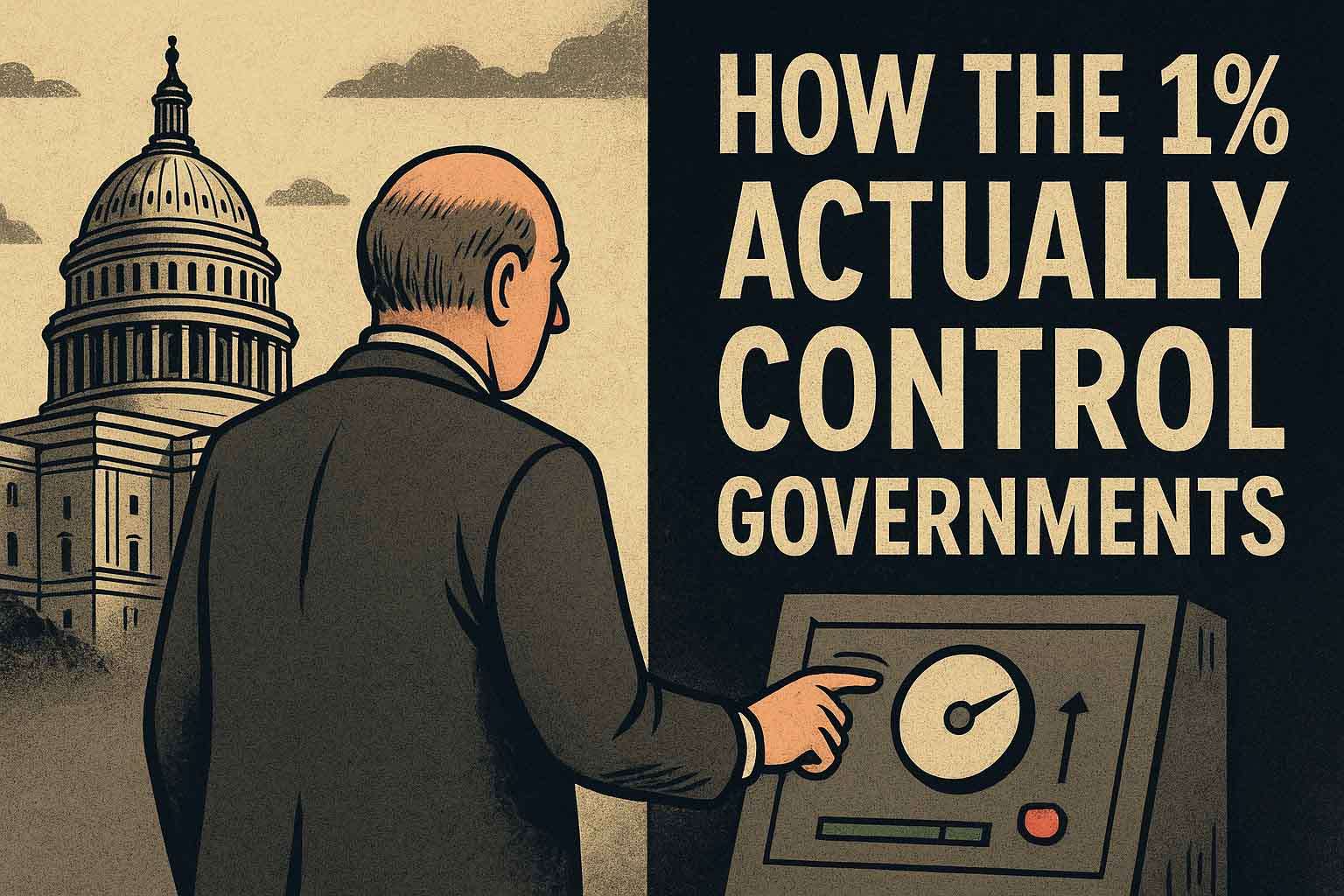
How the Ultra-Wealthy Exercise Structural Control Over Governments
Modern democracies present themselves as systems in which citizens choose their leaders, governments enact policies, and public institutions operate in the collective interest. Elections are held, parliaments debate, and voters are repeatedly assured that political participation matters. Yet beneath this visible machinery lies a deeper and less discussed reality: the decisive levers of power often exist far outside the ballot box. The most consequential decisions are shaped not by voters or even by elected officials, but by a small, concentrated class of capital holders whose influence is embedded within the financial, legal, and informational architecture of the state itself.
This form of power does not rely primarily on bribery, crude corruption, or clandestine meetings in smoke-filled rooms. Instead, it operates through systems that are legal, normalised, and largely invisible to the public. Governments are constrained, disciplined, and guided by mechanisms that ensure policy outcomes remain compatible with the interests of the wealthiest individuals and institutions, regardless of which political party holds office.
Understanding this reality requires moving beyond the conventional narrative of lobbying and campaign finance. While lobbying exists and plays a role, it represents only the surface of a much deeper structure. Real control is exercised through personnel pipelines, financial markets, legal doctrines, capital mobility, information systems, and technological ownership. Together, these mechanisms form a comprehensive framework that limits the range of political possibility and ensures continuity of economic power across electoral cycles.
What follows is a detailed examination of the primary mechanisms through which the ultra-wealthy exert structural control over governments, often without needing to intervene directly in day-to-day politics.
The Revolving Door: When Regulators and Corporations Become Indistinguishable
A foundational principle of governance is that regulators exist to oversee and constrain powerful private interests in the public interest. In practice, this distinction has become increasingly blurred. One of the most effective methods of elite control is the systematic circulation of individuals between senior roles in government and lucrative positions in the industries they are meant to regulate. This phenomenon is commonly known as the revolving door.
Regulatory agencies are often staffed by individuals who previously worked in the private sector and who anticipate returning to it after a period of public service. These positions are frequently poorly paid relative to private-sector alternatives, particularly in major financial centres. As a result, public service becomes less a career in itself and more an audition for future employment.
Officials learn quickly that aggressive enforcement, stringent regulation, or adversarial oversight can jeopardise future prospects. Conversely, restraint, cooperation, and industry-friendly interpretations of regulation are often rewarded with lucrative post-government roles in consultancy firms, law practices, or corporate compliance departments.
The result is not necessarily overt corruption, but a profound alignment of incentives. Regulators internalise the perspectives and priorities of the industries they oversee. Policy becomes shaped by what is considered “market-friendly” or “reasonable” from the standpoint of capital, rather than what is socially optimal or democratically desired.
This dynamic extends well beyond elected politicians. Senior civil servants, financial regulators, central bankers, and prosecutors often emerge from, and later return to, elite financial and legal institutions. Over time, this creates a closed ecosystem in which decision-makers share similar professional backgrounds, social networks, and ideological assumptions.
The implications are significant. Regulatory frameworks are written in ways that privilege complexity, loopholes, and self-regulation. Enforcement actions tend to focus on symbolic penalties rather than structural reform. After major financial crises, responsibility is diffused, accountability is minimal, and systemic change is avoided. The system does not fail by accident; it functions as designed.
Sovereign Debt and the Discipline of Financial Markets
While governments appear sovereign, their autonomy is heavily constrained by their dependence on financial markets. Most modern states operate with persistent budget deficits and rely on borrowing to fund public services, infrastructure, and welfare systems. This borrowing takes the form of sovereign debt, purchased by institutional investors, asset managers, pension funds, and wealthy individuals.
These bondholders wield enormous power. Unlike voters, they can react instantaneously to policy decisions. When governments pursue policies perceived as unfavourable to capital—such as aggressive redistribution, nationalisation, or expansive public spending without clear funding—financial markets respond by selling government debt or demanding higher interest rates.
This response has immediate and severe consequences. Bond prices fall, yields rise, borrowing costs increase, and currencies weaken. Inflationary pressures intensify, pension funds face instability, and financial systems come under stress. Governments are quickly forced to reverse course or face economic crisis.
This phenomenon is often described as the discipline of the bond market, enforced by so-called bond vigilantes. These actors do not need to coordinate explicitly. Market incentives alone ensure conformity. The result is a narrow corridor of acceptable policy, within which all governments must operate regardless of ideological orientation.
The implications for democracy are profound. Elections may change governments, but they rarely change economic direction. Fiscal austerity, low inflation targeting, and the protection of asset values become non-negotiable priorities. Radical departures from orthodoxy are punished swiftly and decisively.
This mechanism effectively transfers veto power over economic policy from voters to capital markets. Governments are permitted to govern only insofar as they maintain the confidence of investors. In this context, political sovereignty becomes conditional rather than absolute.
The Ideological Supply Chain: Think Tanks and the Manufacture of Policy
Policy does not emerge in a vacuum. Legislators are required to vote on complex issues spanning finance, technology, environmental regulation, healthcare, and national security, often with limited staff and time. In this environment, pre-packaged ideas become invaluable.
Enter the think tank ecosystem. Funded predominantly by wealthy individuals, corporations, and foundations, think tanks produce reports, policy briefs, academic-styled research, and model legislation that shape the terms of political debate. While they often present themselves as independent or non-partisan, their funding sources exert a powerful influence on the ideas they promote.
This process can be understood as idea laundering. Private interests are translated into seemingly objective, evidence-based policy recommendations. A proposal that would be dismissed if openly framed as serving elite interests gains legitimacy when presented through the language of economics, efficiency, or innovation.
Think tanks do not merely influence opinion; they frequently write legislation outright. Model bills are drafted, circulated, and introduced across multiple jurisdictions with minimal alteration. This practice results in near-identical laws appearing in different regions, often without meaningful public debate.
The effect is to shape the Overton window—the range of ideas considered politically acceptable. Policies that challenge the fundamental distribution of wealth or power are marginalised as unrealistic or extreme. Meanwhile, incremental adjustments within the existing system are framed as pragmatic and responsible.
Over time, this ideological infrastructure ensures that public discourse remains confined to solutions that do not threaten the underlying economic order. Democratic choice is preserved in form but hollowed out in substance.
Capital Mobility and the Permanent Threat of Exit
One of the most powerful tools available to the ultra-wealthy is the ability to move capital across borders with ease. In a globalised economy, money can be transferred instantaneously between jurisdictions in search of favourable tax regimes, regulatory environments, and labour conditions.
Governments, by contrast, are territorially bound. Their tax bases, workforces, and infrastructure are fixed in place. This asymmetry creates a structural imbalance. When governments attempt to increase taxes on corporations or wealthy individuals, they are often met with threats of relocation.
These threats need not be explicit to be effective. The mere possibility of capital flight exerts downward pressure on taxation and regulation. Jurisdictions compete to attract and retain investment by offering tax incentives, subsidies, and regulatory concessions. This competition drives a race to the bottom, eroding public revenues and weakening labour protections.
The burden of taxation shifts away from capital and onto labour. Income taxes are collected automatically from wages, while wealth is sheltered through complex financial arrangements. Ordinary citizens, unable to relocate easily, bear the costs of public services that capital increasingly avoids funding.
At the national level, this dynamic undermines progressive taxation. At the local level, it distorts economic development, with municipalities offering extraordinary concessions to attract or retain major employers. Public resources are diverted from social needs to corporate incentives, often with limited long-term benefit.
Capital mobility thus functions as a form of structural blackmail. Governments are compelled to accommodate the preferences of mobile wealth or risk economic decline.
Control of Narrative and the Shaping of Public Perception
Economic power alone is insufficient to maintain dominance in a democratic society. Public consent must also be managed. This is achieved through control over narratives—what issues are discussed, how they are framed, and which perspectives are deemed legitimate.
Media ownership is highly concentrated. A small number of corporations control the vast majority of television networks, newspapers, film studios, and digital platforms. These organisations are owned by individuals and shareholders whose economic interests align with the preservation of existing power structures.
This does not require overt censorship. Instead, control is exercised through selection, framing, and omission. Certain topics receive disproportionate attention, while others are marginalised or ignored. Structural critiques of capitalism are reframed as fringe opinions, while market-friendly assumptions are treated as common sense.
Economic conflicts are frequently personalised or culturalised. Issues rooted in class relations are reframed as disputes over identity, values, or lifestyle. Public anger is redirected towards symbolic battles that generate engagement without threatening material interests.
The rise of algorithm-driven digital platforms has intensified this dynamic. Content that provokes outrage, fear, or tribalism is prioritised, fragmenting public discourse and preventing collective focus on systemic issues. Polarisation becomes a feature rather than a bug.
By shaping the information environment, elite interests ensure that democratic participation occurs within carefully managed boundaries. Voters may choose between parties, but rarely between economic systems.
The Judicial Barrier: Entrenching Power Beyond Democratic Reach
Elections are inherently unpredictable. Voters can, on occasion, elect governments committed to challenging entrenched interests. To guard against this possibility, elite power has been embedded within the judicial system.
Courts, particularly at the highest levels, possess the authority to interpret constitutions, invalidate legislation, and set binding legal precedents. Judges are often appointed rather than elected, serve lengthy or lifetime terms, and operate largely insulated from public accountability.
Over decades, well-funded legal networks have worked to shape judicial philosophy. Specific interpretations of law that prioritise property rights, limit regulatory authority, and expand corporate personhood have been promoted through academic institutions, professional associations, and appointment pipelines.
Once entrenched, this judicial framework acts as a firewall. Popular legislation can be struck down on technical grounds. Regulatory agencies can be stripped of interpretative authority. Campaign finance restrictions can be dismantled in the name of free speech.
The result is a legal system that constrains democratic action while protecting economic power. Even when public opinion overwhelmingly supports reform, courts can and do intervene to preserve the status quo.
Philanthropy as Power, Not Altruism
Elite influence does not end with formal institutions. It extends into civil society through philanthropy. Large foundations, funded by immense private fortunes, play an increasingly significant role in education, healthcare, scientific research, and social policy.
While often portrayed as benevolent, philanthropy represents a privatisation of decision-making. Wealth that could have been taxed and allocated democratically is instead placed under the control of unelected individuals. These actors determine priorities, methods, and outcomes based on personal vision rather than collective deliberation.
Philanthropic funding frequently comes with conditions. Institutions dependent on grants adapt their programmes to align with donor preferences. Public accountability is replaced by private discretion.
This dynamic allows the ultra-wealthy to shape society while avoiding democratic scrutiny. It also serves as a reputational shield, reframing systemic inequality as generosity rather than exploitation.
Technological Control and the Emergence of a New Feudalism
The final and most recent mechanism of control lies in technology. Critical infrastructure—cloud computing, digital communication, payment systems, data storage, and artificial intelligence—is increasingly owned by private corporations rather than states.
Governments themselves are becoming dependent clients of technology firms. Data, communications, and even military systems rely on privately owned platforms. This creates a profound shift in power. Control over infrastructure becomes control over function.
In extreme cases, private individuals or corporations can effectively veto state actions by withdrawing services or restricting access. Sovereignty is eroded not through conquest, but through outsourcing.
As artificial intelligence advances, the implications grow starker. Control over advanced AI systems may determine economic productivity, labour demand, and even political influence. If such systems remain concentrated in private hands, democratic governance risks becoming obsolete.
This emerging order resembles a form of technological feudalism, in which access to digital land and tools is mediated by corporate lords. Citizenship is replaced by user status, and rights become contingent on terms of service.
Conclusion: Democracy Within Constraints
The contemporary state is not powerless, but it operates within a tightly constrained environment. The ultra-wealthy do not need to overthrow governments or openly subvert elections. They shape the conditions under which politics occurs, ensuring that outcomes remain compatible with their interests.
This system relies on complexity, fragmentation, and public disengagement. Its greatest vulnerability lies in understanding. When citizens grasp how power is structured and exercised, the illusion of inevitability begins to weaken.
History shows that periods of reduced inequality and expanded democracy have coincided with widespread public understanding of economic systems and collective action. The concentration of power described here is neither natural nor permanent, but it is deeply entrenched.
Meaningful change requires more than voting. It requires financial literacy, institutional reform, and sustained engagement with the underlying mechanics of power. Above all, it requires recognising that democracy is not merely a procedure, but a struggle over who controls the structures that shape collective life.
Knowledge remains the one resource that cannot be hoarded indefinitely. Once widely shared, it has the capacity to disrupt even the most carefully engineered systems of control.