

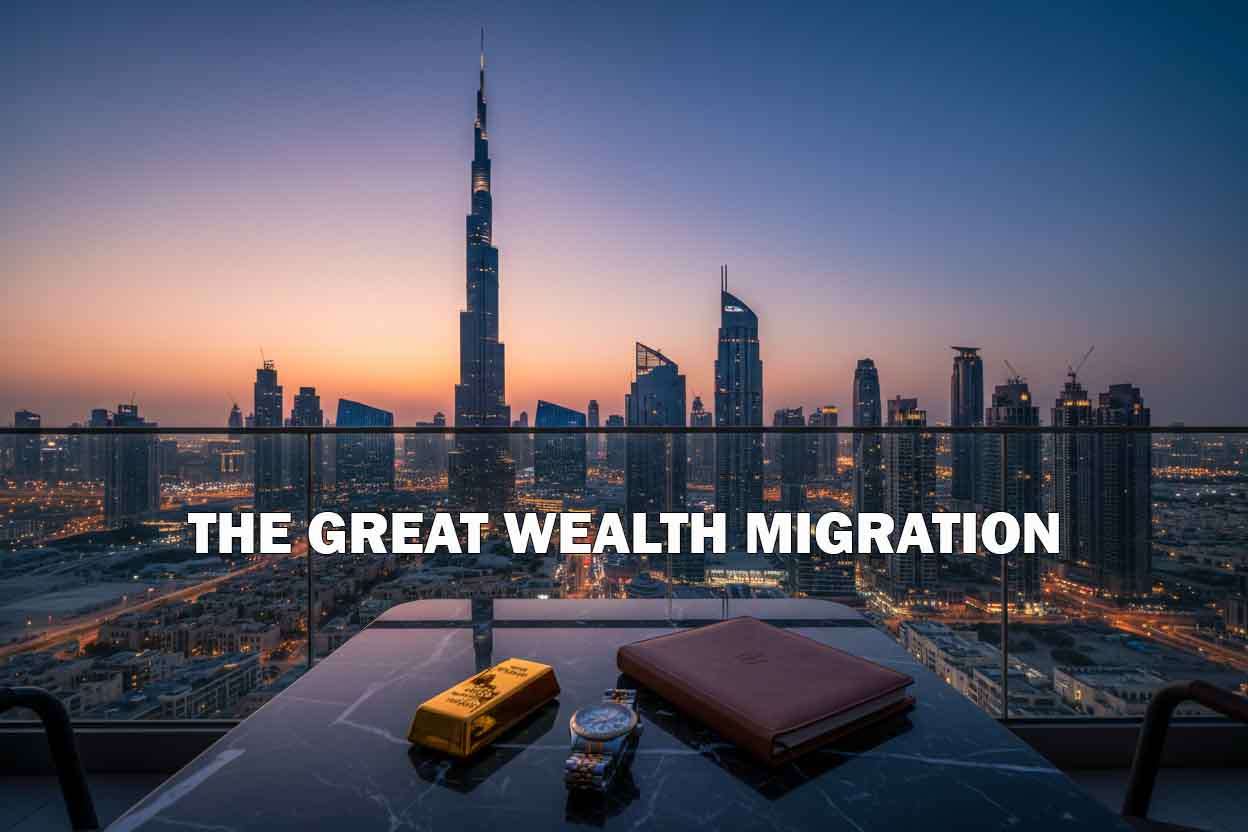
The Great Wealth Migration
Why the Global Elite are Choosing the Gulf
The lobby of the Atlantis The Royal on the Palm Jumeirah serves as a window into a sociological phenomenon that remains largely misunderstood by the Western press. Within its walls, one might observe a Russian oligarch sharing coffee with a British hedge fund manager, or a Chinese technology magnate discussing property acquisitions with a French industrialist. These individuals are not merely tourists; they represent a historic shift in the global distribution of wealth. In 2024, the United Arab Emirates recorded a net inflow of over 6,700 millionaires—the highest migration of private wealth on the planet. This figure significantly exceeds the combined inflows into the United States, Singapore, and Switzerland.
The conventional explanation for this exodus, frequently cited by financial commentators in New York and London, is rooted in the concept of greed. The narrative suggests that the wealthy are drawn to Dubai solely by the absence of personal income tax—a glittering sanctuary for those wishing to retain their earnings without contributing to the internal revenue services of their home nations. However, this perspective is fundamentally flawed. For billionaires relocating their family offices to the Dubai International Financial Center (DIFC), the primary motivation is not a marginal saving on tax. At such levels of wealth, taxation is an administrative hurdle rather than an existential threat. The true driver of this migration is not the return on capital, but the return of capital. The global elite have concluded that the Western financial system, once the gold standard for property rights and the rule of law, has fundamentally altered its terms of service.
The End of Neutrality and the Rise of Confiscation Risk
To comprehend this shift, one must examine the geopolitical events of February 2022. The decision by G7 nations to freeze the foreign exchange reserves of the Russian central bank and seize the private assets of Russian citizens sent a shockwave through the global community of high-net-worth individuals. Regardless of one’s political stance on the conflict, the precedent was clear: private property rights in the West had become conditional. The message conveyed was that assets are only secure as long as an individual’s government, foreign policy, or personal political alignment remains in favour with Western powers.
For over a century, Switzerland served as the world’s vault because of its unwavering neutrality. It was a jurisdiction that prioritised the safety of capital above political disputes. However, under significant pressure, Switzerland abandoned this neutrality to join international sanctions regimes. In that moment, global capital became effectively homeless. The realisation dawned that if a Swiss bank could be compelled to freeze assets without a trial, there was no longer a meaningful distinction between Zurich and New York.
In this new landscape, Dubai has positioned itself as the modern successor to the Swiss model. The United Arab Emirates maintains a stance of aggressive geopolitical neutrality, trading simultaneously with the United States, China, Russia, and Iran. When pressured to seize assets based on foreign political mandates, the UAE has consistently prioritised its domestic laws, which protect investors from external overreach. To a billionaire concerned about the weaponisation of the financial system, this neutrality is an insurance policy far more valuable than any tax incentive.
The Deterioration of the Western Social Contract
The flight to the Gulf is also a response to the perceived weaponisation of domestic institutions in the West. The wealthy are observing the erosion of the social contract with increasing concern. In the United Kingdom, the phenomenon of ‘de-banking’—where individuals lose access to financial services due to their political views—has signaled that access to one’s own money is now a privilege granted by corporate compliance departments rather than a fundamental right. Similarly, the use of emergency powers in other Western democracies to freeze the bank accounts of protesters without due process has demonstrated that the financial life support of citizens can be disconnected at will.
In contrast, the social contract in Dubai is explicitly transactional and transparent. The proposition is straightforward: adhere to the local laws, refrain from political agitation, and the state will not interfere with your person or your property. There is no moral judgment from financial institutions, no social credit scoring attached to bank accounts, and no risk of retrospective wealth taxes designed to address national budget deficits.
In many Western capitals, the successful are increasingly viewed as a resource to be tapped by insolvent governments. With debt-to-GDP ratios exceeding 100% in many G7 nations, the wealthy recognise the mathematical inevitability of future raids on capital. Moving to Dubai is a defensive maneuver—a jurisdictional arbitrage that places assets beyond the reach of potential confiscation. By establishing residency in a sovereign state that does not automatically recognise Western court orders, individuals create a legal firewall around their dynastic wealth.
The Competence Crisis and the Value of Safety
Beyond financial security, the migration is driven by a widening gap in state capacity. A high-net-worth individual in London or San Francisco may contribute millions in taxes, yet they often find themselves living in environments where basic safety and infrastructure are failing. The police in many Western cities have effectively ceased investigating property crimes, and public transport systems are frequently unreliable. The return on investment for their tax contributions has turned negative; they are paying premium prices for declining services.
Dubai offers a starkly different reality. The city is defined by surgical cleanliness and a near-total absence of crime. The infrastructure is world-class, government services are fully digitised and efficient, and the airports function with unparalleled precision. For those who value time and physical security above all else, the West has become increasingly difficult to inhabit—not due to the cost of living, but due to the ‘cost of chaos’.
This shift is creating a new global centre of gravity. Much like Venice during the Renaissance, which thrived by offering a stable legal framework amidst a chaotic Europe, Dubai is becoming the capital of a multipolar world. It is the meeting point for non-aligned capital, where wealth is treated with respect rather than suspicion.
Legal Innovation: The English Common Law Airlock
A significant factor in Dubai’s success is a legal innovation that is often overlooked: the Dubai International Financial Center (DIFC). While many assume the entire region operates under local civil or Sharia codes, the DIFC is a distinct jurisdiction that operates entirely on English Common Law. Contracts within this zone are interpreted by an independent court system, often presided over by retired judges from the High Court of London or the Supreme Court of Singapore.
This creates a ‘legal airlock’, allowing international capital to benefit from the familiarity and stability of Western jurisprudence without the associated political baggage or confiscatory tendencies of Western governments. It is effectively the operating system of the City of London transplanted into a jurisdiction with zero capital gains tax and high physical security. This certainty has led to an institutional migration; major global hedge funds and financial institutions are no longer just opening satellite offices in Dubai, but are relocating their primary ‘alpha generators’—their top traders and portfolio managers—to the region.
The Sovereign Individual and the Golden Visa
The UAE’s ‘Golden Visa’ programme has redefined the concept of residency. Historically, staying in the Gulf was tied to employment; if one lost their job, they were required to leave. The Golden Visa decoupled residency from employment, allowing individuals to secure long-term, renewable residency through property investment. For the global elite, this is a ‘geopolitical put option’—a hedge against instability in their home countries.
Unlike the United States’ green card, which subjects the holder to global taxation regardless of where they reside, the UAE’s residency permits offer freedom without the obligation of global tax reporting. This allows the ‘sovereign individual’ to structure their life on their own terms, using Dubai as a base layer while maintaining a global presence. It has turned citizenship into a consumer product, where the state acts as a service provider competing for the best ‘customers’.
A Parallel Financial Ecosystem
As the United States and its allies increasingly use the banking system as a tool of foreign policy, Dubai is fostering a parallel financial ecosystem. This includes the development of the Virtual Assets Regulatory Authority (VARA), which provides a clear framework for the digital asset industry at a time when Western regulators are often perceived as hostile or inconsistent.
Furthermore, Dubai is re-emerging as a global hub for physical assets, particularly gold. As confidence in Western debt instruments wanes, central banks and family offices are returning to hard assets. Historically, London and New York controlled the gold trade, but geopolitical neutrality is now a primary concern for holders of bullion. Entities from the Global South are increasingly reluctant to store gold in vaults where it could be frozen by Western governments. Dubai has expanded its refining and storage capacity to meet this demand, facilitating trade that bypasses the Western-dominated SWIFT system entirely.
The Network State and the Hinge of the World
The power of network effects, which once anchored the financial world to New York and London, is shifting. The density of deal flow in Dubai’s high-end venues now rivals or exceeds that of Manhattan. While Western financial centres are often preoccupied with domestic politics and cultural debates, the discourse in Dubai is focused on growth and cross-border flows between the emerging economies of the East and South.
Dubai sits at the ‘hinge of the world’, within an eight-hour flight of two-thirds of the global population. By basing themselves there, family offices are positioned to capture the growth of markets in India, Africa, and Southeast Asia—regions that are often under-represented in Western media but represent the primary drivers of future global demand.
In this environment, real estate has evolved into a form of ‘hard money’. The surge in luxury property prices in Dubai is not a typical speculative bubble; it is a monetary phenomenon. When a billionaire acquires a high-value penthouse, they are often not seeking a rental yield, but rather a ‘deposit box’ they can inhabit. They are converting fiat currency, which is subject to inflation and seizure, into a tangible asset within a dollar-pegged jurisdiction. These properties function as collectible assets, similar to fine art, providing a level of privacy and security that has largely vanished in the West.
Governance over Democracy: The Grand Bargain
The migration to the Gulf serves as a real-world test of a provocative hypothesis: that capital cares more about governance than it does about democracy. For the last century, the dominant narrative has been that liberal democracy is the only viable path to sustained prosperity. However, the Dubai experiment suggests that many of the world’s most productive individuals are willing to trade political voice for administrative competence.
In the West, the social contract offers the right to vote and protest, but often in exchange for high taxes, failing public services, and the risk of populist-driven wealth redistribution. In Dubai, the contract is reversed. There is no political participation, but in exchange, the state provides total physical safety, world-class infrastructure, and a government that treats the resident as a valued client. For the entrepreneur who believes they can solve their own problems if the state simply provides a stable environment, this is a trade they are increasingly eager to make.
This shift is highlighted by the ‘competence gap’. When observers compare the protracted timelines and immense costs of infrastructure projects in the West with the rapid execution of landmark projects in the Gulf, they see a difference in civilizational vitality. The West is often perceived as a ‘vetocracy’, where progress is stalled by endless litigation and bureaucratic process. Dubai is viewed as a technocracy, where the latest technologies—from artificial intelligence to advanced logistics—are implemented with speed and efficiency.
The Cultural Sanctuary
There is also a cultural dimension to this migration. Many families are relocating to Dubai to escape the ‘culture wars’ prevalent in Western educational and social institutions. Parents who hold traditional values often feel they have lost influence over the moral and ideological upbringing of their children in the West.
Dubai offers a sanctuary from these ideological shifts. The international schools in the city provide rigorous, traditional curricula without the modern ideological overlays found in many elite Western institutions. The social environment is conservative, family-oriented, and unapologetically meritocratic. For many, the opportunity to raise children in a society that celebrates success rather than viewing it through a lens of guilt is a primary motivator for relocation.
Risks and the Future of the Global Order
While Dubai presents a compelling case for the relocation of wealth, it is not without risks. The model relies heavily on regional stability. A significant conflict in the Middle East could disrupt shipping lanes and impact the tourism and real estate sectors. However, many investors view the UAE’s neutrality as its greatest defence. Because Dubai serves as a financial hub for a diverse range of global actors—including those who are otherwise adversaries—it creates a dynamic of ‘mutually assured economic destruction’. The city is too valuable as a neutral ground for any party to see it destroyed.
The rise of Dubai signals a bifurcation of the global order. On one side is the legacy West: characterised by high debt, high regulation, and a focus on social redistribution. On the other is the rising East and South: focused on production, wealth creation, and high growth. Dubai has emerged as the capital of this second zone, attracting the ‘productive class’ who are weary of supporting insolvent welfare states.
This represents a brain drain of historic proportions. When entrepreneurs and risk-takers leave their home countries, those nations lose not just tax revenue, but the energy, innovation, and employment those individuals generate. Rather than competing by improving their own governance or safety, many Western governments are responding with ‘exit taxes’ and global tax treaties. Yet, capital remains fluid.
The lesson of the billionaire exodus to Dubai is that in a digital and globalised world, citizenship and residency have become competitive markets. The migration is not merely about avoiding taxes; it is about seeking a jurisdiction that respects the sanctity of private property and provides the competence and safety required for long-term prosperity. As the global elite build their ‘arks’ in the Gulf, they are signaling a profound lack of confidence in the future trajectory of the Western system. For the rest of the world, the message is clear: when the foundations of property rights and the rule of law begin to shift, capital will always find the most stable ground.
Frequently Asked Questions
Why is the migration to Dubai described as being about the “return of capital” rather than the “return on capital”? While traditional investing focuses on the “return on capital,” which refers to the profit or interest earned on an investment, the “return of capital” refers to the fundamental ability to retrieve one’s original assets. The article argues that billionaires are less concerned with making a high percentage of profit in Dubai and more concerned with the fact that Western jurisdictions have set precedents for freezing and seizing private property based on political disputes. In this context, Dubai is chosen because its aggressive neutrality provides a guarantee that an individual’s wealth will not be confiscated due to the foreign policy or political alignments of their home country.
How does the legal system in the Dubai International Financial Center (DIFC) differ from the rest of the region? A common misconception is that all business in Dubai is conducted under local civil or Sharia law, which can be unfamiliar to Western investors. To solve this, the UAE established the DIFC as a “state within a state” that operates entirely under English Common Law. This jurisdiction features its own independent court system, often staffed by experienced retired judges from the UK and Singapore, providing a familiar and stable legal framework. This “legal airlock” allows global financial institutions to operate with the same jurisprudence they would find in London or New York, but without the associated political risks or high tax burdens of those nations.
What is the “competence gap” mentioned as a driver for leaving Western cities? The competence gap refers to the disparity between the declining state capacity in many Western cities and the high-efficiency governance found in the Gulf. Many wealthy individuals feel that despite paying premium tax rates in cities like London or San Francisco, they are receiving “third-world service” characterized by crumbling infrastructure, unreliable public transport, and a lack of physical safety. In contrast, Dubai offers world-class infrastructure, surgically clean streets, and near-zero crime rates. For the global elite, the efficiency and safety of the state have become ultimate luxury goods that the West is increasingly failing to provide.
How does the UAE’s Golden Visa function as a “geopolitical put option”? In finance, a put option is a hedge against a decline in value; similarly, the Golden Visa serves as a hedge against a person’s home country becoming unstable or “going insane.” By decoupling residency from employment through property investment, the Golden Visa allows individuals to secure a long-term right to live in the UAE. Unlike a US Green Card, which mandates global taxation on all worldwide income, the Golden Visa grants the right to reside without imposing a global tax leash. This allows “sovereign individuals” to maintain a safe haven where they can relocate immediately if the political or economic climate in their home nation deteriorates.
Is Dubai’s real estate market considered a speculative bubble or something else? The article suggests that the explosive rise in Dubai’s luxury property prices is a “monetary phenomenon” rather than a standard speculative bubble. Instead of buying homes for rental yields or quick flips, billionaires are using high-end real estate as a “bank account they can live in.” By converting fiat currency—which is prone to inflation and government seizure—into hard assets like branded residences, they are effectively parking their wealth in a secure, dollar-pegged jurisdiction. These properties function more like collectible fine art or private vaults, providing a level of privacy and asset protection that has largely vanished in Western property registries.