

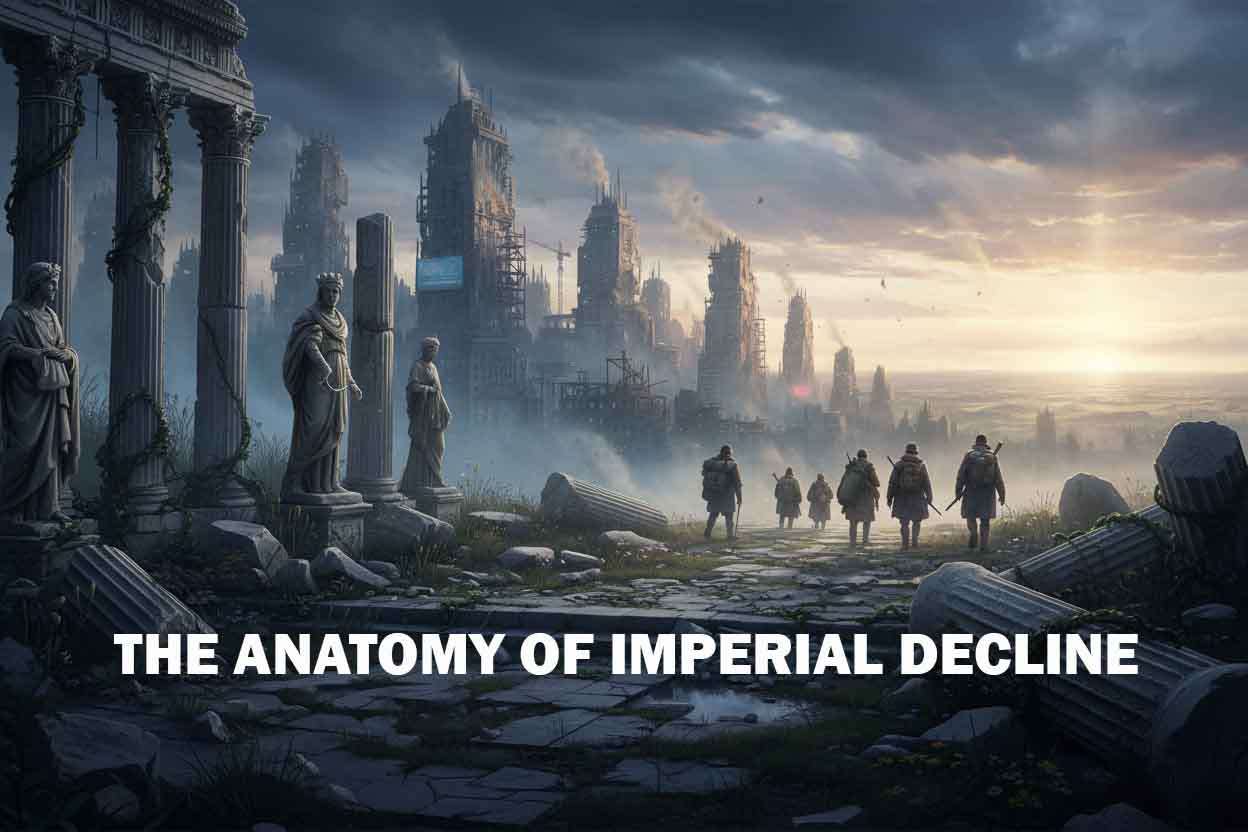
The Anatomy of Imperial Decline
A Study of the Cyclical Nature of Civilisations
The historical record suggests that the moment of a civilisation’s greatest perceived security is, paradoxically, the moment of its greatest peril. To a citizen of Rome in the year 150 AD, or a merchant in the City of London in 1900, the suggestion that their respective global hegemonies were on the precipice of terminal decline would have been dismissed as an absurdity. These individuals lived at the absolute apex of human achievement; their armies were peerless, their currencies served as the global standard, and their capital cities acted as irresistible magnets for the world’s finest minds and most concentrated wealth. Yet, within a remarkably short historical window, these superpowers were transformed into hollowed-out shells, their monuments left to crumble and their economic foundations reduced to ruin.
This phenomenon reveals a fundamental truth: history is not a linear progression of constant improvement, but a series of repetitive, predictable cycles. Empires are best understood not as static political entities, but as biological organisms. They are born in struggle, they grow through conquest, they mature through commerce, they age through intellectualism, and they eventually expire in decadence. Terrifyingly, the lifespan of these great powers is almost statistically constant. From the Assyrians to the British, the average duration of a great power cycle is approximately 250 years—roughly ten generations.
The Glubb Thesis and the Structural Anatomy of Fall
To comprehend the current geopolitical landscape, one must look beyond the ephemeral noise of daily political discourse and study the structural anatomy of imperial rise and fall. The most profound analysis of this phenomenon was provided by the British military officer and historian Sir John Glubb. In his seminal essay, The Fate of Empires, Glubb analysed three millennia of history, identifying a recurring sequence of stages driven by the shifting psychology of the populace. This sequence is a predictable mutation of culture and economics that has remained consistent across disparate geographies and eras.
The Age of Pioneers: The Foundation of Hardship
The cycle invariably begins with the Age of Pioneers. This is the breakout phase, led by a group of hardy, stoic, and frequently ruthless individuals who are profoundly dissatisfied with the status quo. Whether one considers the early settlers of the American West or the Macedonian phalanxes under Alexander the Great, the psychology of this era is defined by duty, sacrifice, and a collective commitment to survival.
In this stage, there is no complex finance. Wealth is tangible and physical, consisting of land, livestock, or precious metals. The currency is “hard,” typically silver or gold coins possessing intrinsic value. Because no sophisticated banking system exists to issue credit, there is very little debt. Society is strictly meritocratic because nature serves as the ultimate judge; incompetence in the Age of Pioneers results in literal death. This environmental “hardness” creates a surplus of energy and competence that propels the civilisation upward. These pioneers do not merely conquer through superior weaponry, but through superior social cohesion—a concept known as asabiyyah. They trust one another because they rely on one another for their very existence.
The Age of Commerce: From Duty to Profit
As borders are secured and internal stability is established, the Age of Conquest transitions rapidly into the Age of Commerce. The vast territories under imperial control allow for the unhindered movement of goods. The Roman roads, the British shipping lanes, and the American interstate system serve as the arteries pumping wealth into the heart of the empire. This is the golden age of material prosperity, where the merchant begins to replace the soldier as the societal hero.
Initially, this shift is healthy. It facilitates the construction of skyscrapers, the founding of universities, and the establishment of hospitals. The standard of living for the average citizen explodes, and a robust middle class is born. However, this massive influx of wealth carries the seeds of a future malignancy: arrogance. Citizens begin to believe that their prosperity is a result of their innate superiority rather than the fruit of the sacrifices made by their pioneer ancestors. Security is taken for granted. The martial spirit begins to atrophy; the empire stops training its own citizens for war and begins to outsource its defence to mercenaries or a small, professionalised military class, while the bulk of the population focuses on consumption.
The Age of Affluence and the Financialisation of Reality
The Age of Affluence represents the peak of the empire, but it is a false peak. The primary objective of society shifts from building to consuming. The foundational work ethic that built the empire begins to dissolve. In the Age of Commerce, wealth was generated by producing value—steel, textiles, and ships. In the Age of Affluence, wealth is increasingly generated by moving money around. The banker displaces the merchant as the “master of the universe.”
This transition toward the financialisation of the economy is subtle but fatal. The empire stops producing value and begins extracting it. To sustain escalating imperial expenses, the currency is inevitably debased. In ancient Rome, the silver content of the denarius was gradually reduced from 95 per cent to less than 5 per cent. In the modern era, the abandonment of the gold standard turned global currencies into pure fiat. This “easy money” fuels massive asset bubbles, causing real estate and stock prices to soar. Consequently, the gap between the asset-owning elite and the wage-earning poor widens into a chasm. This inequality is not merely a policy failure; it is a mechanical result of the monetary cycle.
The Age of Intellect: The Loss of Pragmatism
As a society becomes hyper-wealthy, it enters the Age of Intellect, where it begins to idolise theory over practice. Education, which was once about learning a trade or fundamental literacy, becomes an abstract status symbol. There is a proliferation of philosophers, lawyers, and academics who debate the idea of the world rather than engaging with its reality.
While this appears enlightened, it marks a catastrophic loss of pragmatism. The ruling elites become detached from the physical consequences of their ideas. They champion universalism and open borders because they have never personally had to fight for the empire’s security; they assume that peace is the natural state of the world. Glubb noted that in every declining empire, there is a surge in pacifism and internationalism among the ruling class at the exact moment the “barbarians” are gathering at the gates. The intellectuals begin to deconstruct the myths and heroes of the past. The pioneers are no longer celebrated as founders but are criticised as oppressors. This destroys the social cohesion that held the empire together. A society that learns to hate its own history cannot survive a crisis.
The Welfare State and the Fiscal Death Spiral
The final warning sign in this transition is the emergence of the expansive welfare state. In the Age of Pioneers, survival was linked to labour. In the Age of Affluence, the state possesses such vast reserves of capital that it begins to subsidise the population. This began with “bread and circuses” in Rome—free grain and entertainment to pacify the urban masses—and has evolved into the cradle-to-grave welfare systems of the modern West.
Though often well-intentioned, this destroys the character of the citizenry. It creates a class of dependents who view state support as an inherent right. The social contract shifts from a focus on contribution to a focus on entitlement. This creates a fiscal death spiral: the cost of the welfare state grows exponentially while the productive capacity of the economy stagnates. The only way to maintain these promises is to print more money, which causes inflation, which makes the people poorer, which in turn makes them demand more welfare. It is a self-reinforcing feedback loop of decay.
The Age of Decadence: The Suicidal Impulse
We now arrive at the final stage of the life cycle: the Age of Decadence. This period is frequently misunderstood as merely a time of wild parties and hedonism. While excess is a symptom, the true definition of decadence is the period when a civilisation actively destroys the institutions and values that created it. It is a suicidal impulse.
In this stage, the society ceases to believe in itself. The shared narrative that once bound the pioneer and the merchant together dissolves into a million fractured, warring tribes. The collective “us” is replaced by the atomised “me.” The energy that was once directed outward at conquering the world is turned inward at consuming what remains of the empire’s carcass.
The Shift of Heroes: The Elevation of the Jester
One of the most striking markers of decadence is the shift in who a society chooses to idolise. In the early stages of an empire, heroes are warriors, statesmen, or builders—men who sacrifice for the collective good. In the Age of Decadence, the heroes are celebrities. Glubb observed that in the final years of the Arab Empire in the 10th century, the public was obsessed not with generals or explorers, but with singers, dancers, and comedians. In Rome, the gladiator and the actor became the wealthiest and most famous men in the city, worshipped by the mob while the legions on the frontier went unpaid.
In the contemporary era, the highest-paid individuals are rarely the engineers maintaining the power grid or the doctors advancing medical science; they are athletes, influencers, and entertainers. We have elevated the jester to the position of the king. This obsession with entertainment is not a sign of societal happiness, but a mechanism of coping. It is a massive, society-wide distraction strategy. The populace senses, perhaps subconsciously, that the system is failing—that the debt is unpayable and the future is bleak. Rather than facing this reality, they retreat into a digital coliseum, arguing passionately about the personal lives of pop stars because those are problems that feel manageable compared to civilisational collapse.
The Law of Complexity and the Rise of the Veto-cracy
As cultural cohesion rots, the state attempts to compensate by expanding its bureaucracy. This is the law of increasing complexity. In the Age of Pioneers, laws were few because trust was high; a handshake was a binding contract. In the Age of Decadence, trust has evaporated. Everyone assumes they are being cheated, so the state creates millions of regulations and compliance codes to force behaviour.
The historian Tacitus famously wrote of dying Rome: “The more corrupt the state, the more numerous the laws.” This bureaucracy does not save the system; it paralyses it. The empire becomes a “veto-cracy” where nothing can be built. New infrastructure, power plants, or factories are strangled by environmental reviews, diversity impact statements, and endless permitting processes. The empire becomes a giant, frozen Gulliver, tied down by the threads of its own administrative state. The only sector that grows is compliance. The ratio of administrators to “doers” explodes in universities, hospitals, and the military, creating a friction that eventually stops the machine entirely.
Civil Conflict and the Death of Asabiyyah
Simultaneously, the Age of Decadence is marked by an explosion of civil conflict and extreme polarisation. As the economic pie stops growing, politics becomes a zero-sum game. In the growth phase, a rising tide lifts all boats, making political disagreements manageable. In the stagnation phase, for one group to win, another must lose.
The population fractures into hostile camps. Glubb noted that in the Byzantine Empire before the fall of Constantinople, the citizens were so divided by political factions—the Blues and the Greens—that they were killing each other in the streets while the Ottoman Turks were assembling cannons outside the city walls. They hated their internal rivals more than the external enemy who sought to enslave them. Today, political identity has largely replaced national identity. Citizens of the same nation often view one another as aliens with whom they share no moral universe. This is the death of asabiyyah. A house divided against itself cannot stand, especially when the wolves are at the door.
The Terminal Phase of Currency Debasement
This internal division is exacerbated by the terminal phase of currency debasement. The state has promised more than the productive economy can support—pensions, healthcare, and global military presence. Choosing the path of least resistance, the government prints money to meet these obligations.
In the 3rd century AD, Rome faced a crisis where the middle class was obliterated by hyperinflation. The merchant class, which had built the empire, saw their savings vanish as the currency lost its value. The only survivors were the ultra-rich, who owned massive landed estates, and the ultra-poor, who had nothing to lose. The middle class—the glue of any stable society—vanished. We are witnessing a modern parallel in the “K-shaped” recovery, where asset price inflation enriches those who already own stocks and real estate, while the cost of living skyrockets for everyone else. When a man works forty hours a week and cannot afford a roof over his head, he ceases to believe in the social contract and begins looking for a “strongman” to smash the system.
Demographic Collapse and the Failure of Assimilation
Glubb also identified the influx of unassimilated foreigners as a consistent feature of the final stage. As an empire becomes wealthy and decadent, its birth rates collapse. Citizens become too self-absorbed or too pessimistic to have children. To maintain the labour force and the military, the empire begins to import people from the periphery.
Rome invited the Goths to farm the land and man the legions. Initially, this works, as the immigrants are often hardworking and resemble the pioneers of old. However, because the host culture is weak and self-hating—having been taught by its intellectuals that its history is shameful—it fails to assimilate the newcomers. Rome did not turn the Goths into Romans; the Goths eventually turned Rome into a Gothic kingdom. The “melting pot” freezes, and society becomes a collection of unassimilated enclaves with no loyalty to the central state. The very diversity that is celebrated in the Age of Intellect becomes the fault line that shatters the empire in the Age of Decadence.
The Delusion of the Elites
Finally, there is a pervasive sense of magical thinking among the ruling class. The elites believe that the laws of economics, physics, and history do not apply to them. They believe they can print infinite money without inflation, or that they can radically overhaul energy systems overnight without consequence. This detachment from reality is the result of being insulated from the consequences of their decisions for too long.
In the Age of Pioneers, a bad decision meant death. In the Age of Decadence, a bad decision results in a government bailout or a promotion within the bureaucracy. This lack of evolutionary pressure creates a ruling class that is high in IQ but low in wisdom. They can manipulate complex financial models, but they cannot manage the basic functions of a civilisation. They spend their time rearranging the deckchairs on the Titanic, arguing about seating arrangements while the water pours into the hold.
The Seneca Cliff: Collapse is Exponential
The most dangerous misconception regarding civilisational collapse is that it is a slow, gradual slide. We imagine it like a dimmer switch being slowly turned down over decades. However, the laws of physics and history suggest otherwise. The collapse of a complex system is not linear; it is exponential.
The Roman philosopher Seneca observed this two millennia ago: “Fortune is of sluggish growth, but ruin is rapid.” In modern systems science, this is known as the “Seneca Cliff.” A civilisation spends centuries painstakingly building its wealth and institutions, but it can lose them all in a moment of sudden, catastrophic phase transition. The Soviet Union appeared to be a monolithic superpower in 1985; by 1991, it had ceased to exist. The structure does not degrade; it shatters.
Diminishing Returns on Complexity
The mechanism of this shattering is driven by diminishing returns on complexity. In the early days of an empire, solving problems is relatively cheap. If you need food, you plant crops. If you need security, you build a wall. Every investment in complexity yields a massive return.
In the Age of Decadence, however, the “low-hanging fruit” has been harvested. Problems become exponentially more expensive to solve. To fix a failing education system, the state does not simply hire more teachers; it creates a massive department of education with thousands of administrators and diversity consultants, spending billions for zero improvement in outcomes. Eventually, the cost of solving a problem exceeds the benefit of the solution. The society becomes a heat engine that burns massive amounts of energy and capital just to remain stationary. When the next major crisis hits—be it a war, a pandemic, or a debt default—the system has no spare capacity left. The central authority simply stops functioning.
The Process of Feudalisation
When the empire collapses, power does not disappear; it devolves. Power abhors a vacuum. When the central government can no longer pave the roads, police the streets, or guarantee the currency, power returns to the local level. This is the process of feudalisation.
In the 5th century, as Rome withdrew its legions, the people of Britain and Gaul turned to the nearest strongman—a local warlord or a wealthy landowner—for protection. They traded their loyalty and a portion of their labour for safety. In the 21st century, this feudalisation is likely to take a corporate form. We are already seeing the rise of “corporate feudalism” in cities where public services have failed. Wealthy neighbourhoods hire private security forces—effectively private armies. Technology corporations build campuses that provide housing, transit, and security for their employees. In this model, safety depends not on citizenship, but on subscription. The public utility model of civilisation ends, and the private membership model begins.
The Remonetisation of Reality
The economic manifestation of this collapse is the remonetisation of reality. In the Age of Decadence, money is an abstraction—a number on a digital screen. In a collapse, money returns to its original definition: a store of value and a medium of exchange for survival.
When fiat currency hyperinflates, the trust layer of the economy evaporates. You cannot pay for essential services with a check or a credit card if the network is down or the currency is devaluing by the hour. The economy reverts to hard assets. Gold, silver, fuel, and food become the new currencies. In such a society, the most valuable individuals are not hedge fund managers or lawyers, but those with practical skills—mechanics, farmers, and doctors. The intellectuals who spent their lives deconstructing narratives find themselves destitute because they possess no marketable skills in a reality-based economy. The pioneers return, and those who know how to build, repair, and grow things become the new aristocracy.
The Lifeboat Strategy: Becoming a New Pioneer
The history of imperial cycles is a warning, but it also serves as a map. If the cycle is nearing its end, one cannot “vote” their way out of the Age of Decadence. The empire is structurally insolvent and culturally exhausted. Instead, the individual must focus on building a “lifeboat”—becoming a new pioneer within the ruins of the old world.
This requires a shift in strategy. First, one must exit the paper system. Holding wealth in the liabilities of a dying state—such as government bonds or fiat currency—is akin to holding shares in a bankrupt corporation. Capital should be moved into “outside money” like gold or decentralised assets that are not dependent on a central political authority.
Second, one must build parallel supply chains. Reliance on a “just-in-time” global delivery system is a vulnerability in a collapsing empire. Resilience is found at the local level: knowing your local producers, securing independent energy sources, and fostering a community of like-minded individuals with diverse, practical skills. The “lone wolf” rarely survives a systemic collapse; the “pack” does.
Third, one must acquire hard skills. The Age of Intellect suggested that manual labour was beneath the elite classes, but a collapse reverses this hierarchy. Learning to repair an engine, treat a wound, or produce food provides the “gold coins” of a post-collapse world.
Conclusion: The Clearing Mechanism of History
The fall of an empire is undeniably a tragedy, but it is also a necessary clearing mechanism. It burns away the “dead wood” of a society—the suffocating bureaucracy, the unpayable debt, and the cultural delusions that were strangling progress. The fall of Rome was a catastrophe for the Roman Senate, but for many in the provinces who were being crushed by imperial taxes, it was a form of liberation.
The “Dark Ages” were not dark for everyone; they were a period of intense localisation and reorganisation. We are currently heading into a historical storm. The 250-year clock is reaching its conclusion, and the accumulated debt of the Age of Affluence is coming due. The Age of Decadence is ending, and an age of chaos is beginning. However, chaos is merely the ladder to the next Age of Pioneers. The fundamental question for the individual is whether they will be found clinging to the wreckage of the old world or building the foundations of the new.
Frequently Asked Questions
What is the “250-year cycle” mentioned in the article, and how consistent is it? The 250-year cycle is a historical observation, most notably detailed by Sir John Glubb, suggesting that great empires typically last for approximately ten generations. This timeframe has remained remarkably consistent across three millennia of human history, appearing in civilisations as diverse as the Assyrians, the Romans, the Arab Empire, and the British Empire. The cycle is driven by a predictable shift in human psychology and societal values, moving from the rugged self-sacrifice of founders to the complacent entitlement of their descendants.
How does the transition from a production-based economy to a financialised one signal decline? In the early and middle stages of an empire, wealth is generated through the creation of tangible value, such as manufacturing, infrastructure, and trade. As an empire enters the Age of Affluence, the economy shifts toward “moving money around” rather than making things, leading to the dominance of the banking and financial sectors over the merchant and builder classes. This financialisation often leads to currency debasement and asset bubbles, which widen the gap between the rich and the poor and hollow out the productive middle class that serves as the empire’s stability.
Why is the “Age of Intellect” considered a period of danger rather than progress? While a surge in education and philosophy appears enlightened, it often marks a transition from pragmatism to abstraction. In this stage, the ruling elite becomes detached from the physical realities of security and production, often championing idealistic or universalist policies that ignore historical precedents and external threats. This era is characterised by a loss of social cohesion, as intellectuals begin to deconstruct and criticise the very foundational myths and values that originally unified the civilisation.
What are the primary markers of the “Age of Decadence”? Decadence is defined by a societal “suicidal impulse” where a civilisation actively undermines the institutions that created its success. Key markers include the elevation of celebrities and entertainers over statesmen and heroes, an explosion of complex bureaucracy and laws that paralyse innovation, and intense internal polarisation where citizens view political rivals as greater threats than external enemies. Additionally, a decline in birth rates and a failure to assimilate newcomers often lead to a fractured society with no shared sense of purpose.
What practical steps can individuals take to prepare for a potential civilisational collapse? The article suggests a “lifeboat strategy” focused on local resilience rather than attempting to fix a structurally insolvent system. This involves three main pillars: moving wealth out of “paper” assets and fiat currency into hard assets like gold; building parallel, local supply chains for food and energy; and acquiring “hard skills” such as mechanics, medical training, or agriculture. The goal is to transition from being a dependent consumer of the old system to a self-sufficient pioneer capable of navigating a more localised, reality-based economy.