

Why Some Older Men Are Choosing Solitude Over Romance
A Quiet Revolution
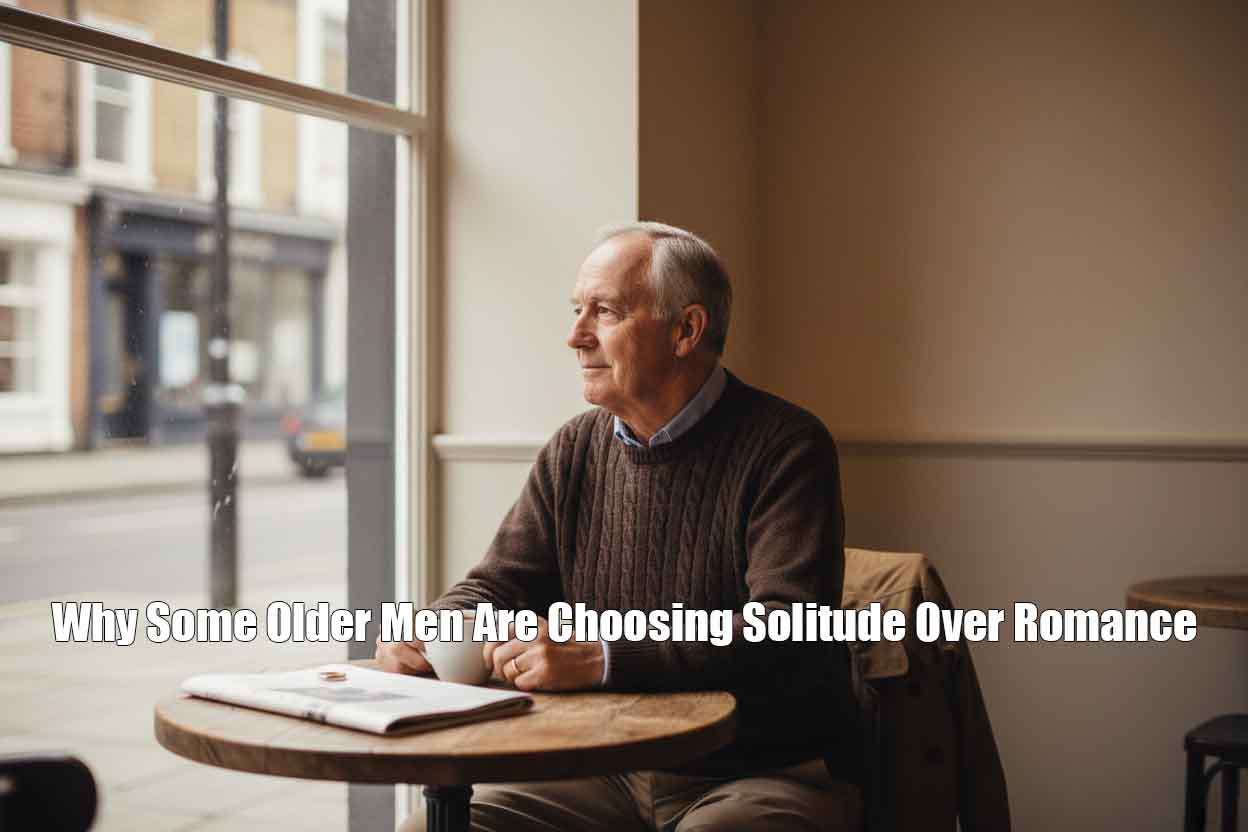
In a quiet corner of a coffee shop, a 67-year-old man sits across from an attractive, intelligent and financially secure woman of a similar age. On paper, it is an ideal match. They share interests, stability and a stage of life. When she asks whether he would like to see her again, he smiles politely and declines.
There is no dramatic backstory. He is not embittered by divorce, nor is he harbouring unresolved feelings for a former spouse. He is not incapable of connection, nor fearful of intimacy. His decision is deliberate. He has considered what a relationship would bring into his life and what it might take away, and he has concluded that, for him, solitude is the better arrangement.
This scene is not unusual. Across Britain and much of the Western world, a subtle shift is taking place among older men. Having experienced marriage, family life, divorce or bereavement, many are choosing not to pursue another romantic partnership. They are not campaigning, not declaring manifestos, not announcing their choice with fanfare. They are simply opting out.
To those observing from the outside, the decision can appear puzzling or even tragic. Cultural narratives still position romantic partnership as the ultimate measure of a fulfilled life. The image of “dying alone” carries a particular emotional weight, often framed as a failure or misfortune. Yet for a growing number of men in later life, the absence of a romantic partner does not equate to loneliness. It represents autonomy, simplicity and peace.
What is happening is not a crisis of abandoned men, but something closer to a quiet revolution: a reassessment of what constitutes a good life in its later chapters.
The Life Already Lived
To understand this shift, it is necessary to consider the life stage in question. Men in their late sixties and seventies have often already travelled the traditional route. They have married, built homes, raised children and navigated the compromises inherent in long-term partnership. Many have endured divorce, with its emotional and financial upheaval. Others have lost a spouse after decades together, grieving not only a person but an entire shared way of life.
For forty or fifty years, their lives were shaped by interdependence. Decisions about where to live, how to spend money, how to raise children, where to holiday and how to structure daily routines were rarely unilateral. Marriage, at its best, is a collaborative enterprise. At its most challenging, it can feel like a constant negotiation.
By the time these men reach retirement, something changes. For the first time since early adulthood, they may find themselves fully in charge of their own schedules, spaces and priorities. They wake when they wish. They eat what they fancy. They spend hours on hobbies without explanation or compromise. Their homes are arranged exactly to their liking. Their days have a rhythm that feels settled and self-determined.
This is not a trivial shift. For some, it is the first prolonged experience of genuine personal sovereignty in half a century. The freedom to watch whatever one pleases late into the evening, to turn a spare room into a workshop or model railway sanctuary, to leave dishes until morning without comment, can feel quietly transformative.
To an outsider, these details may seem mundane. To the individual living them, they symbolise something larger: the recovery of self.
The Changing Cost–Benefit Analysis
Relationships in early adulthood often serve clear purposes. They provide companionship, intimacy and shared financial responsibility. They contribute to social status and offer the possibility of building a family. When two people in their twenties or thirties come together, they are typically constructing a life from the ground up.
By the age of seventy, much of that construction is complete. The mortgage may be paid off. The children are grown. Careers have concluded or slowed. Identities are well established. Financial systems are set. Friendships have endured decades.
In this context, the calculus changes. A new relationship does not offer the same structural advantages. There is no shared mortgage to tackle, no nursery to furnish, no fledgling career to support. What remains is companionship and perhaps shared leisure. For some, that is more than enough. For others, it does not outweigh the potential costs.
Introducing a partner into an already stable life can mean renegotiating routines that have become deeply satisfying. The early morning coffee ritual might need adjusting. The hobby room might be repurposed. Social arrangements with children or long-standing friends may feel subtly altered. Financial matters, once simplified, may grow complex again.
It is not that older men are incapable of compromise. Many have spent decades doing precisely that. Rather, some are asking whether they wish to return to that mode of living at this stage. The answer, increasingly, is no.
Complexity in Later-Life Relationships
There is also the matter of complexity. Relationships later in life are rarely simple. Two people in their late sixties or seventies come with histories: adult children, grandchildren, property, pensions, health conditions and established social circles. Blending these elements can be intricate.
Children may have opinions about inheritance or property. Differing expectations about retirement — travel versus home-based hobbies, urban living versus countryside — can create tension. Health disparities may introduce imbalances in care responsibilities. Financial arrangements require clarity and trust, especially after previous divorces.
The idea that love alone will seamlessly resolve such complexities is optimistic at best. For men who have already navigated one or more major relational upheavals, the prospect of entering another intricate negotiation may feel exhausting rather than exciting.
Divorce rates among older couples have risen in recent decades, a phenomenon sometimes referred to as “grey divorce”. This reality is not lost on men observing their peers. They have seen friends remarry only to disentangle finances and households again years later. They have witnessed the strain of blending families with established dynamics. They have observed that later-life partnership can be as fraught as youthful marriage, if not more so.
Faced with these examples, many conclude that the simplicity of remaining single is preferable.
The Myth of Universal Coupling
Modern Western societies tend to assume that romantic partnership is both natural and necessary. Films, novels and social rituals reinforce the notion that fulfilment is tied to being coupled. Weddings are celebrated milestones. Anniversaries are honoured. Single status, particularly in later life, is often treated as a temporary or unfortunate state.
Yet this narrative does not account for those who have already experienced long marriages and feel no need to repeat the experience. There is limited language for someone who says, with contentment, “I have already had my great love. I do not need another.”
Interestingly, older women who choose to remain single are often framed as independent or empowered. Articles praise their freedom and self-discovery. By contrast, older men who decline to date may be perceived as damaged, withdrawn or secretly lonely. Their choice is sometimes treated as a problem to be solved.
This double standard obscures a simple truth: autonomy is not gendered. The desire for peace, routine and self-direction in later life is not evidence of emotional deficiency. It is, for many, an expression of maturity.
Structured Socialisation Without Romance
A common misconception is that men who avoid romantic relationships are withdrawing from society altogether. In reality, many cultivate rich social lives — on their own terms.
They maintain weekly poker nights, golf groups or walking clubs. They volunteer at local charities, attend church groups or participate in community classes. They meet friends for pints, lunches or theatre outings. They see their children and grandchildren regularly.
What they often avoid is the exclusivity and obligation of romantic partnership. They prefer what might be called structured socialisation: connection that is predictable, bounded and free from the emotional labour of constant negotiation.
This distinction is crucial. Choosing not to date does not equate to choosing isolation. It is a rejection of a specific form of intimacy, not of human contact itself.
The Concept of Relationship Fatigue
There is a psychological dimension to this phenomenon that can be described as relationship fatigue. Long-term partnership requires continuous investment: emotional availability, compromise, communication and shared decision-making. These are not negative attributes; they are the scaffolding of intimacy.
However, after decades of such investment, some men feel their capacity or desire to re-engage in the same cycle has diminished. It is not cynicism but depletion. The thought of beginning again — learning new preferences, negotiating habits, integrating families — can feel overwhelming.
In earlier life, these efforts are often energising. They represent growth and building. In later life, they may feel like repetition without clear gain. For a man who has already spent forty years in the “relationship trenches”, the prospect of starting anew may not inspire excitement but fatigue.
This does not negate the beauty of second or third partnerships. Many older couples find profound happiness together. It simply explains why others decide not to pursue that path.
Time as a Precious Commodity
Age alters perception of time. At thirty, a few years in an unsatisfying relationship may seem recoverable. At seventy, the margin feels narrower. Health, energy and cognitive sharpness are finite resources.
Some older men speak candidly about this shift. They are acutely aware that they may have ten or fifteen good summers left — years in which they can travel easily, pursue hobbies vigorously and enjoy physical independence. The idea of spending those years navigating the uncertainties of dating or the compromises of a new partnership feels, to them, like a poor allocation of time.
This perspective is not morbid. It is pragmatic. With a clearer sense of life’s limits, priorities sharpen. Peace, autonomy and personal fulfilment often rise to the top.
The Fear of “Dying Alone”
Society frequently frames solitude in later life as tragic. The phrase “dying alone” carries heavy emotional resonance. It conjures images of abandonment and regret.
Yet the men making this choice are not necessarily rejecting all connection. Many have strong ties to family and friends. They may have children who visit regularly, neighbours who check in, community groups that provide belonging.
Their decision is specifically about romantic partnership. They accept that they may not have a spouse at their bedside in their final moments. For some, that possibility does not outweigh the value of living their remaining years exactly as they wish.
It is also worth noting that having a partner does not guarantee a particular end-of-life scenario. Spouses often predecease one another. Illness can isolate even those in relationships. The promise of not “dying alone” is, in many cases, illusory.
What these men fear more than solitary death is compromised living — spending their final healthy years in arrangements that diminish rather than enhance their well-being.
Observations from Retirement Communities
In many retirement communities, the ratio of women to men is skewed. Women generally live longer, resulting in a surplus of single women in older age groups. On the surface, this imbalance might suggest that men would be in high demand and eager to form new partnerships.
Yet anecdotal reports indicate that many men in such settings are cautious about romantic entanglements. They participate in social events, attend book clubs and dance at community gatherings. However, when interactions move towards exclusivity or cohabitation, they often withdraw.
They have observed friends who have moved into a partner’s home only to adapt to new rules and routines. They have seen finances grow complicated again after being carefully simplified. They have watched peers sacrifice preferred activities to accommodate a spouse’s preferences.
These observations reinforce their decision to maintain independence.
The Widower’s Perspective
Consider the widower who spent four decades married to a beloved partner. After years of grief, he rebuilds a life that is stable and meaningful. His children visit. He volunteers, travels occasionally, and takes up a new hobby. His home is quiet but comfortable.
Well-meaning friends encourage him to date. They assure him he is still a “catch”. He acknowledges the compliment but feels no urge to re-enter the romantic sphere. He cherishes the memory of his marriage as a complete chapter. He does not wish to compare, replicate or dilute it.
For him, remaining single is not a rejection of love but an honouring of it. He has experienced profound partnership. He does not feel the need to repeat it.
When Pressure Backfires
Family members and friends sometimes struggle with these decisions. Adult children may worry about their father’s loneliness. Friends may feel uneasy about a peer’s withdrawal from dating. Attempts to arrange introductions or encourage online profiles are often made with good intentions.
However, pressure can have the opposite effect. Being treated as a problem to be fixed can lead to withdrawal. Older men who feel their autonomy is being questioned may retreat further into solitude.
A more constructive approach involves respecting their choice while ensuring they remain socially connected. Regular visits, shared activities and genuine friendship provide support without imposing romance as a requirement.
Rethinking Support Structures
As the number of older single men grows, social institutions may need to adapt. Community programmes and retirement facilities often focus heavily on couple-based activities. Events may assume that participants will attend as pairs. Travel packages, housing designs and even health services frequently default to a couple-centric model.
Recognising the legitimacy of single life in older age requires rethinking these structures. Spaces that value friendship, mentorship and communal engagement — independent of romance — can better serve this demographic.
Such changes benefit not only men who choose solitude but also widows, divorcees and those who have never married.
Confronting Our Own Discomfort
It is worth examining why the idea of older men choosing solitude provokes concern. Part of the discomfort may stem from confronting our own fears about ageing and mortality. The image of being alone in later life can feel unsettling, challenging deeply ingrained beliefs about security and belonging.
Encouraging older men to couple up may sometimes reflect our desire to reassure ourselves that partnership is a universal solution to vulnerability. Yet autonomy, too, can be a form of security.
Respecting an older man’s decision to remain single requires acknowledging that fulfilment is subjective. A good life at seventy may look very different from a good life at thirty.
A Different Kind of Success
For decades, success in personal life has been measured by milestones: marriage, children, anniversaries. Those who have achieved these milestones may feel they have completed that particular arc. They are not rejecting love; they are choosing a new focus.
This shift does not invalidate the joy of long-term partnership. It simply recognises that life contains multiple chapters, each with its own priorities. The man who chooses to spend his final years fishing with friends, tending a garden or travelling solo is not necessarily avoiding intimacy. He is defining success on his own terms.
In many ways, this autonomy represents a culmination of life experience. Having fulfilled societal expectations once, he now feels free to design the remainder without reference to them.
Conclusion: Respecting the Choice
The sight of an older man politely declining a romantic opportunity may invite assumptions. It is tempting to interpret the decision as evidence of bitterness, fear or hidden sorrow. Yet for many, it is none of these.
It is a considered response to a lifetime of experience. It reflects a recalibrated understanding of time, energy and fulfilment. It acknowledges that partnership, while valuable, is not the only path to connection or meaning.
Rather than viewing these men as tragic figures destined to “die alone”, we might see them as participants in a quiet cultural shift. They have examined the equation of gain and loss and chosen the arrangement that best suits their remaining years.
Their choice deserves the same respect afforded to any adult exercising autonomy over his own life. In the end, what matters is not whether a person is coupled or single, but whether he lives in a way that aligns with his values and brings him peace.
For some older men, that peace is found not in a new romance, but in the steady rhythm of a life that is finally, entirely their own.
Frequently Asked Questions
Is the decision for older men to remain single usually driven by a negative past experience or bitterness toward women? While some men may have had difficult divorces, the growing trend is often based on a rational, forward-looking calculation rather than lingering resentment. Many of these men have had successful, happy marriages in the past but simply feel that they have completed that chapter of their lives. Their choice is frequently motivated by a desire for peace, autonomy, and the preservation of their current routines rather than a reaction to trauma or a dislike of others.
Does choosing to live without a romantic partner mean these men are socially isolated or lonely? There is a significant distinction between being alone and being lonely, and many older men maintain robust social networks through “structured socialisation.” They often have deep connections with adult children, grandchildren, long-standing friends, and community groups such as gardening clubs or volunteer organisations. By opting out of romantic partnership, they are not rejecting human connection entirely, but rather the specific emotional and domestic obligations that come with a live-in or committed relationship.
Why do older men find the “cost-benefit analysis” of a new relationship less appealing than younger men do? In youth, relationships often provide essential building blocks such as social status, financial pooling, and the creation of a family unit. By the age of 70, most men have already established their identities, paid off their homes, and secured their retirements, meaning the structural incentives for partnership have diminished. When they weigh the benefits of companionship against the “costs”—such as compromising on their daily schedule, renegotiating their living space, or managing complex blended family dynamics—they often find that solitude offers a higher quality of life.
How should family members react if an older male relative consistently turns down dating opportunities? The most helpful response is to respect his autonomy and avoid applying pressure or guilt, as “fixing” his single status can often lead to withdrawal. It is important to recognise that his definition of a fulfilled life may have shifted away from the traditional couple-centric model you might expect. Instead of focusing on his lack of a partner, family members should focus on providing consistent, non-romantic connection through regular visits and inclusive social invitations that do not require him to be part of a pair.
What is “relationship fatigue,” and how does it influence the choice to stay single in later life? Relationship fatigue refers to the emotional exhaustion that can come after decades of making the constant deposits—compromise, communication, and emotional labour—required to maintain a long-term partnership. For men who have spent 40 or 50 years navigating the complexities of marriage and child-rearing, the prospect of starting that cycle over with a new person can feel draining rather than exciting. They may feel they have “done their time” in the relationship trenches and now prefer to spend their remaining energy on personal interests and quiet reflection.