

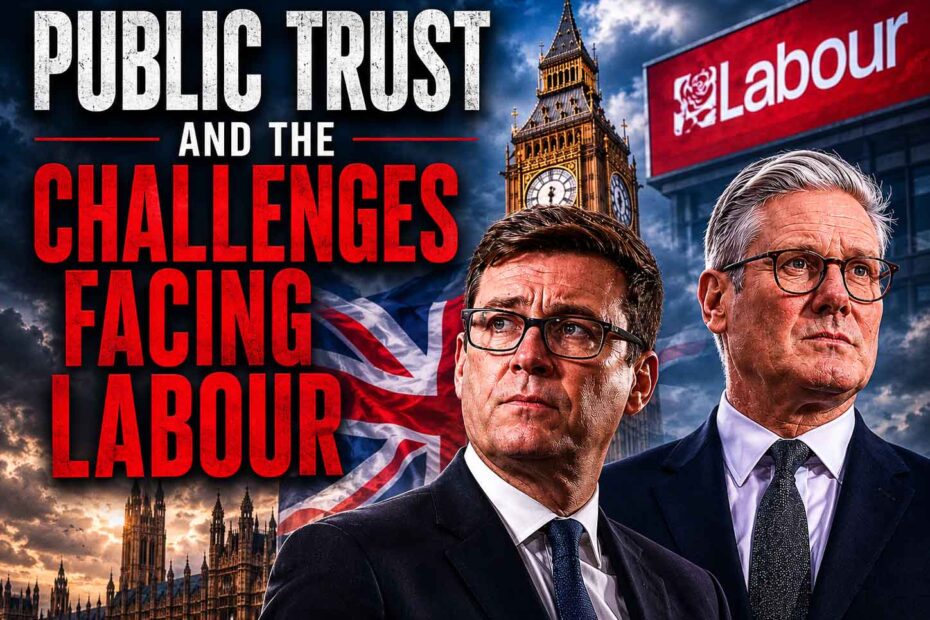
Public Trust and the Challenges Facing Labour
The Battle for Political Leadership
Questions surrounding political leadership, public trust and the future direction of the Labour Party have once again moved to the centre of British political debate. Recent discussions around Andy Burnham, Keir Starmer and the wider Labour movement highlight growing uncertainty about how political leaders are selected, how they present themselves to the public and whether the current political system still reflects the expectations of voters.
At the heart of the debate is the perception that some politicians appear reluctant to state clear positions on major issues. Concerns have been raised about whether modern political leadership has become increasingly driven by image management rather than conviction, particularly when difficult or controversial topics arise.
One issue drawing attention is the Labour Party’s position on the European Union. Senior Labour figures have made comments suggesting closer alignment with Europe in the future, while others within the party appear more cautious. This balancing act is especially delicate in constituencies across Northern England, where support for Brexit remains politically significant.
Andy Burnham has found himself at the centre of this discussion. While viewed by some as a potentially credible future leader, critics argue that he has yet to present a decisive political vision. Interviews intended to demonstrate leadership credentials have instead prompted questions about whether he is prepared to take firm positions on contentious issues.
Observers noted that Burnham appeared cautious when discussing topics such as the European Union and debates surrounding transgender policies in public spaces. Rather than projecting certainty, his responses were interpreted by some as politically defensive, reinforcing a wider perception that many politicians are increasingly unwilling to risk alienating sections of the electorate.
This reflects a broader criticism of contemporary politics: that public figures often prioritise avoiding mistakes over presenting bold ideas. In an era of constant media scrutiny, every statement is dissected and amplified, leaving politicians under pressure to deliver carefully managed responses rather than authentic convictions.
Comparisons have also been drawn with Keir Starmer’s rise to the Labour leadership. Starmer initially benefited from being viewed as a relatively unknown and moderate figure following the leadership of Jeremy Corbyn. For many voters, his appeal was based less on a clearly defined ideological programme and more on the absence of major controversy.
Some commentators now argue that a similar calculation may be emerging around Burnham. The suggestion is that political parties increasingly select leaders who appear competent, calm and broadly acceptable, even if their underlying political direction remains unclear. Critics contend that this represents a lowering of expectations for political leadership, particularly given the immense responsibilities attached to the office of Prime Minister.
Another major issue raised in the discussion concerns democratic legitimacy and leadership succession. There is growing discomfort among some voters about the prospect of a Prime Minister taking office without first leading their party through a general election campaign.
The debate reflects wider frustrations that emerged during the final years of the Conservative government, when leadership changes occurred without a public vote. The transitions from Boris Johnson to Liz Truss, and subsequently to Rishi Sunak, left many voters feeling disconnected from the process.
Critics argue that while parliamentary systems technically allow governing parties to replace leaders internally, repeated changes without a general election can create a sense that the electorate is being bypassed. This perception risks damaging public trust, particularly when voters feel they are no longer choosing the individual ultimately leading the country.
There is a growing belief that future governments may need to seek a renewed public mandate following major leadership changes, both for democratic legitimacy and political stability. Some analysts believe that any incoming Labour leader replacing Starmer would likely face pressure to call an early general election in order to secure direct public endorsement.
Economic realities also form a significant part of the challenge facing Labour. Any future government is expected to confront severe fiscal constraints, limited public spending flexibility and difficult decisions regarding taxation and public services.
For a centre-left government, these pressures create particular political difficulties. Labour governments are traditionally associated with public investment and expanded social programmes. However, in an environment where public finances are constrained, the party may instead be forced into politically unpopular decisions involving spending restraint or structural reform.
There is a perception among critics that Labour has failed to fully utilise the political opportunity it inherited after the decline of the Conservative government. Expectations were high that the party would pursue substantial reforms in areas such as the NHS, welfare, housing and economic growth.
Instead, detractors argue that the government has often opted for cautious or incremental approaches rather than pursuing major structural change. This, they claim, has contributed to a growing sense of political drift and public frustration.
The changing nature of the British political landscape further complicates predictions about future elections. Britain’s traditional two-party structure appears increasingly fragmented, with support spread across multiple parties rather than concentrated solely between Labour and the Conservatives.
This fragmentation makes electoral forecasting significantly more difficult. Small shifts in public opinion can now produce major changes in parliamentary seat projections, meaning coalition governments or minority administrations are becoming increasingly plausible outcomes.
In such a fragmented environment, leadership image and political presentation may become even more influential. Parties are no longer simply competing for broad national majorities but are instead attempting to hold together diverse and sometimes conflicting voter coalitions.
This creates additional pressure on political leaders to remain flexible and electorally cautious, even if doing so weakens perceptions of authenticity or conviction.
Ultimately, the debate reflects a deeper uncertainty about the future of British politics itself. Questions surrounding leadership legitimacy, political courage, economic constraints and voter trust are no longer confined to individual parties but are becoming central challenges for the political system as a whole.
Many voters appear increasingly sceptical of highly managed political messaging and are looking for leaders who demonstrate clarity, consistency and decisiveness. At the same time, modern political realities — including media scrutiny, fragmented electorates and economic pressures — make such leadership increasingly difficult to sustain.
Whether Labour can successfully navigate these challenges remains uncertain. What is clear, however, is that public expectations of political leadership are evolving rapidly, and parties that fail to adapt risk further deepening the disconnect between Westminster and the electorate.