
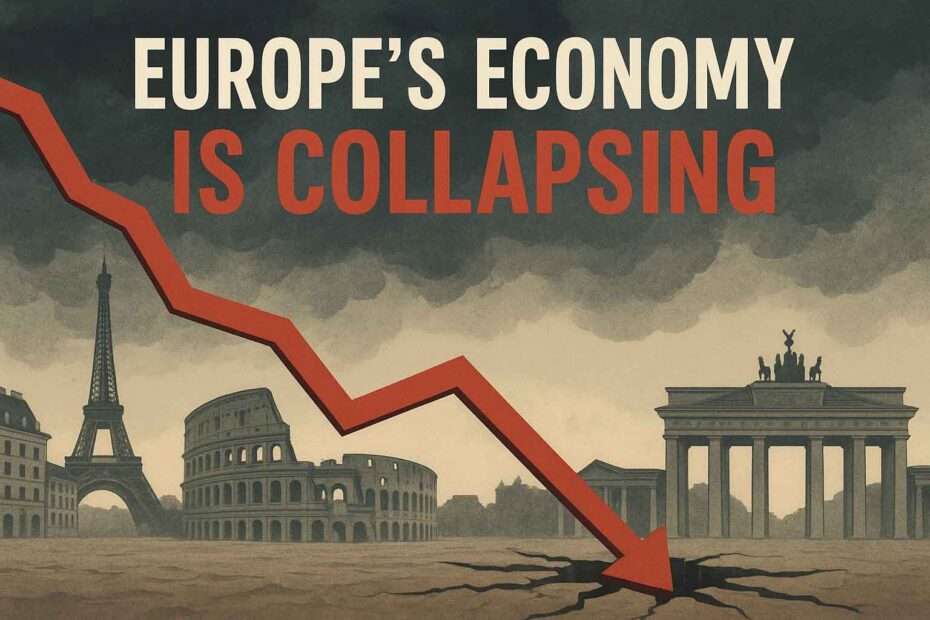
Europe’s Economy – A Deepening Crisis and Its Structural Fault Lines
Imagine in the near future you are an international visitor to Europe. You begin your day with breakfast on a café terrace in Paris, take a high-speed journey south to Rome for lunch, and end the day with dinner in Berlin. The cities are beautiful; the cultural heritage is breathtaking. Yet beneath the surface, something is deeply amiss. Streets are impeccably clean but eerily quiet. Cafés are populated mostly by older patrons. When you make a purchase at a souvenir shop, the goods are sold by a branch of a multinational conglomerate, not a locally owned business. You suddenly realise that you are not in the economic powerhouse of old but in what feels like an expensive open-air museum of a bygone era.
This imagined scenario is not the opening scene of a science fiction novel but an illustrative metaphor for the anxieties surrounding the European economy in the mid-2020s. Once nearly equal in size to the United States economy, the European Union’s aggregate gross domestic product (GDP) has lagged far behind in recent decades. While the US economy has continued to expand rapidly, Europe’s growth has been comparatively modest and inconsistent. This divergence has led to serious debate among economists, policymakers and business leaders over why Europe is faltering relative to global competitors, and what the long-term consequences may be.
A Tale of Divergent Trajectories
At the start of the 21st century, the European Union and the United States stood as economic peers in many respects. The population sizes and levels of industrial capability were comparable; long-established systems of infrastructure, education and manufacturing underpinned strong living standards. But since the global financial crisis of 2008, the trajectories of these two large economic blocs have diverged sharply. The United States has grown robustly; many observers cite technological innovation, dynamic labour markets and capital-rich financial systems as key drivers. In contrast, European GDP growth has been slower and more fragmented according to most economic metrics over the same period. The cumulative growth difference has become so pronounced that Europe’s total GDP now trails the US by an amount roughly equivalent to the size of Japan’s economy — an entire major developed economy. This structural gap raises important questions about sustainable prosperity, the vitality of European industry, and the region’s global competitiveness.
Recent official EU forecasts suggest modest growth in 2025 and 2026. According to the European Commission’s spring 2025 economic projections, the EU was expected to see GDP growth of around 1.1 per cent in 2025 and 1.5 per cent in 2026 (with the eurozone, the core economic area, projected to expand by 0.9 per cent and then 1.4 per cent). Inflation was expected to moderate further over this period, and labour markets were projected to remain relatively strong, with unemployment continuing to decline modestly. However, these forecasts also underscore the fragility of the European recovery amid global uncertainties and structural headwinds.
Six Structural Challenges Undermining Europe’s Economy
Economists and policymakers typically frame Europe’s economic challenges under a set of broad, interrelated structural issues. These can be grouped into six major fault lines that together help explain the region’s persistent underperformance.
1. De-Industrialisation and the Retreat of Manufacturing
For much of the post-World War II era, Europe’s economic strength rested on heavy industry: machinery, chemicals, automotive production, steelmaking and related sectors. Germany, in particular, functioned as the industrial engine of the European economy. Its economic model combined disciplined export strategies, close integration with global supply chains, and access to relatively inexpensive energy. German industrial success was built on sustained demand for its manufactured products in international markets and on secure supplies of energy and raw materials.
However, over the past decade, that model has been severely tested. The disruptions in natural gas supplies from Russia following geopolitical tensions, and specifically the collapse of the Nord Stream gas pipelines, deprived central European economies — especially Germany — of a relatively low-cost source of energy that had powered heavy industry. The sudden energy supply shock led to skyrocketing energy prices that significantly increased production costs for energy-intensive industries, forcing many companies to reassess their operations. At the extreme end of this spectrum, some major industrial firms have scaled back production in core European markets and announced plans to invest and build facilities in other parts of the world where energy is cheaper and regulatory environments more favourable.
The impact on manufacturing activity has been measurable: recent economic data show that industrial production in some European regions has contracted, with Germany experiencing periods of stagnation or decline in manufacturing output as firms struggle to compete in a global market where energy costs are a key determinant of competitiveness.
Europe’s retreat from manufacturing is not uniform across all countries or sectors, but the broader trend is clear: industry is shrinking as a share of total economic output in many parts of the continent. The decline of manufacturing not only affects direct employment and production but also undermines the complex supply chains that support broader innovation ecosystems. This hollowing-out process — where factories close, jobs are lost, and technological capabilities weaken — has long-term consequences for productivity and economic resilience.
2. Demographic Decline and Ageing Populations
Europe’s demographic situation represents a fundamental challenge to its economic future. Many European countries, particularly in southern and central Europe such as Italy, Spain and parts of Eastern Europe, face some of the world’s lowest birth rates. Fertility rates in countries like Italy have fallen well below the replacement level of approximately 2.1 children per woman required to maintain a stable population without immigration. Some estimates suggest rates as low as around 1.2 births per woman in recent years in parts of southern Europe. This represents a demographic emergency in which the population is ageing rapidly, and the proportion of older residents is growing relative to the working-age population.
An ageing population creates multiple fiscal pressures. Public pension systems in Europe are overwhelmingly “pay-as-you-go” schemes — the pensions of current retirees are financed from the taxes paid by current workers. As the ratio of active workers to retirees shrinks, the burden on younger workers increases. In the 1960s, European economies typically had around four working-age adults for every retiree. Within a few decades, that ratio in some countries has fallen to well under two workers per retiree forecast for the middle of the century. The implication for public finances is significant: governments must allocate more tax revenue to support pensions, healthcare and long-term care for ageing populations, leaving less available for investment in education, infrastructure, and innovation.
The result is a demographic spiral: younger workers leave high-tax, low-growth economies in search of better opportunities in faster-growing regions such as North America or Australia; this in turn reduces the tax base and further intensifies the fiscal strain on those who remain. Political considerations complicate reforms that might ease demographic pressures; proposals to cut pension benefits or raise the retirement age are often politically fraught, especially where older voters form a potent electoral constituency.
3. The Innovation Gap and Fragmented Tech Ecosystem
Success in the modern global economy increasingly depends on innovation in high-tech sectors: artificial intelligence, digital platforms, biotech, semiconductors and advanced manufacturing technologies. Europe has world-class universities and research institutions, and historically it has been a source of many foundational technological breakthroughs. Yet in the technology commercialisation race, Europe lags far behind the United States and China.
The absence of large European technology companies is striking. Where Silicon Valley and China’s tech hubs have produced firms with valuations in the trillions of euros, Europe has not seen a comparable creation of global tech champions. Analysts note that over the past several decades, very few European firms with market capitalisations above €100 billion have emerged domestically — a stark contrast with the rapid proliferation of US tech giants. Moreover, many European startups with significant potential have chosen to list and operate in the United States, seeking deeper capital markets and greater access to finance. This outflow of corporate headquarters and capital exacerbates the structural weakness of Europe’s innovation ecosystem.
One factor contributing to this gap is the regulatory environment. The European Union has sought to position itself as a “regulatory superpower,” crafting comprehensive frameworks governing data privacy, digital markets, artificial intelligence, and competition. While the intent behind rigorous standards such as the General Data Protection Regulation (GDPR) and forthcoming AI regulation is to protect consumers and promote ethical technology use, the sheer complexity and scale of regulatory requirements adds to the cost and administrative burden for startups trying to scale across an already fragmented market. Each member state retains variations in language, tax law, labour law and other legal frameworks, complicating cross-border expansion within Europe. This fragmentation stands in contrast to the relatively homogeneous regulatory and legal environment in the United States.
In response, some reform proposals emphasise the need to harmonise regulations, deepen the single market and stimulate investment in research and development at significantly higher levels. Indeed, a landmark competitiveness report by former European Central Bank president Mario Draghi, commissioned by the European Commission, outlines a multi-pronged strategy to boost European competitiveness, including substantial public and private investment, streamlined regulations, and coordinated industrial policy. However, the pace and depth of implementation have been limited, reflecting political resistance and the complexity of coordinating action across 27 member states.
4. Capital Flight and Underdeveloped Financial Markets
A robust economy requires not only productive industry and innovation but also efficient capital markets that mobilise savings and channel them into growth opportunities. The United States, with its deep and vibrant equity markets, provides a fertile environment for companies to raise capital, scale rapidly, and compete globally. In contrast, European financial markets are relatively shallow and bank-centric. Individuals and institutions in Europe tend to hold savings in low-yield bank deposits or low-growth assets, rather than investing broadly in productive equity.
The limited share of the population invested directly in equities reduces the pool of risk capital available to European firms. When companies require substantial funding to grow, they often look outside Europe’s financial markets, choosing to list in New York or attract foreign venture capital. This pattern creates a feedback loop: European investors receive low returns at home, so they invest abroad; European firms seek capital abroad, reducing domestic investment activity; and the home market receives diminished liquidity and investment depth.
High-profile examples illustrate this phenomenon. Major European technology firms have chosen to list on US exchanges, despite their European origins. European companies, faced with capital constraints at home and more attractive financing conditions in the United States, are effectively trading national identity for access to global capital. This structural issue in Europe’s capital markets limits the ability of domestic enterprises to scale and compete internationally.
5. Energy Costs, Policy Choices and the Green Transition
Europe’s energy policies have been shaped by a complex interplay of environmental goals, geopolitical events, and economic imperatives. In the past two decades, the EU has sought to lead the world in reducing carbon emissions and accelerating the green transition. Policymakers have pursued ambitious targets for renewable energy deployment, phased out nuclear power in certain countries, and limited the use of fossil fuels such as shale gas.
While these efforts have contributed to a reduction in carbon emissions in some areas, they have also exposed Europe to energy price volatility and heightened production costs. The decision by Germany to close its remaining nuclear power plants amid concerns about nuclear safety and waste management highlights the trade-offs inherent in energy policy. In the absence of sufficient low-carbon baseload energy, parts of Europe became heavily reliant on imported natural gas to fill the shortfall. When geopolitical tensions disrupted Russian gas supplies, energy prices spiked sharply for European consumers and businesses. As a result, European industrial electricity costs have been significantly higher than in other advanced economies, such as the United States, where abundant domestic natural gas has kept energy prices comparatively low.
High energy prices act as a competitive disadvantage for energy-intensive manufacturing sectors and increase operating costs across the economy. Even as intermittent renewable sources like wind and solar expand, insufficient investment in energy storage and grid infrastructure contributes to price volatility and uncertainty for businesses. These dynamics complicate efforts to maintain industrial competitiveness while transitioning to a low-carbon future.
6. The Geopolitical Security Burden and Defence Spending
A further dimension of Europe’s economic predicament is the interplay between defence spending and social welfare commitments. For much of the post-World War II period, European countries benefited from a US security guarantee under NATO. This allowed many European governments to focus public spending on social programmes, healthcare, pensions and other welfare entitlements while relying on the United States for strategic defence. Defence spending in many European countries remained below the NATO target of 2 per cent of GDP for decades.
However, shifting geopolitical realities, including the return of high-intensity conflict in Europe and broader geopolitical instability, have prompted reassessment of defence commitments. European leaders now recognise that they must invest more in national and collective defence capabilities. This recalibration places additional strain on public finances, especially at a time when economic growth is slow, debt levels are significant, and social welfare commitments are substantial.
The challenge is stark: funding defence modernisation while preserving robust social safety nets requires either fiscal retrenchment or additional revenue generation. Either option risks public discontent and further complicates already difficult political decisions around tax policy, social spending and economic reform.
Where Does Europe Stand Today?
Despite the narrative of decline, it is essential to acknowledge that Europe’s economic situation is not monolithic or uniformly dire. Moderate growth forecasts for 2025 and 2026 indicate that the European economy retains capacity for expansion under favourable conditions. European policymakers continue to pursue initiatives aimed at enhancing competitiveness, reducing energy costs and supporting strategic industries. Reform proposals, such as the EU’s emergency competitiveness plan, reflect recognition among leaders that decisive action is required.
However, insights from business leaders and economic observers suggest that significant challenges remain. A recent survey of major European chief executives highlighted persistent pessimism about Europe’s business environment and a preference among many firms to increase investment in the United States rather than Europe. Respondents to that survey cited slow regulatory reform and ongoing barriers within the internal market as factors dampening investment sentiment.
Mario Draghi’s competitiveness report — a comprehensive blueprint for reform — has drawn attention to the magnitude of Europe’s structural challenges and the urgency with which they must be addressed. Yet implementation has been limited by political inertia and disagreement among member states. Draghi and other analysts argue that Europe must pursue greater regulatory harmonisation, significantly increase investment in innovation and energy infrastructure, and strengthen the single market to close the competitiveness gap with global rivals.
A Crossroads: Futures for Europe
Europe’s economic trajectory is at a crossroads. One possible future entails a painful but necessary series of reforms: harmonising regulations, deepening the single market, investing in research and innovation, modernising energy systems and revamping capital markets. Such a path would require political courage and collective action among EU member states, challenging entrenched interests and overcoming fragmentation. If successful, this approach could revitalise European competitiveness and sustain economic prosperity in the decades ahead.
An alternative scenario sees the continuation of current trends: modest growth, persistent structural weaknesses, and an economy increasingly overshadowed by global competitors. Under this trajectory, Europe’s cultural heritage and quality of life might remain attractive, but its economic dynamism and global influence could diminish. Rather than lead, Europe could become known more as a destination for tourism and history than as a centre of innovation and economic power.
Both scenarios underscore a simple truth: success is never guaranteed. The economic foundations built over centuries can erode without adaptation to changing global conditions. Europe’s past achievements do not automatically translate into future prosperity. The world is watching, and Europe’s choices in the coming years will determine whether it can reinvent itself or settle for a quieter role on the global stage.
Five Frequently Asked Questions (FAQs)
1. Why is Europe’s economic growth slower than that of the United States?
Europe’s slower growth relative to the United States reflects several structural factors: weaker capital markets that limit investment; a fragmented regulatory and legal environment that complicates business expansion across borders; an ageing population that burdens public finances; and higher energy costs that reduce industrial competitiveness. These factors combine to constrain productivity, innovation and investment compared with the United States, where deeper equity markets, unified domestic markets and robust technological ecosystems create conditions more favourable for rapid economic expansion.
2. Is Europe truly de-industrialising, or are its industries shifting to services?
Europe is experiencing a decline in manufacturing’s share of GDP and employment, a trend partly driven by global competitive pressures and high energy costs. While service sectors have expanded and contribute significantly to employment, the loss of manufacturing presents risks beyond a simple shift in economic composition. Manufacturing often underpins innovation ecosystems and complex supply chains; a decline in industrial capacity can weaken technological leadership and economic resilience if not offset by growth in high-value services and technology sectors.
3. Can the European Union fix these economic challenges through new policies?
Yes, many economists argue that policy reforms could strengthen Europe’s economic performance. Key priorities include harmonising regulations to facilitate cross-border business activity, deepening the single market, boosting investment in research and innovation, reforming capital markets to mobilise savings into productive ventures, and modernising energy infrastructure to reduce costs. Recognised reform blueprints — such as the Draghi competitiveness report — emphasise coordinated action and significant investment, but achieving consensus and implementation across member states remains a central political challenge.
4. Are demographic trends in Europe irreversible?
Demographic decline and ageing populations are long-term trends driven by sustained low fertility rates and increasing life expectancy. While certain demographic measures can be influenced — for example, through policies that support family formation, childcare and parental leave — reversing population decline solely through public policy is difficult. Migration can help mitigate workforce shortages, but political sensitivities around immigration complicate the design and implementation of such policies.
5. Does Europe still have the potential to lead in innovation?
Europe possesses many strengths that could underpin innovation leadership, including world-class universities, a skilled workforce and leading research institutions. The principal challenge lies in translating intellectual capacity into commercial success at scale. This requires reforms to capital markets, streamlined regulation, enhanced cooperation within the single market, and policies that encourage risk-taking and entrepreneurship. With coordinated effort and sustained investment, Europe could close parts of the innovation gap with global competitors, though it will require concerted action at both EU and national levels.