
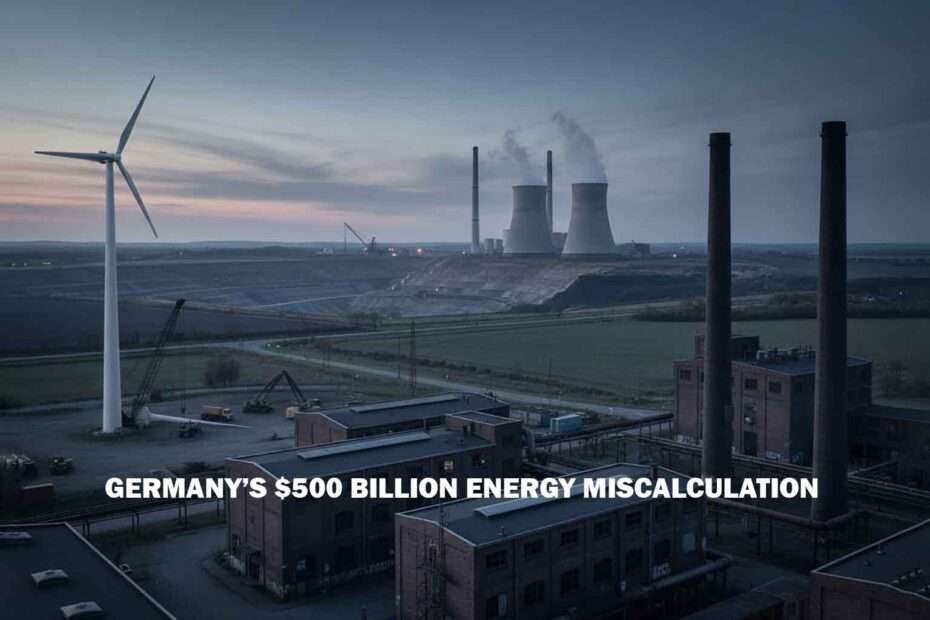
Germany’s $500 Billion Energy Miscalculation
How an Industrial Powerhouse Trapped Itself
Germany, long regarded as the industrial engine of Europe and a global symbol of engineering excellence, has spent more than $500 billion trying to build a green energy utopia. The aim was to pioneer a new model for advanced economies: phasing out nuclear power, rapidly expanding wind and solar generation, and drastically cutting carbon emissions while maintaining prosperity and industrial strength.
Instead, the country has ended up with some of the highest electricity prices in the developed world, a wave of de‑industrialisation, and the bitter irony of tearing down wind turbines in order to expand coal mines. What was meant to be an “energy turnaround” has, in crucial respects, turned into an energy trap.
This article explores how a sequence of political decisions, driven by fear, ideology and misjudged geopolitical assumptions, led Germany into this position – and what lessons other countries might draw from this extraordinarily costly experiment.
1. The Turning Point: When Fear Killed the Atom
To understand Germany’s energy predicament, it is necessary to return to 2010. At that time, the country’s energy mix appeared well balanced. Nuclear power, coal and a growing share of renewables together supplied a stable and relatively affordable flow of electricity. Nuclear stations alone provided around a quarter of Germany’s electricity. They were already built, largely paid off, and produced low‑carbon, steady base‑load power.
The strategic plan, on paper, was reasonable: retain nuclear for several decades as a bridge technology, while scaling up renewables gradually and methodically. This would maintain security of supply and limit emissions without compromising the competitiveness of German industry.
Then came the Fukushima Daiichi nuclear disaster in Japan in March 2011. Triggered by a massive offshore earthquake and ensuing tsunami in a seismically active region, it was a grave incident. But geographically and geologically, it was worlds away from Germany. Germany is not exposed to tsunamis, nor does it have the same seismic risks, and the plant design involved in the Japanese accident dated back some forty years.
A rational response in Germany might have been a detailed safety review: a thorough inspection of reactor designs, emergency systems and back‑up generators, leading to upgrades where necessary. Instead, the reaction was dominated by emotion. Public fear of nuclear technology, already strong since the Chernobyl disaster of the 1980s, surged. Anti‑nuclear activism intensified, particularly from environmental groups that had long campaigned against atomic energy.
Under this intense pressure, the German government abandoned its own earlier stance. Rather than standing by the bridge strategy and the data that underpinned it, a political choice was made to commit to a complete nuclear phase‑out. A policy decision was announced: all nuclear power stations would be shut down by 2022, and eight facilities were taken offline almost immediately.
In practical terms, it was like destroying a functioning, reliable heating system in mid‑winter before the replacement had been installed. Germany had seventeen operating nuclear plants, providing low‑carbon, stable electricity at relatively low marginal cost. These were effectively discarded, not because they were technically obsolete or unsafe by international standards, but because of political and public pressure.
What makes this choice so expensive is not simply the cost of renewables themselves. Building wind turbines and solar arrays is costly but defensible as part of an energy transition. The real issue is building vast quantities of intermittent renewable capacity merely to replace existing low‑carbon nuclear stations. That is not an investment that adds new capacity on top; it is, in economic terms, spending colossal sums simply to stand still.
Between 2010 and 2020, large subsidies were poured into renewables through mechanisms such as the Renewable Energy Sources Act. Surcharges were levied on every kilowatt hour consumed by households and businesses. As a result, electricity prices for consumers soared to around three times the average levels seen in the United States.
Yet carbon emissions stagnated. For roughly a decade, despite hundreds of billions of euros of investment, Germany’s overall emissions profile barely improved. The reason lies in the physics of intermittent generation. When the wind failed to blow or the skies were overcast – frequent conditions in northern Europe – solar panels and wind turbines could not supply enough power. Those nuclear stations, once closed, could not simply be restarted. In their place, Germany increasingly resorted to lignite – a particularly carbon‑intensive form of coal.
The country therefore shut down its cleanest, most reliable form of base‑load energy in the name of environmental protection, only to fall back on one of the dirtiest fossil fuels available whenever the weather did not co‑operate.
2. Dependency on Russian Gas: The Geopolitical Trap
With nuclear energy being deliberately phased out and renewables unable to guarantee constant output, Germany needed a flexible back‑up fuel. Natural gas seemed the obvious candidate: cleaner than coal in terms of carbon emissions, quick to ramp up and down, and suitable for industrial heat processes essential to chemical production, steelmaking and other core sectors.
However, Germany possesses only limited domestic gas resources. It therefore turned abroad – and, crucially, to Russia.
For decades, German foreign and economic policy had been influenced by the concept often summarised as “change through trade”. The idea was that deep commercial ties, particularly in energy, would create mutual dependence and help keep relations peaceful and constructive. If Germany became a major customer for Russian gas, and Russia a major supplier, the logic went, neither side would have an interest in serious conflict.
On this basis, Germany supported and built major pipelines such as Nord Stream 1 and planned Nord Stream 2, running beneath the Baltic Sea to deliver vast volumes of Russian gas directly to German territory. This gas was cheap and reliable – until it was not – and it powered the furnaces and boilers of some of Germany’s most important companies.
By 2021, approximately 55 per cent of Germany’s natural gas imports came from Russia. The competitiveness of its industrial giants, including chemical manufacturers, carmakers and other exporters, was increasingly predicated on the assumption that this flow of low‑cost gas would be permanent.
Warnings abounded. Countries in eastern Europe, particularly Poland, the Baltic states and Ukraine, repeatedly cautioned that over‑reliance on Russian gas created a strategic vulnerability. They argued that these pipelines effectively handed Moscow enormous leverage – a “kill switch” for the German economy.
These concerns were widely dismissed in Berlin as overblown or overly pessimistic. When international figures suggested that Germany might become dangerously dependent on Russian energy, the idea was sometimes treated with thinly veiled derision.
All this changed in early 2022, when Russian forces invaded Ukraine. The underlying geopolitical assumptions behind Germany’s energy policy collapsed almost overnight. Sanctions and counter‑measures followed, and the flow of Russian gas was sharply reduced and then further disrupted by damage to pipeline infrastructure. The price of gas on international spot markets did not merely climb; it rose almost vertically, at times increasing by orders of magnitude.
For energy‑intensive firms, the consequences were immediate and severe. A factory previously paying around $1 million per month for energy could suddenly face bills closer to $10 million. In globally competitive industries such as steel, chemicals or automotive manufacturing, such input cost shocks cannot simply be passed on to customers in full. Buyers can source products from regions where energy remains cheaper and more stable.
The German state found itself forced into emergency interventions. It had to rescue major energy companies, including one of its largest utility providers, at enormous public cost. It also had to allocate additional tens or even hundreds of billions of euros to subsidise energy bills for households and businesses, in an effort to avoid social unrest and a wave of bankruptcies.
At this point, the trap was fully sprung. Nuclear power had been all but eliminated. Coal had been ideologically cast as unacceptable, even though it continued to be burned in practice. The one fossil fuel still politically accepted as a “bridge” – gas – was now under the control of a state with which relations had deteriorated to open hostility.
In a painful twist of irony, senior German officials who had come to office promising a decisive break with fossil fuel dependence now had to tour gas‑producing countries, persuading them to supply liquefied natural gas (LNG) instead. LNG, however, is much more expensive than pipeline gas. It has to be cooled, transported long distances by specialised tankers, and then re‑gasified at import terminals before entering the grid.
The age of abundant, cheap gas that had quietly underpinned German manufacturing competitiveness for years appeared to be over. Without that hidden subsidy, the margins and cost advantages that helped make “Made in Germany” a global mark of quality and value began to evaporate.
3. De‑industrialisation: The Slow Hollowing‑Out of “Made in Germany”
To grasp the full consequences of this energy transformation, one must look beyond aggregate statistics and focus on specific industrial centres. One emblematic example is Ludwigshafen, home to the giant chemical producer BASF. This single complex consumes roughly as much natural gas as an entire small country.
For decades, plants like this were integral to Germany’s success: importing relatively cheap energy, adding high‑value processing and engineering, and exporting a wide range of products – from fertilisers to speciality chemicals and plastics – around the world.
By 2023, however, this model was under severe strain. BASF announced that it would permanently scale back operations in Europe. Thousands of jobs at its flagship German site were cut. One of its ammonia plants – an energy‑intensive facility crucial for fertiliser production – was shut down.
Investment, instead of being committed to expanding operations in Germany, began flowing to other countries. BASF, for instance, embarked on building a new multi‑billion‑dollar complex in China, where energy prices were lower and industrial policy more accommodating to heavy energy users.
This was not an isolated case. Other manufacturers, including well‑known producers of household appliances, announced they were relocating production from Germany to countries with cheaper energy and labour costs, such as Poland. Major automotive companies began openly considering or planning to site new battery or component factories in North America, lured by subsidies and more favourable cost conditions.
Economists sometimes refer to such shifts as “structural change”, a neutral term that can conceal the severity of the underlying trend. In reality, this process amounts to de‑industrialisation: the steady erosion of the industries that have historically provided well‑paid, skilled, often unionised jobs and sustained regional economies.
In a country like Germany, where the economic model is based not on large digital platforms but on tangible exports – cars, machinery, chemicals, precision equipment – this is particularly significant. If the ability to produce these goods competitively disappears, what remains is service activity that may struggle to replace the income, tax base and social stability once provided by manufacturing.
Senior corporate figures have been candid about this reality. They have publicly warned that Europe, and Germany in particular, is becoming increasingly uncompetitive due to high energy costs and burdensome regulation. When such leaders talk of “uncompetitiveness”, what they often mean in practice is a decision to move capital, new projects and, ultimately, jobs to other jurisdictions.
Once a steel mill or large chemical facility closes, it rarely reopens. Recreating such industrial capacity later would require enormous capital, long planning horizons and a supportive policy environment. Facilities that migrate to other continents tend to remain there for the long term.
Thus, in pursuing aggressive climate targets largely in isolation from similar commitments elsewhere, Germany risks trading domestic carbon reductions for increased production – and therefore emissions – in other parts of the world. At a global level, this can result in limited net environmental benefit, but at a national level it can mean a significant loss of employment, income and technological capability.
4. Grid Constraints and “Ghost Electricity”
Beyond the political and industrial consequences, Germany’s energy transition has also exposed serious infrastructural and planning problems, particularly within the electricity grid.
The geography of the country presents a challenge. Much of the best wind resource is in the north, especially offshore in the North Sea. However, many of the largest industrial centres and factories are located in the south, in regions such as Bavaria and Baden‑Württemberg. The straightforward solution is to build high‑capacity transmission lines to move large volumes of electricity from north to south.
One of the primary projects to achieve this is a major high‑voltage corridor designed as a key artery of the energy transition. In theory, it was meant to be operational by the early 2020s, coinciding with the shutdown of the last nuclear plants. In practice, the project became bogged down in protracted consultations, legal challenges and local opposition.
Concerns over visual impact and land use led to a decision to place much of the infrastructure underground rather than using overhead lines. While this addressed some objections, it also dramatically increased costs and significantly delayed completion. New estimates shifted the likely operational date into the second half of the decade, well after the closure of nuclear stations.
The result is a mismatch between where renewable electricity is generated and where it is needed. During periods of strong wind in the north, turbines can produce large surpluses of power. But if the transmission system cannot carry this surplus southward, the grid risks becoming overloaded. To avoid system instability or blackouts, grid operators sometimes instruct wind farms to curtail output.
Crucially, these operators are still paid – not for electricity actually delivered to customers, but for electricity they could have produced were it not for grid constraints. This practice, often referred to using technical terms such as redispatch, has led to what might be described as “ghost electricity”: consumers ultimately footing the bill for energy that never reaches them.
In some years, the cost of these congestion management measures has run into several billion dollars. Consumers and businesses, through their electricity bills, pay once for renewable capacity that is not fully utilised, and again for conventional power plants – frequently coal or gas – located nearer to industrial centres in the south that must be fired up to meet demand when renewable flows are curtailed.
From an efficiency standpoint, this is deeply problematic. It reflects a system in which generation capacity has been expanded faster and more aggressively than the necessary transmission infrastructure, leaving the grid struggling to cope with the new patterns of supply. Rather than a seamlessly integrated clean energy system, the result is a complex, expensive arrangement that sometimes undermines both environmental and economic objectives.
5. The Heat Pump Backlash
As it became clear that emissions targets were not being met largely through the intended expansion of renewables, the German government turned increasingly to the building sector. Heating is a major source of greenhouse gas emissions, and decarbonising households’ energy use was seen as essential.
A major legislative initiative sought to shift residential and commercial heating systems away from oil and gas boilers towards electric heat pumps. Technologically, heat pumps are efficient devices, capable of transferring heat rather than generating it directly, and can work well in suitable buildings.
However, much of Germany’s housing stock consists of older, solidly built, but relatively poorly insulated properties. Making a heat pump effective in such a building can require extensive and costly renovations: upgrading insulation, replacing radiators, sometimes reconfiguring entire heating systems.
The proposed law aimed to phase out new fossil fuel heating systems from a set date, effectively compelling property owners to adopt alternatives such as heat pumps if they replaced their boilers. Although subsidies were offered, many households perceived the change as a forced expense that could reach tens of thousands of dollars – a particularly daunting prospect for pensioners and lower‑income owners of older homes.
The public response was one of intense resistance. The policy quickly became a symbol of perceived overreach and insensitivity on the part of political leaders, especially in the context of already high energy bills and broader economic anxiety. Political support for parties associated with the legislation suffered, and opposition parties capitalised on the backlash by promising to protect existing heating systems.
In the end, the law had to be watered down, timelines extended and exceptions introduced. But the damage to public confidence was considerable. Manufacturers of heat pumps, having ramped up capacity in anticipation of a surge in demand, instead faced uncertainty and falling sales as many homeowners rushed to install new gas boilers before any ban could take effect. Ironically, this behaviour locks in fossil fuel usage for potentially decades more.
This episode illustrates how even technically sound solutions can fail if the social and economic realities of implementation are mishandled. Rather than building broad consent for a gradual change in heating systems, the attempt at rapid legislative change created confusion, fear and political polarisation, undermining trust in the wider energy transition.
6. The “Green Mirage”: Emissions Falling for the Wrong Reasons
Officials can point to one headline success: measured greenhouse gas emissions in Germany have, indeed, fallen. In 2023, they reportedly reached their lowest level in around seventy years, and climate targets on paper were achieved.
Yet the underlying cause of this reduction raises serious questions. A significant share of the decline in emissions did not stem from cleaner energy production or more efficient technologies. Instead, it resulted from a contraction in energy‑intensive industrial activity.
When factories producing steel, chemicals, paper and other heavy products reduce output or close down entirely, their emissions fall accordingly. If these materials are then imported from other countries with lower environmental standards or higher carbon intensity, global emissions may not fall as much as domestic statistics suggest. The environmental gain is, at best, ambiguous, while the economic loss is immediate and clear.
This has led some observers to describe the apparent success as a form of statistical illusion: climate progress that is achieved more by de‑industrialisation than by genuine decarbonisation of production. It is akin to achieving weight loss by losing a limb; the numbers change, but in a way that reflects serious harm rather than improved health.
In parallel, Germany’s electricity system, having removed nuclear power from its mix, now exhibits higher carbon intensity than neighbouring France, where nuclear provides the majority of electricity. French power generation emits far fewer grams of carbon dioxide per kilowatt hour than German electricity, even when German renewables output is strong.
This discrepancy also has implications for consumer behaviour. A German buying an electric vehicle may do so partly to reduce emissions, yet if the electricity used to charge that vehicle is significantly more carbon‑intensive than in other countries, the net environmental benefit is smaller than it appears. In contrast, a similar purchase in a country with a predominantly nuclear or hydroelectric grid can have a greater impact on emissions, even with identical consumption patterns.
Thus, the country frequently held up as a champion of green energy has, in some respects, ended up with a relatively high‑carbon electricity system compared with peers that have retained or expanded nuclear capacity.
7. The 2025 Reality Check
By the mid‑2020s, the consequences of Germany’s energy strategy had become stark. Economic growth stalled, with the country even experiencing outright contraction in some years while other major economies expanded. Key industrial sectors struggled under pressure from rising energy costs, stricter regulation and global competition.
The political environment became more fractured, with public frustration over high prices, perceived policy failures and concerns about jobs and industrial decline. Parties that had strongly promoted the rapid energy transition faced a backlash, while oppositional forces gained ground by promising to defend traditional energy sources or resist mandated changes in heating and transport.
Internationally, emerging economies such as India and Vietnam observed Germany’s experience with caution. Rather than imitating its rapid phase‑out of nuclear and heavy reliance on weather‑dependent renewables, many opted to continue expanding coal and gas capacity while also building nuclear stations. Their priorities remained clear: ensuring reliable, affordable energy to support industrialisation and rising living standards before committing to the kind of deep structural changes pursued in Europe.
Germany had sought to be a role model: a leading example of how a rich, advanced country could decarbonise rapidly while maintaining economic strength. Instead, it has inadvertently become a cautionary tale about the risks of moving too fast on certain fronts without adequate planning for back‑up capacity, grid infrastructure and geopolitical resilience.
The fundamental lesson is that an advanced industrial economy cannot be powered solely by intermittent energy sources unless there is a robust, low‑carbon back‑up – whether in the form of nuclear, massive storage, firm low‑carbon fuels, or some combination of these options. If that back‑up is removed prematurely, the system becomes fragile, costs spiral, and industries may either shut down or relocate.
8. Is There a Way Out?
The question now is whether and how Germany can extricate itself from the position it finds itself in.
The country still has substantial strengths. Its engineering expertise, scientific institutions and financial resources remain formidable. It has a well‑developed industrial base and a workforce with advanced technical skills. These assets could, in principle, be harnessed to correct course.
There has been occasional discussion of whether some nuclear capacity could be restored or entirely new plants built. Technically and politically, however, this would be extremely challenging. Decommissioned plants are not easily restarted once dismantling procedures are well advanced, and building new reactors would require a wholesale rethinking of long‑standing anti‑nuclear positions.
There is also significant interest in hydrogen as a future energy carrier, particularly “green hydrogen” produced from renewable electricity. If cost‑effective, this could help decarbonise sectors such as steel and chemicals and provide a form of stored energy to balance intermittent renewables. But hydrogen solutions remain capital‑intensive, and deploying them at scale will take time and further technological progress.
In the meantime, Germany faces immediate pressures: retaining what remains of its industrial base, supporting households against high energy costs, and maintaining social cohesion in the face of contentious climate policies. The room for further large‑scale policy mistakes is limited.
For other countries watching from the outside, however, the lessons are clearer.
9. Lessons for the Rest of the World
Germany’s experience demonstrates that energy policy cannot be built primarily on hope, emotion or ideological preferences. It must be grounded in physics, engineering realities and hard economic calculation.
Several key principles emerge:
- Do not dismantle reliable low‑carbon capacity prematurely.
Shutting down functioning nuclear power stations before alternative firm low‑carbon capacity or adequate storage is in place creates a structural vulnerability. The result is often increased reliance on fossil fuels, not their elimination. - Beware of over‑reliance on a single external supplier.
Deep dependence on one country, particularly one with which relations may deteriorate, carries enormous geopolitical risk. Diversification of supply and domestic capacity are essential for resilience. - Coordinate generation with grid infrastructure.
Building large amounts of renewable generation without corresponding investment in transmission and storage leads to waste, inefficiency and additional costs. The system must be planned holistically. - Align climate policy with social reality.
Policies that impose heavy upfront costs on households, particularly older or lower‑income groups, without sufficient support or clear communication, can provoke backlash and undermine public support for decarbonisation more broadly. - Distinguish between genuine decarbonisation and de‑industrialisation.
Emissions falling because industry is shutting down and moving elsewhere is not a sustainable or desirable route to climate targets. The goal should be to produce goods and services with lower emissions, not simply to stop producing them domestically. - Recognise the value of firm low‑carbon power.
Countries that retain or expand nuclear, or develop other firm low‑carbon options, are likely to find it easier to combine decarbonisation with industrial competitiveness than those that rely almost entirely on intermittent sources.
Germany has effectively paid an immense sum – on the order of half a trillion dollars – to learn these lessons. Others can observe and, ideally, avoid making the same sequence of errors.
10. Conclusion
Germany’s attempt to lead the world into a green energy future was ambitious and, in some respects, admirable. Concern for the climate and a desire to reduce dependence on fossil fuels are widely shared goals. However, the path chosen – rapid nuclear phase‑out, heavy dependence on intermittent renewables without adequate back‑up, and deep reliance on imported gas from a politically risky supplier – has had severe and costly consequences.
Instead of a smooth, well‑managed transition, the country has endured soaring electricity prices, an erosion of industrial competitiveness, and a deeply divided public debate over energy and climate policy. Emissions have fallen, but partly for the wrong reasons: not through the steady decarbonisation of a thriving industrial economy, but through the contraction and relocation of energy‑intensive production.
The broader message is not that the pursuit of low‑carbon energy is misguided, but that the way it is pursued matters enormously. Technology choices, timing, infrastructure, geopolitics and social consent all have to be aligned. When they are not, the result can be both economically damaging and environmentally underwhelming.
Germany’s experience stands as a large‑scale case study in how not to manage an energy transition. It shows that good intentions are not enough; reality will always assert itself. The hope now is that other countries can take heed of these lessons and design energy policies that are not only green in aspiration, but also robust, affordable and consistent with the long‑term health of their economies and societies.
Frequently Asked Questions
1. Why did Germany decide to shut down all its nuclear power plants?
Germany’s decision to phase out nuclear power was primarily a political response to the Fukushima disaster in Japan in March 2011. Despite the fact that the incident occurred in a seismically active region prone to tsunamis—conditions that do not apply to Germany—public fear of nuclear technology intensified dramatically. The anti-nuclear movement, which had been active since the Chernobyl disaster in the 1980s, gained significant momentum. Under intense political pressure, Chancellor Angela Merkel announced the Atomausstieg (nuclear phase-out), committing to close all nuclear reactors by 2022. Eight plants were shut down immediately. This decision was driven more by emotion and political calculation than by technical risk assessment, as Germany’s nuclear facilities were fundamentally different from the ageing Japanese plant and posed no comparable tsunami or earthquake risk.
2. How much has Germany spent on its energy transition, and what were the results?
Germany has spent over $500 billion on its energy transition, known as the Energiewende. This enormous investment was intended to create a model green economy powered primarily by wind and solar energy. However, the results have been deeply problematic. Germany now has some of the highest electricity prices in the developed world—nearly three times the average in the United States. Despite the massive expenditure, carbon emissions barely declined for a decade because intermittent renewable sources required back-up from fossil fuels, particularly lignite coal, when weather conditions were unfavourable. The country also faces severe de-industrialisation, with major manufacturers relocating production to countries with cheaper, more reliable energy. In essence, Germany spent half a trillion dollars but achieved neither the environmental nor the economic outcomes it sought.
3. Why did Germany become so dependent on Russian natural gas?
Germany’s dependence on Russian gas stemmed from a policy known as Wandel durch Handel (“change through trade”). The underlying belief was that deep economic integration, particularly in energy, would foster political stability and prevent conflict. Germany needed natural gas as a flexible, cleaner-burning back-up to intermittent renewables and as fuel for energy-intensive industries. Since Germany has limited domestic gas resources, it turned to Russia, which offered abundant, cheap supplies via pipelines such as Nord Stream 1 and the planned Nord Stream 2. By 2021, Russia supplied approximately 55 per cent of Germany’s natural gas. Warnings from Eastern European countries about the geopolitical risks were largely dismissed. When Russia invaded Ukraine in 2022 and gas supplies were disrupted, Germany found itself in a severe energy crisis, with prices skyrocketing and the government forced to spend hundreds of billions on emergency measures and alternative supplies.
4. What is “ghost electricity” and why is it costing Germany billions?
“Ghost electricity” refers to the phenomenon where wind farms in northern Germany are paid for electricity they do not actually produce. The problem arises because Germany’s best wind resources are in the north, particularly offshore, whilst most of its industrial demand is in the south. The high-voltage transmission lines needed to carry large amounts of power from north to south have been severely delayed due to bureaucratic obstacles, legal challenges and local opposition. When strong winds generate surplus electricity in the north but the grid cannot transmit it southward, operators must instruct wind farms to curtail their output to prevent grid overload. However, under the subsidy system, these wind farms are still compensated as if they had delivered power. In 2022 alone, the cost of this congestion management reached approximately $4.2 billion. Meanwhile, factories in the south must rely on coal and gas plants to meet their energy needs, meaning consumers effectively pay twice: once for renewable energy that never reaches them, and again for fossil fuel generation.
5. Are Germany’s falling emissions a sign that the energy transition is working?
Not necessarily. Whilst Germany’s CO₂ emissions did fall to their lowest level in around seventy years by 2023, the reasons behind this decline are troubling. A significant portion of the reduction came not from cleaner energy production, but from the contraction of energy-intensive industries. Steel mills, chemical plants and other heavy manufacturers either reduced output or closed entirely, often relocating production to countries such as China where energy is cheaper. This means emissions may have simply shifted geographically rather than being eliminated. Germany’s own audit office has warned that the country is not on track for a sustainable transition, but rather for an economic contraction that masquerades as climate success. Additionally, because Germany shut down its nuclear plants, its electricity grid is now more carbon-intensive than that of neighbouring France, which relies heavily on nuclear power. The apparent environmental progress is therefore partly an illusion created by de-industrialisation rather than genuine decarbonisation.