
How the Vertical Corridor Redrew Europe’s Energy Map
The remaking of Europe’s energy architecture did not begin with a public announcement or a high-profile summit. It started in a closed room in Washington, with a blunt strategic demand: Europe had to reduce its dependence on Russian energy and find a way to weaken Moscow’s leverage over the continent. The initial response from Ankara was dismissive. Turkey believed geography guaranteed its position as the indispensable bridge between East and West, and that no serious alternative existed to the Turkish route for gas supplies into Europe.
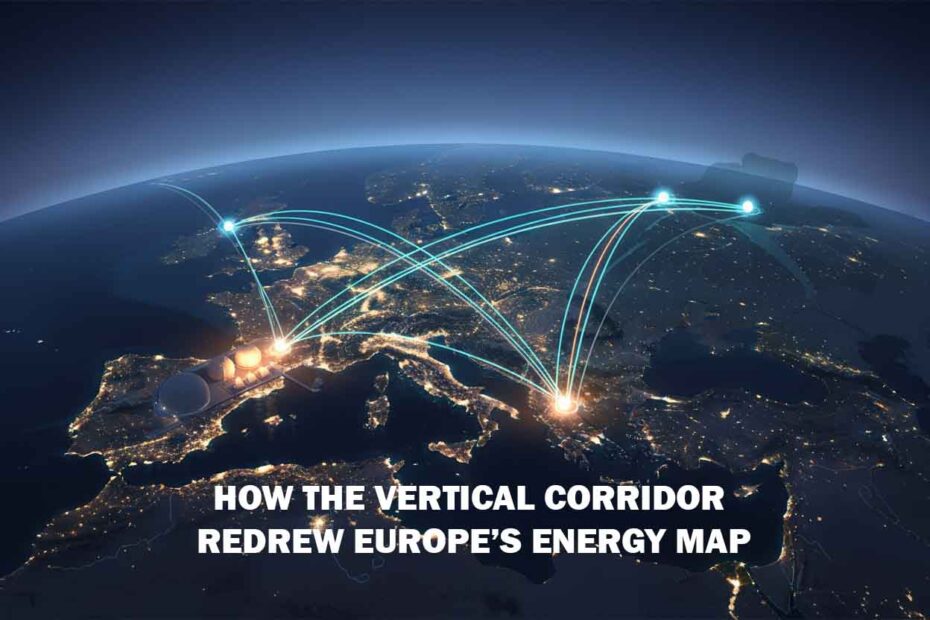
That calculation proved to be profoundly mistaken. In response, Washington and its partners did not escalate rhetorically; they redrew the map. Rather than relying on the traditional east–west axis of pipelines that crossed Turkish territory and channelled Russian gas into Europe, they engineered a new north–south route. This is the so‑called “Vertical Corridor”: a network of infrastructure running from the Aegean Sea up through the Balkans to the borders of Ukraine. It is not simply a new set of pipes; it is a deliberate geopolitical counter‑architecture designed to block Russian influence, bypass Turkey, and reposition Greece as a critical energy gateway to Europe.
This new configuration has already begun to dismantle decades of Turkish leverage and to rewire the political and economic relationships of south‑eastern Europe. Understanding this transformation requires focusing less on speeches and more on the “plumbing” of the energy system: the floating terminals, the reversed pipelines, the contracts and memoranda, and the way they combine to shift power.
The Strategic Role of Alexandroupolis: Floating Fortress of the Aegean
Just off the coast of Alexandroupolis, in north‑eastern Greece, lies a vessel that looks to the casual observer like a conventional gas tanker. In reality, it is something quite different: a Floating Storage and Regasification Unit, or FSRU. This ship is effectively a mobile liquefied natural gas (LNG) terminal. It receives LNG from tankers, stores it, regasifies it, and injects it into the onshore gas network.
From a military and strategic perspective, this is more than an industrial facility. It is a floating fortress; a hardened node of energy security, linked into a network that stretches across the Balkans. Alexandroupolis has been positioned as the primary seaward “entry point” for this new northbound flow of gas.
To understand why this matters, it is necessary to recall how the region’s energy architecture has functioned for the last half‑century.
The Old Order: A One‑Way Street from North to South
For decades, the Balkans and large parts of south‑eastern Europe depended on a single fundamental structure: the Trans‑Balkan Pipeline. Constructed during the Soviet era, this pipeline carried Russian gas from Ukraine through Romania and Bulgaria, before terminating in Greece and Turkey. It was designed as a one‑way artery: energy flowed southwards from Soviet and then Russian fields toward dependent consumers downstream.
This arrangement created not just physical dependence but political vulnerability. Gas did not merely heat homes and power factories; it also served as an instrument of coercion. That reality was brutally illustrated on 27 April 2022, when Gazprom cut off gas supplies to Bulgaria after Sofia refused to pay in roubles. The message was unmistakable: compliance would be rewarded with warmth; defiance would be punished with cold.
In the turmoil that followed, Ankara saw an opening. By leveraging its position at the crossroads of multiple pipeline routes and building on a proposal from Moscow, it put forward a plan for a so‑called “Thrace Gas Hub”. The concept was straightforward: Russian gas would arrive in Turkey, be blended and re‑labelled, and then sold onward into Europe. In this design, Turkey would become the gatekeeper. The Balkans and parts of the EU would be compelled to look south‑east for their survival, reinforcing Ankara’s influence at every negotiation table in Brussels.
On paper, it was a shrewd concept. Yet it overlooked one critical detail: while these manoeuvres were under discussion, Greece and the United States were already working quietly to re‑engineer the system itself.
Reversing the Flow: From Trans‑Balkan to Vertical Corridor
The breakthrough was not to lay an entirely new pipeline across virgin territory, but to repurpose what already existed. Rather than accepting that the Trans‑Balkan Pipeline had to function exclusively as a southbound conduit for Russian gas, engineers and planners explored a more radical alternative: reversing the flow.
By upgrading compressor stations and reconfiguring connections, the same infrastructure that once channelled gas from north to south was adapted to move gas from south to north. This is the essence of the Vertical Corridor concept: using existing Soviet‑era hardware in precisely the opposite direction it was intended, and thereby rewriting the logic of the region’s energy geography.
At the southern end of this system sits Alexandroupolis, receiving shipments of LNG—above all from the United States—regasifying it and sending it into the Greek transmission network. From there, high‑powered compressors push the gas northwards into the Interconnector Greece–Bulgaria (IGB). This interconnector marks the first major breach in what had been a Russian monopoly.
Once in Bulgaria, the gas moves on through the existing network toward Romania, Moldova and ultimately Ukraine. The physical reversal of flow creates a structural barrier: the pipes that once carried Russian gas are now filled with non‑Russian, predominantly American, molecules moving in the opposite direction. It is not a symbolic gesture; it is a hard constraint. Russian gas can no longer easily dominate these routes because they are occupied by competing supplies.
For Turkey, the implications are stark. The aspiration to become the central energy hub for the Balkans is eroded if those same Balkan states can access alternative routes that do not depend on Turkish territory or Russian gas.
Revithousa: The Quiet Backbone of Greek Energy Independence
While Alexandroupolis draws the headlines as a new strategic asset, it is not the only pillar of Greece’s emerging energy role. Just west of Athens lies the Revithousa LNG terminal, long the backbone of Greek gas imports and a foundational component of its energy security.
Revithousa has been operational for decades, quietly sustaining the Greek system, but recent investments have transformed its capacity and flexibility. Expanded storage tanks, upgraded regasification units and enhanced berthing facilities now enable it to handle substantial volumes of LNG, including large shipments from the United States. Together, Alexandroupolis and Revithousa form a dual‑port system feeding gas into the Greek grid and, by extension, into the broader regional network.
The operational logic is straightforward. LNG tankers arrive at one of the terminals, offload their cargo into storage tanks, and the LNG is regasified and linked into the national transmission system. From there, compressors push the gas northward into interconnectors and pipelines that feed neighbouring countries. But the political and strategic implications are anything but simple: these two terminals act as the southern gateways of a corridor that bypasses both Russian territory and Turkish straits.
The United States: From Supplier of Last Resort to King of LNG
The transformation of Balkan energy routes coincides with a broader realignment in global gas markets. In the years immediately following the full‑scale invasion of Ukraine, Europe was forced to scramble for alternatives to Russian pipeline gas. Domestic production in many EU states had declined, and alternative pipeline sources were limited. The vacuum was filled above all by liquefied natural gas, and within that category, by American LNG.
Within a remarkably short span, the United States became the dominant external supplier of LNG to Europe, capturing close to half of the European LNG market. The core logic was simple. First, Europe panicked as Russian supplies were disrupted or weaponised. Secondly, US exporters—backed by a growing fleet of LNG terminals on the Gulf Coast and elsewhere—stepped in to fill the gap.
However, Washington still confronted a geographical and logistical constraint. While it had abundant volumes of LNG, there were not enough suitable entry points into south‑eastern Europe. The Bosphorus Strait is heavily trafficked and subject to significant restrictions, including stringent safety rules that make frequent passage of LNG tankers politically sensitive and practically difficult. Furthermore, Turkey sits astride the crucial maritime chokepoint and wields regulatory influence over its usage.
The answer was to construct a “second door” into the Balkans that did not depend on transiting Turkish waters or territory. Alexandroupolis FSRU is precisely that door: with a capacity of around 5.5 billion cubic metres per year, it offers a dedicated route for US LNG to enter the European network and move northwards via the Vertical Corridor.
Over time, the American strategy has evolved from simply acting as a transit supplier to deepening its control along the energy value chain in the region.
From Transit to Ownership: A Chain of Custody in the Eastern Mediterranean
The emerging pattern is not limited to LNG cargoes arriving at Greek terminals. Major US energy companies have begun to take direct stakes in upstream and midstream assets in and around Greece, signalling a shift from ad hoc supply to sustained strategic presence.
One striking example is the entry of ExxonMobil into Greek offshore exploration, particularly in blocks west of Corfu and in the Ionian Sea. For years, international oil majors were hesitant to commit to exploration in Greek waters, partly due to regulatory uncertainty and regional tensions. With stronger political backing from Washington and a clearer strategic framework, that reluctance has diminished. US firms are now “all in”, integrating exploration and potential production into the wider scheme of supplying Europe.
At the same time, American and allied interests are expanding their presence in key Greek ports, such as Volos and Kavala. This is often described as building a “chain of custody”: controlling the points of entry for LNG, gaining stakes in ports and logistical hubs, investing in offshore gas prospects, and linking all of this into pipelines and interconnectors under friendly management.
The result is a network where the United States is not merely a distant exporter but a deeply embedded actor in the energy architecture of the eastern Mediterranean and the Balkans. For Turkey, this represents a “nightmare scenario”: the very states it had hoped to keep dependent on routes crossing its territory now have an alternative supply path that is physically and commercially insulated from Ankara’s control.
Eroding the Bottleneck: The End of Turkey’s Energy Monopoly in South‑East Europe
For roughly two decades, Turkish strategy in energy policy has been underpinned by a straightforward doctrine: to become the indispensable “energy bridge” between East and West. The idea was that wherever gas originated—Azerbaijan, Russia, or the Middle East—if it was destined for Europe, it would most likely traverse Turkish territory.
This geographical position was converted into political leverage. As long as key pipelines flowed across Anatolia, European institutions had to maintain at least functional relations with Ankara. Any deterioration in political ties risked complications over transit, tariffs, or access.
The Vertical Corridor undermines this logic. By changing the primary axis of movement from east–west to south–north, it provides what amounts to a backdoor into Eastern and Central Europe. Gas arriving via the Aegean is injected into a network that no longer needs to touch Turkish soil.
This is not solely about the immediate loss of transit fees or reduced usage of Turkish routes. The deeper problem for Ankara is the erosion of its “veto power”. If Europe can ensure the supply of strategic partners such as Ukraine, Moldova and various Balkan states through a combination of US LNG and potential future gas from the Eastern Mediterranean, delivered through Greek infrastructure, then Turkey’s ability to exert pressure or to trade concessions in exchange for energy access is sharply diminished.
A Historic Memorandum and the Emergence of a New Security Architecture
The reconfiguration of physical infrastructure has been matched by formal political commitments. On 19 January 2024, a significant Memorandum of Understanding was signed in Athens by Greece, Bulgaria, Romania, Hungary, Slovakia, Moldova and Ukraine. This agreement went beyond symbolism. It represented a collective declaration that the energy security of these countries—many of them frontline states in the evolving European security order—would henceforth be tied directly to the Aegean Sea.
By aligning their energy strategies around the Vertical Corridor and Greek entry points, these states are effectively institutionalising the new flow patterns. The Aegean becomes a central node in their survival strategies, not a peripheral maritime theatre. Energy contracts, infrastructure plans and regulatory alignments all begin to converge on this new architecture.
This, in turn, elevates Greece’s role in European politics. Athens moves from being merely a consumer at the edge of the continent to an indispensable guarantor of supply for a cluster of vulnerable countries. In practical terms, that translates into diplomatic capital, leverage in EU debates, and a strengthened position within NATO’s broader security framework.
Recasting Relations with Neighbours: Energy Pragmatism Over Old Rivalries
The emergence of Greece as an energy lifeline is also reshaping its relations with neighbouring states that have historically had complicated ties with Athens. Relations with North Macedonia and Albania, for instance, have long been coloured by ethnic disputes, historical grievances and political tensions.
Yet as new interconnectors to Skopje and pipelines across Albania are built and brought online, a more pragmatic logic begins to assert itself. When the stability of a neighbour’s power grid and heating systems depends on gas transiting through Greek infrastructure, the incentives for maintaining hostile or confrontational relations decrease markedly.
Energy interdependence has the potential to moderate tensions. States that might have previously viewed each other primarily through the lens of territorial or identity disputes now have to calculate the risks of jeopardising their access to critical supplies. The state that controls the valves, storage and entry points gains a degree of soft power that cannot easily be replicated by other means.
From Hub to Source: Greece’s Transition from Transit State to Producer
At present, much of the gas flowing through the Vertical Corridor is imported LNG, heavily dominated by US cargoes. However, the long‑term strategy for the region goes far beyond acting as a simple hub or corridor for foreign supplies.
Exploration activity in the Ionian Sea and south of Crete has accelerated. Seismic surveys and preliminary assessments suggest that significant quantities of natural gas could lie beneath Greek offshore waters, adding a potential indigenous production layer to the existing transit role. Should these reserves prove commercially viable and politically acceptable to develop, the same pipelines and terminals currently channelling foreign gas could be used to move Greek‑produced gas northwards into Europe.
This would represent a transformational shift. A country that was historically energy‑poor would become both a transit country and a producer, turning it into a source rather than merely a hub. The political implications are profound: as a producer supplying frontline states that are critical to broader European security, Greece’s position would be even more entrenched.
The signing of the 2024 memorandum in Athens is best understood against this backdrop: it is a pre‑emptive weaving together of future production, existing LNG flows, and shared infrastructure into a coherent framework that binds the participating states into a durable energy community centred on the Aegean gateway.
Designing for the Future: Hydrogen‑Ready Infrastructure
The architects of this system are not only thinking in terms of current gas demand and today’s geopolitical stand‑off. They are also anticipating the technological and policy shifts that will accompany Europe’s energy transition over the coming decades.
Key components of the Vertical Corridor, including the IGB pipeline and substantial sections of the Greek transmission grid, are being designed or upgraded with “hydrogen‑ready” specifications. This means that, in time, the same physical conduits that presently carry natural gas could be repurposed or adapted to transport blends of gas and hydrogen, and eventually pure hydrogen.
The forward‑looking plan is to use the Mediterranean region, including Greece, as a production hub for green hydrogen generated from renewable energy—especially solar and wind. This hydrogen could then be transported via existing or adapted pipelines to heavy industrial centres in Central Europe, where decarbonisation pressures are strongest but domestic renewables potential is relatively more limited.
If such a transition is realised, the Vertical Corridor becomes not only a route for today’s fossil fuels but the main highway for tomorrow’s zero‑carbon energy carriers. In that scenario, the political dependencies currently being created are not short‑lived. They extend into the second half of the century, binding the energy fates of Balkan and Central European states to the Aegean long after natural gas has begun to decline.
From a strategic perspective, this is akin to “checkmate”. Had Greece confined its role to LNG transhipment alone, its influence might have peaked within one or two decades, as global decarbonisation advanced. By integrating hydrogen readiness into its infrastructure, Athens is positioning itself to remain central to European energy security in a low‑carbon future as well.
The Eastern Mediterranean “Plug”: Linking EastMed to the Vertical Corridor
While American LNG is currently the dominant non‑Russian supply feeding the Vertical Corridor, the system is being engineered as an open “socket” into which other sources can be “plugged” in future. The most significant of these potential sources lies in the Eastern Mediterranean.
Gas discoveries off the coasts of Israel, Cyprus and Egypt have long promised to turn the region into a major supplier to Europe. Proposals have circulated for years about pipelines that might connect these fields directly to European consumers. One such concept is commonly referred to as the EastMed project, envisaging a pipeline system that would link Eastern Mediterranean gas reserves to Greece and then on to Europe.
If parts of that infrastructure are built and successfully connected, they could feed directly into the Vertical Corridor, allowing Israeli, Cypriot and Egyptian gas to flow through Greek territory and surge northwards into Eastern and Central Europe. The crucial point here is that such flows would not need to be routed via Turkey. They would arrive by ship to Greek LNG terminals or through pipelines that avoid Turkish jurisdiction altogether.
For Turkish strategists, this is particularly alarming. Their long‑term doctrine—articulated in concepts such as the “Blue Homeland”—has involved using naval presence and maritime claims in the Eastern Mediterranean to influence or obstruct potential energy routes that bypass Turkey. The implicit assumption has often been that if no pipeline could be built that circumvented Turkish territory or waters, Ankara would retain informal veto power over any major gas export scheme from the region.
The Vertical Corridor weakens that assumption. LNG can be shipped directly to Greek terminals under the protection of European and American political, economic and security interests. Pipelines connecting to Greece from Eastern Mediterranean production zones would further embed this pattern. In such a world, naval posturing or maritime disputes cannot easily stop the molecules from flowing.
NATO, the Aegean and the Security of Energy Corridors
The consolidation of the Vertical Corridor has not gone unnoticed in defence and alliance planning. Because the United States and the European Union have invested heavily in this infrastructure, the security of the Aegean and its coastal facilities is no longer merely a national concern for Greece; it has become a collective priority for NATO and the broader Western community.
The Alexandroupolis FSRU, the Revithousa terminal, and associated onshore installations thus acquire a dual character: they are commercial energy facilities and strategic assets. Any threat to their operation, whether through military action, hybrid tactics or sabotage, would have repercussions far beyond Greek borders. They underpin energy flows that keep the lights on in multiple NATO and EU capitals.
This reality tightens the political and security bonds between Greece and its allies. It also subtly shifts the balance of considerations in regional disputes. The more central Greek infrastructure becomes to allied energy security, the more incentive there is for the alliance as a whole to ensure its protection and to deter actions that might disrupt it.
The Closing of the Old “Energy Bridge” and the Opening of a Vertical Highway
The overall picture that emerges is one of a profound structural shift. The old map of Balkan energy politics was largely drawn in Moscow and Ankara. It depicted an east–west landscape in which gas flowed from Russian fields across Turkish territory and into Europe, carrying with it political influence and leverage.
Today, that pattern is being overturned. The flow of authority and dependency is increasingly oriented south–north. The Aegean Sea, rather than the Bosphorus, is becoming the key maritime entry point for energy into the Balkans and parts of Eastern Europe. Greece, once a peripheral consumer, is now at the centre of a new energy architecture that stretches from the Mediterranean to the borders of Ukraine.
For the United States, this aligns neatly with an emerging doctrine that favours controlled corridors over vulnerable bridges. Bridges can be blocked or bargained over; corridors—if properly secured and diversified—can be managed with greater autonomy. By anchoring its energy strategy in stable, allied territory in the Mediterranean, Washington reduces its exposure to the uncertainties of relations with other regional powers.
For Greece, the transformation is nothing short of revolutionary. The country has moved from a position of energy dependence and peripheral influence to one where it acts as both gatekeeper and, potentially, producer. It has obtained a degree of strategic insurance: as long as the Vertical Corridor remains operational and integrated into the energy security plans of multiple European states, Athens will occupy a privileged seat at any table where the future of European energy or Balkan security is being discussed.
For Turkey, the consequences are sobering. It remains a significant regional power with substantial infrastructure and a pivotal geographic position. However, it is no longer the sole indispensable route for energy into south‑eastern Europe. The “horizontal” dream of monopolising east–west transit has been cut through by a “vertical” reality that diminishes its leverage.
For the Balkans, Moldova, Ukraine and other partner states, the emerging system offers something priceless: resilience. With diversified supplies entering through the Aegean and moving along a south–north axis, the capacity of any single external actor to wield energy as a weapon is curtailed. The threat of being forced to “obey or freeze” is less credible when alternative routes exist and are backed by powerful allies.
The Vertical Corridor, then, is not merely a technical project or a regional upgrade. It represents a geopolitical reordering: a reorientation of flows, alliances and dependencies that will shape European security for decades to come.
Frequently Asked Questions
What is the Vertical Corridor and why is it strategically significant?
The Vertical Corridor is a coordinated energy infrastructure project designed to transport natural gas from the Aegean Sea in the south to the Balkans, Central Europe, and Ukraine in the north. Its significance lies in its ability to reverse the historical flow of energy in the region; whereas gas previously moved from Russia southwards, this corridor allows non-Russian gas to move northwards. By repurposing existing pipelines and building new interconnectors, it creates a structural barrier against energy blackmail and provides a viable alternative to traditional east–west routes that rely on Russian supply and Turkish transit.
How does this new energy map affect Turkey’s geopolitical leverage?
For decades, Turkey’s “Energy Bridge” doctrine was based on the premise that all gas from the East must cross Anatolia to reach Europe, granting Ankara a “veto” over European energy security. The Vertical Corridor effectively bypasses the Turkish landmass by using maritime routes and Greek entry points. This diminishes Turkey’s ability to use energy transit as a bargaining chip in its relations with the European Union and NATO, as Balkan and Eastern European nations can now secure their energy needs without Turkish permission or participation.
What role does the United States play in this transformation?
The United States has transitioned from a secondary supplier to a dominant force in the European energy market, now providing nearly 50% of the continent’s liquefied natural gas (LNG). Beyond supply, Washington has actively supported the development of the Vertical Corridor to bypass congested and regulated chokepoints like the Bosphorus Strait. Furthermore, American strategy has shifted toward “ownership,” with major US firms like ExxonMobil engaging in offshore exploration in Greek waters and US interests managing critical ports to ensure a secure “chain of custody” for energy molecules from the wellhead to the consumer.
Why are the Alexandroupolis and Revithousa terminals considered “gateways”?
These two terminals serve as the primary entry points for the entire Vertical Corridor system. The Revithousa LNG Terminal has long been the backbone of Greek energy, while the new Floating Storage and Regasification Unit (FSRU) at Alexandroupolis acts as a dedicated “second door” for international LNG. These facilities allow tankers to offload gas directly into the Greek grid, where high-powered compressors then push the gas north into the Interconnector Greece–Bulgaria (IGB) and beyond. They transform the Aegean Sea into a strategic hub that feeds the energy-hungry markets of the north.
Is the Vertical Corridor only intended for natural gas?
While the immediate priority is natural gas and LNG to replace Russian supplies, the infrastructure is being built with a “hydrogen-ready” future in mind. The long-term strategic plan involves repurposing these pipelines to transport green hydrogen produced from renewable sources in the Mediterranean to industrial centres in Central Europe. This ensures that the geopolitical influence gained by Greece and its partners will persist through the global energy transition, locking Central and Eastern European nations into this new energy orbit for the remainder of the century.