
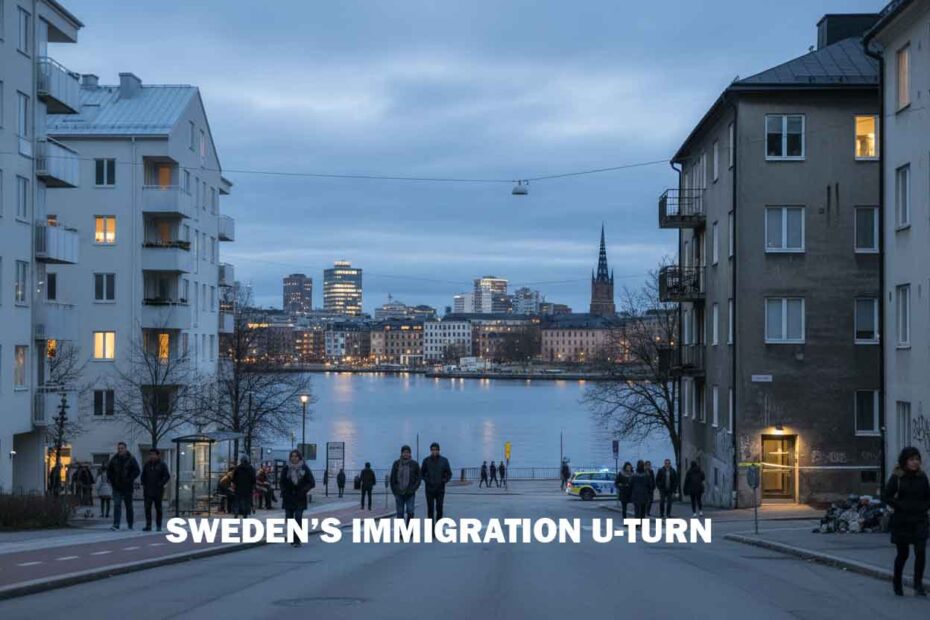
Sweden’s Immigration U‑Turn
From Humanitarian Superpower to Restrictive Outlier
For decades, Sweden was widely regarded as Europe’s humanitarian conscience. It combined a generous welfare model with one of the most liberal asylum regimes in the developed world. Successive governments proclaimed a moral duty to offer refuge; citizens volunteered in large numbers to support new arrivals.
Within a single decade, that self‑image has been fundamentally rewritten. Sweden now operates one of Europe’s most restrictive asylum systems, has sharply reduced refugee resettlement, and is experimenting with tools such as large cash payments for “voluntary return” and proposals to oblige public‑sector workers to report undocumented migrants. In parallel, the country has grappled with an unprecedented surge in gang‑related shootings and bomb attacks, many concentrated in disadvantaged, immigrant‑dense suburbs.
This article examines how that shift occurred, the main policy changes, their measurable effects so far, and the unresolved questions they pose for Sweden and for European migration policy more broadly.
From Refuge for the Persecuted to Global Symbol of Openness
Sweden’s post‑war identity was built partly on the idea of being a safe haven. After 1945 it accepted refugees from the Baltic states and from Nazi persecution. During the Cold War, dissidents from Eastern Europe arrived. In the 1990s, Sweden took in large numbers of people fleeing the wars in former Yugoslavia; in the 2000s it became a key destination for Iraqis and Somalis displaced by conflict.
By 2010 around 14–15 per cent of Sweden’s population was foreign‑born. Immigration was increasingly non‑European, and public debate began to focus on integration outcomes in schools, labour markets and housing. Even so, there remained broad political consensus in favour of comparatively generous asylum rules and permanent residence as the default for recognised refugees.
Sweden’s modern reputation as a humanitarian “superpower” crystallised during the 2015–2016 refugee crisis. As conflict in Syria, Iraq and elsewhere intensified, nearly 163,000 people applied for asylum in Sweden in 2015 alone – in a country of just over 10 million people. This was the highest intake per capita in the European Union.
To grasp the scale, that would be somewhat akin, on a population‑adjusted basis, to the United States admitting well over five million asylum seekers in a single year. Swedish towns and cities rapidly expanded reception facilities, and volunteers provided clothes, food and even temporary housing in private homes. Politicians across the spectrum framed this as a moral duty consistent with Sweden’s post‑war values.
But the decisions taken in those years would later be reassessed as the turning point when Sweden’s integration model came under unsustainable strain.
Integration Under Pressure
The immediate challenge was logistical: housing, schooling, healthcare and basic services for tens of thousands of newcomers. Refugee accommodation centres were established in municipalities that had little prior experience of large‑scale immigration. Local authorities suddenly had to expand social services, language classes and school capacity with limited preparation time.
At the same time, longer‑standing trends intensified. Residential segregation had been growing for years, especially around Stockholm, Gothenburg and Malmö. Suburbs such as Rinkeby and Tensta near Stockholm or Rosengård in Malmö developed into immigrant‑majority districts with elevated unemployment and lower average incomes. Swedish was less frequently spoken in public spaces; local schools became highly segregated by background.
Labour‑market integration proved a persistent weakness. Research has repeatedly shown that employment rates for refugees and their family members lag significantly behind those of native‑born Swedes for many years after arrival. Skilled migrants often struggled to have qualifications recognised; low‑skilled arrivals found themselves competing in a labour market with high wage floors and limited entry‑level jobs.
Data cited by Swedish economists points to stark disparities. Analyses have suggested that people with foreign background account for a disproportionate share of long‑term unemployment and social assistance recipients. Other studies have found that child poverty is heavily concentrated in households with foreign background, underlining the cumulative impact of labour‑market exclusion.
Discrimination and prejudice have also played a role. Surveys of employers have documented reluctance to hire applicants with non‑Nordic names or recent refugee histories, even when qualifications are comparable. For many families, this combination – lower employment prospects, linguistic barriers and concentrated poverty – created fertile ground for social marginalisation.
The gap between Sweden’s self‑image as a global model of integration and the lived reality in disadvantaged suburbs widened steadily. In public debate, frustration grew on two fronts: among migrants who felt locked out of opportunity, and among native‑born Swedes who saw segregation and welfare dependency as evidence that the model was failing.
The Rise of Gang Violence and Public Anxiety
Against this backdrop came a development that shocked the country: a dramatic escalation in lethal gun violence and bomb attacks, strongly linked to criminal gangs operating in or around immigrant‑dense areas.
Between 2013 and 2023 the number of fatal shootings in Sweden more than doubled. By the early 2020s Sweden had, according to comparative European data, one of the highest rates of gun homicide in the EU; only a handful of countries, such as Albania, reported higher levels. While overall crime rates in many categories remained comparable to other Western European states, the pattern and intensity of organised violence looked markedly different.
Cases that received media attention included hand grenades detonated in residential neighbourhoods, car bombs targeting rival gang figures but sometimes killing bystanders, and drive‑by shootings in broad daylight. In 2022 more than 60 people were killed in shootings in a country of around 10.5 million inhabitants, a per capita rate far above those of many neighbouring states. Stockholm’s gun homicide rate was reported as several dozen times higher than that of cities such as London when adjusted for population.
Law‑enforcement officials and criminologists have repeatedly noted that many of those involved in these violent conflicts are young men with immigrant background, often second‑generation: born in Sweden to parents who themselves arrived as refugees or family migrants. Police intelligence has identified organised criminal networks with roots in the Balkans, the Middle East and North Africa, embedded in socially marginalised Swedish districts.
While it would be misleading to reduce Swedish crime as a whole to questions of immigration – the majority of immigrants are not involved in crime, and socio‑economic factors are clearly important – the concentration of shootings and bombings in segregated, disadvantaged areas fuelled a powerful public narrative: that integration had failed, and that the refugee policies of the 2000s and mid‑2010s had contributed to a new type of insecurity.
The police themselves faced capacity challenges. Although the Swedish police authority has tens of thousands of employees, the number of officers per 100,000 residents has in recent years sat below the EU average. Investigations into gang killings are hampered by witness intimidation and a reluctance to testify, and some neighbourhoods acquired the reputation of “no‑go” areas where emergency services hesitated to enter without significant backup.
For a society that had long prided itself on low levels of violent crime and a high degree of social trust, this was a profound shock. It became a central issue in electoral politics.
Political Realignment: The Sweden Democrats and the Tidö Agreement
By the late 2010s, opinion polls showed public concern about immigration and crime overtaking many other issues. The nationalist Sweden Democrats, long considered pariahs due to their origins in far‑right and extremist milieus, capitalised on this discontent.
In the 2022 general election the Sweden Democrats won just over 20 per cent of the vote, becoming the second‑largest party in parliament. This represented a dramatic rise from the low single‑digit support they had recorded little more than a decade earlier.
The centre‑right Moderate Party emerged as the largest party in the right‑of‑centre bloc, but lacked a majority without cooperation from the Sweden Democrats. A new government was only possible via a formalised arrangement between the Moderates, Christian Democrats, Liberals and the Sweden Democrats.
In October 2022 these parties concluded what became known as the Tidö Agreement, named after the castle where the negotiations took place. The Sweden Democrats did not receive ministerial portfolios, but the agreement granted them significant influence over policy, particularly in the areas of migration, integration and law and order.
A central stated objective of the Tidö Agreement was to reshape Swedish asylum and migration policy so that it would rest on the “minimum level” required under EU and international obligations. In plain terms, Sweden would no longer seek to be more generous than its European peers; instead, it would reduce protections and entitlements until they matched the lower bound of what EU law permits.
This represented a conscious break with the country’s previous stance as a humanitarian leader. Mainstream parties that had for decades defended liberal asylum rules now accepted far‑reaching restrictions. Even the traditional centre‑left Social Democrats, while formally in opposition, shifted their rhetoric and policies to a more restrictive line, reflecting the scale of public concern.
The political centre of gravity had moved. What followed was a dense sequence of legislative and administrative changes.
The New Migration Regime: From Open Doors to Narrow Gates
The reorientation of Swedish migration policy rests on several pillars, most of which either have been implemented or are moving through the legislative process.
1. Temporary Protection as the Norm
Previously, recognised refugees were generally granted permanent residence permits, supporting the idea of stable long‑term integration. Recent reforms have made temporary residence the standard outcome for almost all successful asylum applicants.
Under the new approach, refugee status provides only a time‑limited right to stay, subject to periodic review. Government‑commissioned inquiries are examining whether existing permanent residence permits can be converted into temporary ones or revoked if conditions in countries of origin change or if the individual is deemed to have misrepresented their situation.
In effect, protection in Sweden is no longer treated as an automatic path to long‑term settlement, but as a conditional arrangement.
2. Sharp Reductions in Resettlement and Asylum Approvals
Sweden has historically participated enthusiastically in the UNHCR resettlement programme, accepting thousands of particularly vulnerable refugees directly from camps each year. In 2022 it resettled around 5,000 such individuals. Under the Tidö framework this annual quota has been cut to around 900 – a reduction of about 80 per cent, confirmed by the latest asylum country report for Sweden.
At the same time, first‑instance recognition rates have fallen. According to data compiled by the Asylum Information Database, there were 9,634 new asylum applicants in 2024, a decrease of nearly a quarter compared with 2023. Roughly 70 per cent of decisions at first instance were negative, meaning that only around 30 per cent of applicants were granted some form of protection or humanitarian status. The in‑merit protection rate – excluding procedural dismissals – was about 40 per cent.
In raw numbers, Sweden issued 6,250 asylum‑related residence permits in 2024, the lowest such figure since at least the mid‑1980s, down from more than 86,000 at the height of the crisis in 2016. Applications themselves, at under 10,000 in 2024, were at their lowest level since the mid‑1990s, despite global displacement at record highs.
3. Restricting Family Reunification
Family reunion has historically been one of the largest channels of legal migration to Sweden. Under recent reforms, the minimum age for spousal immigration has been raised from 18 to 21, a measure framed as a way to combat forced and child marriages. Income and housing requirements have been tightened. Even recognised refugees are now obliged to demonstrate that they can support family members financially and provide adequate accommodation.
These measures, taken together, significantly reduce the number of people who can enter Sweden via family links and are likely to have long‑term implications for community demographics.
4. Legal Alignment with EU Minimum Standards
The Swedish government has initiated a comprehensive review of asylum and reception legislation with an explicit aim: to ensure that domestic provisions are not more generous than the minimum required by EU directives and international conventions.
This includes reconsidering access to legal aid, conditions of reception, time limits before asylum seekers can access the labour market, and other procedural rights. The intention is not to leave international law, but to cease using national discretion to offer additional safeguards or benefits.
5. Faster and Broader Deportations
Legal amendments have made it easier to revoke residence permits or deny extensions where individuals are found to have provided false information or where their home country is deemed safer than when the permit was granted.
Foreign nationals convicted of certain categories of crime can now be deported more readily, including in cases where removal would previously have been unlikely. Return decisions can remain enforceable for as long as the individual stays in Sweden, removing previous time limits after which an old deportation order would lapse.
An inquiry into strengthening internal immigration controls has proposed expanding the powers of police and migration authorities to conduct checks and enforce removals.
6. Housing Controls and the End of Self‑Arranged Accommodation
For roughly three decades, asylum seekers in Sweden benefited from the so‑called EBO system, which allowed them to arrange their own accommodation – for example, living with friends or relatives – while still receiving financial support.
New legislation has largely dismantled this model. Financial allowances are now tied to residence in accommodation assigned by the Swedish Migration Agency. Asylum seekers who choose to live elsewhere generally forfeit their daily allowance and related support. The authorities have also been granted greater powers to verify that individuals are living at their registered address and to withdraw support if they are not in regular contact.
The stated aim is twofold: to keep unsuccessful applicants within reach for deportation, and to prevent self‑organised settlement in already vulnerable urban districts.
7. Obligations to Report Undocumented Migrants
One of the most contentious proposals in the new framework is the so‑called “reporting obligation” for public‑sector staff. The idea is to require certain officials – such as those in local government agencies – to inform migration or police authorities when they encounter a person they suspect is living in Sweden without legal status.
Early versions of the proposal generated strong opposition because they appeared to include teachers, healthcare workers and social‑service personnel. An official inquiry has since recommended exempting schools, health services and social care from mandatory reporting due to the potential harm to children and public health, but discussions continue about expanding the obligations in other areas of the public sector.
Human‑rights organisations and professional bodies argue that such measures undermine trust and may deter people from seeking medical help or enrolling children in school. Supporters contend that they are necessary to maintain the integrity of migration control.
8. Financial Incentives for Voluntary Return
Sweden has long offered modest payments to people who voluntarily return to their country of origin after an unsuccessful or time‑limited stay. Under the current government, this mechanism is being significantly expanded.
A government‑appointed committee examining incentives for voluntary return reported in 2024 that higher payments could encourage more people to leave, but might also undermine integration for those allowed to stay. Despite this caution, the 2025 budget proposed a substantial increase in the repatriation grant, with plans to raise the maximum amount to around SEK 350,000 (in the region of €30,000) per person from 2026.
This would make Sweden’s return grants among the most generous in Europe. The political logic is clear: if the country has become less attractive as a destination for asylum and irregular migration, it is prepared to spend significant sums to encourage those already present, but not successfully integrated or lacking long‑term status, to depart.
9. Tougher Criteria for Residence and Citizenship
Parallel inquiries are examining stricter conditions for residence permits and naturalisation. Proposals include reintroducing a broad “good conduct” requirement, under which repeated failure to honour debts, abuse of welfare systems or documented links to criminal networks could be grounds for denying or revoking residence permits.
For citizenship, suggested reforms include lengthening the required period of lawful residence from five to eight years, imposing a formal requirement for financial self‑sufficiency, and introducing language and civics tests. The latter would bring Sweden more into line with countries such as Denmark, Germany and the Netherlands, which have long required formal integration examinations.
Integration Policy Reframed: Rights with Conditionality
While much attention has focused on entry and return, the Swedish government is also reshaping policies affecting those who remain. The overarching philosophy is that integration should be more explicitly conditional on fulfilling certain obligations.
Language and Civic Knowledge
Swedish language education has always been a central plank of integration efforts, but attendance and outcomes have been uneven. The current policy direction is to enforce language learning more strictly, link it to access to certain benefits, and make language and civic‑knowledge tests prerequisites for permanent residence or citizenship.
In schools, the emphasis on early acquisition of Swedish has intensified, with debates about the role of mother‑tongue instruction and how to balance multilingualism against the need for common linguistic foundations.
Welfare and Work Incentives
Reforms to social‑assistance rules are geared towards ensuring that full‑time work is consistently more rewarding than welfare, even for low‑wage jobs. Measures discussed or implemented include ceilings on cumulative benefits and stronger requirements to participate in labour‑market programmes.
The government has also reoriented parts of Sweden’s substantial international aid budget, cutting it by more than half in 2023 and redirecting resources towards domestic integration and law‑and‑order priorities. Symbolically, this change encapsulates the pivot from an outward‑looking humanitarian mission to a more defensive focus on internal cohesion.
Segregation and “Vulnerable Areas”
Long‑standing concerns about segregated neighbourhoods, sometimes described in official parlance as “vulnerable areas”, are now being addressed with a mix of policing, social policy and urban planning. Measures include intensified policing, targeted social investment and, at times, controversial discussions about demolition or redevelopment of certain housing estates.
Critics argue that such policies risk stigmatising entire districts and their residents, many of whom are law‑abiding, and can displace rather than resolve underlying socio‑economic issues. Supporters insist that reducing concentrated disadvantage and criminal control is essential for equal opportunity.
Measured Outcomes: Numbers, Trends and Public Opinion
Has Sweden “solved” its immigration crisis, as some political narratives suggest? The answer depends on which metrics are chosen.
Migration Flows
By the narrow measure of asylum inflows, Sweden’s policies have had a dramatic effect. The country has moved from receiving more asylum applications per capita than almost any other EU state to numbers that are low in historical and European context.
In 2016, when the backlog from the 2015 peak was being processed, Sweden approved over 86,000 asylum‑related residence permits. In 2024 that figure was just over 6,000. Total new applications numbered fewer than 10,000 in 2024, down from around 163,000 in 2015.
This reduction is particularly striking given that Europe as a whole again recorded more than one million asylum applications in 2024, approaching levels last seen during the 2015 crisis. In other words, Sweden has largely opted out of the renewed increase in protection claims at European level.
Moreover, Sweden has recorded negative net migration for the first time in about half a century: more people are leaving the country than arriving. Out‑migration has risen among residents born in countries such as Iraq, Somalia and Syria, contributing to net population loss in some diaspora communities. Some individuals are believed to be returning to countries of origin; others are moving on to third countries with more favourable conditions.
Public Opinion
Public support for tighter controls has been a driving factor rather than a simple response to elite decisions. By 2023, opinion surveys showed that roughly three‑quarters of Swedes believed immigration over the previous decade had been too high and posed problems for the country. Immigration and crime ranked among the most important electoral issues.
The 2022 election can be seen as a referendum on law and order and migration: parties promising significant restrictions collectively won a majority of votes. Subsequent polling suggests that many voters, including some from immigrant backgrounds, support tougher measures against gang crime and abuses of the asylum system, while remaining positive about labour migration and legal pathways for highly skilled workers.
Crime and Security
Evaluating the impact of policy changes on crime is more complicated. Official statistics do indicate that the number of fatal shootings began to level off or decline slightly in some recent years, and high‑profile police operations have resulted in the arrest of numerous gang figures. However, Sweden continues to experience far higher levels of gun homicide than most of Western Europe, and bombings and explosions remain a distinct feature of its crime landscape.
Criminologists caution that structural drivers such as segregation, school failure and labour‑market exclusion cannot be reversed quickly and that any measurable effect of stricter migration rules on crime will take time to appear. For now, the link is largely indirect: by limiting new inflows and stepping up deportations of convicted non‑citizens, the government aims to reduce overall pressure on disadvantaged districts and signal that serious offending carries real consequences.
Integration and Labour Markets
On integration metrics, the picture is mixed. Employment rates among foreign‑born residents have improved in recent years in line with a broadly strong Swedish labour market, yet significant gaps remain compared with native‑born citizens, particularly for women from non‑European countries and for those with limited formal education.
Economic researchers have pointed out that foreign‑born individuals represent a disproportionately large share of long‑term unemployed, social‑assistance recipients and those living in relative poverty. School performance data show average attainment gaps between pupils with Swedish and foreign background, compounded in highly segregated schools.
Whether the new, more conditional integration model can close these gaps, or whether restrictions on family reunion and greater insecurity around residence will instead entrench exclusion, remains an open question.
Criticisms and Risks: Human Rights, Social Cohesion and Economic Needs
The transformation of Sweden’s migration regime has attracted significant domestic and international criticism.
Human Rights Concerns
Human‑rights organisations have warned that several of the new or proposed measures risk undermining Sweden’s obligations under international law. Concerns include:
- Very restrictive access to humanitarian residence permits, potentially leaving individuals in limbo despite compelling personal circumstances.
- Plans to extend the duration and enforceability of deportation orders indefinitely.
- The proposed reporting duties for public‑sector workers, which critics argue conflict with professional ethics in healthcare, education and social services and could deter vulnerable people from seeking help.
- The prospect of withdrawing residence permits or citizenship on grounds that may be broadly defined, raising questions about legal security and equal treatment.
Advocacy groups dealing with EU migrants, including many of Roma origin, have drawn attention to extreme hardship among people who fall outside both national welfare systems and formal migration protection frameworks.
Social Cohesion and Polarisation
There is a risk that policies perceived as targeting particular groups will deepen alienation among segments of the population of foreign background, especially younger people who have spent most or all of their lives in Sweden. Feeling singled out or treated as conditionally belonging may reinforce the very divides that integration policies seek to bridge.
Symbolic measures – such as discussions about citizenship revocation for serious crimes, even if applied rarely – can have a strong signalling effect. Supporters argue that this signal is necessary to restore public confidence; opponents fear it risks creating a tiered conception of belonging, in which naturalised citizens of immigrant origin feel less secure than those of native background.
Demographic and Economic Implications
Sweden, like many European societies, faces long‑term demographic pressures: an ageing population, a shrinking share of people of working age and looming labour shortages in sectors such as healthcare, elderly care, technology and engineering. For years, immigration has been a key factor sustaining population growth and labour‑force expansion.
Negative net migration and a sustained reduction in refugee and family inflows could, over time, exacerbate these challenges. Employers have warned that an increasingly hostile climate towards migrants may deter not only asylum seekers but also skilled professionals and international students, potentially undermining Sweden’s competitiveness in high‑tech industries and research.
The government’s answer has been to distinguish more sharply between humanitarian and labour migration: tightening the former while promising to facilitate the latter for highly qualified candidates. Whether this dual strategy can be implemented effectively, and whether talented workers will still view Sweden as an attractive destination, remains to be seen.
Sweden in a European Context
Sweden’s trajectory should not be viewed in isolation. Across Europe, the politics of migration have shifted markedly since 2015.
Denmark, for example, moved early towards a policy of “zero asylum”, combining strict border controls with efforts to externalise asylum processing and make refugee status explicitly temporary. The Netherlands and Austria have also tightened rules, and Germany has introduced new border checks and faster deportation procedures, even as it seeks to attract skilled workers.
What distinguishes Sweden is the height from which it has fallen in terms of international reputation: from being hailed as an exemplar of open, rights‑based asylum policy to positioning itself explicitly at the restrictive end of the EU spectrum. This makes Sweden a powerful reference point in debates elsewhere: some politicians cite it as a cautionary tale about “naïve” generosity; others use it as evidence that even very liberal societies can change course when integration problems become too pressing to ignore.
In EU negotiations on migration and asylum reform, Sweden now tends to align with states favouring stronger external border controls, more limited obligations on redistribution of asylum seekers and greater scope for member states to calibrate their own protection levels close to the legal minimum.
In effect, Sweden has redefined its international role from humanitarian advocate to proponent of a more controlled, security‑oriented approach.
Has Sweden “Solved” Its Immigration Crisis?
Whether Sweden has solved its immigration crisis depends on how that crisis is defined.
If the objective is simply to reduce the number of asylum seekers and family migrants arriving, the answer is that Sweden has been highly effective. By tightening laws, signalling a less welcoming environment and strengthening enforcement, it has cut new asylum applications to multi‑decade lows at a time when global displacement is at record levels. Net migration has turned negative, and some previously arrived migrants are choosing or being encouraged to leave.
If the goal is to restore public confidence that the state has control over its borders and migration system, there are indications that this too is being partially achieved. Voters who demanded a tougher stance have seen concrete measures and falling application figures. Political parties that long resisted such measures have adapted their platforms.
However, deeper questions remain unresolved:
- Crime and Segregation: It is not yet clear whether stricter migration controls will significantly reduce gang violence or whether the phenomenon is now largely driven by dynamics among those already resident. Tackling segregation, school inequality and labour‑market exclusion is a long‑term endeavour that cannot be addressed through asylum policy alone.
- Values and Identity: Sweden’s self‑understanding as a defender of human rights and international solidarity has been challenged. Supporters of the new course argue that a sustainable welfare state and internal security are prerequisites for any meaningful solidarity; critics contend that abandoning humanitarian leadership undermines the very values Sweden once prided itself on.
- Economic Future: A more restrictive stance on asylum and family reunification may ease short‑term integration pressures but could intensify demographic and labour‑market challenges in the medium term, depending on how successfully Sweden attracts and retains needed skills through other channels.
- International Precedent: Sweden is, in effect, running a real‑time policy experiment watched closely across Europe. If it manages to reduce crime, improve integration outcomes and maintain economic dynamism while restricting humanitarian migration, other states may follow a similar path. If, however, the gains on security prove modest and social cohesion frays further, the experiment may be judged far less favourably.
Conclusion: An Unfinished Experiment
In the space of ten years, Sweden has journeyed from being a poster child for liberal asylum policy to one of Europe’s most restrictive regimes. The country that in 2015 accepted around 163,000 asylum seekers in a single year granted just over 6,000 asylum‑related residence permits in 2024. It has slashed its resettlement quota, tightened family reunion, normalised temporary status, expanded deportation powers and prepared to offer substantial financial incentives for voluntary return.
Proponents argue that these steps were necessary and overdue, a corrective after years of underestimating the challenges posed by rapid, large‑scale migration into a small, high‑trust welfare society. They point to falling inflows, increased enforcement and a more candid public debate about integration failures as signs of progress.
Opponents see a country turning its back on people in genuine need, weakening the rule of law and creating a more precarious existence for those of migrant background who are already part of Swedish society. They warn that the price of restored control may be a long‑term erosion of trust, equality and Sweden’s international standing.
The truth is that the outcomes of this high‑stakes experiment are not yet fully visible. It will take years to assess whether Sweden’s new model delivers the safer, more cohesive society its architects promise, or whether it merely displaces problems while creating new ones.
What is already clear is that Sweden has demonstrated how quickly a liberal democracy can pivot when public confidence in integration falters. The pendulum has swung far from open‑door idealism towards restrictive pragmatism. Other countries, facing their own tensions over migration, are watching closely – and drawing lessons, whether for emulation or for caution.