
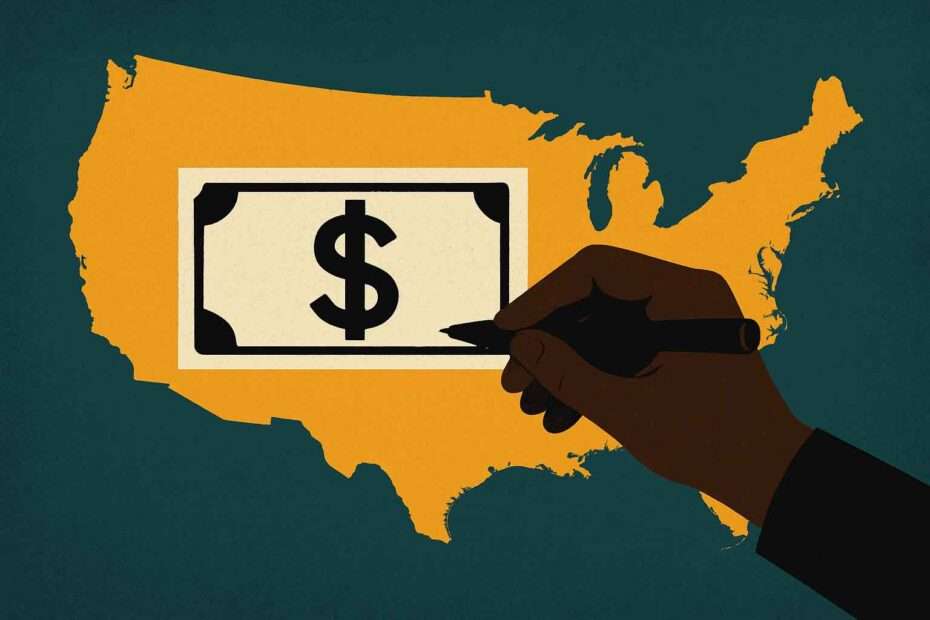
The American Economic Cheat Code Explained
How the Global System Became Structurally Rigged
Imagine a game in which all participants believe they are following the same rules, only to discover that one player has been operating under an entirely different rulebook from the beginning. Everyone else must earn their chips the hard way, and when they lose them, they are out. One participant, however, can simply create new chips when they run out, dictate the house rules, and enforce compliance with overwhelming force. That player also happens to own the table, the building, and the security team.
This is not a metaphor for corruption in a single industry or a failure of one government. It is a structural description of how the modern global economic system has operated since the middle of the twentieth century. For roughly eighty years, the United States has enjoyed a unique and historically unprecedented set of advantages that allow it to absorb shocks, externalise costs, and recover from crises in ways no other nation can replicate.
This advantage is not the result of one policy, one war, or one generation of leadership. It is the product of geography, post-war financial architecture, energy markets, military power, and the systematic concentration of global human capital. Taken together, these elements function less like a competitive edge and more like a collection of embedded “cheat codes” that bend the system itself in America’s favour.
Understanding this system requires moving beyond surface-level discussions about GDP, productivity, or individual administrations. It requires examining how the rules of the game were written, who wrote them, and why they continue to persist long after the circumstances that created them have faded.
What follows is a detailed examination of the five core mechanisms that underpin American economic dominance: geography, monetary privilege, energy pricing, military enforcement, and human capital extraction. Individually, each would be a significant advantage. Combined, they form a self-reinforcing system that has shaped global economics since the end of the Second World War.
1. Geography as Destiny: The Perfect Starting Position
Before considering finance, trade, or technology, it is necessary to start with the most basic and least discussed factor in national power: geography. Long before the United States issued its first treasury bond or built its first aircraft carrier, it benefited from one of the most favourable physical environments any large civilisation has ever possessed.
The North American continent provided early settlers with an extraordinary combination of fertile land, navigable waterways, and natural defences. Unlike regions plagued by deserts, dense jungles, or mountainous terrain that fragments economies, the central and eastern United States offered millions of square kilometres of highly arable soil suitable for large-scale agriculture.
However, fertile land alone does not create wealth. The true geographic advantage lies in transportation. Moving heavy goods over land has always been expensive. Roads degrade, vehicles require fuel, and friction imposes constant costs. Water transport, by contrast, is dramatically more efficient. Barges can move enormous volumes of goods using a fraction of the energy required by road or rail.
The United States possesses the most extensive system of navigable internal waterways in the world, anchored by the Mississippi River and its tributaries. This network connects the agricultural heartland directly to global export markets. Grain grown in the Midwest can be transported to international ports at a cost that competitors in South America, Africa, or Asia struggle to match.
In countries such as Brazil, agricultural producers must rely heavily on road transport, often over long distances and poor infrastructure, to reach ports. These logistical costs are embedded into every tonne exported. In the United States, geography itself provides a permanent, invisible subsidy. This advantage compounds year after year, generation after generation, independent of policy decisions or political competence.
Beyond trade efficiency, geography also provides security. The United States is bordered by two vast oceans, the Atlantic and the Pacific. These natural barriers have historically made large-scale invasion extraordinarily difficult. While European powers spent centuries fighting wars across shared borders, suffering repeated cycles of destruction and reconstruction, the American mainland remained largely untouched by modern warfare.
During the Second World War, this advantage proved decisive. While industrial centres across Europe and Asia were bombed into rubble, American factories operated at full capacity. The United States did not merely avoid destruction; it profited from reconstruction by supplying goods, machinery, and capital to devastated allies.
Energy further strengthens this geographic foundation. For much of the twentieth century, the United States was perceived as dependent on foreign oil. That narrative changed dramatically in the early twenty-first century with the large-scale deployment of hydraulic fracturing and horizontal drilling. Vast shale formations transformed the country into the world’s largest producer of oil and natural gas.
Energy independence, combined with food security and geographic invulnerability, places the United States in a category few nations can approach. Many countries must constantly worry about supply shocks, blockades, or resource scarcity. The United States, by contrast, can endure extraordinary levels of internal dysfunction while remaining materially secure.
Geography does not guarantee prosperity, but it sets the boundaries of what is possible. In the American case, those boundaries are exceptionally wide.
2. Bretton Woods and the Birth of Monetary Privilege
Geographic luck alone does not explain modern American dominance. The most powerful advantage ever acquired by the United States emerged not from the land, but from a conference room in New Hampshire in 1944.
As the Second World War neared its end, representatives from forty-four nations gathered to design a new global financial system. The objective was to prevent a repeat of the interwar chaos that had contributed to depression, protectionism, and conflict. However, the balance of power in that room was profoundly unequal.
Europe was financially exhausted. Industrial infrastructure lay in ruins. Gold reserves had been depleted to pay for war. By contrast, the United States emerged from the conflict with intact industry, enormous productive capacity, and the majority of the world’s monetary gold.
In this context, the United States proposed a new system. The US dollar would become the central reserve currency for global trade. Other currencies would be pegged to the dollar, and the dollar itself would be convertible into gold at a fixed rate. On paper, this appeared stable and mutually beneficial.
In practice, it granted the United States an unprecedented role at the centre of global finance.
For a time, the system functioned as intended. But as decades passed, American spending expanded dramatically. Military commitments, social programmes, and foreign interventions required levels of expenditure that exceeded gold reserves. Foreign governments began to notice the imbalance.
By the early 1970s, some countries sought to exchange their dollar holdings for gold, as the system allowed. Faced with the prospect of losing its gold reserves, the United States made a unilateral decision: it suspended convertibility altogether. The dollar would no longer be backed by gold.
Under normal circumstances, such a move would destroy confidence in a currency. Yet the dollar did not collapse. The reason was simple: there was no viable alternative. Global trade, commodity pricing, and financial contracts were already denominated in dollars. A sudden abandonment would destabilise the entire system.
This created what later became known as “exorbitant privilege”. The United States could issue debt in its own currency, which the rest of the world required to function. Other nations had to earn dollars through exports. The United States could create them.
When America runs deficits, it exports the consequences. Inflation generated by monetary expansion is absorbed globally. Foreign central banks accumulate US treasury bonds not because they are altruistic, but because they need liquid dollar assets to support trade and financial stability.
In effect, American debt does not behave like household or corporate debt. It is embedded within the operating system of global commerce. As long as the dollar remains dominant, demand for US debt persists regardless of fiscal discipline.
This is not a moral judgement; it is a structural reality. The rules of the system ensure that American liabilities function as global assets.
3. Oil, Power, and the Petro-Dollar System
The suspension of gold convertibility could have ended the dollar’s dominance. Instead, it marked the beginning of a new foundation: energy.
In the 1970s, global oil markets became the cornerstone of the international economy. Every industrialised nation depended on reliable access to petroleum. Recognising this, the United States forged strategic arrangements that tied oil pricing directly to the dollar.
Major oil-producing states agreed to sell crude exclusively in US dollars and to recycle surplus revenues into American financial markets. In exchange, they received security guarantees, military equipment, and political support.
The consequences of this arrangement were profound. Any country wishing to import oil needed dollars. This created a permanent, artificial demand for the American currency, independent of domestic economic performance. Even nations critical of US policy were compelled to participate.
Attempts to circumvent this system have historically been met with severe resistance. Whether through sanctions, diplomatic isolation, or military intervention, challenges to dollar-denominated oil trade have consistently failed. The message has been implicit but clear: energy markets operate within a dollar-based framework.
This system allows the United States to finance its military presence, trade deficits, and consumption through monetary expansion, while other nations bear the adjustment costs. Inflationary pressure is diluted across the global economy.
The petro-dollar does not operate in isolation. It reinforces the reserve currency system and ties energy security to American strategic interests. It is one of the central mechanisms by which monetary privilege is sustained.
However, it is also one of the most contested. Emerging economies have increasingly explored alternatives, including bilateral trade in local currencies and commodity-backed settlement systems. While none has yet displaced the dollar, the effort itself signals growing dissatisfaction with the existing order.
4. Military Power as Economic Infrastructure
Military spending is often portrayed as a burden on public finances. In the American case, it functions more like an investment in economic infrastructure.
The United States maintains a global military presence that ensures the security of major trade routes, maritime chokepoints, and financial systems. This security underpins global commerce. Shipping lanes remain open. Insurance markets function. Supply chains operate with predictability.
Other nations benefit from this stability without bearing proportional costs. Yet the arrangement is not altruistic. Control over trade security translates into leverage. Access can be restricted. Sanctions can be enforced. Compliance can be incentivised.
When countries fall out of favour, they do not simply lose diplomatic goodwill. They lose access to banking systems, shipping insurance, and international settlement networks. These tools can be more effective than conventional warfare.
Military research further amplifies this advantage. Public funding supports advanced research that eventually flows into the private sector. Technologies initially developed for defence applications underpin entire industries, from telecommunications to navigation and computing.
The American military thus functions as a publicly funded incubator for private innovation. Risk is socialised. Profit is privatised. The resulting companies dominate global markets, reinforcing economic leadership.
From this perspective, defence spending is not merely about security. It is a foundational component of the American economic model.
5. The Global Brain Drain: Human Capital Extraction
The final and perhaps most understated advantage lies in human capital. The modern economy is driven less by raw materials and more by ideas, innovation, and specialised knowledge. In this domain, the United States operates a highly effective extraction system.
Talented individuals are born everywhere. Genius is not geographically concentrated. However, opportunity is. The United States hosts many of the world’s leading research institutions, venture capital networks, and innovation ecosystems.
For ambitious scientists, engineers, and entrepreneurs, the incentives are clear. Advanced facilities, funding, legal protections, and financial rewards are concentrated within American borders. Immigration pathways for highly skilled individuals facilitate this inflow.
The economic logic is compelling. Other countries bear the cost of upbringing and early education. The United States captures the productive years. This represents an enormous transfer of value.
Entire industries have been built by individuals educated abroad but commercialised in America. Their success reinforces the attractiveness of the system, creating a self-perpetuating cycle.
For the countries they leave behind, the consequences are severe. The loss of skilled professionals undermines domestic innovation, governance, and long-term growth. Human capital flight is more damaging than financial capital flight, as it erodes future capacity rather than present wealth.
America’s ability to attract and retain global talent is not incidental. It is a core component of its economic dominance.
Cracks in the System
Taken together, these five elements explain how the United States has maintained economic primacy despite debt accumulation, industrial decline in certain regions, and internal political division.
However, no system is immutable. The conditions that enabled American dominance are evolving. Emerging economies are exploring alternatives to dollar settlement. Energy markets are diversifying. Military commitments are increasingly strained. Domestic inequality threatens social cohesion.
Empires rarely collapse from external pressure alone. More often, they are undermined by internal contradictions. The concentration of wealth, erosion of trust, and declining legitimacy pose risks that no cheat code can indefinitely offset.
The central question is not whether the system will change, but how and when. The transition, whenever it occurs, will reshape global economics in ways few fully anticipate.
Frequently Asked Questions
1. Is the American economic system deliberately designed to disadvantage other countries?
The system evolved through historical circumstances rather than a single deliberate plan. However, its structure undeniably advantages the United States and imposes constraints on others.
2. Can another country replicate America’s economic model?
Certain elements, such as innovation ecosystems, can be emulated. Others, like geography and reserve currency status, cannot be easily replicated.
3. What would happen if the dollar lost its reserve currency status?
The United States would face higher borrowing costs, reduced monetary flexibility, and greater fiscal discipline. The global economy would likely experience significant volatility during any transition.
4. Are efforts by emerging economies to bypass the dollar likely to succeed?
Incremental changes are possible, but replacing a global reserve currency requires deep financial markets, trust, and stability. Such transitions historically take decades.
5. Does American dominance benefit the rest of the world at all?
Yes. The current system provides stability, liquidity, and security that support global trade. The issue is not whether it provides benefits, but how unevenly those benefits and costs are distributed.