
The China Housing Crash
Ghost Cities and a Global Warning
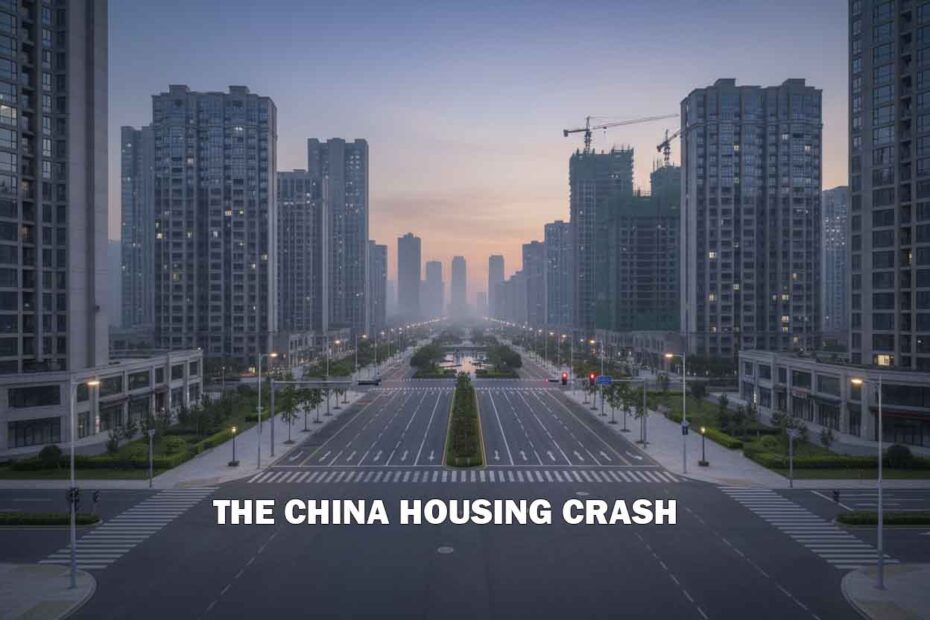
In the early 2020s, a striking and unsettling image emerged from China: vast modern cities, complete with grand boulevards, gleaming skyscrapers, manicured parks and elaborate replicas of European landmarks – but almost no people. Traffic lights cycled dutifully from red to green, yet no cars appeared. Towering apartment blocks stood pristine and silent, their lifts never used, their corridors never scuffed by the passage of residents.
These so‑called “ghost cities” are not the result of war, plague or natural disaster. They are the product of a deliberate economic model that treated concrete and real estate as the primary engines of growth. At its peak, China’s property sector amounted to the largest asset class in human history, estimated at around 60 trillion US dollars. Today that edifice is cracking, revealing a complex story of distorted incentives, hidden debt, broken promises and profound social consequences.
What is unfolding in China is not simply a national real estate crisis. It is also a case study in how financialised housing, demographic change and political choices can together create a bubble of historic proportions – and what happens when it begins to deflate. It offers uncomfortable lessons for the rest of the world, especially countries that have come to rely on rising house prices as a substitute for broader economic dynamism.
This article examines how China’s housing boom grew so large, how it turned into a kind of Ponzi scheme, why demographic realities now make a soft landing unlikely, and how the consequences may radiate far beyond China’s borders.
1. A Concrete Addiction: How the Bubble Was Built
One stark statistic captures the scale of China’s construction binge. Between 2011 and 2013, China used more cement than the United States did during the entire twentieth century. In just three years, more concrete was poured than was used to build the Hoover Dam, the interstate highways, the great American skyscrapers and the sprawling suburbs combined.
This was not the result of a desperate need to house a billion homeless citizens. It was the product of a political and economic system that became addicted to construction-led growth. The substance was concrete; the drug was Gross Domestic Product.
Fiscal Reform and Land as Lifeline
To understand how this addiction began, one must go back to the mid‑1990s. In 1994, China’s central government reformed the tax system in a way that dramatically reshaped local incentives. Beijing claimed the lion’s share of tax revenues, while local governments were left responsible for much of the spending: roads, schools, hospitals, metro systems and the visible hallmarks of development.
Local officials found themselves in a bind. They were politically accountable for delivering rapid urbanisation and modern infrastructure, yet they lacked a robust tax base. The solution lay in the one asset they controlled: land.
In China, all land is ultimately owned by the state. Local governments can, however, convert rural land to urban use and then lease out long‑term use rights to developers. This became a lucrative revenue stream known as land transfer fees. Farmland was expropriated from villagers at low prices, often with minimal compensation, and then sold on to property developers for enormous sums.
Overnight, struggling municipalities became flush with cash. The proceeds funded subways, stadiums, government offices and showcase projects. The visible transformation reinforced the careers of local leaders and sustained the illusion of inexhaustible growth.
Building for GDP, Not for People
The mechanics of this model created a powerful and perverse incentive: the more land values rose, the more money local governments could raise from land sales, and the more they could spend. Conversely, if land prices fell, municipal finances would be imperilled and officials’ careers jeopardised.
In practice, this meant that authorities did everything possible to encourage property development, regardless of whether there was genuine underlying demand. Empty land became a canvas for speculative projects: new districts laid out on grand plans; business parks without tenants; residential towers built in anticipation of future populations that, in many cases, never arrived.
The key point is that the act of building itself became the engine of measured economic growth. Gross Domestic Product, as conventionally defined, rises when money is spent: on cement, steel, labour, machinery and associated services. It does not distinguish between construction that meets real needs and construction that merely shifts dirt from one place to another.
In effect, China institutionalised a kind of economic activity that, in real terms, generated little lasting value. As long as money was being spent on construction, GDP figures looked impressive.
Local Government Financing Vehicles: Debt in the Shadows
To keep the boom going, municipalities needed not only ever‑rising land values but also access to credit. Formal borrowing limits often constrained direct government debt, so local authorities turned to more opaque instruments: Local Government Financing Vehicles (LGFVs).
LGFVs are corporate entities established by local governments to borrow on their behalf. They issue bonds and take bank loans, using land as collateral, and channel the funds into infrastructure and real estate projects. Because these entities sit at arm’s length from the official budget, their liabilities do not appear directly on government balance sheets.
Estimates vary, but such vehicles are thought to have accumulated many trillions of dollars in debt – on the order of the combined gross domestic product of major economies such as Germany and Japan. The true scale is uncertain, and that uncertainty is itself a source of risk.
The system resembles a shell game. Local governments sell land to developers, including to LGFVs that they themselves control, at ever higher prices. Those entities then use the inflated land valuations as collateral for further borrowing from state‑owned banks. The borrowed money finances yet more building, which in turn supports the illusion of rising land values, enabling even more borrowing.
The underlying asset is not genuine user demand but the expectation that prices will continue to rise and that the state will ultimately stand behind the debt. At the base of this edifice lie the savings of ordinary households, poured into property as the preferred store of wealth.
2. The Pre‑Sale Model: A Ponzi‑Like Betrayal
If the fiscal system and LGFVs created the supply of ever more housing, the demand was engineered through a distinctive sales model and deep‑rooted social norms. In China, home ownership is not merely a financial decision; it is closely tied to social status and family expectations.
In many communities, owning a flat is seen as a prerequisite for marriage, particularly for men. A young man without a property deed may be considered an unsuitable husband. This cultural expectation channels the savings of extended families into a single crucial purchase.
Buying a Hole in the Ground
Unlike in many Western markets, where mortgage payments typically begin once a house is completed and handed over, China’s dominant arrangement has been the pre‑sale model. Under this system, developers sell units off‑plan, often years before construction is complete. Buyers put down large deposits or take out full mortgages on properties that may barely exist as foundations in the ground.
For millions of families, the decision unfolded in a similar pattern. After decades of hard work, often at low wages, parents and grandparents pooled their life savings to help a son secure a flat. They visited a glossy sales office, admired architectural models of gleaming towers with landscaped gardens and fitness centres, and were assured of completion dates just a few years away.
Developers encouraged buyers to pay upfront or to begin servicing mortgages immediately, even while their future homes were still construction sites. In a rising market, this appeared rational. Prices on paper often appreciated rapidly, giving buyers the sense that they had made a profitable investment before they had even received the keys.
Robbing Peter to Pay Paul
The fragility of this model lay in how developers used the funds they collected. Instead of ring‑fencing pre‑sale proceeds for the specific projects in question, many large firms, including some of the country’s biggest names, used the money to acquire yet more land, launch new projects and service existing debts.
In effect, cash from one group of buyers was used to cover obligations to previous lenders and to finance fresh developments. As long as new purchasers kept arriving and prices kept rising, the apparent solvency of the system was maintained.
From a financial perspective, the structure bore a strong resemblance to a Ponzi scheme. New money was needed continually to pay back old commitments. So long as confidence remained high, developers expanded aggressively, leveraging their balance sheets and assuming that they could always refinance.
The “Three Red Lines” and the Sudden Stop
By the late 2010s, concern grew in Beijing that the property sector’s debt was spiralling out of control. Housing had become an ever larger share of the economy, and major developers had amassed vast liabilities. To curb the risk, the central government introduced a set of regulatory thresholds known as the “three red lines”, limiting how much highly leveraged developers could borrow based on debt‑to‑asset, debt‑to‑equity and cash‑to‑short‑term‑debt ratios.
Once these rules came into force, heavily indebted firms were suddenly cut off from fresh credit. The flow of new loans that had sustained the entire structure dried up. Major developers found themselves unable to roll over old debts or pay contractors. Construction sites slowed and then halted.
For ordinary homebuyers who had been making mortgage payments on unfinished properties, this was devastating. They found themselves servicing loans for flats that were little more than abandoned shells.
Mortgage Boycotts and Broken Trust
By 2022, anger and desperation spilled into a rare form of collective action: mortgage boycotts. Across numerous cities, buyers of stalled projects organised via social media, publicly declaring that they would refuse to continue paying mortgages unless construction resumed.
In a highly controlled political environment where dissent is usually swiftly suppressed, this wave of coordinated non‑payment was striking. Images emerged of families moving into half‑built towers, living without lifts, electricity or running water, using camp stoves amid bare concrete. Their presence was a form of protest and a practical necessity; they had no alternative housing and no faith that their promised homes would be finished.
At the same time, revelations emerged about how funds had been used. Some developers had invested in unrelated ventures such as football clubs, speculative technology projects and lavish corporate headquarters. Wealthy executives had acquired luxury assets at home and abroad, even as their firms struggled to complete basic housing.
The pre‑sale model was not simply a risky business practice. It represented a profound breach of trust between households and the economic system. For many families, a flat had been the culmination of decades of sacrifice and the linchpin of their financial future. The realisation that their money had been used to perpetuate a bubble, rather than to build their homes, eroded confidence that will be hard to restore.
3. Demographic Reality: An Empty Cradle
If financial excess created the bubble, demographic change is now ensuring that it cannot easily reinflate. Real estate demand over the long term is largely a function of household formation: how many people are entering the age at which they form new households, marry, and have children. In China, multiple trends are converging to depress that demand.
The Long Shadow of the One‑Child Policy
Beginning in 1980, China enforced a strict one‑child policy for most urban families. The policy undoubtedly slowed population growth; by some estimates, it averted around 400 million births. Today, that absence is being felt keenly in the housing market.
The cohorts that would now be forming families and buying their first homes are significantly smaller than they would have been under different policies. Recent years have seen China’s population begin to decline in absolute terms – a milestone not seen since the era of famine in the early 1960s. United Nations projections suggest that, without dramatic changes, the population could halve by the end of the century.
A property market designed around endless growth in household numbers is now facing the opposite reality: fewer births, fewer marriages, fewer new families.
The 4‑2‑1 Family Structure and Inherited Property
For decades, the standard urban family model has been described as “4‑2‑1”: four grandparents, two parents and one child. In the boom years, this structure actually supported the property bubble, as the combined savings of six adults were channelled into buying a single apartment for the only child. That concentrated purchasing power underpinned rising prices.
However, as time progresses, the pattern reverses. The sole child of such a family may eventually inherit not only the parents’ flat but also additional properties owned by each set of grandparents. One individual may find themselves, at least on paper, the owner of multiple dwellings.
The crucial question then becomes: to whom can these properties be sold? Peers in the same age cohort are likely to be in similar positions, inheriting multiple units themselves. In aggregate, this sets up an environment where a relatively small cohort of younger adults is expected to absorb a very large stock of existing housing.
Youth Unemployment and “Lying Flat”
Compounding the demographic issue is the economic situation facing many young people. Youth unemployment has risen sharply in recent years, to the point where official statistics became politically sensitive and were temporarily withheld. In response to intense pressure and bleak prospects, a cultural trend known as “lying flat” has gained traction among some younger Chinese.
“Lying flat” refers to a conscious decision to withdraw from the intense competition of mainstream urban life: rejecting long working hours, declining to participate in high‑pressure career and family expectations, and often choosing to delay or forgo marriage and children altogether.
The implications for housing demand are clear. Fewer marriages and fewer children mean fewer newly formed households. In 2013, China registered over 13 million marriages; by 2022, that number had fallen to under 7 million. Such a sharp decline in marriage rates is directly connected to reduced household formation.
Combined with a shrinking working‑age population and economic insecurity, these trends make it unlikely that demand will absorb the vast overhang of housing stock, particularly in less desirable locations.
4. “Tofu Dreg” Projects: When Assets Become Liabilities
A further problem lies not only in the quantity of housing but also in its quality. In the rush to build quickly and cheaply, corners were often cut and standards compromised. This has given rise to a term in Chinese discourse: “tofu dreg projects”.
The phrase was originally coined to describe shoddy flood defences that crumbled under pressure, likened to the soft residue left after making tofu. It has since been widely applied to substandard buildings and infrastructure that may look solid from a distance but prove fragile in practice.
Construction Shortcuts and Corruption
Reports and videos over the years have shown buildings in which concrete could be scraped away by hand, revealing rusted reinforcing bars; walls filled with inappropriate materials; balconies detaching from towers; and structural elements deteriorating far earlier than expected.
One common shortcut has been the use of sea sand instead of properly treated river sand in concrete. Sea sand, if not thoroughly desalinated, contains salts that corrode steel reinforcement. This greatly shortens the effective lifespan of structures. Such practices can persist when inspection regimes are weak or compromised by bribery, with contractors and officials colluding to sign off on unsafe work.
Where rigorous building standards are enforced, residential structures can remain sound for many decades, even a century or more. In parts of Europe and North America, homes built in the early twentieth century are still in active use and often command premium prices. By contrast, some estimates suggest that many modern Chinese residential buildings may have effective lifespans of only 25 to 30 years before serious structural issues arise.
For owners, this transforms what should be a long‑lived asset into something more like a wasting liability – particularly troubling when mortgages are structured over decades. A buyer may find that a building requires major repairs or even becomes unsafe within the term of their loan.
Waste as a Growth Model
The property sector is part of a broader pattern of overproduction and waste. Fields have been filled with unused electric vehicles built to qualify for subsidies; mountains of abandoned shared bicycles have accumulated on the outskirts of cities; and numerous industrial projects, launched to satisfy growth targets rather than market demand, have fallen into disuse.
In all these cases, the immediate spending boosts measured GDP, but the long‑term economic value is dubious. When applied to housing, the waste is especially stark: millions of structurally questionable flats that may never house long‑term residents.
Instead of a robust housing market, this resembles a vast physical manifestation of misallocated capital – a kind of concrete landfill that will require ongoing maintenance, remediation or demolition.
5. Global Contagion: Why It Matters Beyond China
It might be tempting to view China’s housing crisis as a distant problem, confined to particular cities and the lives of people within China’s borders. That would be a mistake. The scale of the country’s economy, and the extent to which its growth has been intertwined with global trade and investment, mean that the unwinding of its property bubble has international consequences.
Three channels of contagion are particularly significant: commodities, international real estate and global manufacturing.
Commodities: The End of an Era
For roughly two decades, China has been a dominant consumer of many of the world’s key commodities. It has accounted for around half of global steel demand, a majority share of concrete consumption, and substantial portions of copper, iron ore, timber and other raw materials.
Resource‑rich countries, from Australia and Brazil to parts of Africa and Canada, have oriented significant parts of their economies around supplying China’s construction boom. Mines were opened, railways expanded and ports modernised to feed the appetite for building ghost cities and infrastructure.
As construction slows, demand for these inputs falls. Lower prices and volumes can strain the public finances of exporting countries, lead to job losses in mining regions and reduce investment. In nations where government budgets are heavily dependent on resource revenues, this can have knock‑on effects on public services and domestic politics.
The ripple effects can also reach financial markets. Commodity producers often represent a substantial portion of stock indices, particularly in countries dependent on mining and energy. A downturn in Chinese demand, therefore, does not only affect distant workers; it can depress pensions, investment portfolios and government revenues in countries thousands of miles away.
International Property: The Retreat of Foreign Buyers
In the years when China’s domestic property market was booming, many wealthy individuals sought to diversify by purchasing real estate abroad. Cities such as Vancouver, Sydney, London and various locations in North America and Europe saw significant inflows of Chinese capital into both residential and commercial property.
For local markets, this often contributed to rising prices, particularly in the high‑end and new‑build segments. Developers and estate agents in some cities came to rely on such buyers, tailoring marketing campaigns and investment products to their preferences.
Now, as China’s property downturn and capital controls constrain the ability of citizens to move money abroad, this source of demand is weakening. Some overseas buyers are seeking to liquidate assets to cover obligations at home or simply to reduce exposure.
In response, certain luxury property markets have seen increased listings and softer prices. While domestic factors, such as interest rate rises, play a role, the reversal of Chinese capital flows is an important part of the story. Where local markets had become dependent on foreign demand, the adjustment may be painful.
Deflationary Pressure and Trade Tensions
As domestic demand weakens, Chinese manufacturers face excess capacity. Factories built to serve a fast‑growing internal market now find that customers have become more cautious. To maintain output and employment, producers seek foreign buyers, often competing aggressively on price.
This can lead to a surge of low‑priced exports: electric vehicles, solar panels, batteries, consumer electronics and other goods. On the face of it, the availability of cheaper products might appear beneficial to consumers in importing countries. However, the sudden influx can destabilise domestic industries, provoking calls for protection.
Trade disputes have already intensified, with Western governments imposing higher tariffs on certain Chinese products, especially in strategic sectors such as green technology. These measures are often justified on grounds of unfair subsidies, overcapacity and national security, but the underlying driver is the imbalance created when a major economy seeks to export its way out of a domestic slowdown.
The chain of causation leads back to property. Years of construction‑led growth encouraged massive industrial investment. Now, with the building boom fading, that capacity has to find other outlets, exacerbating global tensions.
6. The State’s Dilemma: Attempting a Controlled Demolition
From the perspective of China’s leadership, the property bubble poses a stark challenge. Allowing the market to clear rapidly risks social unrest and financial instability. Intervening too heavily to support it risks perpetuating moral hazard and draining public resources.
Between Collapse and Inflation
One option would be to let major indebted developers fail outright, allowing courts to liquidate assets and bondholders to absorb losses. In a fully market‑based system, that might be the textbook response to over‑leverage and mismanagement. However, the political costs would be enormous.
Millions of households would see the value of their biggest asset plummet, and many would likely lose the homes for which they had paid. Banks and local governments that had lent heavily to developers could find their balance sheets impaired, potentially triggering a wider financial crisis. For a regime that prizes stability, such an outcome is deeply unattractive.
The opposite approach is to socialise the losses entirely: print money, direct state banks to extend new credit indefinitely, and effectively guarantee all major players. While this might stave off a sudden collapse, it would swell public and quasi‑public debt, entrench inefficient firms and potentially undermine confidence in the currency.
Neither path is appealing. The result has been a strategy that seeks to split the difference: support specific projects to prevent mass unrest, while allowing some large developers to default or be restructured.
Prioritising Completion Over Developers
Policies in recent years have increasingly focused on finishing homes that have already been sold. Banks have been encouraged to lend selectively to particular housing projects, rather than to developers as corporate entities. The aim is to ensure that buyers receive physical flats, even if the companies that sold them ultimately disappear or are dramatically downsized.
This “project whitelist” approach is intended to mitigate the anger of ordinary citizens and to fulfil, at least in part, the implicit social contract that underpinned the pre‑sale system. However, it is far from clear that available resources are sufficient to complete all stalled projects, especially given the sheer volume of unfinished units across the country.
Court‑ordered liquidations of large developers outside mainland China, for instance in Hong Kong, have underscored the legal and financial complexity of unwinding these firms. Within mainland China, proceedings may move more slowly or be shaped by political imperatives rather than market logic.
Pivoting the Growth Model
Beyond the immediate crisis management, policymakers have declared a desire to shift the economy away from its heavy reliance on property and infrastructure investment towards more advanced manufacturing and technology‑driven growth. Emphasis has been placed on sectors such as semiconductors, electric vehicles, renewable energy and artificial intelligence.
In principle, this rebalancing is sensible. No economy can indefinitely depend on building ever more housing and roads at the same rate. However, the transition is inherently challenging. Real estate and construction have accounted for a very large share of China’s GDP and employment. High‑tech industries, while important, are not yet large or labour‑intensive enough to absorb the slack quickly.
The result is a period of adjustment that may entail slower growth, higher unemployment in certain regions and rising social strains. The property bubble, in this sense, has delayed but not eliminated the need for a more sustainable growth model. Now that the bubble is deflating, the costs of that delay are becoming visible.
7. A Mirror for the World: Lessons Beyond China
It is tempting, especially in countries with different political systems, to view China’s predicament as an idiosyncratic failure of state capitalism. Yet many underlying dynamics are not unique to China.
At heart, the story is about the financialisation of housing – the transformation of homes from places to live into primary vehicles for savings, speculation and status. When housing becomes the favoured store of wealth, and when credit is abundant, prices can detach from underlying incomes and demographics.
The Universal Belief That Property Only Goes Up
In numerous countries, particularly in parts of North America, Europe and Australasia, there is an entrenched belief that property prices, over time, only move in one direction: upwards. Governments, banks and households alike come to rely on this assumption.
Cheap money, in the form of low interest rates and generous lending, encourages ever more borrowing to buy existing homes. Rising prices, in turn, bolster consumer confidence and make borrowers feel richer, even if their wealth is largely illiquid and contingent on continued price growth.
The term “malinvestment” describes the process by which capital is drawn into projects or assets that do not ultimately produce commensurate real value. In the early 2000s, for example, the United States built vast numbers of houses in regions where long‑term demand was questionable, financed by risky mortgages that eventually triggered the global financial crisis.
China’s experience represents this phenomenon on a far grander scale. Instead of scattered suburbs, there are entire cities built to satisfy speculative demand. Instead of a single decade of excess, the boom has stretched over two decades, fuelled by state‑directed credit and fiscal incentives.
The Limits of Building Your Way to Prosperity
The lesson is sobering. An economy cannot permanently rely on selling houses to itself as a primary engine of growth. Construction can be a powerful driver when it addresses genuine shortages and supports productivity. But when it overshoots, building ahead of sustainable demand, it creates an illusion of prosperity that eventually must be corrected.
Once too many dwellings have been built in the wrong places, or to poor standards, the sunk cost cannot easily be recovered. Prices may stagnate or fall, leaving owners and lenders nursing losses. Governments may be forced to intervene, socialising debts that were once private. The economic hangover can last for years or even decades.
The deeper risk is not merely financial but social. When housing becomes unaffordable for younger generations in some countries, or when it becomes a source of betrayed expectations in others, faith in the broader economic system can erode. Those who did “everything right” – working hard, saving, buying a home – may feel deceived when the promised security evaporates.
Mathematics Does Not Respect Borders
Ultimately, the forces at work are mathematical. If the stock of housing grows faster than the population and incomes that can support it, and if much of that stock is effectively non‑durable due to poor construction, then the notion of ever‑rising value becomes unsustainable.
Debt, too, has limits. When borrowing is repeatedly rolled over rather than repaid from productive returns, it accumulates into a burden that constrains future growth. The laws of compounding interest and balance sheets apply regardless of political system or cultural context.
China’s ghost cities are a dramatic and visible manifestation of these truths. They serve as a kind of physical monument to a period in which concrete and credit were treated as synonyms for development. But they are also a warning sign.
Conclusion: Ghost Cities and Fragile Foundations
China’s housing crash marks the unwinding of the largest construction boom the world has ever seen. In a few extraordinary decades, concrete, steel and glass were assembled on a colossal scale, reshaping skylines and lifting many out of rural poverty. Yet beneath the impressive façades, fundamental imbalances were accumulating.
Local governments, starved of tax revenue, turned land into a fiscal crutch. Developers, emboldened by rising prices and abundant credit, built far more than genuine demand justified, often to poor standards. Households, motivated by cultural expectations and a lack of alternative investment options, funnelled their savings into off‑plan flats.
For a time, all participants appeared to benefit. GDP figures rose, cities gleamed, and property ownership conferred status and apparent wealth. But the model rested on ever‑expanding credit, perpetual price appreciation and demographic stability – conditions that could not hold indefinitely.
Now, as demographic trends reverse, youth unemployment rises and regulatory pressures bite, the weaknesses are undeniable. Millions of unfinished or substandard dwellings, trillions in opaque debts and a profound erosion of trust between citizens and economic institutions are the legacy of this period.
The story does not end at China’s borders. Commodity exporters, international property markets and global manufacturing all feel the tremors. Trade tensions and financial volatility are part of the international fallout.
For other countries, particularly those where housing has become a speculative asset rather than primarily a place to live, China’s experience offers a stark lesson. Real prosperity cannot be built on the endless inflation of property values disconnected from underlying reality. Concrete can disguise imbalances for a time, but eventually, the cracks appear.
When the dust settles over China’s ghost cities, they will stand as museums of a particular era’s hubris – reminders that economic miracles built on distorted incentives and unchecked speculation are, in the end, as fragile as the “tofu dreg” structures that symbolise them. The question for the rest of the world is whether that warning will be heeded before similar fault‑lines emerge closer to home.
Frequently Asked Questions
1. What are China’s “ghost cities” and how many empty homes exist?
China’s ghost cities are large-scale urban developments built to accommodate hundreds of thousands or even millions of residents, yet remain largely uninhabited. These developments feature complete infrastructure—roads, parks, shopping centres, and high-rise apartment blocks—but lack actual populations. Currently, China has approximately 65 million empty homes, enough to house the entire population of France. These properties were built primarily as investment vehicles and to generate economic activity through construction, rather than to meet genuine housing demand. Many were sold to buyers as off-plan purchases, with families investing their life savings in properties that, in numerous cases, were never completed or were built to substandard quality.
2. How did China’s property bubble grow so large?
The bubble’s origins trace back to fiscal reforms in 1994, when China’s central government claimed the majority of tax revenues whilst leaving local governments responsible for infrastructure spending. With limited tax bases, local authorities turned to selling land-use rights to property developers, creating a revenue stream called land transfer fees. This created a perverse incentive: local governments needed property prices to keep rising to maintain their finances. Developers were encouraged to build continuously, regardless of actual demand, because the construction activity itself boosted GDP figures. Between 2011 and 2013 alone, China used more cement than the United States consumed during the entire twentieth century. The system was further fuelled by Local Government Financing Vehicles (LGFVs)—shadowy entities that accumulated an estimated 9 trillion dollars in hidden debt to finance endless construction.
3. What is the pre-sale model and why did it harm Chinese homebuyers?
The pre-sale model is a property sales system where buyers pay for apartments—often taking out full mortgages—years before construction is completed. Unlike Western markets where payment typically occurs upon completion, Chinese buyers were required to start servicing loans on properties that existed only as holes in the ground or construction sites. Developers used these upfront payments not to build the specific projects sold, but to acquire new land and launch additional developments, creating a Ponzi-like structure where new buyers’ money paid for old obligations. When regulators introduced the “three red lines” policy in 2020 to limit developer borrowing, the system collapsed. Major developers like Evergrande defaulted, construction halted, and millions of families found themselves paying mortgages on unfinished concrete shells. This sparked unprecedented mortgage boycotts in 2022, with desperate buyers refusing payments until their homes were completed.
4. Why can’t China’s housing market recover through future demand?
China faces a severe demographic crisis that makes recovery unlikely. The one-child policy, enforced from 1980, prevented an estimated 400 million births—meaning the generation that should now be forming households and buying first homes simply doesn’t exist in sufficient numbers. China’s population began declining in 2022 for the first time since the 1960s famine, and projections suggest it could halve by century’s end. The traditional “4-2-1” family structure (four grandparents, two parents, one child) means younger generations will inherit multiple properties rather than need to purchase new ones. Additionally, marriage rates have plummeted by 50% since 2013, youth unemployment has soared, and many young people are embracing “lying flat”—opting out of traditional career and family expectations. Without household formation, there is no sustainable housing demand to absorb the massive oversupply.
5. How does China’s housing crisis affect the rest of the world?
The crisis has three major channels of global contagion. First, commodities: China consumed roughly 50% of the world’s steel and 60% of its concrete, so reduced construction devastates resource-dependent economies in Australia, Brazil, Canada and Africa. Second, international property markets: wealthy Chinese buyers who drove up prices in cities like Vancouver, London and Sydney are now selling assets or unable to invest abroad, softening luxury property markets globally. Third, deflationary exports: with weak domestic demand, Chinese manufacturers are flooding global markets with cheap electric vehicles, solar panels and electronics, triggering trade wars and tariffs as Western industries struggle to compete. The crisis also demonstrates universal risks of housing financialisation—the dangerous belief that property prices only rise—offering a warning to any country where homes have become speculative assets rather than places to live.