
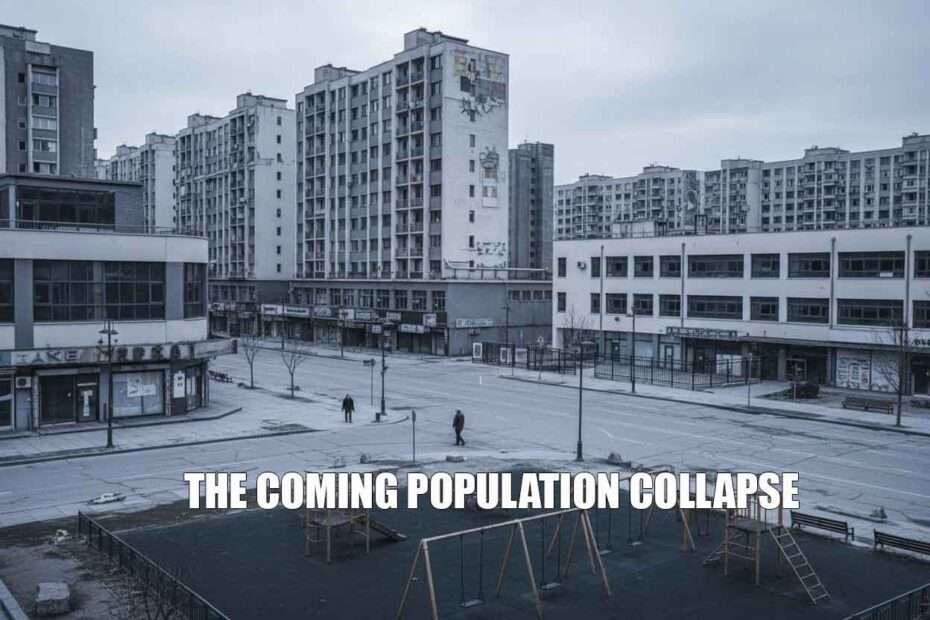
The Coming Population Collapse
Why the Crisis Is Deeper and Faster Than Expected
For decades, public debate has oscillated between fears of overpopulation and concerns about the planet’s ability to sustain billions more people. Yet, in an unexpected reversal of those earlier anxieties, the emerging crisis of the twenty‑first century is not explosive population growth, but an accelerating decline in birth rates across the world. This demographic shift is unfolding far faster than most experts anticipated, and it is beginning to reshape societies, economies, and political systems in ways that are only now becoming visible.
Recent data has starkly illustrated the scale of the challenge. China’s fertility rate fell to just 0.93 births per woman last year—well below the replacement rate of 2.1 required for a stable population. It marks a dramatic continuation of a downward trend that has now produced fewer births in China than the country recorded in 1776. The controversial one‑child policy, scrapped years ago, continues to cast a long shadow over demographic patterns, but China’s situation is not unique. Fertility rates are falling across almost every region of the world, regardless of culture, wealth, or social norms.
United Nations projections, revised in 2024, suggest that the global population will peak around the middle of this century. On the surface, that may appear manageable, even reassuring. Yet these projections rest on assumptions increasingly regarded as unrealistic. In country after country, birth rates are falling to historic lows, and the expectation that they will soon rebound has repeatedly proven misplaced. Instead, most evidence points towards a sustained, global decline that could trigger profound and lasting change.
Flawed Forecasts and the Illusion of Rebound
The UN’s demographic models assume that birth rates will stabilise or partially recover over time. For example, South Korea currently has the lowest fertility rate in the world—around 0.8 births per woman. Yet the UN predicts a future rise in this figure. Such optimism appears increasingly disconnected from observable trends and cultural conditions within Korean society. A rebound of this scale would constitute one of the most dramatic demographic shifts in modern history, with no real precedent.
Instead, many experts argue that it is far more plausible for fertility rates to continue falling, or at best plateau at extremely low levels. The OECD has observed that once a society drops to “ultra-low fertility”—typically defined as fewer than 1.3 births per woman—it often becomes trapped at this level. A number of reinforcing factors contribute to this phenomenon, from rising expectations around education and lifestyle to changing social norms surrounding marriage and parenthood.
Forecasting agencies have consistently underestimated how quickly fertility can fall and how difficult it is to reverse. As a result, long‑term population estimates are repeatedly revised downward. The implications of this trend extend far beyond statistics; they are beginning to reshape the physical and social fabric of communities. Schools in some countries are closing due to a lack of pupils, only to be repurposed into care homes for the elderly. Towns and rural areas are slowly emptying. The balance between generations is shifting in ways without historical parallel.
Beyond Economics: The Global Nature of Declining Fertility
In Western countries, falling birth rates are frequently attributed to economic pressures, including high housing costs, childcare expenses, and stagnating wages. Many young adults say they would like to have more children but feel unable to afford them. While these concerns are certainly relevant, they do not tell the whole story. Fertility is falling in countries with strong economies and relatively affordable housing as well as in areas facing severe economic hardship.
The decline is global, spanning regions as economically diverse as Western Europe, East Asia, Latin America, and the Middle East. Even countries with high levels of economic optimism—such as India and China—are experiencing sharp drops in fertility. This suggests that the underlying drivers may be more cultural and technological than purely financial.
To understand the severity of the issue, consider a fertility rate of 0.8 births per woman. In South Korea’s case, such a rate implies that the population will fall from 50 million to around 20 million within two generations—a reduction so dramatic that it cannot be offset by immigration, raising the retirement age, or similar policy measures. The consequences of such decline are immense: deserted rural areas, shrinking cities, and rising costs for essential services.
The Economics of a Shrinking Population
A declining population exerts pressure on essential services in unexpected ways. Many utilities—such as electricity, water, and public transport—have high fixed costs. Maintaining national infrastructure requires a certain level of investment regardless of how many people use it. If the number of consumers falls, these fixed costs must be spread across fewer households, driving prices upward. In the UK, for example, much of the cost of electricity arises from infrastructure maintenance rather than energy generation itself.
Globally, the UN assumes that Africa will sustain high fertility rates over the coming decades, leading sub‑Saharan Africa to account for a much larger share of the world’s population. However, this projection may be overly optimistic. Fertility is already declining across Africa, and data collection remains challenging. Kenya, for instance, has seen fertility fall from around eight births per woman in the late 1970s to just over three today. As technological penetration—particularly smartphone access—continues to rise across the continent, cultural shifts seen in other regions may soon follow.
The Role of Technology and Culture
One of the most intriguing theories explaining low fertility points to the pervasive influence of smartphones and the internet. As technological adoption spreads across the world, people are increasingly exposed to similar media, cultural norms, and lifestyle choices. This global connectivity may contribute to converging attitudes about family size.
Smartphone use also affects behaviour in more subtle ways. Young people spend far less time socialising in person than previous generations did. Men often spend hours playing video games or watching online content, while women gravitate towards platforms such as Instagram and other social media apps. These digital habits reduce opportunities for forming relationships, a trend reflected in declining rates of dating, sexual activity, and marriage.
Paradoxically, dating apps—designed to facilitate connections—may contribute to the problem. By creating an illusion of infinite choice, they can foster unrealistic expectations or a belief that something better is always just a swipe away. Social media further amplifies the issue by promoting idealised images of relationships and lifestyles, which can make real‑world experiences seem less satisfying.
Marriage rates have fallen sharply in many countries, and single-person households are on the rise. This shift in household composition is contributing to housing shortages because smaller households occupy more housing units per capita.
From Overpopulation Panic to Population Collapse
In the 1980s and 1990s, public discourse was dominated by fears of overpopulation. Textbooks warned of impending resource shortages and environmental catastrophe. Yet as fertility rates continue to decline, it is no longer far‑fetched to imagine national populations falling at unprecedented rates.
Once population decline begins, it becomes extraordinarily difficult to reverse. Countries that have tried to boost fertility through financial incentives have seen limited success. Hungary invested heavily in pro‑natal policies, but the impact has been modest. South Korea offers generous monthly payments to parents—up to $700 per child—yet its fertility rate remains below 0.8. Research suggests that achieving replacement fertility might require child benefits of $10,000 to $20,000 per year per child—a sum that is economically unfeasible for many governments.
Compounding the issue, ageing populations demand more healthcare spending and higher pensions at the very moment when productivity and economic growth tend to weaken. Public investment is squeezed as governments channel more resources into maintaining living standards for retirees. Taxes rise, yet services decline.
Older populations also wield greater political influence. They are more numerous and more likely to vote. This can lead to policy decisions that favour older generations even when younger households struggle dramatically more. In London, for example, residents over retirement age enjoy free public transport despite being, on average, wealthier than many working-age families with children.
Cultural Shifts Reinforcing Low Fertility
Low fertility has a self‑reinforcing quality. Once large families cease to be the norm, social expectations change. In previous generations, childlessness was unusual and often viewed negatively. Today, it is common and socially accepted. Meanwhile, larger families can be perceived as financially burdensome or environmentally irresponsible.
Women in particular face difficult choices between career advancement and family life. In many countries, the cost of childcare and the structure of the labour market implicitly discourage having more than one or two children. At the same time, social norms increasingly prioritise personal freedom, lifestyle flexibility, and financial security—values often seen as incompatible with raising a large family.
Can Population Decline Bring Any Benefits?
Despite the seriousness of the issue, declining populations may bring certain advantages. Housing and land prices could fall over time, making home ownership more accessible. Environmental pressures—including carbon emissions, water usage, and land exploitation—would ease. Urban congestion might lessen, and there could be more green space per capita.
However, these benefits will be unevenly distributed. In countries like Italy, population decline has coincided with an exodus from rural areas to cities, leaving behind ghost towns where properties can be purchased for a symbolic €1 but lack economic opportunities or essential services. A smaller population could reduce pressure to build on green land, but only if housing demand also falls in urban centres—a trend that has not yet materialised in many countries.
Will Technology or Immigration Solve the Crisis?
Technological innovation may mitigate some effects of ageing. Automation, artificial intelligence, and advanced robotics could compensate for shortages in labour-intensive sectors. Drones and automated systems might take over certain tasks previously done by younger workers. Yet technology cannot address every challenge. Machines cannot repopulate empty schools, breathe new life into declining communities, or strengthen the social bonds that have weakened in recent decades.
Immigration, often proposed as an obvious solution, can alleviate demographic pressures temporarily, but cannot reverse global trends. As fertility declines worldwide, the pool of potential migrants will shrink. Furthermore, immigrant populations tend to adopt the fertility patterns of their host countries within one or two generations. Over time, they too will age, creating similar demographic imbalances.
The Future for the UK and Other Ageing Societies
In the UK, population decline is likely to be gradual at first. However, the country will still face the challenges of an ageing population. People may need to work longer, and retirement ages could rise further. The period spent in retirement may become shorter relative to working life.
The economic impacts are already visible. Even with a still-growing population, the UK struggles to fund infrastructure investment and maintain public services. If fertility continues to fall, the strain on the economy could intensify. The political consequences could be far‑reaching, with younger generations increasingly burdened by taxes and older generations demanding substantial public expenditure.
Conclusion: A Profound, Unfolding Transformation
The prospect of global population decline represents one of the most significant and least understood challenges of the twenty‑first century. It touches every aspect of life—from the economy and housing to technology, social norms, and intergenerational politics. While the long-term consequences are difficult to predict fully, the evidence suggests that this trend will shape the future in dramatic ways.
The world may benefit environmentally from a smaller population, yet the social and economic adjustments will be complex and often painful. A shrinking population reshapes communities, strains public finances, and increases the political influence of older generations. It transforms family structures, labour markets, and cultural expectations.
Whether societies can adapt successfully remains an open question. What is clear is that the era of rapid population growth is ending, and a new demographic reality is emerging—one that demands creative thinking, bold policy choices, and a deeper understanding of the cultural forces shaping modern life.
If fertility rates continue to fall globally, the world may soon confront a future very different from the one imagined by past generations: not one of overpopulation, but one of societies slowly hollowing out, schools emptying, towns fading, and a world in which demographic decline is no longer a distant warning but a defining feature of the century ahead.
Frequently Asked Questions
1. Why is fertility falling so rapidly across the world?
Fertility decline is driven by multiple interconnected factors rather than a single cause. Whilst economic pressures—such as high housing costs and childcare expenses—play a role, they do not fully explain the global nature of the trend. Fertility is falling in wealthy countries with affordable housing and in poorer nations facing economic hardship alike.
Cultural and technological shifts appear to be equally important. The widespread adoption of smartphones and the internet has exposed people globally to similar lifestyles, entertainment, and social norms, leading to converging attitudes about family size. Young people spend less time socialising in person, which reduces opportunities for forming relationships. Social media promotes idealised images of relationships that can make reality seem disappointing by comparison. Additionally, childlessness has become socially acceptable, whereas large families are increasingly viewed as financially burdensome or environmentally irresponsible. Research suggests that these cultural forces are stronger than modest financial incentives, which is why countries offering substantial child benefits have seen limited success in reversing fertility decline.
2. Can governments reverse population decline through financial incentives?
Governments have attempted to boost fertility through pro-natal policies with disappointing results. Hungary invested heavily in child support programmes with minimal effect. South Korea offers up to $700 per month to parents, yet its fertility rate remains below 0.8 births per woman—among the lowest in the world.
Research indicates that achieving replacement fertility (2.1 births per woman) might require child benefits of $10,000 to $20,000 per year per child. Such sums are economically unfeasible for most governments, particularly as ageing populations demand rising spending on pensions and healthcare. The evidence suggests that cultural forces—including changing attitudes towards parenthood, career priorities, and lifestyle choices—are more powerful than financial incentives alone. Without addressing these deeper cultural shifts, financial policies are unlikely to reverse fertility decline significantly.
3. What does a fertility rate of 0.8 actually mean for a country?
A fertility rate of 0.8 births per woman implies dramatic population decline within a few generations. In South Korea’s case, such a rate would cause the population to fall from approximately 50 million to around 20 million within two generations. This is not a gradual decline that can be managed through immigration or raising the retirement age; it represents a fundamental transformation of society.
The consequences include school closures due to lack of pupils, deserted rural areas, shrinking towns, and rising costs for essential services. Infrastructure maintenance costs—such as electricity, water, and public transport—are largely fixed, so spreading these costs across fewer households drives prices upward. Additionally, the ratio of working-age people to retirees shifts dramatically, placing enormous strain on pension systems and healthcare services. The adjustment period is likely to be economically and socially disruptive.
4. Will immigration solve the population decline problem?
Immigration can provide temporary relief from demographic pressures, but it cannot reverse global fertility trends. As fertility declines worldwide, the pool of potential migrants will shrink, limiting this option over time. More importantly, immigrants tend to adopt the fertility patterns of their host countries within one or two generations. They will age just like native-born populations, eventually creating similar demographic imbalances.
For countries like the UK, immigration may slow population decline in the short term, but it does not address the underlying economic and social challenges of an ageing society. Ultimately, societies will need to adapt to smaller, older populations through changes to retirement ages, healthcare systems, and public investment priorities.
5. Are there any benefits to population decline?
Population decline does offer some potential advantages, though they are often unevenly distributed. Housing and land prices could fall over time, making home ownership more accessible for younger generations. Environmental pressures would ease, including reduced carbon emissions, lower water consumption, and less pressure on ecosystems and agricultural land. Urban congestion might decrease, and there could be more green space per capita.
However, these benefits come with significant drawbacks. In countries like Italy, population decline has coincided with the abandonment of rural areas, leaving behind ghost towns where properties are worthless despite being cheap. Technology and automation may compensate for labour shortages in some sectors, but they cannot repopulate schools, revive declining communities, or address the social fragmentation occurring in modern societies. The adjustment period is likely to be economically challenging, with rising taxes, deteriorating public services, and political dissatisfaction as governments struggle to maintain living standards for ageing populations with a shrinking tax base.