
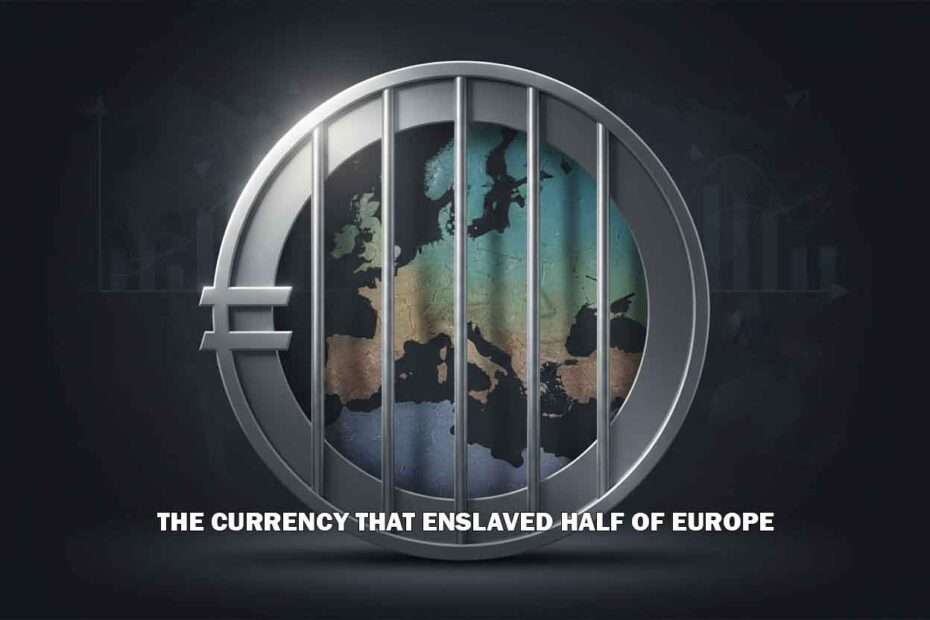
The Currency That Enslaved Half of Europe
How the Euro Became a Modern Economic Cage
Imagine a large Southern European company watching helplessly as its competitors in the North undercut its prices, poach its customers, and dominate export markets. The leadership reaches instinctively for the emergency tool that countless nations have used for centuries to restore competitiveness: a currency devaluation. A swift 20% drop in the value of the national currency would instantly make exports cheaper, attract foreign orders, and reverse the tide.
But the tool has vanished.
The mechanism is no longer available because, in adopting the euro, the nation in question did more than swap one currency for another. It surrendered control over its monetary sovereignty. It renounced the ability to adjust its exchange rate. It relinquished the power to tailor interest rates to the needs of its own economy. When crisis arrives, the country finds itself locked in an unyielding monetary structure with no escape hatch. This situation is not a bug in the euro’s architecture; it is the architecture.
The euro was sold as a grand experiment in integration, convergence, and unity. In reality, for many countries on Europe’s periphery, it has functioned as a rigid economic cage—one that has magnified crises, entrenched inequalities, and left entire generations bearing the long-term scars of decisions made far from home.
A Monetary Union Without the Tools of a Nation-State
When the euro arrived as physical cash in 2002, its member states eliminated two fundamental levers of economic policy: independent monetary control and exchange-rate flexibility. A country that joins the euro relinquishes its ability to cut interest rates during a recession and forfeits the option to devalue its currency when competitiveness collapses. These decisions become the sole responsibility of the European Central Bank, which sets interest rates for an entire continent regardless of local conditions.
If one country overheats while another sinks into recession, the ECB must choose a single path. Typically, that path aligns most closely with the needs of Europe’s economic heavyweight: Germany.
The euro’s rigidity has earned frequent comparisons to the classical gold standard. Under that system, countries tied their currencies to fixed quantities of gold. When nations ran trade deficits, gold flowed out, money supplies contracted, and deflation followed. Wages and prices fell until the country regained competitiveness. It was a brutal system—described by economists as a “deflationary straitjacket”—but at least adjustment was theoretically possible.
The euro lacks even that miserable flexibility. Since wages and prices rarely fall in nominal terms without inflicting immense damage, the eurozone relies instead on a modern variant of that same logic: internal devaluation. Instead of adjusting the currency, wages must be suppressed. Instead of lowering the exchange rate, domestic demand must be crushed. Instead of monetary stimulus, economic pain becomes the mechanism of adjustment.
This design imposes hardship unevenly. Core countries, especially Germany, benefit from stability, while peripheral countries absorb the shocks. They are compelled to endure unemployment, wage stagnation, and prolonged recessions in order to remain “competitive” within a system designed without the very tools required to achieve that competitiveness.
How Germany Learned to Game the System
While many eurozone members found themselves trapped by the currency union’s constraints, Germany discovered how to exploit them.
In 2000, German trade unions and employers reached an extraordinary pact: productivity gains would not translate into wage increases. Instead, they would be used to improve competitiveness and bolster employment. Wage restraint became national policy. Between 1999 and 2008, Germany’s unit labour costs were virtually unchanged, and in manufacturing they actually fell.
Meanwhile, other eurozone economies experienced rising wages and higher inflation. The ECB’s interest rate targets, influenced heavily by Germany’s stagnation in the early 2000s, were too low for booming countries like Spain, Ireland, and Greece. These nations overheated, but Germany’s domestic conditions kept interest rates pinned down.
The consequences were predictable. Germany’s exports surged—not because of a miraculous productivity boom, but because German labour became artificially cheap relative to its neighbours. German workers endured wage stagnation while German corporations feasted on export growth. The wage restraint strategy alone accounted for roughly half the divergence in trade balances within the eurozone. Put plainly, Germany’s profits came from other eurozone countries’ losses.
Economic theory would suggest that an export boom should fuel domestic prosperity. Yet between 2000 and 2005, domestic demand in Germany contracted slightly. German households could not afford to buy more goods even as German companies sold record amounts abroad. The German model became fundamentally imbalanced: prosperity dependent on foreign demand rather than internal consumption.
This asymmetry created a self-perpetuating cycle. Germany accumulated vast current account surpluses while peripheral countries accumulated deficits. German banks recycled these surpluses into loans to the periphery—funding property bubbles, consumer spending, and government borrowing. The periphery purchased German exports with borrowed German money. When the loans turned toxic, Germany insisted on austerity.
The result was a system that rewarded Germany’s wage suppression, punished peripheral wage growth, and magnified every structural imbalance.
The Euro’s Role in Fueling Bubbles
Eliminating currency risk and setting a single interest rate for a diverse group of economies produced massive capital flows across borders. Cheap credit poured into peripheral nations, not because these countries suddenly became less risky, but because markets believed that euro membership made them safe.
In Spain, real interest rates fell dramatically after euro adoption. Mortgage maturities lengthened. Borrowing capacity soared. Banks expanded credit at astonishing rates. Construction surged to unprecedented levels: in 2006, Spain began building more homes than Germany, France, and England combined. This was not a natural response to population growth or rising incomes; it was a bubble inflated by cheap money.
Germany’s banks, flush with excess savings from the country’s export surpluses, eagerly supplied the loans. Portugal, Ireland, and Greece experienced similar inflows. Irish banks issued mortgages exceeding 100% of property values. Portugal’s external debts ballooned. Greece used cheap borrowing to finance government consumption.
It was an unsustainable debt-fuelled feast. And like all such feasts, it ended abruptly.
The Crash: When the Music Stopped
When the US subprime crisis erupted in 2007, global credit markets froze. European banks that had funded peripheral lending through wholesale markets suddenly lacked access to new liquidity. Spain’s construction sector collapsed almost instantly. Housing starts plummeted. Unemployment surged. By 2012, Spain’s jobless rate reached 27%, with youth unemployment surpassing 50%. Millions lost work; hundreds of thousands emigrated.
Spain, bound by the euro, could not devalue, lower interest rates, or print money to support its banks. Its only option was internal devaluation: cutting wages, reducing public spending, and accepting mass unemployment until competitiveness improved.
But internal devaluation is a slow and agonising process. Spain lost 3.8 million jobs between 2007 and 2013. A generation of young workers saw their futures evaporate. Tens of thousands left for Northern Europe, contributing to one of the largest brain drains in modern European history.
Greece’s experience was even more devastating. Years of misreported statistics and hidden debt were exposed in 2010. Panic ensued. Greece was shut out of markets and forced into a series of bailouts tied to brutal austerity measures. The economy shrank by 25%—a contraction comparable to the Great Depression. Unemployment soared; suicide rates rose sharply; depression became widespread.
Despite repeated bailouts, Greece’s debt burden grew not because the country borrowed excessively during the crisis, but because its GDP collapsed, making existing debt unmanageable. The supposed solution—immediate austerity—proved economically catastrophic.
Target2: The Silent Mechanism of Entrapment
One of the least understood yet most important features of the eurozone is the Target2 payment system. It records imbalances in cross‑border payments between national central banks. During the crisis, depositors in peripheral countries moved their money to perceived safe havens like Germany. These movements generated enormous liabilities for the periphery and massive credits for Germany.
By 2023, Germany’s Target2 credit had surpassed €1 trillion. Italy and Spain together owed over €1 trillion. If either country attempted to leave the euro, these liabilities would need settling, triggering immediate financial catastrophe.
Target2 is not merely a technical mechanism. It functions as a powerful deterrent. It creates an economic environment in which leaving the euro becomes almost unthinkably destructive. The longer countries stay in the euro, the greater their Target2 liabilities grow, and the more impossible exit becomes.
This is the essence of the euro’s “prison” effect. Membership is effectively permanent not because countries wish to stay, but because departure carries existential risk.
The Failure of Internal Devaluation
Since external devaluation is impossible within the euro, struggling countries must attempt internal devaluation. This involves reducing wages and prices to restore competitiveness. But wage cuts reduce purchasing power. Lower purchasing power reduces consumption. Reduced consumption lowers business revenues, investment, and employment. This triggers further wage cuts and further contraction.
In countries like Spain, wage suppression produced only modest export improvements while gutting internal demand, deepening recession, and slowing recovery. Italy, which attempted similar labour-market reforms, saw its share of world imports decline significantly. Internal devaluation proved not merely painful, but ineffective.
The fundamental flaw is simple: internal devaluation might work if one country uses it while trading partners remain stable. But when multiple countries pursue the strategy simultaneously—as they did across the eurozone—the result is continent-wide deflation, collapsing demand, and prolonged stagnation.
Wage suppression cannot be the foundation of a prosperous monetary union. It produces a downward spiral that punishes labour, depresses growth, and widens regional disparities.
A Lost Generation
The eurozone crisis inflicted profound damage on younger workers in peripheral economies. Youth unemployment exceeded 50% in Spain and Greece. Many skilled young professionals emigrated, relocating to Germany, the UK, and other countries offering better prospects. Southern Europe effectively subsidised the human capital of the North: training doctors, engineers, and software developers who would ultimately contribute their talents abroad.
Early unemployment has lifelong consequences. Research shows that workers who experience long-term unemployment before age 25 suffer lower earnings and weaker career progression throughout life. The eurozone crisis did not simply cause temporary dislocation; it permanently reshaped the life trajectories of millions.
This represents one of the euro’s most under‑acknowledged failures: the human cost. The lost productivity, dashed aspirations, and emotional toll are not reflected in economic charts but shape societies for decades.
The Eurozone’s Broken Promise of Convergence
The euro was intended to promote convergence: poorer nations would catch up with richer ones through capital flows, shared institutions, and integrated markets. Yet convergence has not occurred. In fact, divergence has become increasingly pronounced.
Newer EU members in Eastern Europe did see substantial convergence before 2008, but progress slowed thereafter. Southern Europe, however, experienced outright reversal. Per capita incomes in peripheral nations fell relative to the EU average. Regional inequality widened within countries and across borders.
Prosperity consolidated in a few high‑productivity urban hubs, while vast regions stagnated. These patterns reflect deep structural flaws within the eurozone: a currency union without fiscal union, without banking union, without mechanisms for stabilisation or redistribution.
The United States succeeds as a monetary union because it has extensive fiscal transfers, labour mobility, and a federal government capable of supporting distressed regions. Texas and California effectively subsidise Mississippi and West Virginia. The eurozone has no equivalent system—and political resistance ensures that it never will.
Why Countries Cannot Leave
Peripheral countries face two grim options.
- Remain in the euro, accepting austerity, long-term stagnation, wage suppression, high unemployment, and outflows of young talent. This option means permanent structural subordination within a system designed to benefit surplus countries.
- Exit the euro, triggering currency redenomination, massive Target2 settlement requirements, bank runs, capital flight, a collapse in savings, legal disputes over cross‑border debts, and probable economic chaos comparable to Argentina’s 2001 crisis.
Neither option is viable. That is precisely why the euro functions as a cage. The system is designed in such a way that leaving is more damaging than remaining, even when remaining guarantees stagnation.
This is the euro’s most profound flaw: it is a monetary union designed without an exit mechanism, without fiscal stabilisation tools, and without an equitable framework for sharing costs across regions.
A System That Protects Creditors Over Citizens
The euro’s architecture systematically prioritises creditors. Austerity became enshrined in European law through the 2012 fiscal compact, yet no such mechanism forces surplus countries to increase spending or wages. Adjustment is required only of deficit nations, creating a one‑sided system that entrenches imbalance and magnifies crisis.
Private sector losses were repeatedly socialised onto public balance sheets through bailouts. These bailouts often protected European banks while imposing the costs on taxpayers in distressed nations. The result was a series of crises in which the financial sector was stabilised while citizens faced unemployment, wage cuts, and reductions in public services.
This imbalance is a structural feature of the eurozone. It is not an accidental by-product but an expression of the system’s priorities.
The Euro as a Modern Economic Prison
The eurozone’s flaws are not temporary. They are embedded within its design, and the costs fall overwhelmingly on the periphery. Germany’s economic gains are mirrored by others’ losses. The Target2 system locks indebted countries into permanent dependency. Internal devaluation inflicts long-term social and economic harm. Fiscal integration is politically impossible.
Membership, once granted, cannot realistically be revoked.
A currency union that cannot be exited, cannot be rebalanced, and cannot be democratically restructured does not function as a union. It functions as a cage.
Countries check in, but they cannot check out.
Conclusion: A Currency at War with Its Own Periphery
The euro has reshaped Europe in ways its architects never openly acknowledged. It has created a hierarchy in which Germany sits securely at the top, wielding disproportionate influence over monetary policy, while peripheral economies struggle with tools too blunt to manage crises.
A system built without escape routes and without fiscal stabilisers cannot claim to unite Europe. It entrenches division, amplifies inequality, and forces countries into cycles of austerity and stagnation.
The euro was meant to symbolise unity. Instead, for many countries, it has become a warning—an economic structure that promises prosperity but delivers dependency.
Whether the eurozone can survive another major crisis without fundamental reform remains an open question. But one fact is clear: for the countries trapped within it, the cost of membership has already been devastating, and the bill continues to rise.
Frequently Asked Questions
1. Why is currency devaluation considered a “panic button” for struggling economies?
In a standard economic system, a country with its own currency can lower its value relative to others to instantly make its exports cheaper and more attractive on the global market. This acts as a vital “escape hatch” during a recession, allowing a nation to grow its way out of trouble by boosting trade. By adopting the euro, member states surrendered this tool; they can no longer adjust their exchange rate to compensate for economic shocks, leaving them with no way to regain competitiveness other than through the painful process of cutting domestic wages and spending.
2. How did Germany’s domestic wage policies affect the rest of the Eurozone?
While other European nations allowed wages to rise in line with inflation, Germany implemented a deliberate policy of wage restraint starting around the year 2000. By keeping labour costs flat while productivity increased, Germany made its goods artificially cheap compared to its neighbours. Because countries like Spain and Greece could not devalue their currency to compete with these low prices, German exports dominated the continent. This created a massive trade imbalance where Germany’s record surpluses were essentially the “mirror image” of the deficits and debts accumulating in Southern Europe.
3. What is “internal devaluation” and why is it so destructive?
Internal devaluation is the only adjustment mechanism left for countries in a monetary union who cannot change their exchange rate. Instead of the currency becoming cheaper, the people must become “cheaper.” This involves slashing public spending, reducing pensions, and freezing or cutting wages to lower the cost of production. The strategy is often self-defeating; when wages are cut, citizens spend less, which causes businesses to fail and unemployment to soar. This creates a “doom loop” where the economy shrinks faster than the costs are cut, often leaving the country with a higher debt-to-GDP ratio than when they started.
4. What are Target2 balances and how do they “trap” member states?
Target2 is the accounting system used by eurozone central banks to settle cross-border payments. During the financial crisis, as investors and citizens moved their money out of “risky” peripheral banks and into “safe” German banks, massive imbalances were recorded. Germany now holds over a trillion euros in credits, while countries like Italy and Spain hold massive liabilities. If a country were to leave the euro, these debts would have to be settled immediately in a hard currency. The sheer scale of these liabilities makes an exit economically suicidal, effectively turning a technical payment system into a “hostage situation” that prevents countries from leaving the union.
5. Why does the article compare the Eurozone to the United States’ monetary system?
The comparison highlights what the Eurozone is missing: a federal fiscal union. The United States shares a single currency, but it also has a central government that automatically transfers wealth from prosperous states (like California) to struggling ones (like West Virginia) through federal taxes, social security, and infrastructure spending. This “fiscal transfer” stabilises the union during local downturns. The Eurozone has the shared currency but lacks the shared wallet; there is no political will for wealthy Northern European taxpayers to permanently subsidise the South, leaving the currency union structurally unstable and prone to permanent regional inequality.