
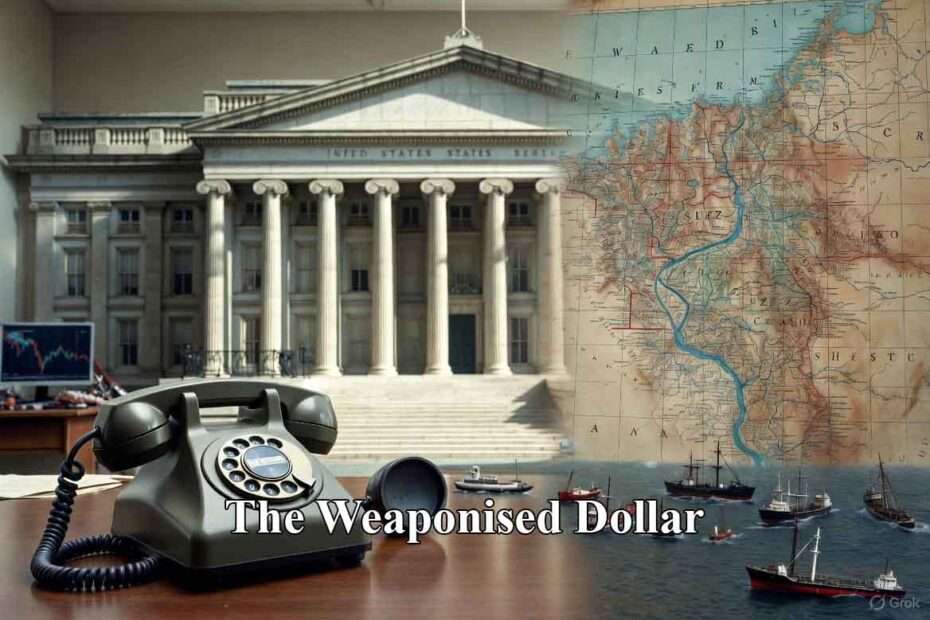
The Weaponised Dollar
How the United States Bankrupted the British Empire in 1956
In the immense graveyard of fallen empires, history often records their last moments as violent spectacles. The end of Rome is imagined in flames as barbarian warbands pour through the gates. Napoleon’s defeat is remembered in the frozen wastes of Russia, where the Grand Armée disintegrated in the snow. The decline of Spain conjures images of the Armada shattered by storms and gunfire. We are conditioned to believe that great powers collapse in fire and fury, the sound of cannon announcing the death of an age.
But the British Empire—history’s most extensive dominion, the empire on which the sun famously never set—met a very different fate. Its decisive moment did not take place on a battlefield, nor was it delivered by a conquering army. Instead, the fatal blow fell in a quiet, air-conditioned office in Washington, D.C. The weapon was not a tank, nor an atomic warhead, but a telephone call from the United States Treasury. What unfolded was a financial execution, swift and silent, carried out by America against its closest ally.
This is the story of the Suez Crisis of 1956—not merely a diplomatic debacle or a botched military intervention, but the moment the United States weaponised the dollar to shatter the last illusions of British imperial power. It was the episode that revealed, brutally and conclusively, that in the modern world military strength means little without financial independence. It was the moment Britain learned that it was no longer a global arbiter but a debtor living on borrowed time.
To understand how Britain walked into this disaster, one must set aside nostalgic images of post-war grandeur and examine the cold reality of the 1950s.
Britain’s Hidden Bankruptcy
On the surface, Britain still looked formidable. A new Queen—Elizabeth II—had been crowned amid global pageantry, inheriting a realm that covered roughly one-quarter of the planet’s land area and population. The Royal Navy remained vast, patrolling waters from Hong Kong to the Falklands. Sterling functioned as one of the world’s two principal reserve currencies, used across continents to settle international accounts.
Schoolchildren still traced pink patches across classroom maps, chanting “Rule, Britannia!” with patriotic pride.
But beneath the outward confidence, the imperial economy was rotting from the inside. The Second World War had nearly destroyed Britain financially. In order to defeat Nazi Germany, Britain had liquidated a colossal store of overseas assets—railways in South America, mines in Africa, shipping companies, plantations, and financial holdings painstakingly built over generations. These sales financed purchases of American arms, aircraft, machinery, and food under Lend-Lease and other emergency agreements.
By 1945 Britain was no longer a global creditor but the world’s largest debtor nation. Its gold and dollar reserves—vital for sustaining sterling’s value—were perilously low. The country’s economic structure rested on the unstable foundation of the Sterling Area, a network of nations across the Commonwealth whose central banks held their savings and reserves in London, denominated in pounds.
This arrangement gave Britain the appearance of liquidity, but it was a house of cards. Any collapse in confidence would trigger a mass flight from sterling into dollars, wiping out Britain’s reserves and paralysing its economy. Prime ministers and chancellors lived in constant fear of a run on the pound. Night after night, senior officials went to bed haunted by a single question: How many dollars and how much gold were left?
This was the precarious world in which Britain confronted Gamal Abdel Nasser and the crisis awaiting in Egypt.
Suez: The Fragile Artery of Empire
At the centre of Britain’s economic vulnerability lay the Suez Canal. Carved through Egyptian desert in the nineteenth century, the canal linked the Mediterranean to the Red Sea and, by extension, Britain to the Middle East, India, and the Far East. By the mid-1950s, around two-thirds of Britain’s oil supplies flowed through this narrow waterway. British industry, transport, heating, and electricity all depended on it.
Technically, the canal was managed by the Suez Canal Company, a joint Franco-British corporation whose operations largely bypassed the Egyptian state. For London, the canal was not merely infrastructure—it was the aorta of national survival.
Prime Minister Anthony Eden understood this profoundly. A veteran of the appeasement era, deeply scarred by memories of Hitler and Mussolini, Eden was predisposed to view aggressive nationalism as the seed of future catastrophe. In Nasser, the charismatic, fiery president of Egypt, he believed he had identified a new dictator who sought to dominate the Arab world.
Nasser represented a rising tide of Arab nationalism, infused with the promise of modernisation and liberation from colonial influence. Central to his vision was the Aswan High Dam, an ambitious hydroelectric project intended to control the Nile’s floods and power Egypt’s future. The project required enormous funding.
At first, Britain and the United States agreed to finance it. But Nasser skilfully played both sides of the Cold War, purchasing arms from the Soviet bloc and recognising Communist China—moves that infuriated Washington. In July 1956, the United States abruptly withdrew its financial commitment. Britain followed suit.
Nasser, furious and humiliated, responded by nationalising the Suez Canal. During a rousing speech in Alexandria, he used a prearranged code word, prompting Egyptian soldiers to seize the canal company’s offices and installations. He declared that the funds from canal tolls would finance the Aswan Dam. Crowds across Egypt erupted in celebration.
In London, the reaction bordered on panic. Eden believed Nasser now held Britain’s economy by the throat. If the Egyptian president controlled the canal, he controlled the oil; if he controlled the oil, he could cripple Britain at will. Worse, Eden feared that backing down would signal imperial weakness, triggering a collapse in the confidence of the sterling area. A run on the pound could destroy what remained of Britain’s global standing.
For Eden and his cabinet, Nasser’s defiance was not merely an act of nationalism but an existential threat. They concluded that he had to be removed.
But the world of 1956 was no longer that of imperial gunboat diplomacy. Open war was illegal under the United Nations Charter, and even more importantly, the President of the United States—Dwight D. Eisenhower—was firmly opposed to any military action.
Eisenhower valued Middle Eastern stability, especially in an election year. A British invasion risked driving Arab states into Soviet arms. He warned Eden that financial repercussions would be severe.
Eden ignored him.
The Secret Plot at Sèvres
Unable to act openly, Britain sought partners equally hostile to Nasser: France, embroiled in a brutal colonial war in Algeria, and Israel, which viewed Egypt as its most dangerous adversary.
Representatives of the three nations met secretly in a villa outside Paris, signing what became known as the Protocol of Sèvres. It was one of the most cynical diplomatic agreements of the twentieth century.
The plot was simple: Israel would strike first, invading the Sinai Peninsula and advancing towards the canal. Britain and France would then issue an ultimatum to both sides, ostensibly to protect international shipping by demanding a withdrawal ten miles from the canal zone. When Egypt refused—as expected—Britain and France would intervene militarily, seize the canal, and overthrow Nasser.
The plan was deceitful, illegal, and deliberately concealed from the United States.
Yet as military preparations progressed, the British Treasury issued dire warnings. The Chancellor, Harold Macmillan, pointed out that Britain’s reserves of gold and dollars were dangerously low. A war would rattle markets. If the United States withheld support—or worse, opposed the intervention—sterling could collapse.
Eden dismissed these concerns. He believed a rapid military victory would restore imperial prestige and shore up the pound. He assumed the “special relationship” would ultimately compel American support.
He was catastrophically mistaken.
The War Begins
On 29 October 1956, Israeli forces launched a lightning assault across the Sinai. The following day, Britain and France issued their scripted ultimatum. Nasser instantly rejected it. On 31 October, the Royal Air Force began bombing Egyptian airfields. British naval forces advanced towards Port Said. After initial successes, paratroopers landed near the canal.
Militarily, the operation was efficient and overwhelming. Egyptian air power was destroyed. Israeli forces advanced rapidly. Britain and France exercised clear superiority.
But while the armed forces advanced, Britain was losing on a far more important battlefield: international opinion and global finance.
The timing of the invasion was catastrophic. Soviet tanks had just rolled into Budapest to crush the Hungarian Uprising. The Western powers had prepared to condemn Soviet brutality—yet now Britain and France appeared to be doing precisely the same thing in Egypt. The United Nations erupted in condemnation. For the first time in the Cold War, the United States and the Soviet Union voted together against Britain and France.
Eisenhower was livid. He felt deceived and politically endangered on the eve of his re-election. He concluded that the British must be stopped—and he would do so without firing a shot.
America’s Financial Strike
Eisenhower telephoned Treasury Secretary George Humphrey. His order was blunt: break the pound.
The United States began quietly unloading its sterling reserves. American banks joined in, and global markets took the hint. Private investors began dumping pounds in massive volumes. The Bank of England, obliged under the post-war fixed-exchange system to defend sterling’s value, was forced to buy back the currency using its limited reserves of gold and dollars.
This defence became a haemorrhage. The reserves—Britain’s lifeline—drained at a terrifying rate.
Sterling was collapsing. The financial system was staggering. Britain was days away from insolvency.
Macmillan attempted a desperate rescue by requesting access to Britain’s own funds stored in the International Monetary Fund. But the United States blocked the withdrawal. Washington made clear that no financial assistance would be released until Britain ceased its military operations and withdrew from Egypt.
Eisenhower tightened the noose further by threatening to sell off Britain’s government bonds, which would trigger a sovereign default.
The United States had weaponised the dollar, and Britain was powerless to resist.
The Canal Blocked and Britain Brought to Its Knees
During the fighting, Nasser played his strongest card: he ordered his navy to block the canal by sinking nearly fifty ships at its entrance. The waterway was made impassable. Oil tankers from the Middle East were forced to sail around the Cape of Good Hope—a far longer and more expensive route.
Britain urgently needed American oil shipments to keep its industry operational. Eisenhower refused. He famously remarked that those who had started the conflict would “boil in their own oil.”
At home, the effects were immediate and brutal. Petrol rationing returned. Motorists received coupons. Heating and electricity were restricted. Factories slowed. The onset of winter turned discomfort into hardship. The public, promised a triumphant reassertion of imperial authority, instead experienced shortages, anxiety, and humiliation.
Inside Downing Street, Eden’s health disintegrated. Addicted to painkillers and stimulants, he suffered physically and mentally under the strain. He left for Jamaica to recover, leaving Macmillan to confront the disaster.
Macmillan presented the cabinet with a stark choice: save the pound or cling to the canal. They could either withdraw or become a bankrupt, isolated nation.
The cabinet capitulated.
On 6 November 1956, a ceasefire was announced. Troops halted their advance just miles from their objective. British soldiers, having achieved military success, were stunned to learn that victory had been nullified by economic collapse.
The humiliation was complete.
Withdrawal and Aftermath
Eisenhower demanded not merely a ceasefire but a complete and unconditional withdrawal. Until Britain complied, the financial siege would continue.
With no options left, Britain agreed. On 3 December 1956, it announced the withdrawal of all forces from Egypt. Immediately, dollar pressure eased. The United States released the IMF funds. Oil shipments resumed.
The crisis was over—but the consequences were permanent.
Britain’s prestige was shattered. The sterling area never fully recovered. Confidence in British economic management diminished around the world. Former colonies accelerated their pursuit of independence, realising the metropolitan centre was no longer a global colossus but a weakened nation dependent on Washington.
The Suez Crisis marked the end of Britain as a superpower. Anthony Eden resigned soon afterwards, his reputation in ruins.
The United States had demonstrated that true power in the twentieth century did not lie solely in armies, navies, or colonies—it lay in control of global finance. The dollar, not the pound, was now the master currency of the world.
The British Empire had not been conquered; it had been foreclosed.