
UK vs EU: Who Is Really Losing the Race to Economic Stability?
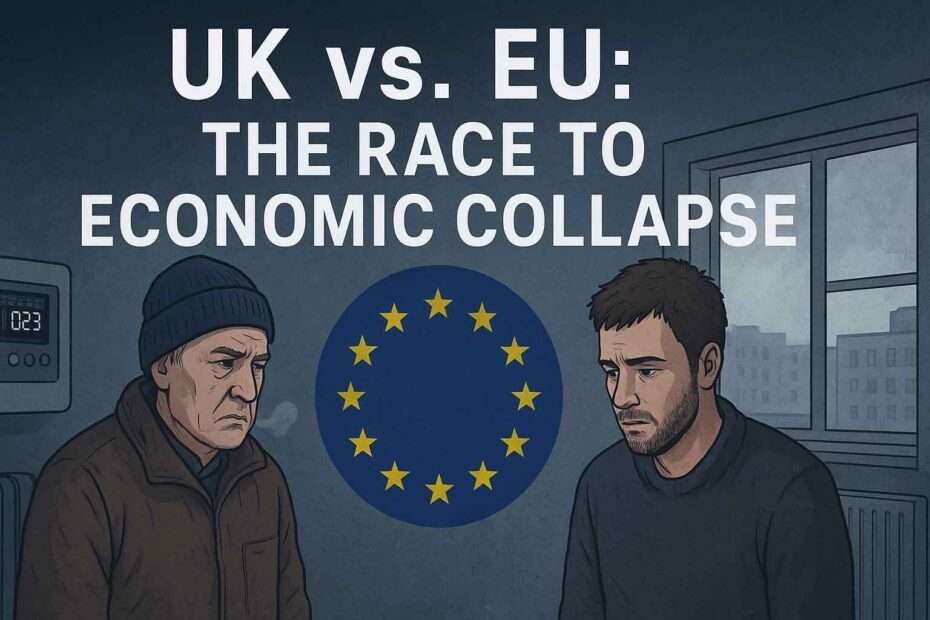
Imagine a winter’s morning in 2025. A smart meter on a kitchen wall flickers relentlessly, climbing as quickly as a taxi fare during rush hour. The homeowner hesitates to turn on the heating, fearful of what the next energy bill might bring. Their breath forms clouds in the cold air inside their own home. This scene could be unfolding in any number of places: a Victorian terrace in Birmingham, a cramped apartment in Berlin, or a suburban flat in Amsterdam. For millions across Europe, this is not fiction—it is the reality of the winter of 2025.
Across the UK and the EU, citizens find themselves caught in a spiralling cycle of rising costs, stagnating industries, deteriorating infrastructure and political disillusionment. In Britain, electricity prices surged by 40% in the first half of the year compared with the previous year. In Germany, long hailed as Europe’s most stable industrial powerhouse, growth flatlined at 0%—a symbolic zero pulse for a nation that once defined continental economic leadership.
The popular narratives are familiar: a broken Britain limping from crisis to crisis versus a Eurozone weighed down by stagnation. Yet the simplified comparisons obscure the complexity of the challenges affecting both sides. Drawing on economic data and the social indicators emerging through 2024 and 2025, this long-form analysis explores which economy is truly faring worse—Britain or the European Union—and what this means for citizens living through the turmoil.
1. The Cost of Living Hangover
Across Europe, few economic issues have been as sharply felt as the cost of living crisis. For the UK, the inflationary wave that began in 2022 has proved far more stubborn than policymakers expected.
By late 2025, UK inflation hovered around 3.6%—higher than the Eurozone average of 2.3%. But headline inflation figures hide the lived reality of a population that has been stuck in an economic chokehold for nearly three years. Core inflation, which excludes volatile food and energy prices, remained entrenched, especially in the service sector. Everyday expenses—transport, hospitality, repairs, childcare—became increasingly unaffordable even as energy prices began to stabilise.
For millions of professionals, the shift from manageable living standards to financial insecurity has been brutal. Consider, as an illustrative example, a young designer living in Manchester. In 2021, her disposable income allowed for modest savings and occasional leisure. By 2025, rents, council tax, travel costs and essentials have risen so sharply that what once felt like a reasonable income now barely covers necessities.
However, wage growth in the UK has outpaced much of Europe. Many British workers received pay rises of between 5% and 6% in 2024 and 2025. Yet the increased earnings are quickly eroded by higher prices, especially for housing and services. A pay rise may be on the payslip, but in real terms the worker feels poorer.
Meanwhile, across the channel, the economic story looks different—less inflation, but deeper stagnation. Many EU countries, including Germany, have successfully kept inflation lower, but at the cost of discouraging wage growth through fears of igniting a wage–price spiral. This leaves workers like a typical professional in Hamburg whose pay packet has barely budged since 2019 despite rising rents and living costs. Their money holds its value better, but there is less of it.
The UK also faces a growing crisis tied to its interest rates. With rates remaining higher for longer, hundreds of thousands of households with expiring mortgage deals have faced monthly payment increases of £300, £400 or more. For many, the cost of debt has overtaken the cost of living as the dominant fear.
In many EU states, particularly in Southern Europe, costs are cushioned by heavier government intervention—but funded by higher taxation on younger workers, creating a different kind of pressure.
Verdict on cost of living:
The UK fares worse. The combination of persistent inflation, rising mortgage burdens and stagnant public services intensifies the day-to-day anxiety in Britain in a way that the EU’s slower, grinding squeeze does not.
2. Industrial Meltdown: Germany’s Structural Slump vs Britain’s Managed Decline
Manufacturing has long been the backbone of Germany’s economic might. Britain, by contrast, stepped away from large-scale industrial production decades ago, reinventing itself as a service-led economy. In 2025, this divergence is starkly visible—and deeply consequential.
Germany is now in what many economists describe as a structural crisis. Its manufacturing model relied on two pillars: abundant cheap Russian gas to power heavy industry, and consistent Chinese demand for premium machinery and cars. Both pillars have eroded. Gas flows from Russia collapsed after the invasion of Ukraine, raising energy prices dramatically. Meanwhile, China’s slowing economy and growing domestic competition have cut demand for German exports.
In the third quarter of 2025, Germany recorded 0% GDP growth. Industrial giants such as BASF have begun relocating major operations to countries with cheaper energy and less regulatory burden. For a nation that built its identity and prosperity on manufacturing, this marks an existential turning point.
The UK’s industrial decline, by contrast, is not a new phenomenon. Manufacturing output fell by approximately 1% in late 2025, but this is part of a decades-long trend rather than a sudden collapse. Meanwhile, the UK as a whole posted positive—though minimal—GDP growth of 0.1% in Q3. The service sector, including finance, legal services, creative industries, education and technology, remains resilient and is driving record levels of service exports.
However, resilience comes with a major vulnerability. Unlike Germany, the UK lacks the capacity to produce vital goods during global supply chain disruptions. A British steel worker in Port Talbot may watch their profession decline under the banner of modernisation, while a German factory worker is still employed—at a plant operating at a financial loss.
Verdict on industry:
Germany and the wider EU manufacturing base are in worse condition. Britain’s industrial decline is old news; Germany’s is a fresh and dangerous fracture with profound implications for the entire Eurozone.
3. Housing: Chronic Failure vs. Acute Breakdown
Housing markets across both Britain and Europe have descended into varying degrees of dysfunction. The UK has faced a chronic shortage of new homes for more than three decades. Demand vastly outstrips supply, especially in cities like London, Manchester and Bristol. Rents have climbed at breakneck speed, with bidding wars now commonplace. Prospective tenants sometimes offer six months’ rent upfront merely to secure a viewing.
The UK’s ageing housing stock compounds the problem. Britain’s cold, damp, energy-inefficient homes leave residents struggling to heat properties already eating up disproportionate portions of their income.
Europe faces different but equally severe problems. Germany has experienced a sudden collapse in new housing construction. Between 2024 and 2025, residential building permits fell by around 26%. Developers suspended projects en masse due to high interest rates and soaring construction costs. Across Berlin, half-finished developments and idling cranes stand as symbols of a frozen market.
Ireland’s crisis is even more severe. Dublin’s housing market has tipped into what many analysts call a humanitarian emergency. Even high-paid workers in technology and finance—earning six-figure salaries—struggle to find accommodation, resorting to temporary arrangements or leaving the city entirely.
In cities with rent controls, such as Berlin, a widespread shadow market has emerged. Tenants may pay the legally capped rent but are pressured into making steep under-the-table payments for items like second-hand furniture, effectively circumventing regulation.
Verdict on housing:
A miserable tie.
The UK suffers from a decades-long failure to build; the EU suffers from a rapid market seizure. In both cases, renters face extreme insecurity and shrinking options.
4. The Demographic Time Bomb
Beyond the immediate pressures lies a more silent but far more dangerous threat: demographic decline.
Southern Europe is at the centre of a demographic crisis. Italy’s fertility rate plummeted to around 1.13 in 2025, one of the lowest in the world. The country is losing the equivalent of a major city every few years. Spain and Greece face similar declines. Germany requires around 400,000 skilled migrants annually simply to maintain its current labour force—but is not attracting sufficient numbers.
This shrinking population means fewer workers paying into tax and pension systems, while more retirees draw from them. GDP per capita in some nations has risen only because the number of citizens has fallen—a statistical illusion rather than economic success.
In contrast, the UK faces the opposite issue: rapid population growth. While this exacerbates pressure on housing, healthcare and transport, it injects energy into the labour market and supports higher long-term productivity potential. Immigration remains high, despite political tensions, and Britain remains an attractive destination for skilled workers who speak English and see the UK as globally connected.
Youth unemployment also paints a stark contrast: around 25% in Spain versus around 15% in the UK.
Verdict on demographics:
The EU faces the greater challenge. Britain experiences congestion; Europe faces depopulation.
5. GDP and Growth: A Reversal of Fortunes
For years, Britain was labelled the “worst performing G7 economy”. But by late 2025, the narrative shifted. The IMF upgraded the UK’s growth forecast to around 1.5%. This is not remarkable, but it is solid relative to its recent past.
Germany, meanwhile, is forecast to grow at effectively 0%. The economic model that served it so well in the early 2000s no longer fits the global landscape. Its heavy reliance on fossil-fuel energy and exports to China leaves it struggling to adapt.
The Eurozone’s structural rigidity—slower regulatory processes, uniform monetary policy across diverse economies and layered bureaucratic constraints—makes rapid response to economic shocks difficult.
Britain, despite lacking a coherent long-term industrial strategy, benefits from flexible labour markets and a responsive service sector capable of adjusting to crises more quickly.
Verdict on growth:
Britain edges ahead. It is limping, but Germany is barely moving.
6. Healthcare: Diverging Models, Converging Problems
If an economy is an engine, its healthcare system is the oil that keeps it running. Both Britain and the EU show deep signs of strain, but the nature of the pressure is very different.
The NHS has entered a new phase of crisis by 2025. Waiting lists remain around the 7.5 million mark. A two-tier system has emerged: those who can afford private treatment use it, while those who cannot endure delays that often worsen health outcomes and push people out of work.
German and French systems offer faster access for many treatments, but the financial burden has risen sharply. In Germany, health insurance contributions for workers continue rising, hitting new highs in 2025. Freelancers and higher earners face steep mandatory monthly costs.
Rural areas across France and Germany grapple with “medical deserts”, where access to GPs and specialists is becoming increasingly limited due to retirements and shortages.
Verdict on healthcare:
The UK fares far worse.
While Europe’s systems are strained, they broadly function. Britain’s struggles are systemic and profound.
7. Stability and Public Mood: Exhaustion vs Anger
Public sentiment reveals much about a nation’s trajectory.
In the UK, political fatigue dominates. Years of turbulence—from Brexit through multiple changes in leadership—have left the public largely cynical. Taxes are at post-war highs, yet services continue to deteriorate. Rather than revolt, Britain experiences quiet resignation and low political energy.
The EU, however, faces a more volatile situation. Right-wing populist movements have surged across member states, winning elections and upending traditional political alliances. In Germany, the rise of parties challenging the political consensus has raised concerns about democratic stability. In France, political polarisation has deepened to unprecedented levels.
Farmers’ protests, energy policy backlash and anti-immigration sentiment have escalated tensions in multiple states, with the potential to destabilise the European project itself.
Verdict on stability:
The EU faces deeper risks. Britain is depressed but stable; Europe is angry and fragmented.
8. The Brain Drain: A Shared Loss
Perhaps the most consequential trend is one affecting both sides equally: the outflow of talent to the United States and other global hubs.
For young engineers, scientists and medical professionals, the UK vs EU debate holds diminishing relevance. Salaries in the US significantly outpace those in Europe. A mid-level software engineer might earn £75,000 in London or Berlin—versus the equivalent of £140,000 or more in Austin or Seattle, often with stock options and dramatically lower living costs relative to income.
Doctors see even greater disparities. A junior doctor in the UK earning around £32,000 struggles to afford basic accommodation in London. In the US, medical residents start on nearly double that amount, with salaries rising sharply after qualification.
The UK’s relatively welcoming skilled immigration policies attract significant talent from Asia and Africa, partially compensating for the brain drain. The EU’s linguistic and regulatory barriers, however, make attracting global talent more difficult.
Verdict on brain drain:
A draw—and a losing one. Both Britain and the EU are training talent that ultimately fuels American innovation.
9. Final Verdict: Who Is Really Doing Worse?
The comparison reveals two contrasting forms of decline.
Britain faces acute pain:
– a broken housing market
– a strained healthcare system
– high inflation
– high personal debt exposure
– deteriorating public services
Daily life feels harder for British residents. Many feel that the country is held together more by habit and politeness than by functioning institutions.
The EU, meanwhile, faces chronic structural threats:
– demographic decline
– industrial erosion
– political fragmentation
– a rapidly weakening economic core in Germany
– rising internal tensions within the union
Britain’s problems hurt more right now. Europe’s problems threaten to undermine its long-term viability.
The difference is one of tempo:
Britain is having a panic attack.
Europe is developing a long-term illness.
Neither is winning. Both are struggling to adapt to a rapidly changing world, while global competition intensifies and the United States draws away the talent that could have helped them rebuild.
For ordinary citizens, the experience is shaped less by macroeconomic charts and more by what they see each morning when they leave their homes: a declining local hospital, a rent bill that grows faster than wages, a job market that rewards specialisation but punishes stagnation.
Across the UK and the EU, the question is no longer who is doing worse, but how either side can find a path to renewal before the next global shock arrives.