
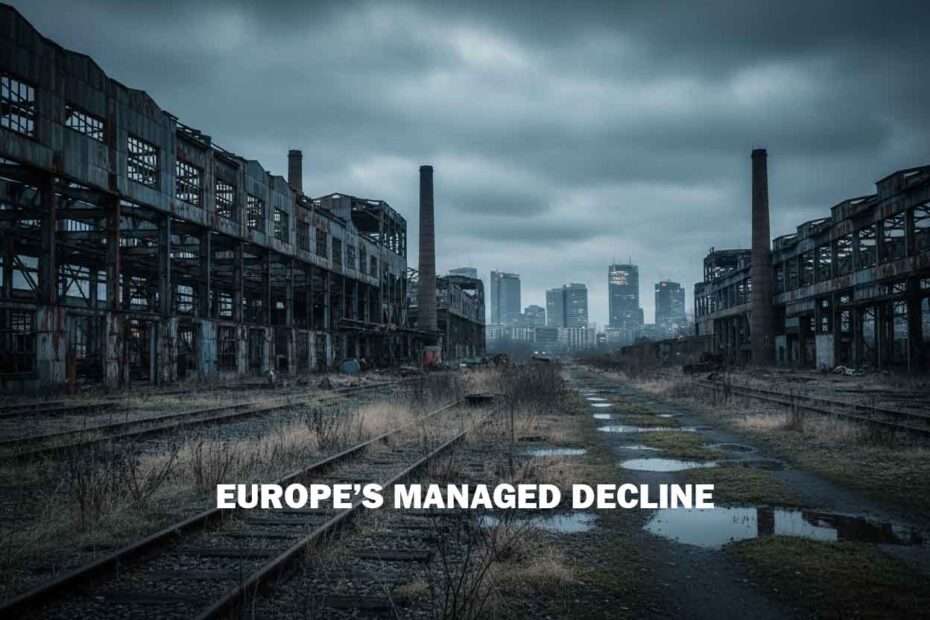
Europe’s Managed Decline
How Germany’s Crisis Threatens the Continent
Europe’s largest economy is undergoing a profound structural crisis that is far more serious than most public commentary admits. While global attention is focused on domestic political disputes in the United States and the strategic ambitions of China, events unfolding in Germany are quietly reshaping the economic and political future of the entire European continent.
For three decades, Germany has been the industrial and financial anchor of Europe. Its export-driven model generated vast surpluses, sustained the euro, and underpinned the fiscal transfers that kept the European Union (EU) together through multiple crises. That model is now unravelling. The symptoms are visible in collapsing industrial output, capital flight, technological relocation, and mounting social and political strains. The deeper cause, however, is not a temporary shock, but a set of long‑term structural choices that have left Germany – and by extension Europe – in a state of managed decline.
This article examines the core elements of that decline: de‑industrialisation, the energy and demographic crises, the constraints of EU‑level policy, and the political consequences that follow when economic pragmatism is sacrificed to ideology.
De‑industrialisation in Real Time
The most immediate and visible sign of Germany’s predicament is the deterioration in its industrial base. Industrial production has fallen by double digits in less than two years, a decline far too deep to be dismissed as a cyclical fluctuation. This is not a short‑term downturn from which factories will simply bounce back when conditions improve; it is a structural contraction.
Key industries that once defined German economic strength are in retreat:
- Steel production has fallen dramatically since 2021.
- Aluminium smelting – a highly energy‑intensive process – has virtually disappeared from the country.
- Chemicals, long the foundation of German manufacturing excellence, are increasingly produced in jurisdictions where energy is cheaper and regulation lighter.
Far from planning to rebuild capacity once the current storm passes, large German corporates are redirecting their future elsewhere. Major manufacturers have announced the closure of domestic plants, not as part of restructuring programmes but as permanent withdrawals. Investment that would once have gone into upgrading German facilities is being relocated to Mexico, China and other regions offering cheaper energy, larger markets and more predictable policy environments.
This is not an adjustment within a healthy system. It is a transfer of productive capacity out of Europe. When factories close, the loss extends far beyond the walls of a single plant. It affects supply chains, local services, municipal tax receipts and the skills ecosystem that supports innovation. Once those elements have disintegrated, they are extremely difficult and costly to rebuild.
The Energy Shock That Became Structural
The war in Ukraine and the subsequent rupture of economic relations with Russia exposed the fragility of Germany’s energy model. For decades, German industry relied on relatively cheap and reliable Russian pipeline gas. That supply has now been severed, not merely by physical damage to infrastructure but by political decisions that effectively rule out any near‑term restoration.
What has replaced this energy source is neither sufficient nor cost‑competitive:
- Liquefied natural gas (LNG) imported from the United States and other producers is substantially more expensive than former Russian pipeline supplies.
- Renewable energy sources, despite years of heavy public and private investment, do not yet provide the stable, large‑scale, low‑cost power essential for heavy industry.
- Green hydrogen, widely touted as a future solution, remains experimental, capital intensive and expensive.
At the same time, Germany has deliberately reduced its stock of reliable baseload generation. The long‑planned phase‑out of nuclear energy culminated in the closure of the last three reactors in April 2023 – precisely at the moment when secure, carbon‑free electricity was most urgently required. The infrastructure built up over decades to deliver steady power at predictable costs was dismantled for political reasons, not technological ones.
The consequences are multiple and reinforcing:
- Industrial users cannot rely on stable long‑term power prices.
- The electricity grid must accommodate large shares of intermittent wind and solar generation, requiring storage and back‑up systems that do not yet exist at the necessary scale.
- Energy companies carry large debts and stranded assets from the forced abandonment of nuclear facilities and the rushed expansion of renewables.
German households and firms now face some of the highest electricity prices in the world despite declining reliability. Energy‑intensive sectors such as aluminium smelting have almost entirely relocated, and other industries that depend on uninterrupted power are actively exploring alternatives abroad.
Crucially, this is not a standard business cycle problem. It is structural. The era of abundant cheap energy that underpinned Germany’s industrial success is over. Unless and until a new, equally robust and affordable energy architecture is created, the competitiveness of German manufacturing will continue to erode.
Demographic Headwinds and Social Pressures
Overlaying the energy and industrial crises is a demographic trend that has been unfolding over half a century. Germany’s birth rate has been below replacement level for around fifty years. The country is ageing more rapidly than almost any major economy apart from Japan.
This has several direct consequences:
- The working‑age population is shrinking at exactly the time when high productivity and innovation are most needed to compete with dynamic Asian economies.
- Social security and healthcare costs are rising as a growing share of the population is retired or elderly, requiring pensions and medical care funded by a diminishing base of active workers.
- The tax burden on those in work increases, discouraging additional labour participation, risk‑taking and entrepreneurship.
Young Germans who see limited prospects at home increasingly choose to emigrate. Net migration of highly educated citizens has reached levels not seen since reunification. This “brain drain” compounds the loss of industrial capacity, as both physical and human capital move abroad.
The resulting social structure is one in which an ageing population depends heavily on transfers from a smaller group of productive workers, many of whom are either leaving or are increasingly disillusioned with their prospects. The strain on the pension system intensifies as the ratio of workers to retirees deteriorates. Health‑care spending escalates, diverting resources from investment in education, innovation and infrastructure.
Immigration is often proposed as a solution to demographic decline, but in practice it has introduced further political and social complexities. Integration has not always been successful. Cultural tensions, perceived or real competition for housing, school places and social services, and fears about security have generated widespread unease. The result has been a powerful backlash against large‑scale migration, making sustained, skills‑focused immigration politically difficult just when it is most needed.
Germany thus finds itself in a paradoxical position: some major cities face housing shortages and overstretched services due to inward migration, while former industrial regions in the east and the Ruhr Valley experience depopulation, unemployment and decay. The country is simultaneously battling growth‑related pressures in some areas and symptoms of deep decline in others.
The Hollowing Out of Technological Leadership
Beyond factory closures and energy costs lies a subtler but ultimately more dangerous development: the relocation of technological leadership. German industry has long been associated with engineering excellence and high‑end manufacturing know‑how. That advantage is eroding as research and development activities themselves move abroad.
Corporate decisions are increasingly channelling not only production but also innovation to other jurisdictions. Investment in domestic research facilities is falling. Patent applications from German companies are declining. New generations of products and processes are being conceived and developed in locations where firms anticipate better long‑term returns.
This process is being accelerated in two ways:
- Acquisition of German technology firms by foreign buyers, particularly from China. Strategic competitors acquire advanced know‑how, intellectual property and established brands, often at attractive valuations for sellers facing domestic headwinds.
- Replication and diffusion through partnerships and joint ventures. Where outright purchase is not possible or politically sensitive, technology can be accessed via collaborations or, at times, illicit methods such as industrial espionage.
In effect, Germany is helping to finance its own future obsolescence by selling world‑class companies and permitting critical capabilities to migrate. Industrial leadership rarely disappears overnight. It usually fades as incremental advantages in cost, speed and innovation accumulate in other centres. Once those alternative hubs are established, reclaiming lost ground is extremely difficult.
A Financial System Under Strain
Germany’s financial sector mirrors the wider economic malaise. Institutions that once symbolised European financial strength are diminished. Major banks have experienced years of restructuring, fines and weak profitability. Their market valuations are modest compared with far smaller foreign counterparts.
Regional savings banks – a traditional backbone of small and medium‑sized enterprise financing – have been squeezed by years of very low or even negative interest rates and an expanding body of regulatory requirements. The effect has been to weaken the availability of domestic credit for expansion and innovation.
When local financial institutions lose strength and risk appetite, firms turn to foreign banks, private equity or sovereign funds, further diluting national economic sovereignty. Decision‑making about which industries to support, which technologies to bet on, and where to build capacity shifts away from German hands.
Ideology Over Pragmatism: The Political Response
Perhaps the most troubling dimension of Germany’s current situation is not the severity of the objective challenges, but the way they are being managed politically. Instead of treating the crisis as a catalyst for serious course correction, much of the political class remains committed to the very policy frameworks that created or exacerbated these problems.
Energy policy is a prime example. The decision to phase out nuclear power was made in 2011, years before the war in Ukraine, and pursued across successive governments. It was then accelerated and completed even as Germany faced a historic energy shock. Arguments about safety, public opinion and environmentalism dominated, while the implications for industrial competitiveness and energy security were relegated to secondary status.
Climate targets have been framed in ways that effectively require continued reductions in domestic industrial activity, rather than incentivising realistic pathways to decarbonisation that preserve productive capacity. Closing factories is too easily presented as an environmental victory, regardless of whether production simply moves abroad to jurisdictions with weaker environmental standards.
At the same time, opposition forces have not offered a coherent alternative. Parties that governed during earlier phases of the energy transition are deeply implicated in current outcomes. Those on the radical right have capitalised on public anger and economic anxiety but often lack a credible economic programme. Citizens thus face a limited menu of policy options: different shades of the same managed decline.
The EU Dimension: Regulation and Rigidity
The crisis in Germany cannot be understood in isolation from the broader framework of the European Union. In response to successive shocks – the eurozone debt crisis, migration pressures, the pandemic, and now war in Ukraine – the EU has increasingly centralised decision‑making. Many of these steps were intended to stabilise the union and prevent unilateral action that might fragment the single market or undermine the common currency.
However, the accumulation of regulations and constraints has also reduced member states’ policy flexibility in the face of global competition.
European firms operate under a dense web of:
- Carbon pricing and emissions rules
- Labour regulations and social protections
- Due diligence and supply‑chain transparency obligations
Individually, many of these measures pursue legitimate social or environmental objectives. Collectively, they impose cost structures that competitors in Asia or elsewhere do not face. When combined with high energy prices and rigid macroeconomic frameworks, the result is a systematic disadvantage for European producers.
The EU’s proposed carbon border adjustments are meant to offset some of this by taxing imports from countries with looser climate policies. Yet these mechanisms will only fully succeed if other major economies implement comparable standards. Otherwise, Europe risks simply making itself more expensive and less attractive as a production base without meaningfully reducing global emissions.
Moreover, the fiscal and monetary architecture of the eurozone was built around the assumption of a permanently strong German economy. German trade surpluses and fiscal discipline were implicitly expected to counterbalance higher debts and weaker competitiveness in southern member states. If Germany itself becomes a source of weakness rather than strength, the sustainability of this architecture comes into question.
Heavily indebted countries rely, in practice if not formally, on the credibility created by German economic performance. If that performance falters, debt dynamics elsewhere may become unstable. Unemployment in countries such as Spain, already structurally high, could deteriorate further without robust German demand. Social models in France and other states are easier to finance when overall European growth is anchored by German productivity.
Social Fragmentation and Political Polarisation
Economic decline rarely remains confined to balance sheets and growth statistics. It reshapes societies and politics. In Germany, the combination of de‑industrialisation, demographic stress, energy insecurity and constrained policy space is already feeding political polarisation.
Regions that have borne the brunt of industrial restructuring – parts of Eastern Germany and the Ruhr Valley – display higher unemployment, population loss and infrastructure decay. As opportunities shrink, so too does trust in established parties and institutions. Political forces that promise to overturn existing arrangements and reclaim national sovereignty or industrial strength gain support.
By contrast, major metropolitan centres such as Munich and Frankfurt remain comparatively prosperous, supported by finance, services and advanced sectors. This growing regional divergence creates a sense of two different countries coexisting uneasily within the same borders: one still thriving, the other experiencing a form of economic aftershock reminiscent of the early post‑communist period.
Such geographic and social polarisation has clear political consequences:
- Parties challenging EU integration and climate‑driven industrial policy gain traction in struggling regions.
- New alliances on both the radical right and left position themselves as defenders of national interests against technocratic elites in Berlin and Brussels.
- The political centre, associated with the policies that produced the current impasse, struggles to offer a convincing narrative beyond promises of better management.
Economic stress tests democratic systems in ways that constitutional safeguards alone cannot prevent. When citizens confront declining living standards and a pervasive sense that their children will be worse off than they are, they become more receptive to radical proposals and simple explanations.
The parallels with earlier historical periods are uncomfortable. In the interwar years, Weimar Germany faced a toxic mix of economic crises, political fragmentation and social resentment. Today’s institutions are far stronger, and European integration provides buffers that did not exist then, but the underlying lesson remains: prolonged economic insecurity can corrode democratic norms.
From Temporary Crisis to Managed Decline
The defining feature of Germany’s current predicament is not a single catastrophic shock but the gradual accumulation of structural weaknesses:
- Energy policy dismantled reliable infrastructure before workable alternatives were ready.
- Demographic trends were recognised for decades but not addressed with consistent family, education and immigration strategies.
- Economic regulation at both national and EU level has increased costs without always considering global competitiveness.
- Industrial leadership was taken for granted while critical capabilities were sold or relocated.
These are not technical issues awaiting clever technocratic fixes. They are political choices that reflect deeply embedded ideological commitments. In several cases, symbolism has been prioritised over tangible outcomes. Ambitious climate targets sit alongside the offshoring of industry to jurisdictions with looser environmental standards, resulting in little net global benefit but significant domestic damage.
As a result, Germany is experiencing what might be called “managed decline”:
- A gradual reduction in living standards rather than a sudden collapse
- A steady transfer of factories, research centres and skilled workers to countries with more favourable conditions
- A slow erosion of influence within Europe and globally as economic weight diminishes
This form of decline is particularly insidious because it rarely produces a single dramatic moment that forces immediate change. Instead, each year brings a little less growth, a little more strain on public finances, a little more frustration among citizens, and a little more polarisation in politics.
Global Implications: A Weakened Europe in a Dangerous World
Germany’s difficulties extend far beyond its borders. In an era of renewed great‑power competition, economic strength is closely linked to geopolitical influence and military capability. A Germany that cannot maintain a strong industrial base, that struggles to fund its welfare state, and that is internally divided will inevitably be less able to contribute to European security or global stability.
A weaker Europe creates openings for regional powers and authoritarian regimes that are willing to exploit vacuums. Traditional alliances come under strain when partners doubt one another’s capacity to deliver. Within Europe itself, disputes over burden‑sharing, migration, energy and fiscal policy may intensify as the economic pie shrinks.
The stakes, therefore, are much higher than German living standards or the health of the euro. They touch upon the balance of power in a world where coercion and military force are once again prominent tools of statecraft.
The Missed Opportunities
One of the most sobering aspects of the present situation is that it was not inevitable. Germany, and Europe more broadly, had alternative choices:
- It could have kept nuclear plants running while developing realistic decarbonisation strategies that did not destroy industrial competitiveness.
- It could have reformed labour markets and taxation to encourage productivity growth and entrepreneurship rather than overburdening a shrinking workforce.
- It could have designed immigration policy around attracting and integrating skilled workers at sustainable levels, with clear expectations and support mechanisms.
- It could have prioritised competitiveness when shaping EU regulations, recognising that social and environmental objectives are ultimately undermined if the economic base erodes.
Instead, policy was often driven by short‑term political considerations, symbolic gestures and the desire to project moral leadership on issues such as climate change, sometimes without adequate assessment of the long‑term economic consequences. The transition from a successful industrial powerhouse to a constrained, energy‑poor and demographically ageing economy was not forced by external enemies; it was, in large part, self‑inflicted.
Reversing this trajectory will be significantly harder than preserving the strengths that previously existed. Energy infrastructure dismantled over decades cannot be recreated overnight. Industrial ecosystems take generations to build and only a few years to disperse. Once skilled workers, entrepreneurs and researchers have established their lives in other countries, attracting them back becomes a formidable task.
Choices Ahead
Germany now faces a series of hard choices that will determine not only its own future but that of the European project for decades to come.
To restore energy security and competitiveness, it would need to revisit some of the most sacrosanct assumptions of its recent politics, including its categorical rejection of nuclear power. To address demographic decline, it would have to combine more effective family policies with a frank, long‑term strategy for skills‑based immigration and integration – accepting that this will require difficult conversations about identity, culture and social cohesion.
To revive industrial and technological leadership, Germany would have to create conditions under which firms once again see long‑term advantages in keeping research, production and headquarters on its soil: reliable and affordable energy, reasonable taxation, a flexible yet fair labour market, and a regulatory environment that safeguards social and environmental standards without making productive activity unviable.
At the European level, there would need to be a recalibration of policies that, while well‑intentioned, have eroded competitiveness. This does not mean abandoning climate goals or social protections, but rather designing them in a way that recognises the realities of global competition and the necessity of maintaining a solid industrial base.
All of these steps would require political courage and a willingness to challenge entrenched narratives. They would involve acknowledging policy failures, revisiting past decisions and accepting that some cherished ideological positions are incompatible with long‑term prosperity.
Conclusion: The Cost of Ignoring the Warning Signs
Germany’s current crisis is not simply a story of unfortunate external shocks or unforeseeable events. It is the cumulative result of decades of policy choices that prioritised symbolism over substance and short‑term political comfort over long‑term resilience.
Industrial output is falling, energy is expensive and unreliable, demographics are adverse, technological leadership is draining away, and political polarisation is deepening. The institutions of the EU, built around the assumption of a strong and steady Germany at their core, are ill‑prepared for a scenario in which that assumption no longer holds.
Economic decline of this kind rarely produces immediate collapse. It advances slowly, almost imperceptibly, year after year – until a point is reached where the options for reversal are limited, costly and politically explosive. By the time the gravity of the situation is widely recognised, the margin for painless adjustment has vanished.
Germany still retains immense strengths: a highly educated population, world‑class firms, considerable accumulated wealth, and a central role in European institutions. Whether those assets can be mobilised to arrest and reverse the current trend depends on decisions taken in the coming years.
If those decisions continue to be guided by rigid ideology, wishful thinking and the hope that incremental reforms within existing frameworks will somehow suffice, then the country – and Europe with it – will continue along a path of managed decline. If, on the other hand, policymakers and citizens alike are willing to confront uncomfortable realities and rethink fundamental assumptions, a different trajectory remains possible.
What is clear is that the period when these issues could be safely ignored has passed. The warning signs are now unmistakable. Europe’s strongest economy is no longer a secure anchor; it is a source of mounting risk. How Germany responds will shape not only its own destiny but that of the continent for a generation.
Frequently Asked Questions (FAQs) on Germany’s Economic Situation
1. What are the primary indicators suggesting Germany’s economic decline?
Germany’s economic decline is evidenced by several key indicators. Industrial production has seen a significant drop of 11.6% in the past 18 months, signalling a substantial contraction in its manufacturing sector. Major German companies, such as Volkswagen, BMW, and BASF, are relocating production and investment out of Germany to countries with lower costs and fewer restrictions. Furthermore, critical industries like steel production and aluminium smelting have experienced sharp declines, with chemical production also moving abroad. These trends collectively point to a systematic de-industrialisation rather than a temporary economic downturn.
2. How has Germany’s energy policy contributed to its current economic challenges?
Germany’s energy policy has played a crucial role in its economic difficulties, particularly the decision to phase out nuclear power and the reliance on Russian gas. The permanent cessation of cheap Russian pipeline gas, coupled with the closure of the last nuclear power plants in April 2023, has left Germany with significantly higher energy costs. Liquefied natural gas (LNG) from the US is three times more expensive, and while renewable energy sources are being developed, they cannot yet provide the consistent, cost-effective power required by heavy industry. This shift has led to increased operational costs for businesses, driving industrial relocation and reducing overall competitiveness.
3. What role do demographic issues play in Germany’s economic outlook?
Demographic challenges are a significant long-term factor exacerbating Germany’s economic problems. With a birth rate below replacement level for 50 years, Germany’s population is ageing rapidly, leading to a shrinking workforce. This demographic shift places immense pressure on social security and healthcare systems, as a smaller base of productive workers must support a growing number of retirees and elderly citizens. The increasing tax burden on working-age Germans discourages work and investment, while a “brain drain” of educated young people seeking better opportunities abroad further depletes the country’s human capital.
4. How do EU regulations impact Germany’s industrial competitiveness?
EU regulations, while often well-intentioned, contribute to Germany’s industrial competitiveness challenges by imposing additional costs and restrictions that global competitors do not face. European companies are subject to carbon taxes, stringent labour regulations, and complex compliance requirements. These measures increase operational expenses and reduce flexibility, making it more attractive for businesses to relocate production to countries with less restrictive regulatory environments. While initiatives like carbon border adjustments aim to level the playing field, their effectiveness is limited if other major economies do not adopt similar measures, potentially making European producers less competitive globally.
5. What are the broader implications of Germany’s economic decline for Europe and global stability?
Germany’s economic decline has profound implications for both Europe and global stability. As Europe’s long-standing economic anchor, a weakened Germany undermines the entire European project. The stability of the Eurozone, which was designed around German strength, becomes precarious without its robust support, potentially destabilising economies like Italy and Spain. Furthermore, in an era of rising global tensions, a weakened Germany translates to a weaker Europe, which could embolden regional powers and authoritarian regimes. The economic stress fuels political extremism across the continent, threatening democratic institutions and potentially leading to greater global instability.