

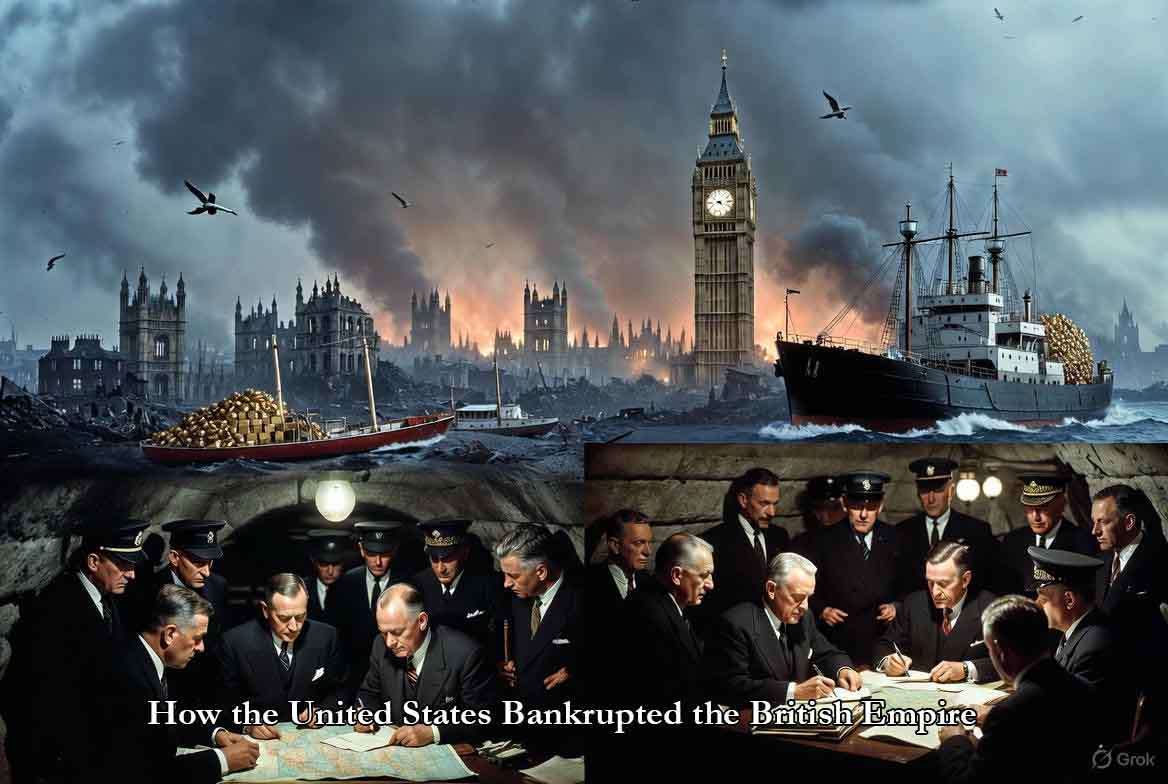
How the United States Bankrupted the British Empire
The Hidden Price of WWII
In the freezing darkness of December 1940, the fate of Western civilisation hung by a thread. The skies above Britain — for now — belonged to the RAF, but on the ground the terror had only just begun. The Blitz was ravaging the streets of London. German bombers had set their sights on Britain’s industrial heartlands. Cities such as Coventry and Liverpool, the backbone of British manufacturing and shipping, were being pulverised by the Luftwaffe. Britain seemed to many to remain a world power, the pink splash on world maps still covering swathes of territory. Yet inside the subterranean war-rooms of Whitehall, Britain’s leaders knew a terrifying truth: the empire was not just bleeding soldiers — it was bleeding funds. It was, in effect, bankrupt.
The British Prime Minister sat at his desk in the underground cabinet rooms and penned a letter to the President of the United States, a nation still officially neutral. It was one of the most important letters he would ever write. In it he was forced — with trembling pride — to admit that Great Britain, once the workshop and banker of the world, was utterly broke.
This article traces how the wealthiest empire in history, whose railways ran across continents and whose investments spanned the globe, ended the Second World War as a debtor. It examines how economic desperation, forced asset sales, and loans transformed the global power balance — not through conquest, but by contract.
From Global Titan to War-Treasury
At the outbreak of war in September 1939, Britain still stood as a formidable financial and economic power. London was the centre of global shipping, insurance and finance; British citizens owned railways in Argentina, copper mines in Chile and industrial assets across the United States. Billions in gold and foreign exchange reserves lay in the vaults of the Treasury.
But this effort was about to be taxed in a way unlike any previous war. The conflict unleashed by Hitler was not one limited to fronts and trenches — it was a war of machines: tanks, ships, aeroplanes, oil, steel, rubber, aluminium. The demands of modern warfare far outstripped anything imagined in peacetime budgets.
Worse, Britain now stood isolated. The fall of continental Europe and the blockade imposed by Germany severed traditional trade routes. No longer could Britain rely on European trade. If the Empire was to survive, it would have to look across the Atlantic — to the United States.
At that time, the U.S. was officially neutral. American public opinion, scarred by losses in the First World War, was staunchly isolationist. U.S. Congress had passed neutrality acts that forbade giving credit to belligerents. The only option for friendly nations was “cash and carry”: if you wanted American arms or supplies, you must pay immediately in hard currency and ship the goods yourself.
Thus Britain began draining its treasury. Gold reserves were sold, foreign assets liquidated. Everything that could be turned into quick cash was called in. In a covert operation — the largest movement of wealth in history — Britain shipped enormous quantities of gold and negotiable securities across the dangerous Atlantic to Canadian vaults.
By late 1940, the gold was gone, the foreign investments largely depleted, and the coffers empty. Contracts sat unsigned in Washington. The government’s Purchasing Commission lacked the dollars to pay. And the shortages became painfully clear: no munitions, no aircraft, no destroyers.
The Letter, The Deal — and the Birth of Lend-Lease
When the letter arrived in Washington, there was no glamour, no theatre — just stark reality. If Britain fell, so might the rest of Western civilisation. American leaders — even those reluctant to deepen involvement — understood the stakes. But they also faced domestic constraints: U.S. law forbade handing vast sums of money to foreign powers, and the public would balk at “giving away” billions.
What emerged was a compromise — a deal dressed as business rather than charity: the scheme known to history as Lend‑Lease. The public face of this policy was humble — likening it to lending a neighbour a garden hose if his house were on fire. The private reality could scarcely have been more stark.
Behind closed doors, Lend-Lease was not about generosity — it was about contracts, leverage, and stripped assets. The U.S. was not aiding an equal ally. It was extending a line of credit to a debtor on the brink of collapse.
The man overseeing U.S. finances insisted that before a single dollar changed hands, Britain prove it had squeezed every last asset from its empire. Every investment, every factory, every stockholding — British or imperial — had to be declared, counted, potentially sold. The era of silent colonial wealth was drawing to a close.
British negotiators — led by men deeply aware of what was being asked — were stunned. Sell everything, they were told. Strip the Empire bare. At that moment, the logic of global finance replaced the logic of alliance. Britain was no longer an equal fighting side-by-side with the United States. It was a bankrupt client, negotiating with its banker.
Forced Liquidation: Selling the Crown Jewels
The process was brutal and humiliating. Among the most painful cases was that of a major American industrial firm deeply embedded in British ownership: a large rayon and synthetic-fibre company. It had been a source of steady and significant dividend flows back to London, helping to stem Britain’s trade deficits. But it had to be sold.
Given no choice — and under severe duress — the British government expropriated the company and sold it off under a rushed “compulsory purchase order.” The firm fetched a fraction of its real value. Dollars from the sale went straight to the U.S. Treasury to pay for British war materiel. The firms, the factories, the revenue streams that had once helped sustain Britain’s economic might — gone.
But it was more than industry. Strategically, too, Britain would pay. The urgent need for destroyers — old American warships mothballed and deemed obsolete by the US Navy — led to a second critical deal. In exchange for fifty of these ageing destroyers, the U.S. demanded basing rights: 99-year leases on naval and air bases spanning the Atlantic, the Caribbean, the North Atlantic, Canada, and British colonial territories.
Britain, desperate for warships, agreed. The result: a century-long American strategic footprint on former British sovereign soil — obtained for a handful of worn-out destroyers. The selling off of strategic assets under the guise of “aid” marked a turning point: the ceding of global strategic influence, not by conquest, but by contract.
Thus, even as Lend-Lease flowed — tanks, planes, oil, food — Britain was being stripped of its economic and geopolitical independence.
Victory — and the Cold Cut of American Policy
When war ended in 1945, Britain had done what seemed almost impossible: it had survived. Defeated Germany. Surrendered Japan. The people poured into the streets in joy. Crowds gathered. Celebrations erupted.
But victory brought no benevolence from Washington. In accordance with U.S. law, aid ended at once. No transitional support, no grace period. The supply lines of Lend-Lease were cut. Ships laden with wheat, meat, tools and machinery — en route — were ordered to turn back. The lifeline snapped.
Britain, deprived of both export revenue and American supplies, was suddenly facing starvation. Its industries were geared wholly to war production; peacetime export markets had collapsed. Gold reserves were empty. Foreign investments gone.
In 1946, a desperate British government, led by the celebrated economist John Maynard Keynes, boarded a ship for Washington, not as ambassadors, but as supplicants. Keynes hoped to argue that Britain should receive a grant — a retroactive payment for the sacrifices made to save the democratic world. He called it justice.
What he got instead was a loan — a £3.75 billion credit line from the United States, at 2% interest, to be paid back over 50 years. (Canada extended a smaller line too.)
The agreement came with harsh strings attached. Among the most damaging was the requirement that, within a year, the British pound sterling become fully convertible into US dollars. In effect, any foreign holder of sterling could immediately demand dollars. When that convertibility opened on 15 July 1947, the floodgates opened. Foreign holders of sterling dumped their pounds for dollars. In just weeks, Britain’s dollar reserves evaporated.
By August 20, convertibility was suspended, but the damage was done: the country’s financial stability was shattered, and the economic backbone of the British Empire irreparably weakened.
The Collapse of the Sterling Era and the Economic Aftershock
The suspension of convertibility was not the end — only the beginning. In 1949, under pressure and in the face of collapsing reserves and persistent balance-of-payments deficits, the British government devalued the pound. The old pre-war American peg was gone. Sterling, once a pillar of global finance, was now a shadow of its former self.
The result was a deliberate devaluation — the pound’s value in dollars dropped precipitously. Overnight, British citizens, British businesses, the British Treasury all became poorer in dollar-terms. Imports became far more expensive. The cost of living rose. Export industries struggled. The global prestige of sterling — once second only to gold and dollars — plunged.
Meanwhile, the loan repayments began in 1950: fifty annual instalments stretching over decades, with interest. The repayments continued through war-time austerity, reconstruction, the decline of the Empire, economic crises, inflation, even into the era of post-war British governments of various stripes. On 29 December 2006 — over six decades after the war had ended — Britain made the final payment, closing the last chapter of the debt.
This final repayment — the last free-standing link between wartime sacrifices and post-war obligations — stands as a symbol of how deeply Britain had mortgaged its future to survive the war.
The Empire’s Economic Disintegration
It is often said that the war was won in the skies, but lost in the ledgers. War-time destruction was devastating, but the financial and economic devastation was greater and far more lasting.
By the end of WWII, Britain had lost two-thirds of its export trade. The country’s net losses in wealth by some estimates amounted to nearly a fifth of its pre-war national wealth — a reduction measured not in bombs dropped, but in capital drained, assets sold, industries neglected.
In the immediate post-war years, investments in essential peacetime sectors — manufacturing, energy, transport, agriculture — were minimal. The majority of the funds available under the loan went not into rebuilding industry or housing, but to maintaining global defence commitments, sustaining the Empire, and servicing foreign debt.
The result was predictable: Britain entered a long period of austerity, rationing continuing well into the 1950s; widespread economic hardship; diminished ability to maintain global commitments; and an accelerating decline in Britain’s economic clout.
By contrast, through Lend-Lease, the subsequent wartime spending, and massive industrial mobilisation untouched by the destruction of war within its mainland, the United States emerged much stronger. The U.S. economy more than doubled during the war. It held much of the world’s gold reserves in post-war years. It emerged as the financial and industrial centre of the post-war world.
In geopolitical terms, the transfer of wealth and strategic influence from London to Washington — effected not through tanks or bombs, but through credit, contracts and currencies — marked the beginning of a new era: the ascent of American global power, and the decline of the British Empire.
The Myth of Aid: Loans, Not Gifts
To many Britons at the time — and to many historians since — the assistance from the United States under Lend-Lease and the post-war loan was seen as generosity. A willingness by the Roosevelt administration to help the tired, war-ravaged British people rebuild.
In truth, the aid was not a gift. The provisions were wrapped in the laws of commerce. The conditions imposed — forced liquidation of assets, strategic base-leases, convertibility of sterling, long-term debt — all pointed to a deeper purpose. The assistance was designed to restructure British economic policy, to dismantle the old imperial trade networks, to open up global markets to American goods, and to reposition Britain as a junior economic power indebted to the United States.
Far from being a gesture of friendship, it was a strategic financial manoeuvre. By the end of the long repayment schedule, British taxpayers had written out cheques for decades — long after the victory parades had ended, long after reconstruction had (somewhat) begun.
No wonder that, for many in Britain, the legacy of 1941 remains a scar on the national psyche: a moment when survival was bought at the price of independence, where global standing was exchanged for short-term rescue, and where victory came at the cost of a self-inflicted decline.
A Moral Victory — But an Economic Defeat
It is undeniably true: Britain helped to save civilisation. Alone, for two years, it stood firm when much of the continent had fallen. The bombers thundered overhead, cities burned, the people endured. The nation held.
But when the guns fell silent, the economic reality could not be ignored. The cost of survival proved far greater than the cost of war. By dispensing with the old wealth, the old capital, the old strategic advantages, Britain had won the war but lost its future. It had dismantled its Empire, sacrificed its industries, and mortgaged its people’s prosperity.
The global power centre moved. The baton had been passed — not by force of arms, but by the invisible weight of dollars, debt, and financial contracts. America did not conquer the British Empire with battleships. It bought it — piece by piece.
When the final payment was made in 2006, Britain closed the last page of its war-debt ledger. But the deeper moral and economic consequences remain: a humbled empire, stripped of wealth and global authority, and a Britain that survived only by sacrificing its future.
This is the true cost of victory.
Aftermath and Reflection
In the decades that followed, Britain struggled. The post-war economic malaise, industrial decline, decolonisation, loss of global influence — many factors contributed. But the financial aftershocks of those critical wartime years and the pressure applied under the guise of support played a central, underestimated role.
The 1946 loan — the so-called Anglo–American Loan Agreement — though officially hailed as a lifeline, was fraught with conditions that undermined Britain’s long-term economic sovereignty. The convertibility clause forced open the pound to global currency markets, triggering a run on sterling that collapsed reserves in weeks.
The asset sales — including industrial giants and foreign investments — permanently removed sources of overseas income that had sustained Britain’s trade imbalance before the war.
And though the repayable loan was technically a favour — a 2 % interest loan over half a century — the real burden lay in what was lost: control over trade, strategic independence, and the ability to sustain empire or industry.
By 2006, when the final payments were made, the world had long since changed. Britain was no longer an empire. Sterling was no longer a reserve currency of global stature. London still mattered — as a financial centre — but Britain’s role in shaping the global order was a fraction of what it had been before the war.
In the end, the story of the price of victory is the story of how a nation can win a war, but lose its future. Britain defeated Nazi Germany — and in doing so, defeated itself. It spent its past to preserve its present and sold its future to survive.
Why this History Still Matters
This history of wartime bankruptcy and forced restructuring underlines a broader truth about modern war and geopolitics: brutal conflict destroys more than lives and cities — it can destroy economic sovereignty.
It also demonstrates how economic power can shift not only through military conquest, but through financial leverage. The ascendancy of one superpower may come not with tanks on foreign soil, but with treaties, loans, and currency convertibility rules.
For modern readers, the tale serves as a cautionary parable. Empires — and nations — that rely heavily on external financing may survive a crisis only at the cost of long-term autonomy. What seems like help in the short run may well be a quiet mortgage on a nation’s future.
In the case of Britain, the debt was finally repaid in 2006. But the consequences — economic decline, loss of empire, diminished global influence — could not be so easily repaid.
Victory, in the end, carried a price far steeper than bullets or bombs.
Conclusion
The Second World War demanded everything of Britain — not just men, but gold, industry, influence, identity. Under the harsh logic of total war and global finance, Britain did not just fight to survive: it sold itself.
The support from the United States was real — tanks, aircraft, food, fuel. But it was not generosity. It was a transaction. A transaction that stripped Britain of its economic core. A transaction that forced it to bow, in gold and debt, before a new world order.
When the final cheque was signed in 2006, the last formal link between wartime Britain and the United States was severed. But the legacy remains.
Britain emerged from World War II a military victor — but an economic defeated power. The story of how the United States bankrupted the British Empire is not just history. It is a lesson about power, leverage, pride — and the true cost of survival.