

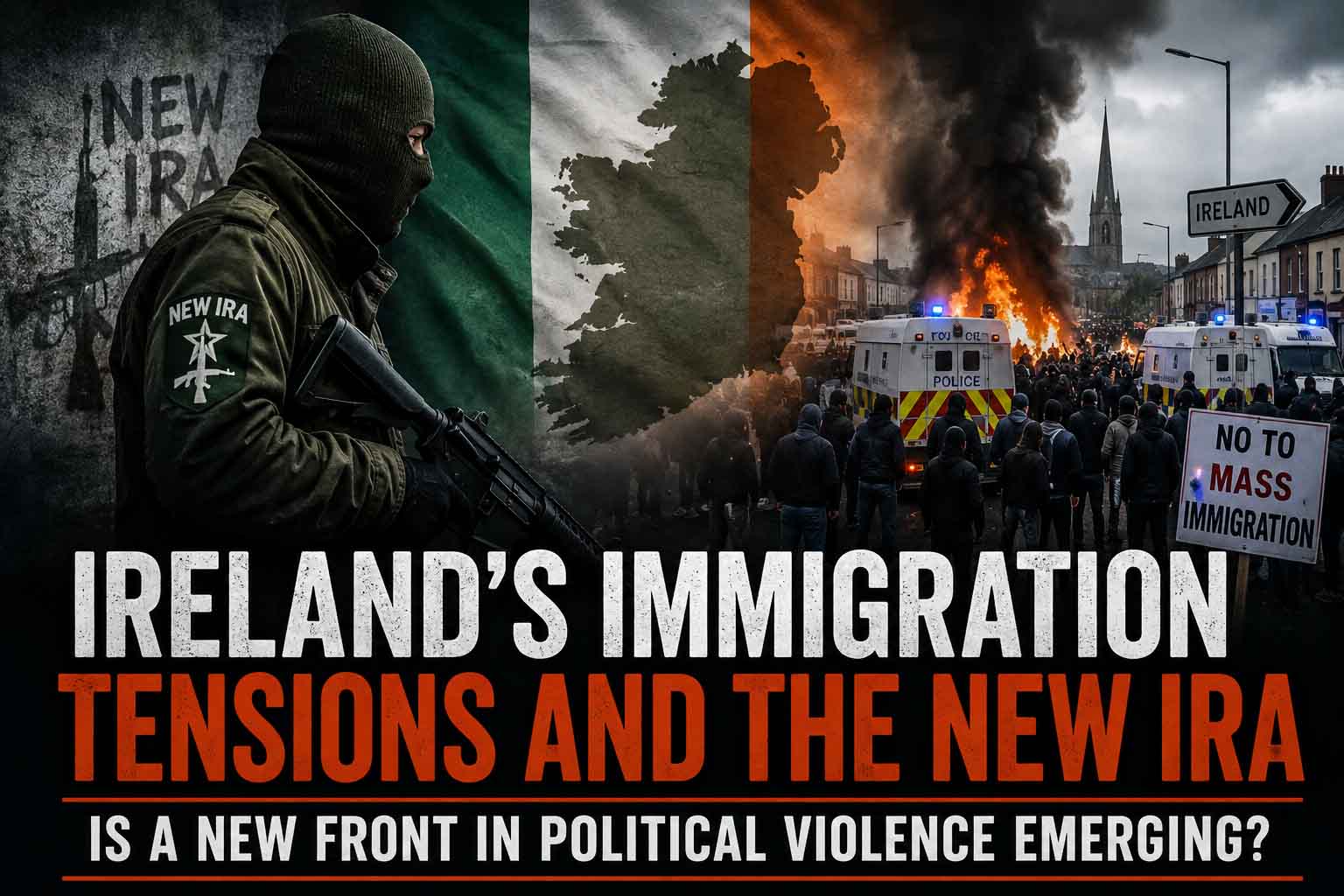
Ireland’s Immigration Tensions and the New IRA
Is a New Front in Political Violence Emerging?
Ireland is facing an increasingly uncomfortable convergence of immigration tensions, community unrest, extremist politics and persistent paramilitary activity.
A report by GB News has raised the alarm over an alleged New IRA plan to exploit opposition to immigration and potentially use violence to drive migrants from parts of Ireland. The report, which cites intelligence sources, describes the alleged strategy in terms of a potential “civil war” scenario.
The allegation is serious. But it also requires careful examination.
There is currently no publicly available evidence demonstrating that Ireland is on the brink of a civil war, nor is the specific claim that the New IRA has formally developed a campaign to expel migrants independently established in the public domain.
What is considerably better established, however, is that the New IRA remains an active terrorist organisation, paramilitary networks continue to operate across Ireland, and tensions surrounding immigration have escalated dramatically.
The potential convergence of those developments deserves close attention.
The New IRA remains an active threat
The New IRA is considerably smaller than the Provisional IRA at the height of the Troubles, but its reduced size should not be mistaken for an absence of capability.
Security assessments have continued to identify dissident republican organisations, including the New IRA, as a significant terrorist threat in Northern Ireland.
The organisation’s traditional targets have been the British state and security forces. Its activities have included attacks against police officers, prison officers and other representatives of the state.
That pattern has continued into 2026.
Recent attacks against police facilities in Northern Ireland, including incidents involving vehicles and explosive devices, demonstrate that dissident republican terrorism remains a live security concern.
The organisation has also continued to issue statements calling for attacks against what it describes as the “crown forces”.
This history is important because it provides the context against which the latest allegations must be judged.
The New IRA has not historically existed primarily as an anti-immigration organisation. Its fundamental ideological objective remains Irish republicanism and opposition to British sovereignty in Northern Ireland.
Consequently, if intelligence assessments indicating a strategic move towards targeting migrants are accurate, they could represent a significant development in the organisation’s activities.
A relatively small organisation can still have a disproportionate impact
Estimates reported by security sources have suggested that the New IRA has fewer than 250 members across the island of Ireland.
That figure is a fraction of the manpower available to the organisations involved in the Troubles.
Yet numbers alone do not determine the potential threat posed by a terrorist organisation.
A relatively small group can cause considerable disruption through bomb attacks, intimidation, assassination attempts and the creation of fear.
It can also exploit divisions that already exist within society.
This is particularly relevant to the current debate over immigration.
The New IRA would not need the capacity to wage a conventional war in order to create serious instability. It would potentially need only the ability to provoke incidents, intimidate vulnerable communities, exploit public anger and encourage retaliation.
That is very different from possessing the capability to fight an actual civil war.
Ireland’s immigration debate has become increasingly volatile
The alleged New IRA strategy comes against a background of rapidly intensifying public debate over immigration and asylum accommodation.
Across Ireland, opposition to aspects of government immigration policy has become increasingly visible, with protests taking place in communities where asylum accommodation has been introduced or proposed.
In Northern Ireland, tensions have escalated further.
Following the stabbing of a young woman in Ballymena in June, serious unrest developed, with violence subsequently spreading to other areas.
Homes and businesses associated with foreign nationals were attacked, while online networks helped circulate inflammatory material and organise activity.
The events demonstrated how quickly a specific criminal incident can become incorporated into a much wider political narrative about immigration, policing, national identity and the perceived ability of the authorities to maintain order.
They also exposed the continuing relevance of Northern Ireland’s paramilitary infrastructure.
The uncomfortable role of loyalist paramilitaries
One of the most important aspects of the current situation is the reported involvement of loyalist-linked networks in parts of the anti-immigration unrest.
This creates an unusual and potentially dangerous dynamic.
For decades, Northern Ireland’s principal paramilitary fault line was broadly defined by the conflict between republican and loyalist organisations.
Today, immigration has the potential to become another issue around which paramilitary organisations can mobilise.
That does not mean that loyalist organisations and the New IRA are working together. There is no basis for such an assumption.
Indeed, their ideological objectives remain fundamentally opposed.
But both could potentially exploit the same underlying social instability.
Loyalist groups could attempt to present themselves as defenders of local communities against immigration.
Dissident republicans could exploit the resulting instability for their own purposes, particularly if they believe that social disorder weakens confidence in the authorities.
The danger is not necessarily cooperation.
It may be competition.
Why would the New IRA be interested in immigration?
If the intelligence allegations are accurate, several possible explanations emerge.
The first is simple opportunism.
Terrorist organisations frequently exploit existing grievances rather than creating those grievances themselves. Immigration has become one of the most divisive political issues in Ireland, making it an obvious potential target for extremist exploitation.
The second possibility is recruitment.
Periods of social unrest can provide extremist organisations with opportunities to attract individuals who previously had little involvement in organised political violence.
The third is destabilisation.
An organisation committed to undermining the authority of the state could benefit from increasing hostility between communities and the authorities.
And there is another possibility that deserves consideration: competition with loyalist organisations.
If loyalist paramilitary groups increasingly attempt to portray themselves as defenders of communities against immigration, dissident republicans may see an opportunity to challenge, manipulate or exploit that narrative.
Immigration could therefore become another arena in which rival extremist organisations seek influence.
The “civil war” question
The phrase “civil war” makes for a powerful headline, but it should be treated cautiously.
There is no evidence currently available to demonstrate that Ireland is approaching a conventional civil war.
The New IRA is far too small to wage a conventional conflict against the Irish state, and there is no evidence of the kind of mass mobilisation normally associated with a civil war.
The more credible concern is considerably more fragmented.
It involves the possibility of:
- sporadic terrorist attacks;
- intimidation of migrant communities;
- attacks on accommodation centres;
- retaliatory violence;
- paramilitary involvement;
- extremist recruitment;
- online radicalisation;
- and increasingly violent confrontations between protesters and the authorities.
Such developments could create a cycle of escalation without ever becoming a conventional civil war.
In fact, that may be the more realistic danger.
The border adds another layer of complexity
The situation also has implications for the United Kingdom.
The Common Travel Area allows substantial freedom of movement between the UK and Ireland, while Northern Ireland occupies a unique position on the island.
The absence of a conventional land border creates particular challenges for law enforcement and security agencies when dealing with organised crime, terrorism and extremist activity.
The New IRA itself operates across the island rather than being confined to one jurisdiction.
Counter-terrorism operations have consequently required close cooperation between the Police Service of Northern Ireland, An Garda Síochána, MI5 and other agencies.
If immigration tensions were to become increasingly connected with organised extremist activity, that cross-border dimension would become even more important.
A dangerous convergence
The most significant issue may therefore not be the allegation of a “civil war plot” in isolation.
It is the convergence of several developments that, until recently, could have been viewed as largely separate.
Ireland is experiencing intense debate over immigration.
Anti-immigration protests have become more prominent.
Northern Ireland has witnessed serious unrest.
Online networks are amplifying grievances and encouraging mobilisation.
Loyalist paramilitary networks remain active.
Dissident republican organisations remain capable of terrorist violence.
And the New IRA is allegedly examining whether immigration tensions can be exploited.
Individually, none of these developments necessarily signals an imminent national crisis.
Together, however, they create conditions that extremist organisations could exploit.
The allegation must still be tested
It is important not to confuse intelligence reporting with publicly established fact.
The GB News report’s central allegation is based on intelligence sources, and there has not yet been sufficient independent public corroboration to establish that the New IRA has formally adopted a strategy of attacking migrants or driving them from Ireland.
That distinction matters.
It would be irresponsible to present an intelligence allegation as though it were a proven operational plan.
But it would be equally irresponsible to dismiss the allegation simply because the details have not been publicly confirmed.
The New IRA remains operational.
Paramilitary networks remain embedded in parts of Northern Ireland.
Immigration has become a major source of political and community tension.
And recent events demonstrate that violence can escalate rapidly when existing grievances collide with inflammatory narratives and organised mobilisation.
Ireland may be entering a new phase of instability
The most important question is therefore not whether Ireland is about to experience another civil war.
There is currently insufficient evidence to make that claim.
The more immediate question is whether immigration has become a new fault line through which Ireland’s existing extremist and paramilitary networks can expand their influence.
If so, the consequences could extend well beyond immigration policy.
A sustained cycle of attacks against migrants could provoke retaliatory violence. Retaliation could then be used by extremists on opposing sides to justify further mobilisation. Communities could become increasingly polarised, while confidence in the ability of governments and police forces to maintain order could deteriorate.
That is how relatively small extremist organisations can have an impact far greater than their numbers suggest.
Ireland has spent decades trying to move beyond the political violence of the Troubles.
The danger now is not necessarily a return to the past.
It may be the emergence of something different: a new form of political violence in which immigration, identity, online radicalisation and dormant paramilitary structures intersect.
Whether the New IRA is genuinely preparing to exploit that environment remains a question for intelligence and law-enforcement agencies to establish.
But the conditions that could allow extremists to exploit Ireland’s growing divisions are already visible.
And that is a development that deserves considerably more attention than a headline about a “civil war plot” alone.