

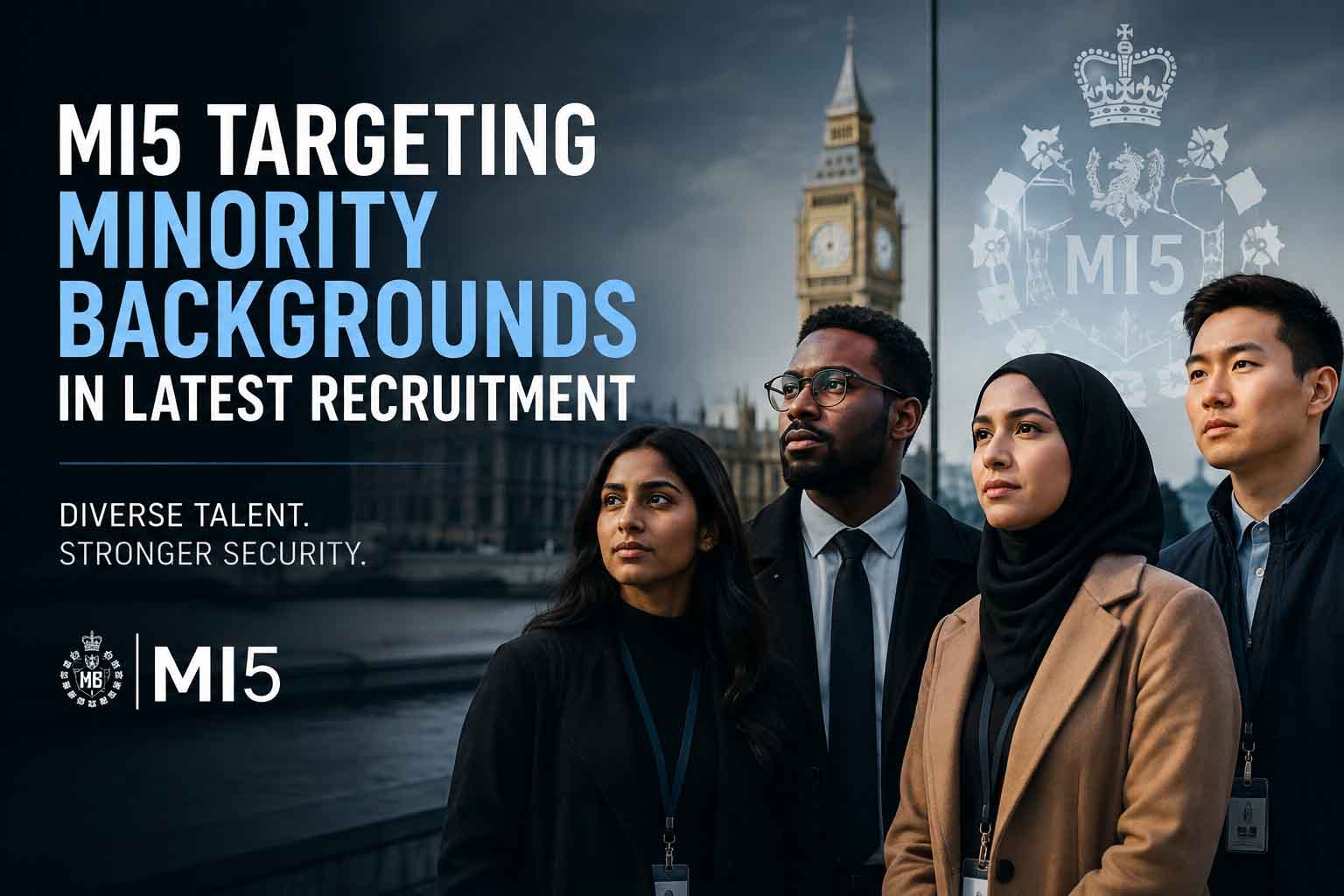
MI5 targeting minority backgrounds in latest recruitment
MI5 is facing renewed scrutiny over its latest summer intelligence internship after explicitly restricting applications to university students from specified ethnic-minority backgrounds who also come from socially or economically disadvantaged backgrounds.
Applications for the 2027 Summer Intelligence Internship, covering the 2026/27 academic year, are currently open. MI5 says applicants must be in their final or penultimate year of university and must be from a “Black, Asian, mixed heritage or ethnic minority background” as well as a socially or economically disadvantaged background.
Crucially, this is not simply a case of MI5 encouraging applications from minority candidates. The agency explicitly states: “We’re confining the applications for this internship to those within this demographic due to a current underrepresentation in our workforce.”
That wording has inevitably raised questions about equality, fairness and the distinction between positive action and positive discrimination.
A deliberately targeted programme
The internship is not open to all university students who otherwise meet MI5’s general requirements.
MI5’s criteria include applicants from Asian or Asian British, Black or Black British, mixed-heritage and other ethnic-minority backgrounds. The definition also includes certain groups classified as “White other”, such as Romany Gypsies, Scottish Travellers and Irish Travellers. Applicants must additionally meet MI5’s socio-economic criteria, which examine the occupation of the main or highest income earner in their household when they were aged 14.
The placement is a substantial opportunity. MI5 says the internship is expected to run for around 11 weeks and offers an internship payment of £4,849 in London, with accommodation available for successful candidates who do not live within reasonable commuting distance.
Participants gain exposure to operational intelligence work and can subsequently apply for positions such as an Intelligence Officer on MI5’s Intelligence Officer Development Programme.
However, completing the internship does not guarantee employment. MI5 makes clear that anyone subsequently applying for a permanent position must go through a competitive selection process.
The Government has defended the approach
The controversy has already reached Parliament.
In June 2026, Conservative MP Ben Obese-Jecty asked the Cabinet Office why the MI5, MI6 and GCHQ Summer Intelligence Internship was open only to Black, Asian and ethnic-minority applicants.
Dame Angela Eagle, Minister for the Cabinet Office, responded that the UK Intelligence Community operates a number of internships and placement schemes and that their eligibility criteria are published by the individual agencies.
She stressed that anyone subsequently applying for employment must participate in “fair and open competition, with selection based on merit.”
Another parliamentary question in June asked about government departments restricting internship programmes according to race or ethnicity. The Government stated that individual departments are responsible for recruitment decisions but must comply with the Equality Act 2010, with restricted internship schemes assessed on a case-by-case basis.
The Government’s position is therefore that targeted internships can be lawful where they satisfy the relevant requirements of equality legislation.
Positive action or positive discrimination?
This is where the issue becomes considerably more complicated.
The Equality Act 2010 contains provisions allowing employers and other organisations to take positive action to address disadvantage or under-representation affecting people who share a protected characteristic.
The Government has previously explained that such measures can include internships and training opportunities aimed at groups that are disadvantaged or under-represented.
However, the Equality and Human Rights Commission draws an important distinction.
Its guidance states that employers may encourage people from an under-represented protected group to apply for vacancies. But it also says that positive action cannot be used to restrict a job opportunity to people with a particular protected characteristic or to give applicants preferential treatment during recruitment simply because they possess that characteristic.
That distinction makes MI5’s wording particularly significant.
MI5 is not merely saying that minority students are encouraged to apply. It says that applications are being confined to the specified demographic because of under-representation.
Whether that amounts to a lawful form of positive action in the particular circumstances of the scheme is ultimately a question of how the Equality Act applies to the programme. The available parliamentary material does not establish that MI5 has acted unlawfully, and no court finding of illegality has been identified.
Nevertheless, the apparent tension between the EHRC’s general guidance and MI5’s explicit restriction is a legitimate issue for public scrutiny.
MI5 says diversity matters
MI5’s wider recruitment policy emphasises the importance of drawing staff from different parts of society.
The agency describes itself as an equal opportunities employer and says it seeks to recruit from “all areas of the UK and all sections of society”. It also says that its workforce should reflect the diversity of the communities it serves.
The agency’s argument for the targeted internship is therefore straightforward: if particular groups are under-represented, creating a dedicated route into the organisation can help broaden the pool of people who consider intelligence careers.
There is also a practical argument. Intelligence work involves assessing people, cultures, communities and threats across an increasingly complex international environment. MI5 can reasonably argue that a workforce drawn from a wide range of backgrounds strengthens its ability to understand the society it protects.
But that argument does not automatically resolve the question of whether ethnicity should determine who can access a particular career opportunity.
This is not a new policy
The current controversy should also be placed in context.
Targeted diversity internships within the UK intelligence community have existed for several years. MI5’s workforce reporting has previously highlighted efforts to increase ethnic-minority representation, while parliamentary questions about the eligibility criteria for intelligence internships have been raised since at least 2025.
The current programme therefore represents a continuation of an established approach rather than a sudden change introduced in 2026.
The difference is that the latest MI5 recruitment advertisement makes the restriction particularly explicit.
What about ordinary MI5 recruitment?
It is important not to confuse the internship with MI5’s general recruitment programme.
The agency does not state that its ordinary intelligence officer vacancies are reserved for ethnic-minority applicants. The internship is a specific targeted programme designed to address what MI5 describes as under-representation.
Nor does completing the internship guarantee a permanent job.
MI5 explicitly states that interns who subsequently apply for employment must compete through the normal selection process. The Government has separately confirmed that subsequent UK Intelligence Community recruitment is based on fair and open competition and merit.
This distinction matters because claims that MI5 has introduced a general ethnic-minority-only recruitment policy would go beyond the evidence.
A difficult question of fairness
The underlying debate is nevertheless legitimate.
There is a fundamental difference between actively encouraging applications from under-represented groups and preventing people outside those groups from applying.
Supporters of MI5’s policy would argue that the internship is not an ordinary job competition. It is an outreach and development programme designed to address an identified imbalance in the intelligence workforce. On that basis, they argue, targeted access can provide opportunities to people who may otherwise be less likely to enter the profession.
Critics can reasonably ask why other measures could not achieve the same objective without excluding otherwise eligible students.
Targeted advertising, mentoring, outreach programmes, university partnerships and financial support could all encourage applications from disadvantaged groups without necessarily making ethnicity an entry requirement.
That is ultimately the central question: is restricting access proportionate to the problem MI5 is attempting to solve?
The Government has said that such decisions must comply with the Equality Act and that eligibility criteria are determined by the individual intelligence agencies.
A policy that deserves scrutiny
There is no evidence that MI5 has abandoned merit-based recruitment generally, nor is there evidence from the sources examined that the current internship has been ruled unlawful.
But there is also no need to pretend that the programme is simply an open recruitment exercise.
MI5 has deliberately created a route into one of Britain’s most prestigious public institutions and restricted applications according to ethnicity and socio-economic background, explicitly citing under-representation as its justification.
That is a significant policy choice.
The debate should therefore move beyond slogans about either “racism” or “diversity”. The relevant questions are whether the groups targeted by MI5 are demonstrably under-represented, whether the restriction is proportionate, whether less restrictive alternatives would work, and whether opportunities connected to public service should ever be closed to otherwise qualified applicants because of their ethnic background.
MI5’s stated objective — creating a workforce capable of protecting the entire country — is understandable.
The question is whether the means used to achieve greater diversity are consistent with the principle of equal opportunity that the organisation itself says it upholds.