

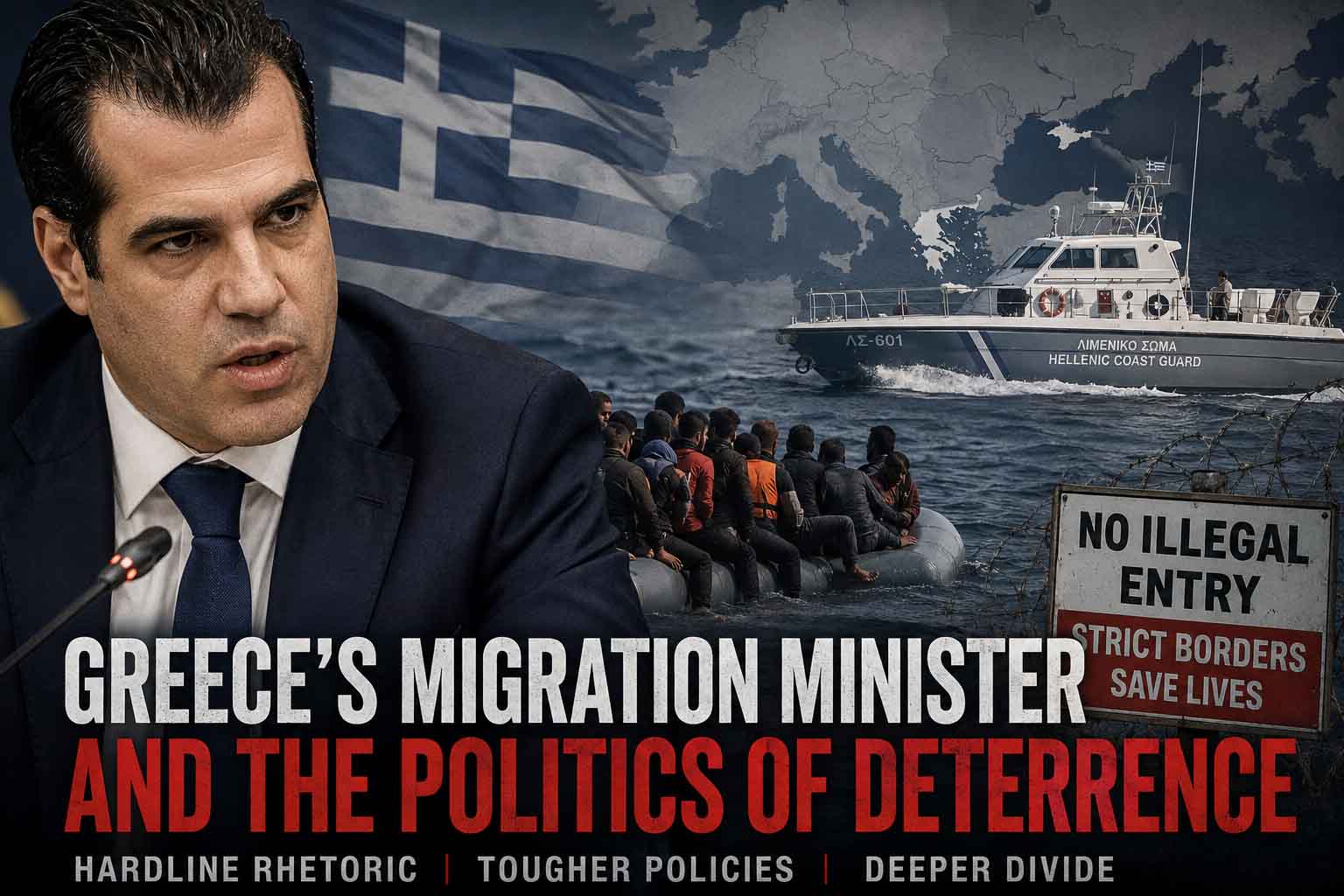
Greece’s Migration Minister and the Politics of Deterrence
Thanos Plevris, Greece’s Minister for Migration and Asylum since June 2025, has become one of Europe’s most polarising figures on irregular migration. A hardline conservative with roots in the far-right Popular Orthodox Rally (LAOS), he has long argued that effective border control requires both physical force and deliberate disincentives. His record includes explicit statements that border security “cannot exist if there are no deaths” and that migrants who reach Greece should face conditions worse than those in their countries of origin. These views, first aired in 2011, have shaped policy under the Mitsotakis government and intensified scrutiny of Greece’s approach to Mediterranean crossings.
A Record of Uncompromising Rhetoric
In April 2011, while still a LAOS MP, Plevris spoke at an event organised by the nationalist magazine *Patria*. He stated that border guarding “cannot exist if there are no casualties — and, to be clear, if there are no deaths.” He went further on the treatment of those who succeed in entering: migrants should receive “no social benefits,” should be unable to eat, drink or access hospitals, and must experience conditions so harsh that “hell must look like heaven” by comparison. The aim, he said, was to ensure that people in places such as Pakistan would hear that life in Greece was worse than at home and stay away.
These remarks, captured on video and repeatedly resurfaced by Greek and international media, have never been disowned. Wikipedia and multiple outlets summarise them as advocacy of deadly force as a deterrent and the deliberate denial of food, water and healthcare. Critics describe the language as a call for lethal enforcement and systematic deprivation. Supporters present it as unvarnished realism about the limits of soft deterrence.
From Rhetoric to Policy
Plevris’s appointment as Migration Minister in late June 2025 coincided with a sharp rise in arrivals from Libya to Crete. Within weeks the government suspended asylum processing for North African arrivals for three months, expanded detention, and passed legislation offering rejected claimants a stark choice: voluntary return or prison terms of two to five years plus fines. Plevris framed the measures as ending “the fairy tale” that most arrivals were vulnerable women and children, noting that the majority were young men from countries such as Egypt, Pakistan and Bangladesh.
He has repeatedly declared that “the Ministry of Migration is not a hotel.” Facilities’ menus were reviewed and cut back; cash allowances and housing support were reduced or redirected towards language and vocational training. The stated goal is to remove pull factors. Government figures claim significant drops in arrivals on certain routes, though the Libya–Crete channel has continued to deliver hundreds of people in single 24-hour periods as recently as August 2026.
Plevris has also backed faster deportations and the creation of “return hubs” outside the European Union, potentially in Africa. He has coordinated with like-minded governments and praised the Hellenic Coast Guard as a force that both protects borders and saves lives. Fatal incidents, including the February 2026 collision off Chios that killed 15 people, have been blamed squarely on “killer smugglers.” Survivor accounts that contradict the official version have been dismissed; critics who question the Coast Guard are accused of siding with traffickers.
Context and Controversy
Greece remains a primary entry point for irregular migration into the European Union. The eastern Aegean route from Turkey has been heavily policed since 2020, shifting pressure southwards to the longer and more dangerous Libya–Crete crossing. Smuggling networks exploit instability in eastern Libya, often using overcrowded boats and, according to Greek authorities, underage pilots. Human-rights organisations and some European Court of Human Rights rulings have documented systematic pushbacks by Greek forces. Plevris’s rhetoric is frequently cited by critics as creating a political climate that tolerates or encourages high-risk interceptions.
Domestically the minister’s stance commands substantial support among voters who view uncontrolled arrivals as a threat to social cohesion, public services and demographic balance. Internationally it places Greece at the sharp end of a wider European shift towards deterrence, returns and external processing. Whether the combination of legal penalties, reduced benefits and robust maritime enforcement will produce lasting reductions in crossings remains to be seen. What is already clear is that Plevris has translated long-held convictions into operational policy, making Greece one of the most restrictive jurisdictions on irregular migration in the European Union.
The debate he embodies is unlikely to soften. For his supporters, the priority is the integrity of national borders and the prevention of deaths at sea through the only method they believe works: making the journey and the destination unattractive. For his opponents, the language of necessary casualties and engineered hardship crosses a moral line that no democratic government should approach. The gap between those positions defines much of Europe’s contemporary migration politics.