

Which G7 Nation Faces the Highest Defecit
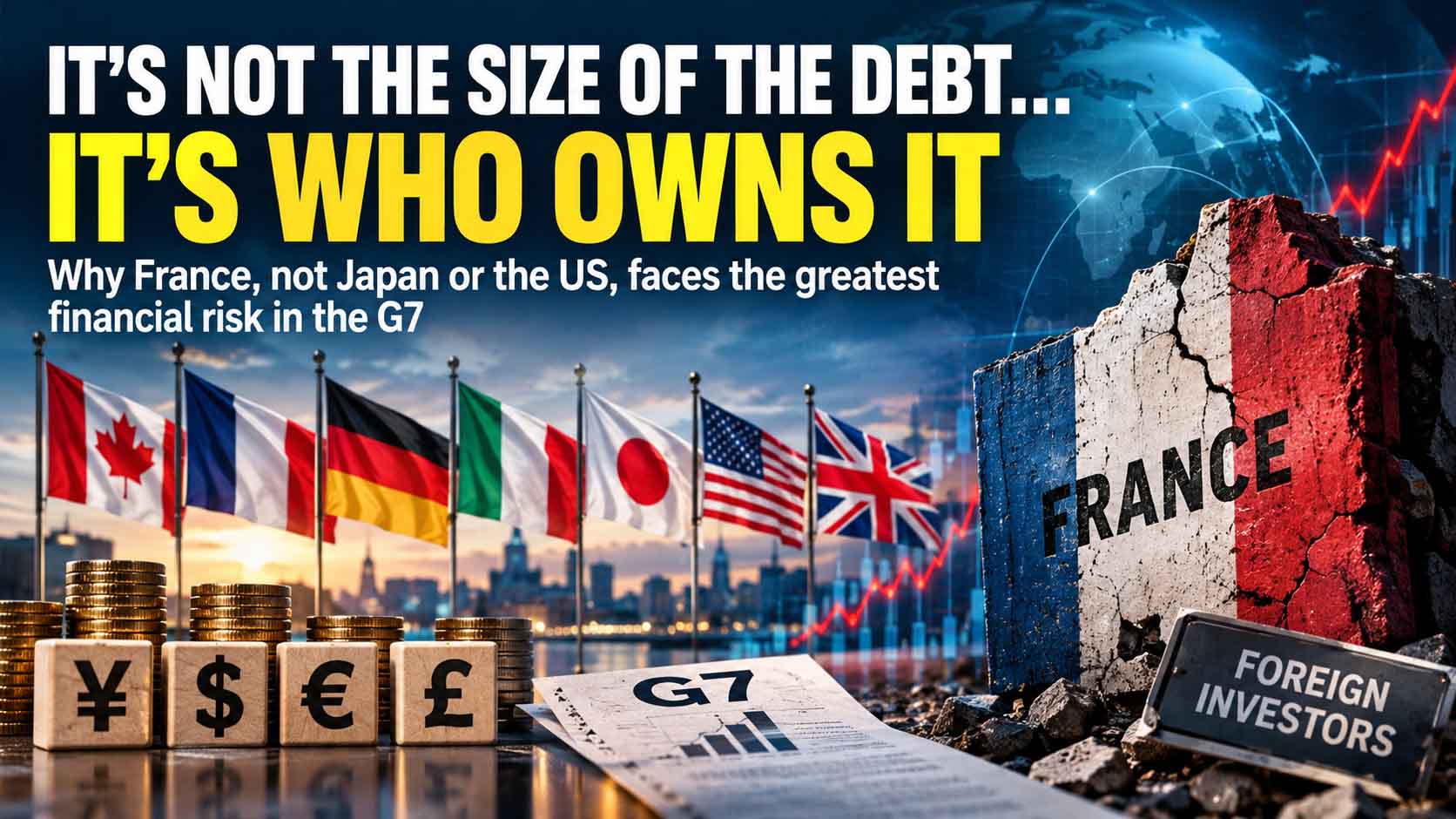
When evaluating the fiscal health of the world’s most advanced economies, a high debt-to-GDP ratio is frequently treated as an immediate red flag. However, a closer examination of the Group of Seven (G7) nations reveals that the raw size of a country’s debt tells us remarkably little about its actual risk of default. In the race to financial instability, the nation most vulnerable to bankruptcy is not the one with the largest headline liabilities, but the one most exposed to international market sentiment.
To understand why, one must look at how different nations structure and fund their obligations. Japan serves as the ultimate paradox, carrying a staggering government debt that approaches 200 per cent of gross domestic product (GDP). Despite this massive figure, Japan borrows more cheaply than almost any other developed nation. The reason is structural: approximately 87 per cent of Japanese debt is held domestically by Japanese institutions and households. Because the debt is denominated in yen, the Bank of Japan retains the ultimate authority to print its own currency to meet obligations if required.
A similar dynamic applies to the United States. While US national debt stands at 126 per cent of GDP and continues to escalate rapidly, the global status of the US dollar provides a unique safety net. Like Japan, America owes its debt in its own currency and possesses the ability to print dollars indefinitely. Consequently, the primary macroeconomic risk for the United States is not an outright sovereign default, but rather the threat of runaway inflation.
Elsewhere in the G7, structural advantages and strong reputations provide significant insulation. Germany, despite being bound to the single currency and unable to independently print euros, maintains a much lower debt burden than its peers. Its long-standing reputation for fiscal discipline and stability acts as a magnet for international investors, consistently driving German bond yields down. Canada presents an even more deceptive headline figure; while its gross debt sits at 115 per cent of GDP, the country holds substantial offsetting financial assets. When these are factored in, Canada’s net debt drops to roughly 10 per cent, the lowest overall ratio in the G7.
The United Kingdom currently experiences the highest bond yields in the G7, making government borrowing exceptionally expensive. However, analysts note that these elevated yields are primarily driven by high inflation expectations rather than an underlying default risk. Crucially, the UK retains its monetary sovereignty through sterling, giving it the capacity to create money to service its debts if a crisis demands it.
This process of elimination leaves two final Eurozone heavyweights under the microscope: Italy and France. On paper, Italy appears to be in far greater danger. It holds a lower credit rating of BBB+ compared to France’s superior A+ rating. Furthermore, a quarter-century of stagnant economic growth has left Italy with a debt-to-GDP ratio of 138 per cent, substantially higher than France’s 118 per cent.
Yet, financial markets are behaving in a way that defies these surface-level metrics. Italy, Spain, and even Greece currently enjoy cheaper borrowing costs than France. If high debt alone dictated high interest rates, France would sit comfortably below these southern European nations on the risk yield curves. Instead, French bond yields have risen to the top.
Italy’s underlying fiscal fundamentals have quietly improved, with a budget successfully passed and its deficit brought under control. Only 36 per cent of Italian government debt is held by non-residents. France, by contrast, has developed a dangerous vulnerability. An astonishing 56 per cent of French sovereign debt is held by overseas investors. This represents by far the highest reliance on foreign buyers within the G7, leaving the French treasury exposed to the whims of international markets that can liquidate their positions at short notice.
Compounding this vulnerability is the projected trajectory of French public finances. While Italy, Spain, the UK, and Greece are all forecast to successfully reduce their debt-to-GDP ratios over the coming five years, France stands alone as the major economy where the debt burden is projected to keep climbing. Without the ability to print its own currency to inflate away the problem, France’s deep reliance on volatile foreign capital, combined with a worsening fiscal trajectory, makes it the unexpected frontrunner for financial distress within the G7.