

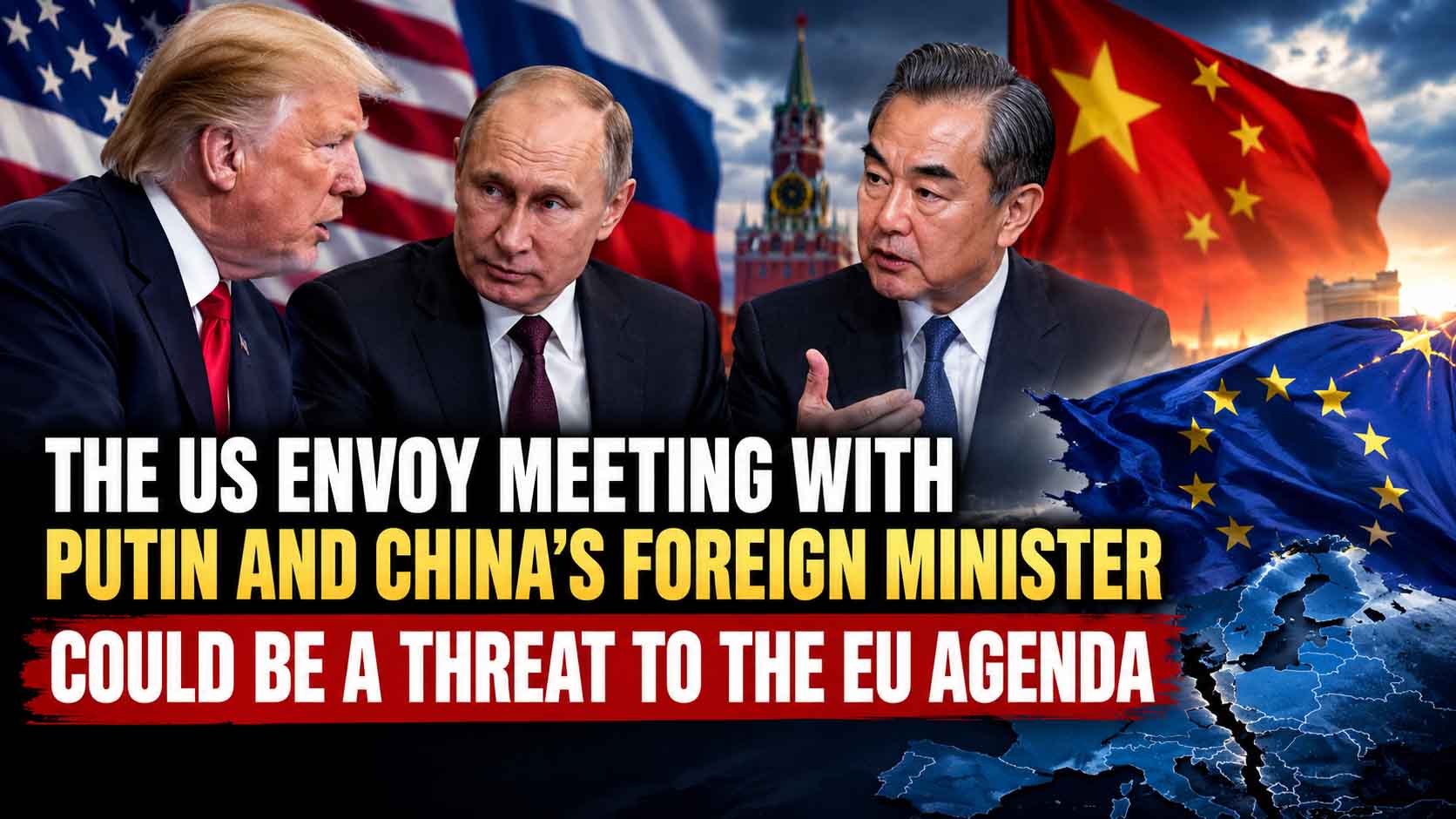
The US envoy meeting with Putin and China’s foreign minister could be a threat to the EU agenda
As Washington explores renewed engagement with Moscow and Beijing, European leaders face the prospect of being sidelined in decisions that could reshape the continent’s security, undermine its political leverage and challenge the direction of its Russia policy.
A changing diplomatic landscape could present one of the most significant strategic challenges to the European Union in years. As the United States explores renewed engagement with Russia, while China maintains close diplomatic relations with Moscow, the prospect of closer dialogue between the world’s three major powers raises an uncomfortable question for Brussels: what happens if the future of European security is negotiated without Europe at the table?
The possibility deserves serious attention. However, the distinction between confirmed diplomatic contacts and a formal strategic alliance is crucial. The significance lies not in assuming that a new alliance already exists, but in understanding how one could alter the balance of power if it were to emerge.
A diplomatic realignment that Europe cannot ignore
Relations between Washington and Moscow have been characterised by confrontation over Ukraine, sanctions, NATO expansion and the wider European security architecture. Yet the United States has periodically explored direct negotiations with the Kremlin, including discussions about ending the war in Ukraine and restoring elements of economic cooperation.
China, meanwhile, has strengthened its relationship with Russia through trade, energy cooperation and diplomatic engagement. Beijing has repeatedly called for a political settlement to the Ukraine conflict, although its approach and its relationship with Moscow remain subjects of considerable debate in Western capitals.
If these separate diplomatic relationships were to develop into a coordinated framework involving Washington, Moscow and Beijing, the implications for Europe could be substantial.
The three countries possess enormous economic, military and diplomatic resources. Together, they could exercise considerable influence over international security, energy markets, trade arrangements and the future of the global order.
Europe’s vulnerability would not necessarily arise from an explicit agreement directed against the EU. It could arise simply because the major decisions were made elsewhere.
Could this undermine the European agenda on Russia?
Since Russia’s full-scale invasion of Ukraine in February 2022, the EU has pursued a policy centred on supporting Ukraine, imposing sanctions on Moscow, reducing European dependence on Russian energy and strengthening continental defence.
European governments have presented these measures as necessary to defend Ukrainian sovereignty and deter further Russian aggression. They have also argued that any settlement must prevent Russia from benefiting strategically from its invasion.
However, there is a potential tension between Europe’s approach and Washington’s diplomatic priorities.
If an American administration concludes that a negotiated settlement with Moscow offers greater strategic or economic benefits than continued confrontation, it could pursue an agreement that does not fully reflect the preferences of Brussels or individual European capitals.
Such an agreement might involve a ceasefire, sanctions relief, restrictions on future military deployments or a broader discussion about European security arrangements. The terms would determine whether European governments regarded it as an acceptable settlement or a serious strategic setback.
The danger for the EU is that it could find itself having to respond to an agreement negotiated by others, rather than shaping the terms from the outset.
That would expose the limitations of a European foreign policy that depends heavily on American military capabilities while seeking to maintain an independent political position on Russia.
It is important, however, to distinguish between European efforts to deter Russian aggression and an alleged agenda to provoke war. There is no sufficient evidence to conclude that the EU, as an institution, is deliberately seeking a war with Russia. European governments differ over the balance between deterrence, military assistance, negotiations and the risks of escalation.
The more defensible argument is that policies intended to contain or deter Russia can carry escalation risks, and that a diplomatic settlement led by Washington could challenge the assumptions underpinning Europe’s current strategy.
The possibility of a three-power understanding
A closer understanding between the United States, Russia and China would not necessarily amount to a military alliance. The countries have competing interests, and their relationships are far from straightforward.
Washington and Beijing remain engaged in strategic competition over technology, trade, military power and influence in the Indo-Pacific. Russia depends increasingly on its relationship with China, but Moscow also has reasons to avoid becoming excessively dependent on Beijing. The United States and Russia continue to disagree over fundamental questions of European security.
These differences make a comprehensive three-way alliance far from inevitable.
Nevertheless, the three powers could pursue selective cooperation where their interests overlap. Arms control, energy markets, regional conflicts, trade and diplomatic arrangements could all provide opportunities for negotiated understandings.
Even limited cooperation could have consequences for Europe if it changed the incentives facing Washington or reduced the importance attached to European preferences.
Consider the possible scenarios.
First, Washington and Moscow could reach an understanding on Ukraine without giving European governments a decisive role in the negotiations.
Secondly, Washington and Beijing could prioritise trade, technology or Indo-Pacific security in ways that leave European economic and diplomatic concerns secondary.
Thirdly, Moscow and Beijing could continue their strategic cooperation while Washington sought to reduce tensions with Russia, creating a more complicated environment for European sanctions and security policy.
None of these outcomes requires the three countries to establish a formal alliance. They require only that their respective national interests lead them to arrangements that Europe has limited power to influence.
How Europe could become politically ineffective
The EU’s influence depends substantially on its ability to coordinate the positions of its member states and translate their collective economic weight into diplomatic leverage.
Its single market is a formidable asset. Its collective regulatory power, trade relationships and financial resources give it influence well beyond what individual European countries could achieve alone.
But economic weight does not automatically translate into strategic independence.
The EU is not a unified military power comparable to the United States, and European governments continue to rely on NATO and American capabilities in important areas, including intelligence, strategic transport, air defence and nuclear deterrence.
Foreign policy coordination also remains difficult. Member states do not always agree on the appropriate response to Russia, the level of military support for Ukraine, the use of sanctions or the long-term relationship with Washington.
A diplomatic framework negotiated by the United States, Russia and China could therefore expose three structural weaknesses.
First, divided European governments. If Washington pursued a settlement that some EU states supported and others opposed, Brussels could struggle to formulate a coherent response.
Secondly, limited negotiating leverage. European governments might find it difficult to influence decisions affecting their own security if they were excluded from the central negotiations and lacked the military capabilities to impose an alternative.
Thirdly, the erosion of strategic credibility. If Europe repeatedly announced objectives that it lacked the independent capabilities to deliver, its influence in subsequent negotiations could diminish.
The result would not necessarily be the collapse of the EU. It could, however, be a form of political marginalisation in which European institutions retain substantial economic power but exercise less control over the continent’s most consequential security decisions.
That is a serious possibility for European policymakers to consider.
Britain faces its own strategic dilemma
For the United Kingdom, the consequences would be particularly important.
Britain remains a leading NATO member, a nuclear-armed state and a permanent member of the United Nations Security Council. It also maintains close intelligence and defence relationships with the United States.
At the same time, British security is directly affected by developments in continental Europe.
If Washington negotiated a major settlement with Moscow without substantial European involvement, London could face pressure to accept arrangements it had little influence over. Alternatively, if Britain and other European states rejected an agreement supported by Washington, they could face the challenge of sustaining their security objectives with reduced American backing.
Neither scenario is inevitable. The outcome would depend on the agreement’s terms, the positions taken by NATO members and the willingness of the United States to maintain its existing commitments.
Nevertheless, the prospect reinforces the importance of Britain’s ability to contribute to European defence while preserving its transatlantic relationship.
Would an agreement bring peace or create new risks?
Supporters of renewed diplomacy with Russia could argue that direct negotiations offer the best opportunity to end the fighting in Ukraine, reduce the danger of escalation and establish a more stable European security environment.
That argument should not be dismissed. Diplomacy between adversaries is not inherently a threat, and a negotiated settlement could reduce human suffering if it were credible, enforceable and consistent with Ukraine’s sovereignty.
Critics, however, would question whether a settlement reached principally by major powers could provide lasting security if Ukraine and the affected European countries had insufficient influence over its terms.
A ceasefire that left fundamental security questions unresolved could create new tensions rather than end them. An agreement that undermined confidence in NATO’s commitments could also have consequences extending well beyond Ukraine.
The central issue is therefore not whether the United States should talk to Russia or China. It is whether any diplomatic settlement would produce a durable peace, preserve the security of European states and give those directly affected a meaningful role in determining their future.
A stable settlement would require more than a meeting between powerful leaders. It would require credible commitments, workable enforcement arrangements and a realistic understanding of the competing interests involved.
Europe’s choice: strategic independence or continued dependence?
The prospect of a changing relationship between Washington, Moscow and Beijing presents the EU with a difficult strategic choice.
It can continue to rely primarily on American military leadership while hoping that US policy remains aligned with European objectives. Alternatively, it can accelerate efforts to strengthen European defence capabilities, improve foreign policy coordination and develop a more credible capacity to negotiate independently.
The second approach would be expensive and politically demanding. It would require European governments to address disagreements over defence spending, military procurement, industrial capacity and the division of responsibilities between the EU and NATO.
It would also require realism about the limits of European power. Strategic autonomy does not mean that Europe must become hostile to the United States, nor does it require abandoning support for Ukraine. It means ensuring that European security cannot be determined entirely by decisions taken in Washington, Moscow or Beijing.
Ultimately, the EU’s influence will depend not simply on the diplomatic relationships other powers develop, but on Europe’s ability to act coherently and credibly in defence of its own interests.
Conclusion: the danger of being left out
The possibility of closer engagement between the United States, Russia and China should be treated as a significant geopolitical development, but not as proof that a new alliance has already formed or that the European project is about to collapse.
The more immediate concern is the risk of strategic exclusion.
If Washington and Moscow reach an understanding on Ukraine and European security, while Beijing helps shape the wider international environment, the EU could find that its policies have less influence over events than its economic size would suggest.
That could challenge the assumptions behind Europe’s current approach to Russia, expose divisions between member states and force European governments to reconsider their dependence on American military power.
For those concerned about the risk of a wider European conflict, the lesson is equally important: deterrence, diplomacy and credible security guarantees must be considered together. A policy that fails to create a viable route towards a durable settlement risks prolonging confrontation; a settlement imposed without adequate security guarantees risks sowing the seeds of another crisis.
The decisive question is whether Europe can remain an influential participant in negotiations that determine its future — or whether it will be left reacting to decisions made by the world’s most powerful states.
In a rapidly changing geopolitical environment, political influence cannot be taken for granted. It must be supported by diplomatic unity, credible capabilities and a willingness to engage with difficult realities.
For the EU, the challenge is no longer simply how to manage its relationship with Russia. It is how to ensure that the future of European security is not decided without Europe.