

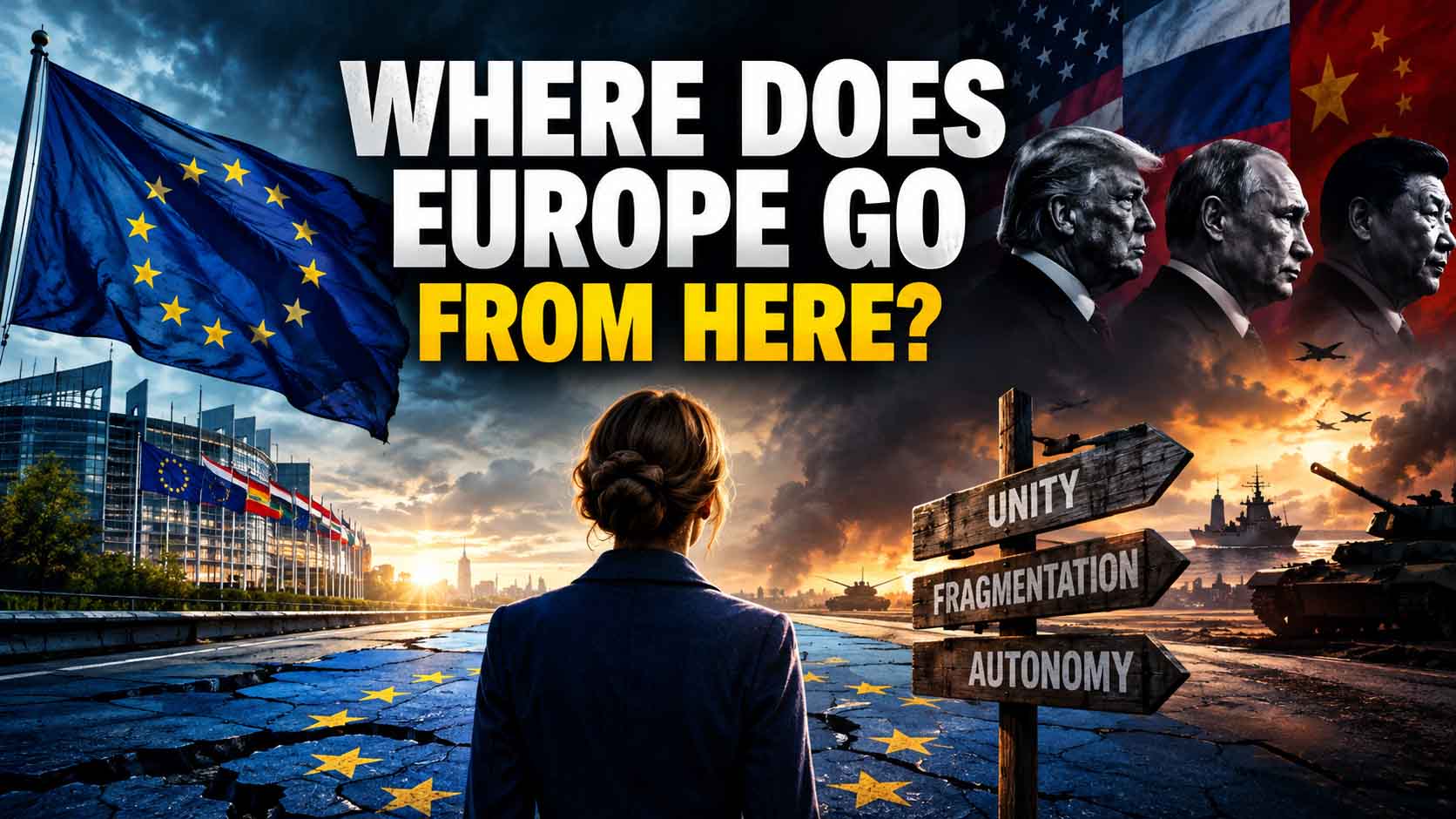
Where Does Europe Go From Here?
Europe has arrived at one of the most consequential strategic crossroads in its post-war history. The continent faces a dilemma that is as much the product of its own political choices as it is the result of a rapidly changing international order. For decades, European governments operated on the assumption that the transatlantic alliance would remain the cornerstone of their security, that American military power would ultimately deter major threats, and that economic integration, diplomacy and interdependence would provide the foundations for lasting stability. That assumption is now under serious strain.
The question is no longer simply whether Europe should spend more on defence, strengthen its borders or seek greater independence from Washington. The more fundamental question is whether Europe can transform itself into a credible geopolitical power without undermining the economic and social model that has defined it for generations.
This is the predicament Europe has got itself into: it must prepare for a more dangerous and unpredictable world at precisely the moment when its finances are constrained, its politics are fragmented, its populations are increasingly dissatisfied, and its capacity for collective action remains uncertain.
The End of Strategic Comfort
Since the end of the Second World War, European security has rested heavily on American military power. NATO provided the collective defence framework, while the United States supplied much of the strategic deterrence, intelligence, logistical capacity and military infrastructure underpinning the alliance. European countries were therefore able to devote substantial resources to rebuilding their economies, developing welfare systems and deepening economic integration without having to replicate the full spectrum of American military capabilities.
This arrangement was not without costs or contradictions, but it offered Europe an extraordinary degree of security and stability.
The difficulty is that a security model built around a dependable external guarantor becomes a vulnerability when that guarantor’s priorities change. If Washington increasingly questions the cost of defending Europe, demands greater European responsibility, or seeks transactional arrangements with rival powers, European governments can no longer assume that American commitments will operate as they have in the past.
Even without a formal American withdrawal from NATO, uncertainty itself has strategic consequences. Military deterrence depends not only on capabilities but also on the credibility of political commitments. If an adversary begins to doubt whether the United States would respond decisively to a crisis involving Europe, the risk of miscalculation increases.
Europe must therefore plan for a world in which American support remains possible but can no longer be treated as an unquestioned constant.
The uncomfortable truth is that Europe has enjoyed the benefits of American protection for decades without building a sufficiently integrated military capacity of its own. Correcting that imbalance will take years, enormous financial resources and political decisions that many governments would prefer to avoid.
The Prospect of a New Great-Power Arrangement
The challenge becomes more serious if the international system moves towards a more explicitly transactional relationship among the United States, Russia and China.
A framework in which these three powers seek to manage their competing interests through direct negotiations could reshape the geopolitical landscape. Whether or not such an arrangement ever emerges in a formal sense, the possibility raises a fundamental concern for Europe: major decisions about European security could be influenced, or even effectively determined, by powers whose priorities do not necessarily coincide with those of European nations.
The historical parallel with the Yalta Conference of 1945 is instructive, although the circumstances today are fundamentally different. At Yalta, the victorious Allied powers discussed the post-war order and the distribution of influence in a Europe emerging from catastrophe. Smaller nations had limited ability to shape the decisions that would determine their futures.
A modern great-power accommodation would not need to reproduce that arrangement literally to create a similar strategic anxiety. If Washington, Moscow and Beijing increasingly treat security, energy, trade and regional influence as subjects for bilateral or trilateral bargaining, Europe risks becoming an object of negotiations rather than an independent participant in them.
For the European Union, this would expose a central contradiction. It is an enormous economic bloc, a major trading power and a regulatory force, yet its ability to translate those advantages into unified geopolitical influence remains limited by national divisions and competing strategic priorities.
Europe’s influence cannot be guaranteed by the size of its market alone. Economic weight matters, but it does not automatically produce military deterrence, diplomatic leverage or the ability to act quickly in a crisis.
If Europe cannot speak with sufficient unity or defend its interests with credible capabilities, other powers will have fewer reasons to accommodate its preferences.
The danger is not simply that Europe might be excluded from a particular diplomatic agreement. It is that a pattern of exclusion could gradually reduce its freedom to determine its own future.
The Fiscal Trap: Defence Versus the European Social Model
This is where Europe’s strategic predicament becomes especially difficult.
Building credible military independence is not merely a question of announcing higher defence budgets. It requires sustained investment in personnel, ammunition, air and missile defence, intelligence, surveillance, military transport, secure communications, maintenance, logistics and industrial production. It also requires the ability to coordinate these capabilities across national borders and deploy them effectively.
These investments are expensive, and the costs cannot be postponed indefinitely if the security environment deteriorates.
Yet European governments are already operating under considerable fiscal pressure. Ageing populations are increasing demands on pensions and healthcare. Public services require investment. Infrastructure needs modernisation. Economic growth is uneven, productivity remains a concern in many economies, and high public debt limits the room for manoeuvre in several countries.
Migration and integration policies create further demands on public administration, housing and social services, although the fiscal consequences vary significantly between countries and depend on policy choices.
The result is a collision between two legitimate obligations: protecting citizens against external threats and maintaining the domestic economic and social arrangements on which political stability depends.
Governments can raise taxes, borrow more, redirect existing expenditure or attempt to stimulate growth sufficiently to finance additional commitments. None of these options is painless, and none guarantees success.
Higher taxes may weaken household purchasing power or business investment. Additional borrowing can increase debt-servicing costs and constrain future budgets. Cutting social expenditure risks alienating voters who already feel that their living standards have stagnated. Reducing investment in infrastructure or education may weaken the very economic competitiveness needed to sustain higher defence spending over the long term.
There is no cost-free route out of this dilemma.
Nor is the problem solved by treating defence and social spending as entirely separate categories. Security is a prerequisite for prosperity, but social cohesion is also a component of national resilience. A country that possesses sophisticated weapons but suffers deep political alienation, declining public services and persistent economic stagnation may struggle to sustain the national consensus required for a prolonged security commitment.
Europe must therefore increase its capacity to defend itself without destroying the domestic foundations that make its societies worth defending.
That is a considerably harder task than simply meeting a spending target.
The Defence Gap Is More Than a Financial Problem
The scale of Europe’s military dependence becomes apparent when defence expenditure is compared with that of the United States.
The original analysis places collective defence spending by European NATO members at approximately $559 billion, against an annual US defence budget of roughly $920–960 billion. These figures illustrate the broad scale of the disparity, although comparisons depend on the year, exchange rates, accounting methods and which countries and expenditure categories are included.
But the difference in spending is only part of the problem.
Money cannot instantly create the institutional experience, military infrastructure and operational integration that have accumulated over decades. Europe remains divided among national defence establishments, procurement systems and industrial priorities. Different countries operate different platforms, maintain separate supply chains and pursue their own procurement programmes, sometimes competing for contracts that might be more efficiently coordinated.
The consequences are practical. Fragmentation can increase costs, complicate maintenance, limit economies of scale and make it harder to sustain operations over time. A larger collection of national military budgets does not automatically translate into a coherent European force.
Europe would also need to address critical dependencies in strategic intelligence, satellite capabilities, air-to-air refuelling, heavy transport, integrated command systems and other areas in which American capabilities have been particularly important to NATO operations.
Replacing these capabilities would require more than additional spending. It would demand common priorities, industrial coordination, political trust and a willingness to accept that individual governments cannot always get everything they want.
In other words, Europe must overcome not only a military shortfall but also a problem of political organisation.
The continent has the resources to become more capable. Whether it can organise those resources effectively, and do so quickly enough, is a much less certain proposition.
Two Roads, Both Fraught With Risk
Europe’s future can be understood through two broad scenarios.
The first is fragmentation.
Under this scenario, governments respond to the same external pressures in increasingly different ways. Countries closest to Russia’s military threat prioritise deterrence and immediate security. Others focus more heavily on economic weakness, public debt, migration or domestic political pressures. Governments disagree over the distribution of defence costs, the nature of future relations with Washington, the appropriate approach towards Moscow and the degree of authority that should be exercised at the European level.
These differences are not imaginary or inherently illegitimate. Geography, historical experience, economic circumstances and national threat perceptions genuinely vary.
The danger arises when those differences become impossible to reconcile.
If national governments conclude that European cooperation no longer serves their immediate interests, common policies may weaken. Disagreements over defence, fiscal rules, border management and foreign policy could reinforce existing political divisions. Pressure for national solutions could grow at the expense of collective institutions.
The Schengen system, the single market and the European Union itself could come under increasing strain—not necessarily through a single dramatic collapse, but through gradual erosion of trust, repeated exceptions and the growing inability to agree on common action.
Such fragmentation would be strategically self-defeating. Individual European states might seek bilateral guarantees from Washington, make accommodations with Moscow or pursue their own arrangements with other major powers. But a divided Europe would have less bargaining power than a united one, leaving smaller and more exposed states particularly vulnerable to decisions taken elsewhere.
The second scenario is forced strategic autonomy.
Here, a reduction in the reliability of American security guarantees becomes the catalyst for a deeper European transformation. Governments recognise that no individual European country can efficiently reproduce the full range of capabilities previously supplied through the transatlantic alliance. They therefore pool resources, coordinate procurement, expand joint military production, strengthen shared command structures and explore common borrowing to finance investments that benefit the continent as a whole.
Strategic autonomy, in this context, would not necessarily mean abandoning NATO or severing relations with the United States. It would mean ensuring that Europe could protect its essential interests and sustain credible deterrence even if American support became more limited, conditional or delayed.
This path would demand a significant redistribution of political authority and financial responsibility. Governments would need to accept common priorities, reduce unnecessary duplication and make difficult decisions about which capabilities Europe must develop collectively.
It would also require a clearer understanding of what strategic autonomy actually means. Complete military self-sufficiency across every domain may be prohibitively expensive and unnecessary. A more realistic objective would be the capacity to defend European territory, sustain operations, deter coercion and make independent political decisions in circumstances where external support could not be assumed.
This is potentially the stronger long-term path, but it is not guaranteed to succeed. Integration requires trust, time and political leadership. It also requires European governments to convince their populations that the sacrifices involved are necessary and fairly distributed.
The Political Cost of Doing What Is Necessary
Perhaps the greatest obstacle to European strategic autonomy is not financial or technological. It is political.
European leaders must ask their electorates to accept greater defence expenditure at a time when many households are concerned about living costs, housing, employment, public services and their future economic prospects.
The immediate benefits of additional military investment are difficult to communicate. A new defence production facility, an integrated air-defence system or a stockpile of ammunition may strengthen deterrence, but these investments do not provide the visible and immediate returns associated with a new hospital, better transport links or lower household taxes.
The benefits of deterrence are often measured in events that never occur. The costs of defence, by contrast, appear in budgets and competing demands for public money.
This creates a structural political disadvantage for governments attempting to prepare for future threats. The price of inaction may remain invisible until a crisis arrives, while the price of preparation is immediately apparent.
There is also a question of legitimacy. Citizens are unlikely to support an open-ended increase in military expenditure if they believe that the burden falls disproportionately on ordinary households while political and economic elites remain insulated from the consequences.
Nor can European governments assume that the public will automatically accept deeper integration in the name of security. National sovereignty, democratic accountability and control over public finances remain important political concerns. Any move towards common borrowing, joint procurement or more centralised defence decision-making must address those concerns rather than dismiss them.
Europe’s leaders therefore face a dual challenge: they must convince their populations that the strategic environment has changed, and they must demonstrate that the response is economically credible, politically accountable and equitable.
Failure on either front could undermine the very policies intended to strengthen Europe.
The Strategic Cost of Delay
Time is one of the most important variables in this equation.
A serious European defence capability cannot be built overnight. Industrial capacity requires investment. Skilled personnel must be recruited and trained. Equipment takes years to develop, manufacture and integrate. Shared procurement and command arrangements require sustained coordination. Public finances and national political priorities cannot be transformed instantly.
If the external security environment deteriorates more quickly than Europe develops these capabilities, the continent could find itself in a particularly vulnerable position: aware of its dependence but unable to eliminate it in time.
That would weaken Europe’s bargaining position precisely when the value of credible independent capabilities was greatest.
Delay also risks making the eventual adjustment more expensive. Governments that invest gradually and coordinate their decisions may be able to spread costs, avoid duplication and build industrial capacity in a planned manner. Governments that act only after a major crisis may be forced into emergency procurement, inefficient spending and politically destabilising fiscal measures.
Nevertheless, urgency should not be confused with panic. Spending more without a coherent strategy can produce expensive but ineffective capabilities. The objective should not be to maximise defence expenditure for its own sake, but to convert resources into credible military capacity while preserving economic resilience.
Europe needs a plan that connects defence requirements to industrial policy, fiscal capacity, energy security, technological development and long-term economic growth.
Without that integration, higher spending risks becoming a series of disconnected national responses rather than the foundation of a stronger European strategic position.
Where Does Europe Go From Here?
Europe’s predicament cannot be resolved by returning to the assumptions of the past. The international environment has changed, and the continent must be prepared for the possibility that its traditional security arrangements will no longer provide the same degree of certainty.
Nor can Europe simply declare itself strategically autonomous and expect the declaration to become reality. Independence requires capabilities, resources, institutional coherence and the political will to use them.
The immediate priority must be to establish a credible, long-term European defence strategy built around clearly identified capability gaps, coordinated procurement and a stronger industrial base. Governments should focus on areas where collective investment offers the greatest strategic return, rather than allowing national competition to perpetuate fragmentation.
At the same time, Europe must develop a more sustainable approach to financing security. Common borrowing for carefully defined joint defence investments may deserve serious consideration, alongside national spending commitments and reforms designed to improve the continent’s economic performance. Any such approach must be transparent about its costs, risks and distributional consequences.
Europe must also preserve the transatlantic relationship wherever possible. Building greater European capacity should strengthen the alliance, not become an excuse for unnecessary estrangement from Washington. A Europe capable of carrying a greater share of its own defence would be a more valuable partner to the United States and a less attractive target for coercion by rival powers.
Diplomatically, European governments need to ensure that they remain active participants in decisions affecting their security. This requires a greater capacity to coordinate foreign policy, articulate common interests and engage major powers from a position of collective strength.
Above all, European leaders must recognise that security, economic prosperity and social stability cannot be treated as competing ambitions that can be separated indefinitely. A sustainable strategy must protect the continent against external threats while preserving the productive economy, social cohesion and democratic legitimacy necessary to finance that protection.
The central dilemma remains stark.
If Europe spends too little on defence, it risks remaining dependent on a security guarantor whose future commitments cannot be taken for granted. If it spends too much, too quickly or without coordination, it risks aggravating fiscal pressures, weakening public services and fuelling the domestic political divisions that already threaten European cohesion. If it fails to unite, it may find itself negotiating its future from a position of weakness. If it attempts to unite without sufficient political legitimacy, its own internal tensions may frustrate the project before it matures.
There is no painless option, and there is no guarantee that the necessary compromises will be made.
Yet the most dangerous outcome would be to recognise the scale of the problem and still postpone the decisions required to address it.
Europe’s historical achievement was not simply to create a prosperous common market or to establish institutions that reduced the likelihood of conflict between its members. It was to build an order in which cooperation made individual countries more secure and more influential than they could have been alone.
That achievement now faces a test. Can Europe extend the logic of economic integration into the realm of security, or will national differences prevent it from adapting to a world in which economic size alone is no longer sufficient to guarantee political influence?
The continent must decide whether it is prepared to pay the price of greater strategic responsibility—or whether it will continue to rely on arrangements whose durability it can no longer confidently assume.
The irony is that Europe has not necessarily become poorer, smaller or less economically significant. Rather, it has reached a point at which the relationship between its economic weight and its geopolitical power is increasingly exposed. It possesses substantial resources, sophisticated industries, considerable technological expertise and a large collective market. What it lacks is the certainty that these advantages can be translated into unified strategic action when the circumstances demand it.
That is the real crisis confronting Europe: not an inevitable decline, but a growing mismatch between the responsibilities it must assume and the political, fiscal and institutional arrangements through which it attempts to fulfil them.
Where Europe goes from here will depend on whether its leaders can confront that mismatch before external events make the choices for them.
The price of strategic autonomy will be high. The price of fragmentation could be higher still.
And the longer Europe waits to make that choice, the less control it may retain over the outcome.