

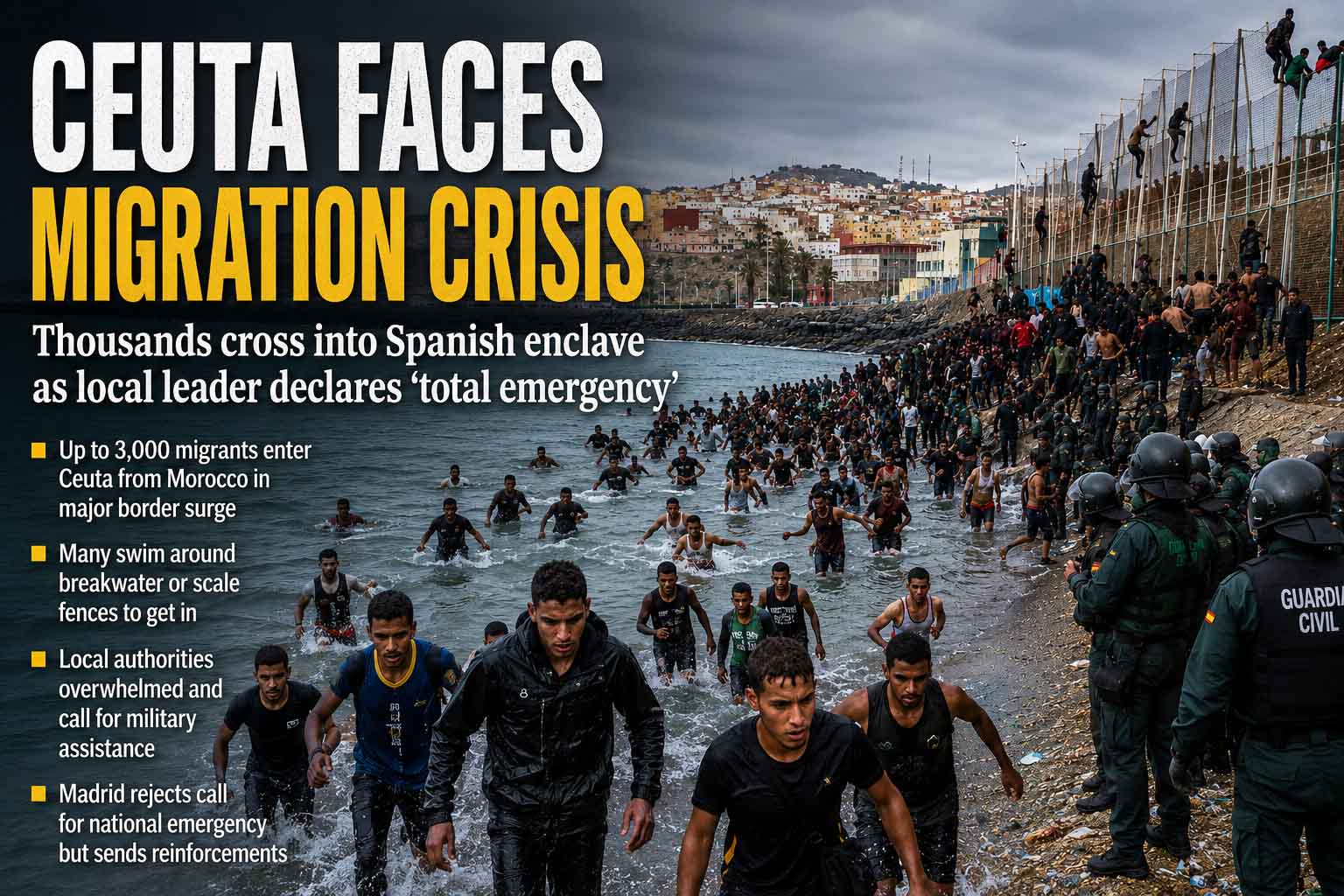
Ceuta Faces Renewed Migration Crisis as Thousands Cross into Spanish Enclave
The Spanish enclave of Ceuta has declared a state of “total emergency” after thousands of migrants crossed from neighbouring Morocco in one of the largest mass arrivals since the border crisis of 2021. The influx has placed significant pressure on local authorities, prompting urgent calls for additional resources and renewed debate over European border security and migration policy.
A Sudden Surge
On 30 July 2026, an estimated 2,000 to 3,000 migrants entered Ceuta within a matter of hours. Many reached the enclave by swimming around the Tarajal breakwater and coming ashore on local beaches, while others crossed or bypassed sections of the border fence. The volume of arrivals overwhelmed the capacity of Spanish police and border guards, who were forced to respond to multiple crossing points simultaneously.
Video footage circulating on international news channels showed large groups arriving on the shoreline before moving inland, while emergency services and security personnel worked to manage the situation.
Local Authorities Declare an Emergency
Juan Jesús Vivas, President of the Autonomous City of Ceuta, described the situation as one of “total emergency” and appealed to Spain’s central government for immediate assistance. His requests included additional police officers, Civil Guard personnel, military support and the declaration of a national emergency to coordinate the response.
Although Madrid acknowledged the seriousness of the situation, Spain’s Interior Ministry declined to declare a national state of emergency. Officials argued that existing legal frameworks were sufficient to manage the crisis while confirming that reinforcements had been deployed and that cooperation with Moroccan authorities had been intensified.
Why Ceuta Matters
Ceuta occupies a unique geopolitical position. Although located on the North African coast, it is sovereign Spanish territory and forms part of the European Union. Together with the nearby enclave of Melilla, it represents the EU’s only land border with Africa.
For decades, the territory has been a focal point for irregular migration into Europe. Extensive border infrastructure, including high-security fencing, surveillance technology and maritime patrols, has reduced but not eliminated attempts to enter the enclave.
Factors Behind the Latest Crossings
No single factor has been officially identified as the cause of the latest surge. However, several developments appear to have contributed.
Local officials have reported sustained migratory pressure along the Morocco–Spain border in recent weeks. At the same time, organised criminal networks involved in people smuggling continue to facilitate crossings using both land and sea routes.
Attention has also focused on a recent ruling by Spain’s Supreme Court concerning the treatment of migrants intercepted at sea. Some regional politicians believe the decision may have encouraged additional attempts to reach Spanish territory, although no official investigation has established a direct causal relationship.
Humanitarian and Security Challenges
The sudden arrival of thousands of people has created immediate humanitarian concerns. Reception facilities in Ceuta were already operating near capacity before the latest influx, leaving authorities struggling to provide accommodation, medical care and basic services for new arrivals.
Alongside these humanitarian pressures, security agencies face the complex task of processing migrants, identifying individuals requiring international protection and arranging the return of those without legal grounds to remain in Spain.
Officials have also highlighted the dangers associated with irregular sea crossings. Numerous fatalities have been recorded in waters surrounding Ceuta and the western Mediterranean during recent months, underlining the risks undertaken by those attempting the journey.
Echoes of the 2021 Crisis
The latest events inevitably invite comparison with May 2021, when approximately 8,000 migrants entered Ceuta within two days after Morocco relaxed border controls during a diplomatic dispute with Spain. That episode prompted the deployment of Spanish military personnel and the rapid return of many migrants to Morocco.
While the current influx is smaller than the events of 2021, it nevertheless represents one of the most significant migration incidents to affect Ceuta in recent years and demonstrates the continued vulnerability of Europe’s external borders to sudden surges in migration.
Political Implications
The developments have intensified debate across Spain and the wider European Union.
Supporters of tougher border controls argue that the events demonstrate the need for stronger external border protection, closer cooperation with neighbouring countries and more effective measures against organised people-smuggling networks.
Others emphasise the humanitarian dimension, noting that many migrants are fleeing conflict, persecution or economic hardship and arguing that any response must comply with international refugee law while ensuring that vulnerable individuals receive appropriate protection.
Looking Ahead
As Spanish authorities continue to reinforce security in Ceuta and process those who have arrived, attention will focus on whether the latest surge proves to be an isolated incident or the beginning of a broader increase in migration pressure along Europe’s southern frontier.
Whatever the longer-term outcome, the events in Ceuta illustrate the complex balance between maintaining secure borders, fulfilling humanitarian obligations and managing migration in a manner that is both lawful and sustainable. They also reinforce the importance of continued cooperation between Spain, Morocco and the European Union in addressing one of the region’s most enduring policy challenges.
We are being invaded, these people will keep coming and they will kill us all!