

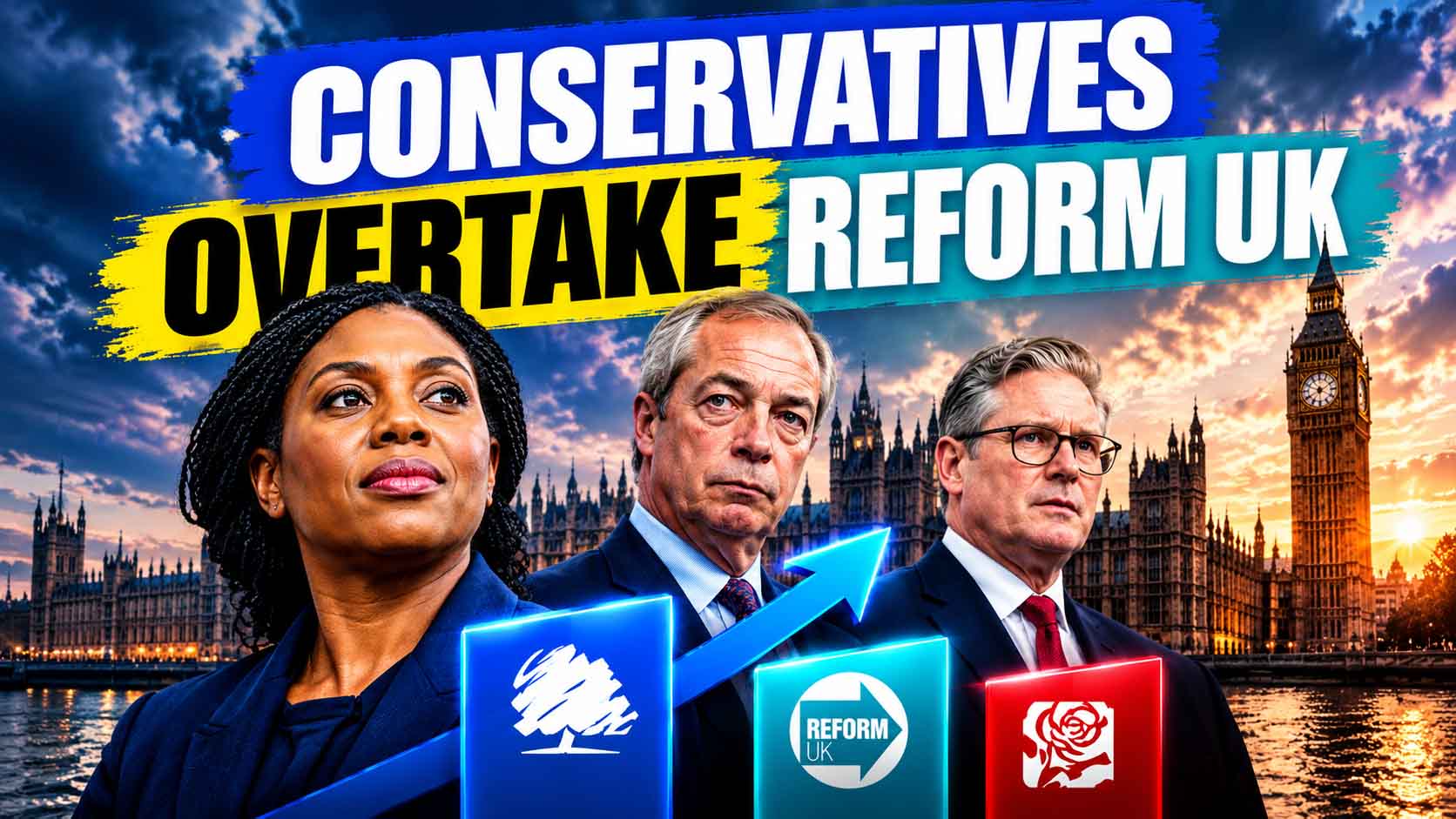
Conservatives Overtake Reform UK
Badenoch’s Party Records Significant Polling Bounce
A new YouGov survey puts the Conservatives on 23 per cent, just one point behind Labour, as Reform UK slips to 21 per cent. The result raises fresh questions about the direction of British politics and whether the Conservatives can sustain their recovery.
The Conservatives have moved back into second place in a closely watched national voting intention poll, overtaking Reform UK and closing the gap on Labour.
The latest YouGov survey, conducted on 11 and 12 October 2026 for Sky News and The Times, puts Labour on 24 per cent, the Conservatives on 23 per cent and Reform UK on 21 per cent. The Conservative vote share has risen by three percentage points, while Labour has fallen by three and Reform has slipped by one.
The result represents the Conservatives’ strongest performance in YouGov’s voting intention tracker since January 2025, providing a welcome boost for party leader Kemi Badenoch as she seeks to rebuild the party’s credibility following its defeat at the 2024 general election.
However, while the figures offer grounds for optimism among Conservatives, they also require careful interpretation. All three parties remain closely grouped, and the pollster has cautioned that their support levels fall within the margin of error.
A potential turning point for the Conservatives
The improvement follows the Conservative Party conference, where Badenoch sought to establish a clearer political and economic direction for her party.
Her message has focused on reducing the tax burden, rewarding aspiration and presenting the Conservatives as a credible alternative to the Labour Government. The conference also provided an opportunity to demonstrate greater unity and reinforce Badenoch’s position as leader.
The subsequent polling increase suggests that the party may be benefiting from renewed media attention and a more focused political message.
Nevertheless, it would be premature to conclude that the Conservatives have achieved a lasting recovery. Conference-related improvements in polling can prove temporary, particularly when voters’ attention moves on to other political issues.
The critical test will be whether the party can maintain its improved position over the coming weeks.
Reform UK faces renewed pressure
The Conservatives’ rise comes as Reform UK experiences a modest decline in support.
Nigel Farage’s party has established itself as a major force in British politics by attracting voters dissatisfied with the traditional parties, particularly over immigration, public services and the economy.
However, internal difficulties and political controversies have created challenges for Reform, potentially offering the Conservatives an opportunity to win back voters who abandoned them in recent years.
The latest figures suggest that the contest for voters on the right is becoming increasingly competitive.
If the Conservatives can sustain their gains while Reform continues to lose ground, Badenoch could begin to re-establish her party as the principal challenger to Labour.
Yet Reform remains close behind, and a single poll is insufficient to establish a definitive change in the balance of support between the two parties.
Labour remains narrowly ahead
Despite its decline in the latest survey, Labour continues to occupy first place.
Its 24 per cent rating puts it just one percentage point ahead of the Conservatives, highlighting the increasingly fragmented nature of British electoral politics.
The narrow gap also demonstrates the volatility of voting intention figures. Changes of only a few percentage points can substantially alter the order of the leading parties, even when the underlying level of public support has not changed dramatically.
Other recent polling has placed Labour further ahead, suggesting that the Conservatives have yet to demonstrate a consistent national lead or a sustained narrowing of the gap across all polling organisations.
For the Government, however, the latest result is a reminder that it cannot take continued electoral support for granted.
For Badenoch, it presents an opportunity to argue that the Conservatives are once again capable of competing seriously for power.
What does this mean for the next general election?
The implications extend beyond the headline percentages.
Under the UK’s first-past-the-post electoral system, national vote share does not translate directly into parliamentary seats. The geographical distribution of support, the performance of individual candidates and the dynamics of constituency contests will all influence the eventual outcome.
A stronger Conservative vote could prove particularly important in marginal constituencies where relatively small shifts in support determine which party wins.
At the same time, a divided political landscape could make it more difficult for any single party to secure an overall Commons majority.
The Conservatives must therefore do more than overtake Reform in national polling. They need to demonstrate that they can retain existing supporters, win back former voters and build sufficient support across the country to translate improved polling into parliamentary representation.
The next few weeks will be crucial
The latest YouGov survey provides an encouraging snapshot for the Conservatives, but the longer-term significance remains uncertain.
If subsequent polls confirm support consistently in the low-to-mid-20s, the party will have stronger grounds to claim that its recovery is becoming established. Continued weakness for Reform and further declines in Labour’s support could make the political contest substantially more competitive.
Conversely, if the Conservatives fall back towards their previous levels, the latest result may ultimately be remembered as a short-lived conference bounce rather than a decisive turning point.
For now, the central finding is clear: the Conservatives have regained ground, overtaken Reform UK in this poll and moved to within touching distance of Labour.
Whether this marks the beginning of a genuine political comeback will depend on what happens next.
One poll does not transform the political landscape. But in an increasingly fragmented electoral contest, even a modest shift in public opinion can carry significant consequences.