

The UK’s Asylum System by the Numbers
Examining the Facts Behind the Headlines
The issue of asylum and illegal migration remains one of the most contentious topics in British politics. Campaign organisations, government departments, charities and the media frequently publish statistics to support competing narratives, leaving many people uncertain about what the numbers actually mean.
One recent infographic, published by Great British PAC, presents a series of figures under the headline “The Numbers Britain Is Not Being Told.” Many of the statistics are drawn from official government data or parliamentary reports. However, while several of the figures are accurate, they are presented with limited context and alongside political messaging designed to support a particular viewpoint.
This article examines each of the principal claims, compares them with official sources and explains what the figures reveal—and what they do not.
The Cost of the Asylum System
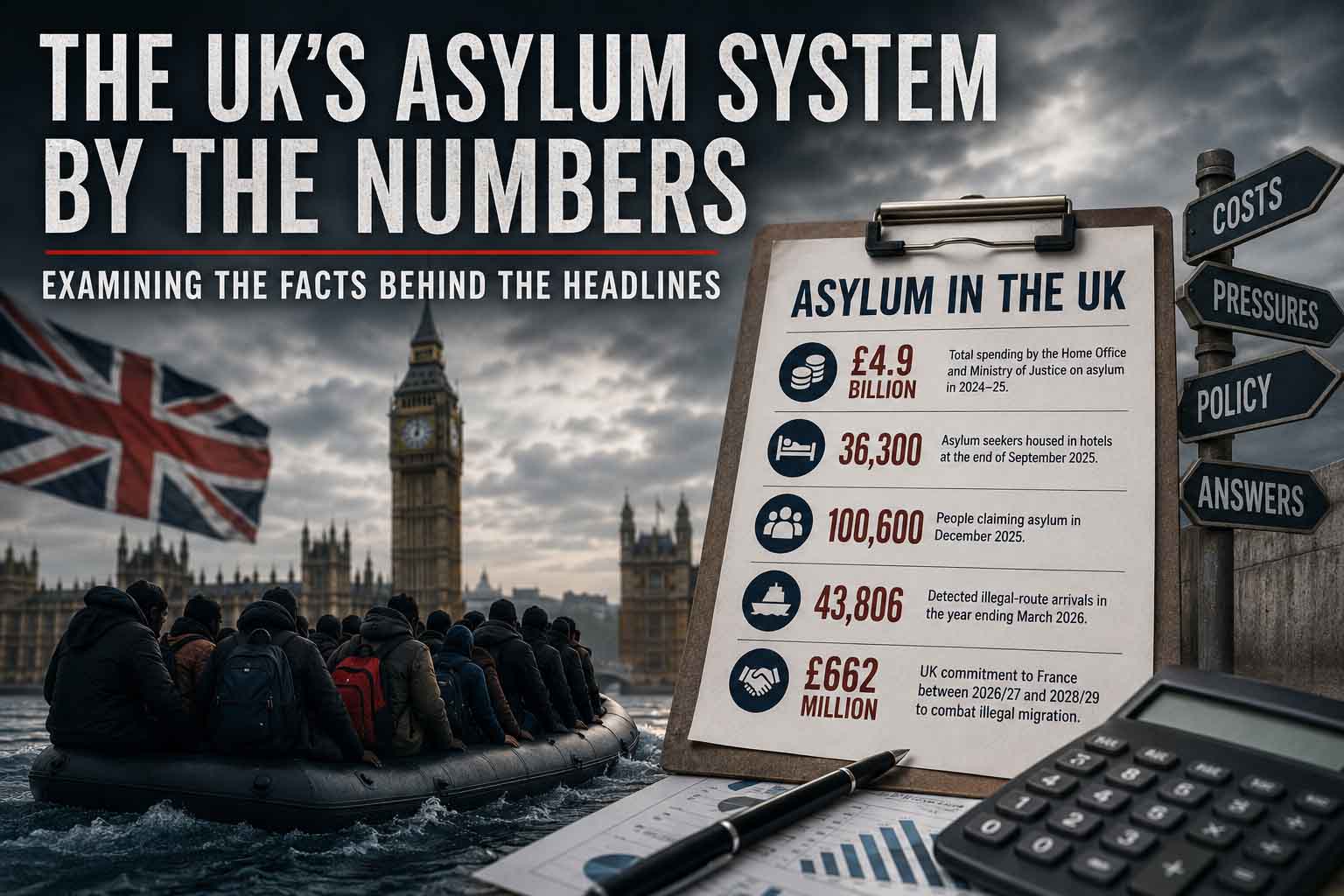
Perhaps the most striking statistic is the claim that the Home Office and Ministry of Justice spent £4.9 billion on asylum during the 2024–25 financial year, with £3.4 billion spent on accommodation and support alone.
These figures are supported by findings from the UK Parliament’s Public Accounts Committee (PAC), which has repeatedly criticised the escalating costs of the asylum system. The committee has described the system as struggling under the weight of increasing demand, lengthy processing times and dependence on expensive temporary accommodation.
The accommodation budget alone has become one of the largest components of asylum expenditure. Because many applicants wait months or even years for decisions, the Government has been required to house tens of thousands of people while their claims are assessed.
It is important to understand that these figures represent gross public expenditure on the asylum system, not the broader economic impact of migration. They do not account for taxes paid by recognised refugees who later enter employment, nor do they measure wider economic contributions or costs associated with migration more generally.
Hotel Accommodation Remains One of the Largest Costs
The infographic highlights that 36,300 asylum seekers were living in hotels at the end of September 2025, while £274 million was spent during December 2023 alone to provide up to 64,000 hotel beds.
Both figures originate from official government reporting.
The widespread use of hotels began during the COVID-19 pandemic when processing delays combined with increasing asylum applications left existing accommodation capacity exhausted. Although intended as a temporary solution, hotels have remained heavily utilised because the backlog has persisted.
Successive governments have acknowledged that hotels represent one of the least cost-effective forms of accommodation. The current Government has committed itself to reducing and eventually ending their routine use, although achieving this depends upon significantly increasing the speed of asylum decision-making.
Asylum Claims Have More Than Doubled
Another headline statistic states that 100,600 people were claiming asylum in December 2025, more than twice the level recorded in December 2019.
Official Home Office statistics support this claim.
The increase reflects several global developments, including conflicts in Afghanistan, Ukraine, Sudan and the Middle East, as well as broader patterns of international displacement. However, the total number of people claiming asylum should not automatically be interpreted as the number of people entering the UK illegally.
Many asylum applicants arrive legally using visas before making claims, while others enter through irregular routes such as small boats crossing the English Channel.
Recent statistics suggest that asylum claims have begun to stabilise, although they remain historically high.
Illegal Channel Crossings
The infographic reports:
- 43,806 detected illegal-route arrivals during the year ending March 2026.
- 90% arrived by small boat.
- An average of 63 people occupied each small boat, representing a record level.
These figures correspond with official Home Office migration statistics.
Small boat crossings have become the dominant method of irregular entry across the English Channel, replacing earlier methods involving lorries, ferries and concealed freight transport.
However, an important legal distinction often omitted from public debate is that illegal entry and refugee status are not synonymous.
Under the 1951 Refugee Convention, an individual may still qualify for refugee protection even if they entered a country irregularly. Each asylum claim must therefore be assessed individually before determining whether the applicant qualifies for international protection.
This legal distinction is frequently overlooked in political discussion.
Problems in Contract Management
The infographic also notes that the Home Office sought to recover £46 million from accommodation providers because of weak contract management.
This figure stems from government audit findings examining asylum accommodation contracts.
The issue concerned shortcomings in contract oversight rather than fraudulent activity by asylum seekers themselves. Parliamentary committees have repeatedly criticised procurement arrangements, monitoring processes and value for money within the accommodation system.
These findings illustrate that rising costs are not solely attributable to increasing demand but also to administrative inefficiencies.
Funding Agreements with France
One statistic receiving considerable attention concerns the UK’s commitment of £662 million to France between 2026/27 and 2028/29 to combat illegal migration in northern France.
This funding forms part of bilateral agreements intended to strengthen border enforcement before migrants reach the English Channel.
The money supports activities such as:
- additional French police patrols;
- surveillance technology;
- fencing and physical security measures;
- intelligence sharing;
- joint enforcement operations.
It is not direct financial support for migrants or asylum seekers.
Whether these agreements represent value for money remains politically contested, with supporters arguing they improve border security and critics questioning their long-term effectiveness.
Charity Funding
One of the infographic’s more controversial sections concerns taxpayer funding allegedly received by charities and campaign organisations.
The figures include:
- British Refugee Council – £41.6 million (2021–2025)
- British Future – £750,650 (2021–2024)
- Paul Hamlyn Foundation – £1.4 million (2020–2023)
- Barrow Cadbury Trust – £350,000 (2024–25)
It also claims approximately £240 million has been traced to 22 asylum and migration charities.
Unlike many of the earlier figures, these claims are more difficult to verify independently because the infographic does not provide detailed sources or methodology.
Government grants awarded to charities frequently fund a wide variety of activities beyond asylum support, including:
- refugee integration;
- safeguarding programmes;
- community cohesion initiatives;
- legal advice;
- research;
- humanitarian assistance.
Consequently, a grant received by an organisation should not automatically be interpreted as funding migration advocacy or asylum accommodation.
Without transparent supporting documentation, it is difficult to assess precisely how the £240 million figure was calculated.
Why Have Costs Increased So Dramatically?
The headline figures can create the impression that expenditure has risen solely because of increasing migration. In reality, several factors have contributed:
Growing Backlogs
Lengthy asylum processing times have left applicants waiting far longer for decisions, increasing accommodation costs.
Hotel Dependence
Hotels are significantly more expensive than purpose-built accommodation, contributing billions to overall expenditure.
Global Instability
International conflicts have increased the number of people seeking asylum across Europe, including the UK.
Administrative Inefficiencies
Parliamentary committees and the National Audit Office have repeatedly criticised weaknesses in procurement, contract management and operational planning.
What the Infographic Does Not Explain
Although many of the statistics themselves are accurate, several important areas of context are absent.
The infographic does not distinguish between:
- asylum seekers;
- recognised refugees;
- illegal entrants;
- legal migrants.
These are separate legal categories with different rights and obligations.
Nor does it explain the UK’s legal responsibilities under the Refugee Convention, which requires asylum claims to be considered individually regardless of the applicant’s route of entry.
Likewise, while the infographic highlights government spending, it does not discuss any economic contributions made by refugees who later obtain permission to work, pay taxes and settle permanently.
This omission does not invalidate the expenditure figures but does illustrate the selective nature of the presentation.
A Balanced Assessment
Overall, the evidence suggests that many of the infographic’s principal statistics are grounded in official government publications.
Figures relating to:
- asylum expenditure;
- accommodation costs;
- hotel usage;
- asylum claim numbers;
- illegal Channel crossings;
- funding agreements with France;
are broadly supported by official data.
However, the charity funding claims are less transparent and would benefit from clearer sourcing and explanation.
More broadly, the infographic presents genuine statistics through a political lens. It focuses almost exclusively on costs, pressures and funding commitments while omitting legal context, operational causes and longer-term outcomes.
Conclusion
The UK’s asylum system is undeniably expensive, with annual expenditure now measured in billions of pounds. Rising application numbers, persistent processing backlogs, extensive hotel use and operational shortcomings have all contributed to increasing costs borne by the taxpayer.
At the same time, understanding these figures requires careful distinction between political messaging and statistical evidence. Many of the headline numbers are accurate, but numbers alone rarely tell the whole story. Questions about border security, humanitarian obligations, public spending and immigration policy cannot be answered by isolated statistics without considering the legal framework, administrative challenges and broader social context.
For policymakers and the public alike, meaningful debate depends not simply on citing figures, but on understanding what those figures measure, what they omit and how they fit into the wider picture of the UK’s asylum system.