

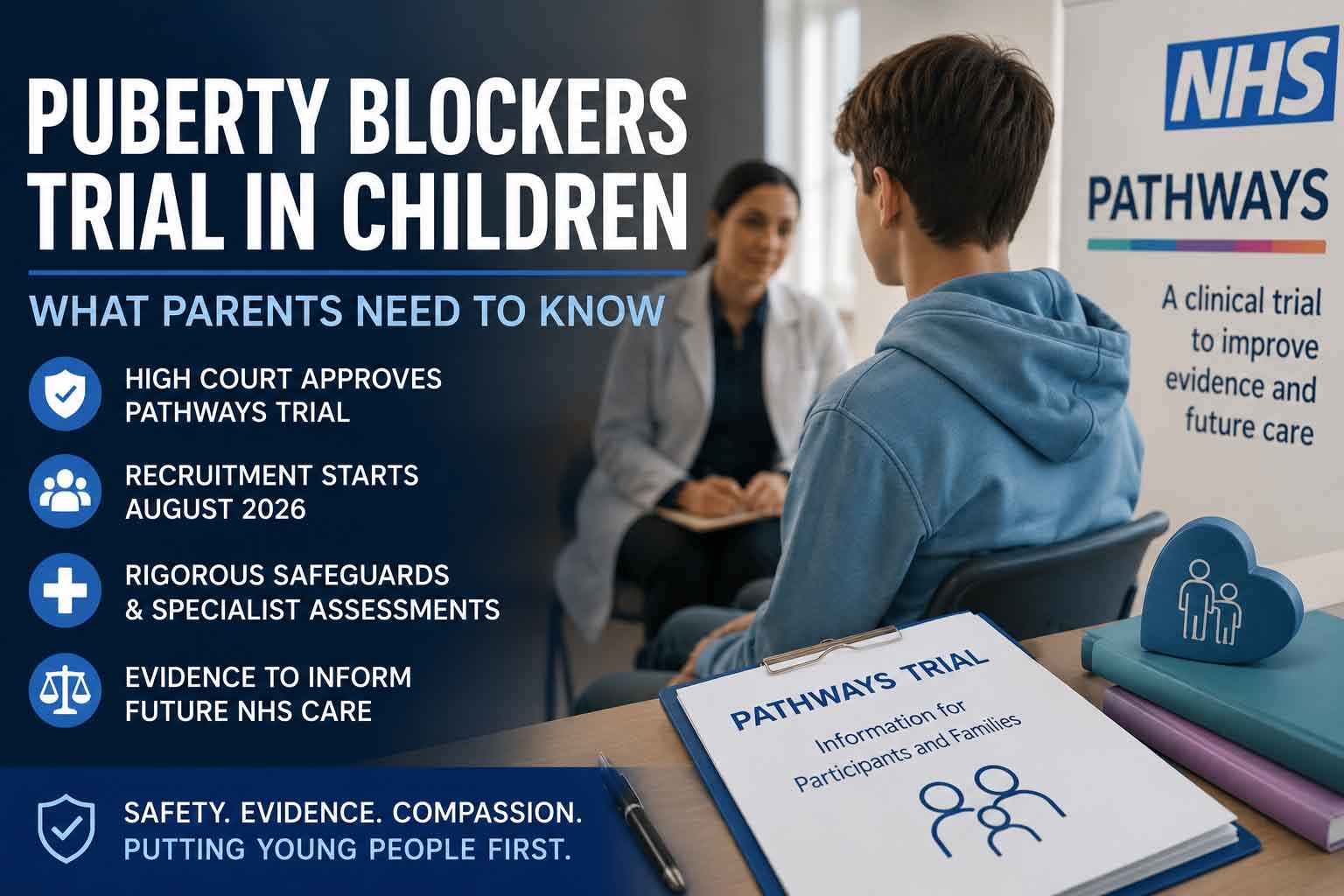
Can Parents Stop Their Child Taking Part in the NHS Puberty Blockers Trial?
Following the High Court’s decision to allow the NHS PATHWAYS puberty blockers trial to proceed, many parents have asked a straightforward question: can a child take part if their parents object?
The answer is that, under the current design of the trial, parental involvement is a fundamental part of the process.
A Voluntary Research Study
The PATHWAYS study, due to begin recruiting participants from August 2026, is a voluntary clinical trial commissioned following the recommendations of the Cass Review. It aims to examine the benefits and risks of puberty blockers in young people experiencing gender incongruence, an area where previous evidence was described by Dr Hilary Cass as “remarkably weak”.
The trial is expected to recruit around 226 young people aged between 11 and 16 who have already undergone specialist assessment within NHS gender services.
Participation is entirely optional. No child is required to enrol.
What Happens if Parents Say No?
Unlike routine medical treatment, clinical research involving children is governed by strict ethical and legal safeguards.
The PATHWAYS trial requires the involvement of parents or legal guardians throughout the consent process. Young people are also expected to agree to participate, but parental consent forms part of the study’s ethical framework.
In practical terms, if a parent or person with parental responsibility refuses permission, the child would generally not be enrolled in the trial.
The study has been designed with oversight from independent ethics committees, researchers and regulators, all of whom place considerable emphasis on informed consent and participant welfare.
Is This Different from Ordinary Medical Treatment?
Yes.
The legal rules governing medical research differ from those that apply to standard clinical care.
In England and Wales, some children under the age of 16 may be considered Gillick competent, meaning they have sufficient understanding to make certain decisions about their own medical treatment.
However, participation in clinical research is subject to additional safeguards. Ethics committees routinely require parental consent for children taking part in research studies, even where a young person may be capable of consenting to treatment in other circumstances.
This distinction exists because research is designed to generate new medical knowledge rather than solely to provide established treatment for an individual patient.
The High Court’s Decision
On 31 July 2026, the High Court rejected a legal challenge seeking to prevent the PATHWAYS trial from proceeding.
The court concluded that the study had been developed with extensive safeguards, specialist assessments and independent ethical oversight. The judge found no realistic prospect of the judicial review succeeding and allowed recruitment to begin as planned.
Campaigners, including former Tavistock patient Keira Bell, had argued that the potential long-term effects of puberty blockers—including concerns relating to bone density, fertility and informed consent—made the trial inappropriate for children.
Researchers at King’s College London and NHS England maintain that the trial has been designed specifically to answer those unresolved questions while prioritising participant safety through rigorous monitoring and independent oversight.
Why the Trial Matters
The PATHWAYS study is intended to address one of the most contentious questions in modern paediatric medicine: whether puberty blockers provide measurable benefits that outweigh their potential risks.
Supporters argue that only a properly conducted clinical trial can provide reliable evidence where previous research has been limited.
Critics maintain that the uncertainties themselves justify extreme caution when children are involved.
While opinions remain sharply divided, one aspect of the trial is clear: participation is voluntary, parental involvement is central to the consent process, and families retain the right to decline participation.
As recruitment begins, the study is likely to remain one of the most closely scrutinised medical research projects currently taking place within the NHS.
Frequently Asked Questions
1. Can my child be forced to take part in the PATHWAYS trial?
No. Participation in the PATHWAYS study is entirely voluntary. No child can be compelled to join the trial, and families are free to decline participation without affecting access to other NHS services.
2. What happens if I refuse permission for my child to participate?
The trial has been designed to involve parents or legal guardians as part of the consent process. If a parent or person with parental responsibility does not consent, the child would generally not be enrolled in the study.
3. Why is the NHS conducting this trial?
The PATHWAYS trial was commissioned following the 2024 Cass Review, which concluded that there was insufficient high-quality evidence on the benefits and risks of puberty blockers for children with gender incongruence. The study aims to provide robust clinical evidence to inform future NHS policy and treatment.
4. What are the main concerns about puberty blockers?
Campaigners and some medical professionals have raised concerns about possible long-term effects, including impacts on bone density, fertility, sexual development and psychological wellbeing. Supporters of the trial argue that these uncertainties are precisely why a carefully monitored clinical study is necessary.
5. Who is overseeing the safety of the trial?
The study is being led by researchers at King’s College London in collaboration with NHS England. It has undergone independent ethical and regulatory review, with oversight designed to protect participants through specialist assessments, ongoing monitoring and strict safety protocols.