

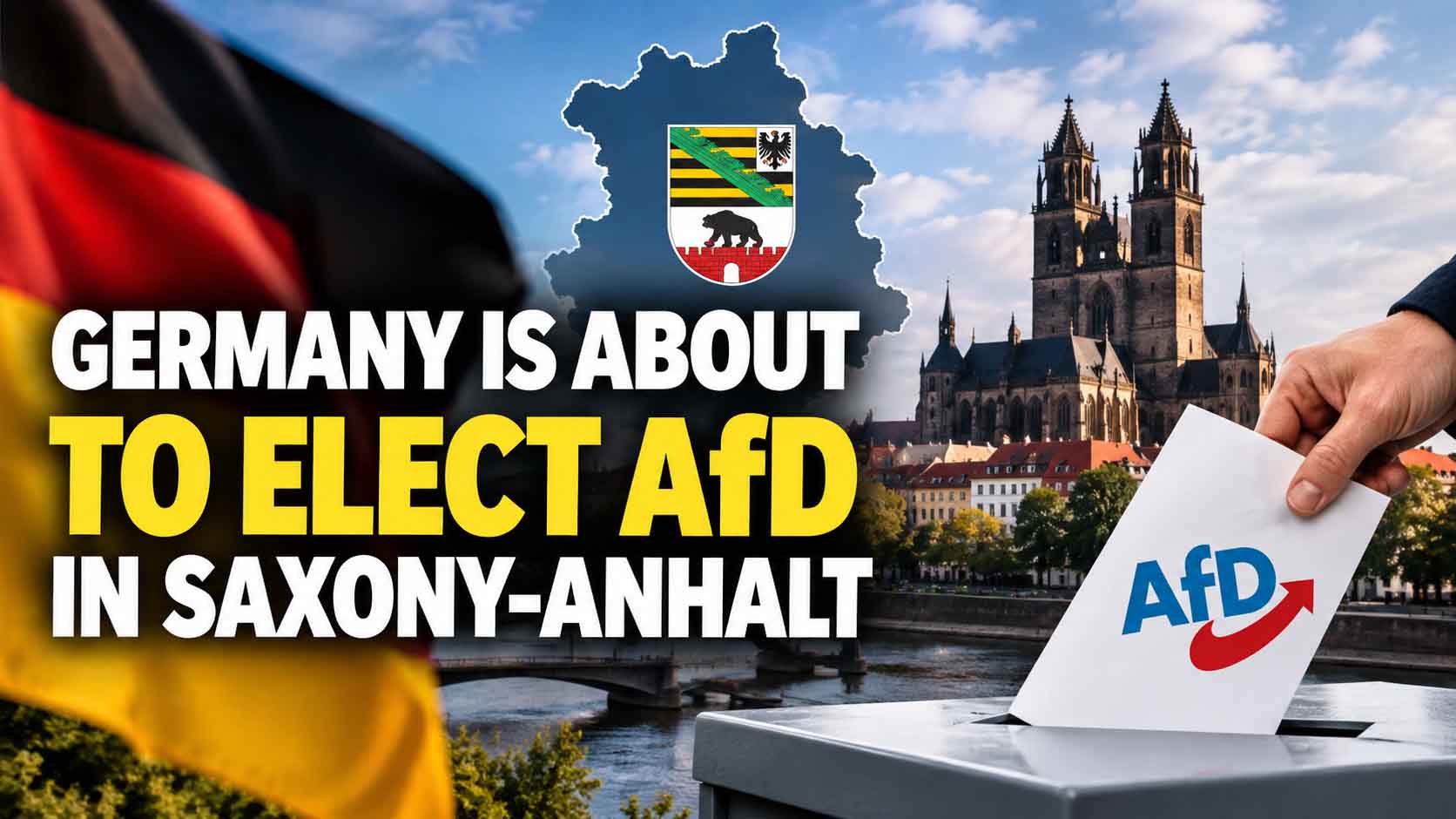
Germany is about to elect AfD in Saxony-Anhalt
Germany is facing a potentially historic political moment today as voters in the eastern state of Saxony-Anhalt go to the polls in an election that could see the Alternative for Germany (AfD) come to power at state level for the first time since the Second World War.
The AfD is not merely expected to finish first. It is polling at more than 40 per cent — roughly twice the support it received at the previous state election in 2021 — and is now within striking distance of an outright parliamentary majority.
That possibility has transformed what would normally be a regional election into an event being watched far beyond Saxony-Anhalt.
Polling stations opened on Sunday, with the latest surveys putting the AfD at around 40–43 per cent, compared with approximately 22–23 per cent for the governing Christian Democratic Union (CDU). The Left, Social Democrats and Greens are considerably further behind. (The Guardian)
The AfD’s lead candidate is 35-year-old Ulrich Siegmund, who has made no secret of his ambition to lead the next state government. The party’s national co-leader Alice Weidel has also publicly declared that the AfD intends to form the government in Saxony-Anhalt. (Reuters)
But there is a crucial question hanging over the election: Can the AfD turn its enormous lead in the polls into an absolute majority of seats?
From second place to potential government
The scale of the AfD’s rise is extraordinary.
In the 2021 Saxony-Anhalt election, the CDU won 37.1 per cent of the vote and 40 seats, while the AfD finished second with 20.8 per cent and 23 seats. The Left received 11 per cent, the SPD 8.4 per cent, the FDP 6.4 per cent and the Greens 5.9 per cent. (Wikipedia)
Five years later, the political landscape looks dramatically different.
The latest polling puts the AfD at roughly 41 per cent, with some surveys reaching 43 per cent. The CDU, which has governed the state for 24 years, is struggling to reach 23 per cent.
The potential reversal is therefore remarkable: the party that once trailed the CDU by more than 16 percentage points could now be more than 18 points ahead.
This is no longer simply a protest vote threatening the established parties. The AfD is seriously challenging for power.
The 42-seat question
Saxony-Anhalt’s Landtag currently has 83 seats, meaning 42 seats are required for an absolute majority under the basic allocation. (Wikipedia)
At first glance, an AfD vote share of 41–43 per cent might appear sufficient.
But German proportional representation is more complicated than simply converting percentages into seats.
The number of parties that clear the five per cent threshold could prove decisive. Parties that fail to enter the parliament affect how the seats are distributed among those that do.
That means the AfD could potentially secure a parliamentary majority without winning 50 per cent of the popular vote.
Equally, a vote share above 40 per cent does not automatically guarantee an outright majority.
Reuters has identified this parliamentary arithmetic as one of the central uncertainties of the election. (Reuters)
And that is why tonight’s result could be much more significant than simply announcing which party has won the largest share of votes.
The end of Germany’s political firewall?
For years, Germany’s established political parties have maintained what is commonly known as the Brandmauer — the political “firewall” against cooperation with the AfD.
The principle is straightforward: mainstream parties will not form coalitions with the AfD.
That policy has so far prevented the party from translating strong electoral performances into control of a German state government.
Saxony-Anhalt could change that.
If the AfD wins an absolute majority, there would be no coalition negotiations and no need for another party’s support. Ulrich Siegmund could attempt to form the first state government led by the AfD in post-war German history. (Reuters)
If the AfD falls short, however, the situation becomes considerably more complicated.
The CDU has ruled out cooperation with the AfD. Other established parties have likewise maintained their refusal to enter government with it.
That could leave the CDU facing the difficult task of constructing a governing coalition from parties that collectively may struggle to produce a straightforward majority.
Why are voters turning to the AfD?
The AfD’s success in eastern Germany cannot be explained by one issue alone.
Immigration is unquestionably central to its campaign. The party has promised a much harder approach to illegal migration and deportations and has attacked what it regards as the failure of Germany’s established parties to control the country’s borders. (Reuters)
But economic and social grievances are also important.
Saxony-Anhalt remains one of the former East German states, where the political and economic consequences of reunification continue to influence voters.
Economic insecurity, demographic decline, lower incomes, the loss of young people to western Germany and dissatisfaction with Berlin have all contributed to resentment towards the established political system.
The AfD has successfully presented itself as the party willing to challenge that system.
For many of its supporters, voting AfD is not simply about immigration. It is also a rejection of the political establishment and an expression of frustration with the direction in which Germany has travelled.
What would an AfD government actually mean?
The implications would extend far beyond immigration.
An AfD-led state government would have substantial influence over areas such as education, policing, culture and elements of regional economic policy.
The party has proposed major changes to education and cultural policy, a stronger emphasis on German national identity, tougher immigration enforcement and significant changes to public broadcasting and other state institutions. (Reuters)
That makes Saxony-Anhalt potentially more than an electoral breakthrough.
It could become a test case.
For the first time, voters could give the AfD substantial executive responsibility and allow the party to demonstrate whether it can turn its opposition platform into functioning government.
That prospect has alarmed the party’s opponents.
Critics point to the AfD’s classification by German domestic intelligence authorities and argue that allowing it to govern would represent a serious challenge to Germany’s post-war political consensus. The AfD rejects such characterisations and insists that it is a democratic political party seeking to enforce its interpretation of German law and national interests. (AP News)
A warning for Friedrich Merz
The election is also a major test for Chancellor Friedrich Merz and the CDU.
Saxony-Anhalt has been governed by the CDU for roughly a quarter of a century. Yet the party is now facing the prospect of being comprehensively defeated in a state where it once enjoyed a commanding position.
A result showing the AfD above 40 per cent would send a powerful message to Berlin.
It would demonstrate that the party’s surge is not confined to federal elections or isolated pockets of eastern Germany. It would show that the AfD can potentially dominate an entire state electorate.
And there is little time for Germany’s political establishment to digest the result.
Two further state elections are scheduled for 20 September, in Mecklenburg-Western Pomerania and Berlin. A strong AfD performance in Saxony-Anhalt could therefore provide momentum going into both contests. (AP News)
A historic day for Germany
The AfD is therefore standing on the threshold of something it has never achieved before.
It has already transformed itself from a relatively small protest party into one of Germany’s most powerful political forces. In Saxony-Anhalt, it now has the opportunity to go one step further and take control of a state government.
Whether it actually achieves that today will depend on the final vote share, the number of parties clearing the five per cent threshold and the resulting distribution of seats.
But one fact is already clear.
The political map of Saxony-Anhalt has changed dramatically since 2021.
The CDU once dominated the state. The AfD was a distant second.
Today, the AfD is polling at almost twice its previous level and more than 18 percentage points ahead of the CDU.
If those numbers are reflected in the ballot boxes, Germany will wake up to a political reality that would have seemed extraordinary only five years ago:
The AfD could be on the verge of governing a German state.
And if it secures an outright majority, the political firewall that has kept the party out of government since its creation will face its biggest test yet.
This version deliberately avoids saying that the AfD has won or will definitely form the government, because voting is still taking place today. The more accurate and arguably more powerful framing is that Germany is on the verge of potentially seeing its first AfD-led state government since the Second World War. (Reuters)