

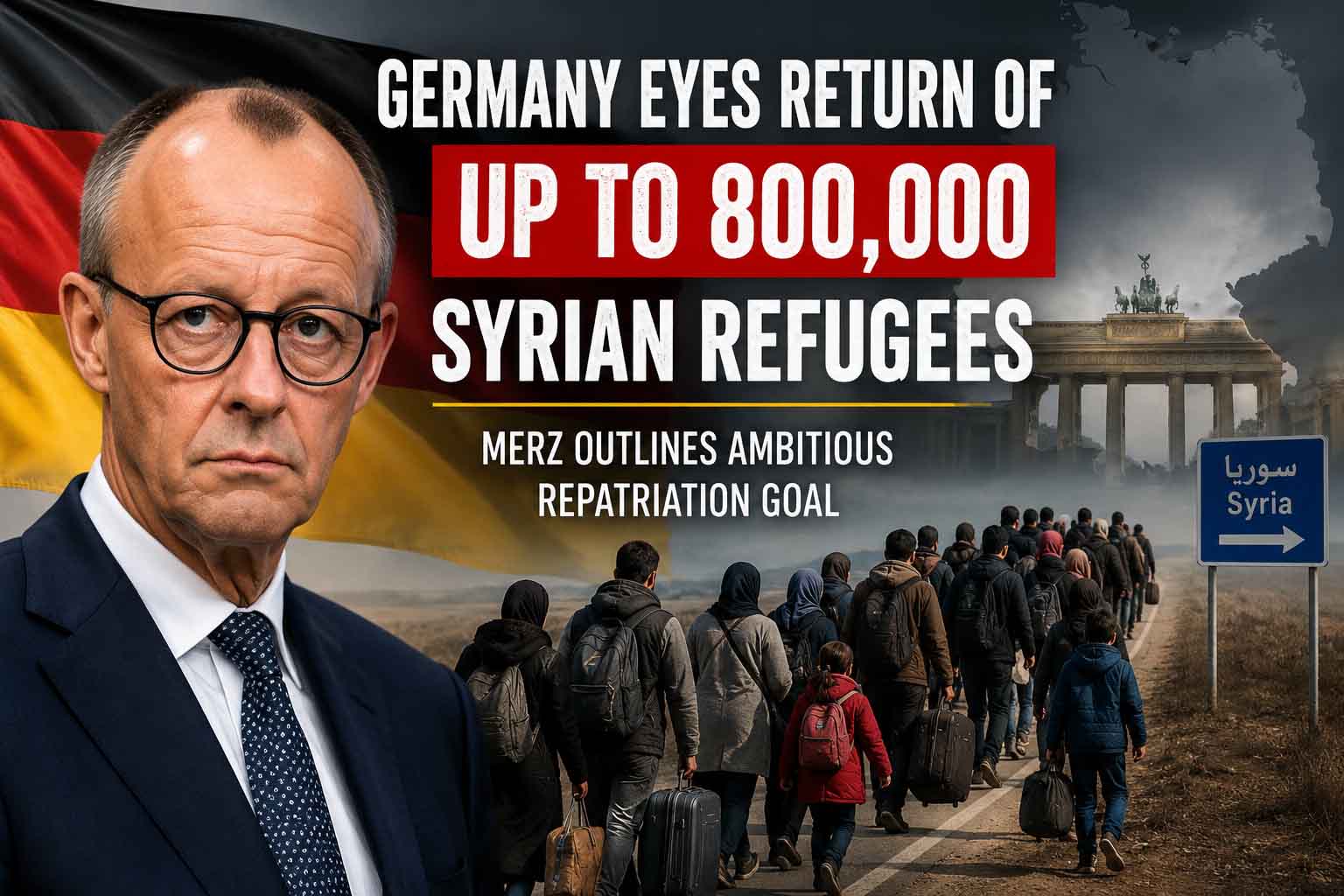
Germany Eyes Return of Up to 800,000 Syrian Refugees as Merz Outlines Ambitious Repatriation Goal
German Chancellor Friedrich Merz has set out an ambitious vision for the return of Syrian refugees, stating that he expects around 80% of Syrians currently living in Germany to return to their homeland over the next three years.
The comments, made following talks in Berlin with Syrian President Ahmed al-Sharaa in March 2026, have reignited debate over migration, asylum policy and the future of nearly one million Syrians who have sought refuge in Germany since the outbreak of the Syrian civil war.
Merz’s Vision
Speaking alongside President al-Sharaa, Chancellor Merz argued that the end of Syria’s prolonged civil conflict presents an opportunity for many refugees to return home and contribute to rebuilding their country.
Germany is currently home to approximately 900,000 to one million Syrian nationals. If Merz’s expectation were realised, between 720,000 and 800,000 people would leave Germany over the next three years.
The Chancellor announced plans for Germany and Syria to establish a joint task force to facilitate returns, while indicating that priority would be given to individuals who no longer have the legal right to remain in Germany, as well as those convicted of criminal offences.
Merz described reconstruction as a responsibility that ultimately belongs to the Syrian people, suggesting that the country’s recovery will require the return of a substantial proportion of its population.
Political Objective Rather Than Confirmed Policy
Despite widespread reports referring to the potential return of 800,000 Syrians, the German government has not announced a formal programme to forcibly deport that number of people.
Instead, Merz’s remarks are widely understood as a political objective or expectation rather than an approved government policy.
Current discussions within the German government focus on expanding voluntary return programmes, reassessing asylum protections in light of changing conditions in Syria, improving cooperation with Syrian authorities, and accelerating the removal of foreign nationals who have committed serious crimes or no longer meet the legal requirements for protection.
Any compulsory removals would still need to comply with German constitutional law, European Union asylum legislation and international refugee obligations.
Significant Challenges
While the proposal has attracted support from those advocating stricter immigration controls, experts have questioned whether returns on such a scale are realistic.
Many Syrians have now lived in Germany for more than a decade. Hundreds of thousands have entered employment, established businesses, completed higher education and started families.
Germany also faces well-documented labour shortages across several sectors, leading some economists to warn that large-scale departures could place additional pressure on the country’s workforce.
There are also practical concerns surrounding documentation, transport, housing availability in Syria and the capacity of the Syrian government to absorb hundreds of thousands of returning citizens within a relatively short period.
Political Backlash
Merz’s remarks prompted immediate criticism from opposition politicians, refugee organisations and migration experts.
Critics argue that although large parts of Syria are no longer experiencing the level of conflict seen during the civil war, significant security, humanitarian and economic challenges remain.
Questions have also been raised over whether conditions in all regions of Syria can currently support the safe and sustainable return of large numbers of former refugees.
Following the initial reaction, German government representatives appeared to moderate the Chancellor’s comments, describing the anticipated returns as a long-term aspiration rather than a fixed numerical target.
A Changing European Migration Debate
Merz’s proposal reflects a broader shift in European migration policy.
Across the continent, several governments have sought tougher approaches to asylum and illegal migration, while also exploring agreements with countries of origin to facilitate the return of individuals whose protection claims are no longer considered valid.
Germany’s discussions with Syria form part of this wider trend, although the legal, diplomatic and humanitarian complexities involved mean that any large-scale returns are likely to take place gradually, if at all.
The Bottom Line
The widely shared claim that Germany intends to repatriate up to 800,000 Syrian refugees is based on genuine comments made by Chancellor Friedrich Merz.
However, those comments should not be interpreted as confirmation of an approved government plan to forcibly deport that number of people.
Rather, they represent an ambitious political objective linked to Germany’s evolving migration policy. Whether anything approaching that figure is ultimately achieved will depend on legal constraints, cooperation with the Syrian government, voluntary participation by refugees, and the continuing stability of post-war Syria.
For now, the proposal remains one of the most significant—and controversial—migration initiatives to emerge from Germany in recent years, with its practical implementation still very much uncertain..