

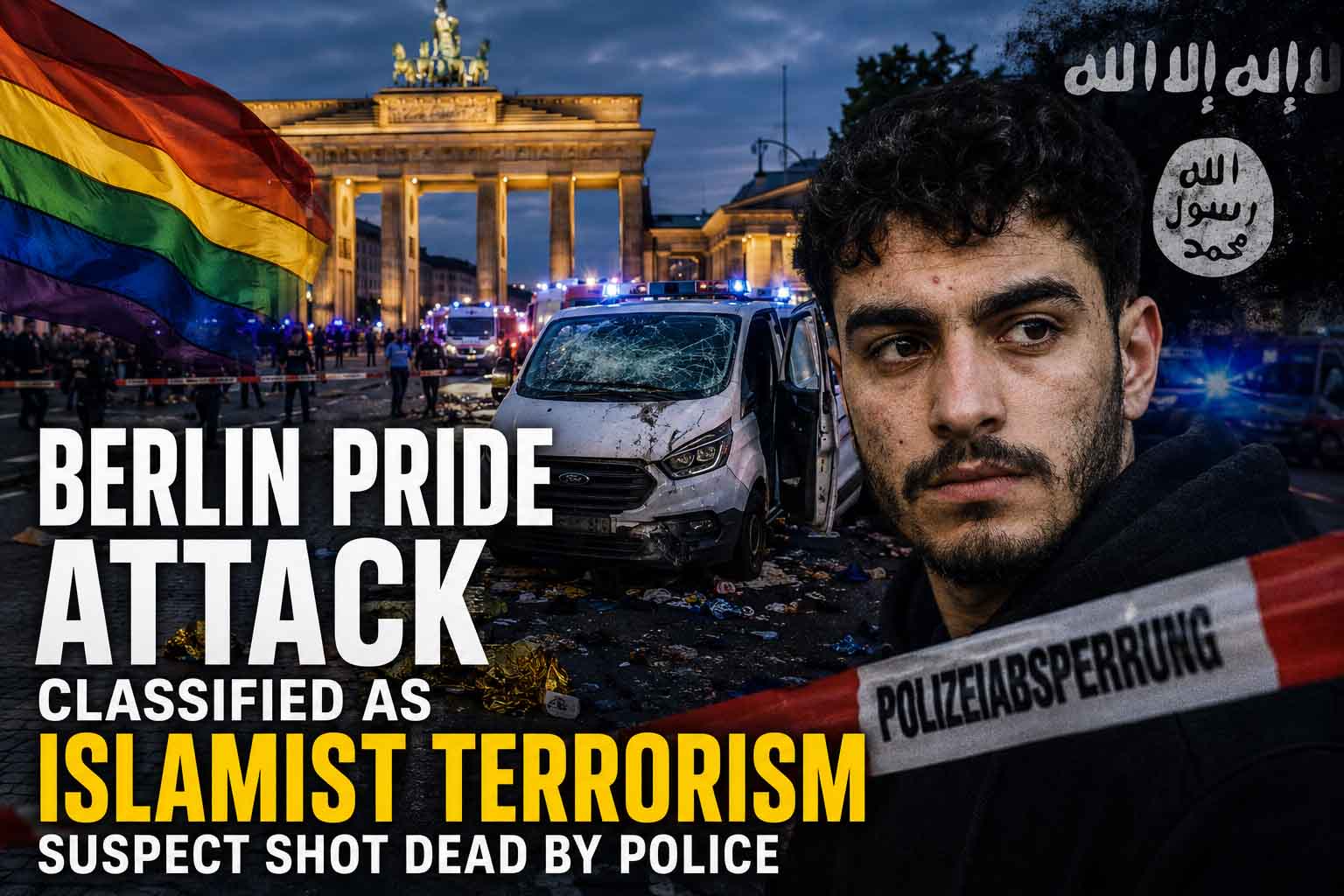
Berlin Pride Attack Classified as Islamist Terrorism After Suspect Shot Dead by Police
German authorities have formally classified the deadly attack on Berlin’s Christopher Street Day (CSD) Pride celebrations as an act of Islamist terrorism following the death of the prime suspect during a police operation in the capital’s Spandau district.
The attack, which unfolded on the evening of Saturday 25 July 2026, left one woman dead and at least 29 others injured after a van was deliberately driven into pedestrians before the attacker allegedly emerged carrying a large bladed weapon and continued the assault on foot. The incident brought one of Europe’s largest LGBTQ+ celebrations to an abrupt end and has reignited debate in Germany over counter-terrorism policy, judicial sentencing and the management of convicted extremists. (The Guardian)
Attack on a Major Public Celebration
Berlin’s Christopher Street Day is among Europe’s largest Pride events, regularly attracting hundreds of thousands of participants from across Germany and abroad. Earlier on Saturday, colourful parades had passed peacefully through the city before concluding near the Brandenburg Gate and Tiergarten, where the evening celebrations were underway.
According to investigators, shortly before 22:00 local time a white rental van entered Ahornsteig within Tiergarten park at speed, mounting a pedestrian route crowded with festival-goers. Witnesses reported the vehicle struck numerous people before crashing into a tree.
Police say the suspect then exited the vehicle armed with what German media have described as a machete or similarly large bladed weapon and attacked people attempting to flee.
Emergency services rapidly established a major incident, deploying hundreds of firefighters, paramedics and police officers. Festival organisers immediately halted the celebrations while officers evacuated large sections of the area surrounding the Brandenburg Gate.
One woman died from her injuries at the scene. At least 29 others were injured, with several suffering life-threatening injuries and remaining in hospital. (The Guardian)
Suspect Identified as Known Islamist Extremist
German authorities identified the suspect as 21-year-old Abdul Ballout, a German citizen of Lebanese heritage.
According to prosecutors and the Federal Interior Ministry, Ballout had been known to security services for several years because of Islamist radicalisation and his support for the so-called Islamic State (ISIS).
Investigators state that his pathway into violent extremism became increasingly apparent through both online activity and attempts to travel overseas to join the terrorist organisation.
The chronology released by prosecutors outlines an escalating pattern:
- June 2024: First came to the attention of authorities after allegedly distributing prohibited ISIS propaganda through social media.
- May 2025: Travelled via Turkey to Lebanon with the intention of crossing into Syria to join ISIS fighters.
- July 2025: Arrested by Lebanese authorities and imprisoned for inciting religious conflict.
- November 2025: Deported to Germany, where he was arrested immediately upon arrival at Berlin Brandenburg Airport.
- 12 May 2026: Convicted of preparing a serious act of violence endangering the state and sentenced to one year and ten months’ imprisonment. The sentence was suspended, with Ballout placed on parole and required to participate in an intensive deradicalisation programme.
- 3 July 2026: Police searched his Berlin flat after intelligence suggested he was displaying weapons online. Officers reportedly found only a replica firearm and no grounds existed for further detention. (The Guardian)
Why Was He Still Free?
One of the most contentious aspects of the case is that Ballout remained at liberty despite his terrorism conviction.
German law permits suspended custodial sentences in certain circumstances, particularly where courts conclude that rehabilitation remains possible and the offender can be managed through strict probation conditions.
In Ballout’s case, the court determined that participation in a structured deradicalisation programme, together with probation supervision, was preferable to immediate imprisonment.
The decision is now expected to face intense scrutiny as investigators examine whether existing risk assessments underestimated the threat he posed or whether legal powers available to the authorities were insufficient.
Opposition politicians have already questioned whether known extremists convicted of terrorism-related offences should ever qualify for suspended sentences.
Massive Manhunt Across Berlin
Immediately after the attack, Berlin Police launched one of the largest manhunts in recent years.
More than 1,000 officers, including specialist tactical units, helicopters, armed response teams and intelligence officers, were deployed throughout the capital.
Authorities released the suspect’s photograph publicly, warning residents not to approach him because he was believed to be armed and extremely dangerous.
The investigation included searches of his home, interviews with associates and extensive forensic examination of the rental vehicle.
The search concluded on Sunday afternoon when specialist police units located Ballout at an allotment garden complex in Berlin’s Spandau borough.
Police state that officers attempted to arrest him, but he violently resisted. During the confrontation officers opened fire, fatally wounding the suspect. Authorities have confirmed that a routine investigation into the police shooting has commenced, as required under German procedure. (The Times of India)
Authorities Confirm Islamist Terrorism
Following the investigation, Federal Interior Minister Alexander Dobrindt stated that all available evidence indicated the attack was motivated by Islamist extremism.
Officials have cited Ballout’s previous conviction, his documented support for ISIS and his earlier attempt to travel to Syria as key elements supporting that assessment.
The Federal Government has indicated that Germany’s security posture will be strengthened amid concerns over potential copycat attacks or retaliatory violence.
Counter-terrorism investigators are also examining Ballout’s online communications, electronic devices and any possible links to extremist networks, although authorities have not publicly indicated that others were directly involved in planning the attack. (The Guardian)
Political Reaction
German Chancellor Friedrich Merz condemned the attack as a “heinous act” directed not only against those attending Pride but against Germany’s democratic values.
Berlin Mayor Kai Wegner similarly described the violence as an assault on freedom and diversity, expressing support for victims, emergency workers and the LGBTQ+ community.
Across Germany’s political spectrum, leaders condemned the attack while calling for a full review of how convicted extremists are monitored after release or while serving suspended sentences. (euronews)
LGBTQ+ Community Responds
The attack has deeply shocked Berlin’s LGBTQ+ community, for whom Christopher Street Day represents both a celebration and a political demonstration for equality.
Organisers cancelled the remaining events immediately after the attack, while vigils were organised across the city to remember the victims.
Community leaders stressed that the violence would not deter future Pride events, describing the attack as an assault on openness, inclusion and democratic freedoms. Many participants emphasised solidarity and resilience in the aftermath, while acknowledging heightened concerns about security at future public gatherings. (AP News)
Wider Security Questions
The incident is likely to become one of Germany’s most significant terrorism cases in recent years, prompting renewed examination of several long-running issues:
- whether deradicalisation programmes are effective for high-risk Islamist offenders;
- whether terrorism-related offenders should be eligible for suspended prison sentences;
- whether intelligence sharing between police, prosecutors and courts is sufficiently robust;
- and whether additional security measures are required for major public events.
Germany has experienced several Islamist-inspired attacks over the past decade, leading successive governments to expand surveillance powers and strengthen counter-terrorism legislation. Nevertheless, the Berlin attack is expected to intensify debate over whether current legal frameworks adequately balance rehabilitation with public protection.
As forensic investigations continue, prosecutors are expected to produce a comprehensive report examining Ballout’s radicalisation, his interactions with security agencies and whether opportunities existed to prevent the attack before it occurred. (tagesschau.de)