

Certainly. The transcript is quite long (around 3,500–4,000 words), which exceeds the maximum length I can rewrite in a single response.
How the UK’s Asylum Accommodation Contracts Grew from £4.5 Billion to £15.3 Billion
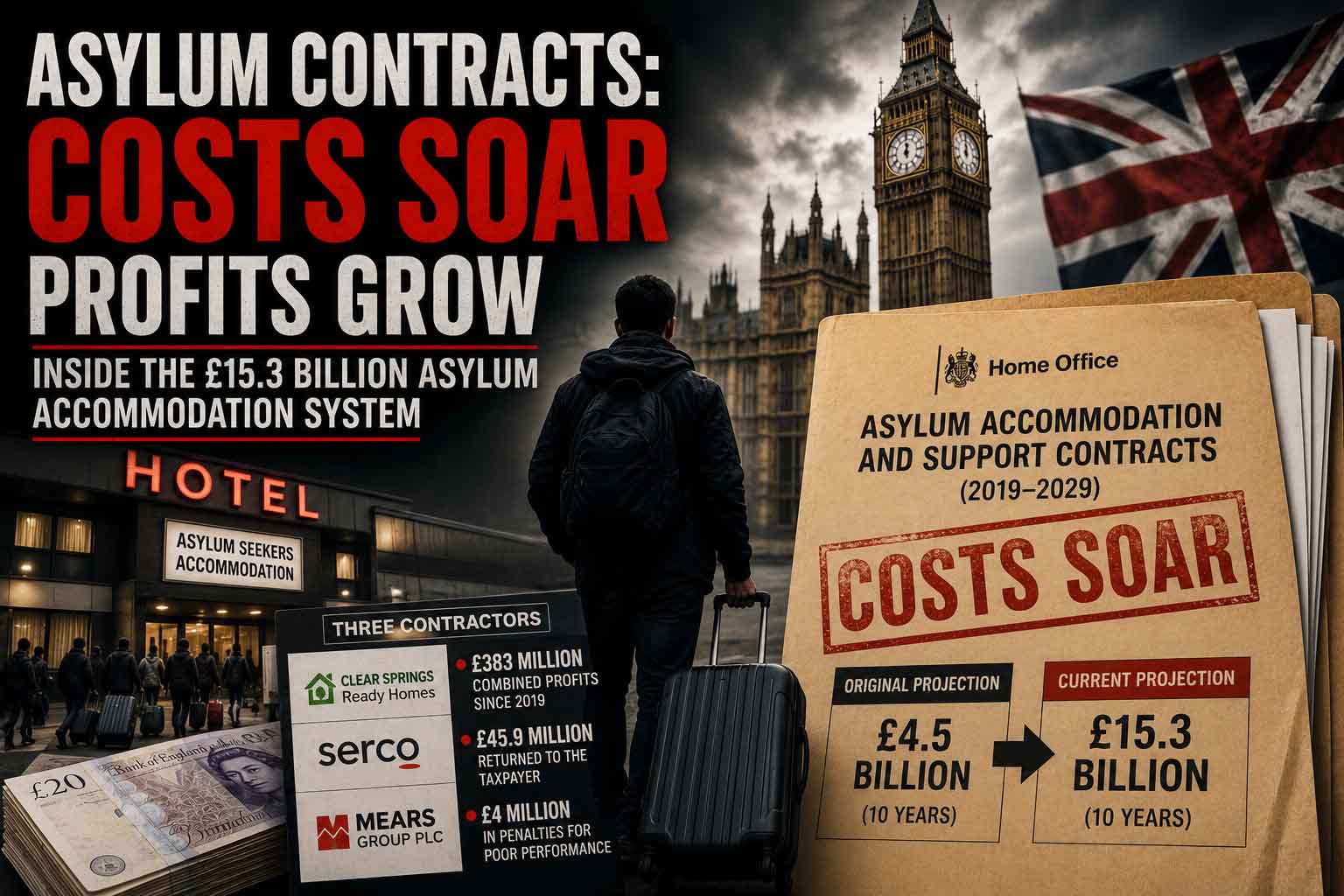
The UK’s asylum accommodation system has undergone a dramatic transformation since 2019, with projected costs rising from an original £4.5 billion to £15.3 billion over the lifetime of the contracts. At the centre of this increase are three private companies responsible for housing asylum seekers across the country.
According to the National Audit Office (NAO), Parliamentary committee evidence, Companies House filings and publicly available financial records, these companies have collectively generated hundreds of millions of pounds in profit while taxpayers have recovered only a small fraction through contractual penalties and profit-sharing arrangements.
The Three Main Contractors
Since 2019, responsibility for asylum accommodation has been divided between three providers:
- Clear Springs Ready Homes – covering the South of England and Wales.
- Serco – responsible for the North West, the Midlands and the East of England.
- Mears Group – managing Scotland, Northern Ireland, Yorkshire and the Humber.
Together, these companies operate the Asylum Accommodation and Support Contracts (AASCs), which run from September 2019 until 2029.
As of June 2025, they were providing accommodation for approximately 103,000 asylum seekers, more than double the figure of around 47,500 recorded in late 2018.
From COMPASS to the AASC Contracts
Before 2019, asylum housing was delivered under an earlier framework known as the COMPASS contracts.
These contracts were operated by G4S, Serco and a joint venture involving Clear Springs. However, bidders had submitted prices that later proved unsustainable.
Robert Sumsion, then Managing Director of Serco’s immigration business, told Members of Parliament that the contracts had been priced too low. He described the procurement process as a “reverse Dutch auction conducted over the internet”, arguing that it was an inappropriate method for establishing pricing for services supporting tens of thousands of vulnerable people.
G4S ultimately withdrew from the sector after suffering substantial financial losses.
A New Contract Model
When the Home Office redesigned the contracts in 2019, it introduced a more flexible model.
Instead of fixed volumes, the contracts were designed to expand or contract depending on demand. In theory, this allowed the system to respond more effectively to changes in asylum numbers.
However, this flexibility also allowed projected costs to increase dramatically as demand rose.
The National Audit Office estimates that the original ten-year contract value of £4.5 billion has now increased to approximately £15.3 billion, more than three times the original forecast.
Why Costs Increased
The National Audit Office identifies two principal factors behind the increase:
- A growing asylum backlog.
- Heavy reliance on hotel accommodation.
The backlog increased due to several factors, including the disruption caused by the COVID-19 pandemic, delays in asylum decision-making while the previous Government pursued the Rwanda policy, and continued growth in the number of arrivals.
As demand outpaced the availability of dispersal accommodation—shared houses and flats intended to be the primary form of housing—the Home Office increasingly relied on hotels as emergency accommodation.
Hotels Become the Most Expensive Solution
The NAO found that, during 2024, only 35% of people accommodated under the contracts were housed in hotels.
Despite this, hotels accounted for 76% of total contract expenditure.
Of approximately £1.7 billion spent that year, around £1.3 billion was spent on hotel accommodation alone.
This disparity highlights why hotel use has become such a significant driver of overall costs.
Hotels also operate under a different financial model from dispersal housing.
With ordinary rented accommodation, contractors assume the financial risk if properties remain vacant because they continue paying lease costs regardless of occupancy.
Hotels operate differently. Contractors are paid by the Home Office on a per-person, per-night basis. If an individual leaves, payment simply ceases. Any empty rooms become the responsibility of the hotel operator rather than the contractor.
As a result, hotels represent a lower financial risk for contractors while also generating higher profit margins.
Evidence presented to the Home Affairs Committee by Clear Springs Managing Director Steve Lake acknowledged that emergency hotel accommodation was more profitable than longer-term housing.
During the same evidence session, he also stated that hotels were a poor form of accommodation for those living in them.
These admissions illustrate a central concern raised by critics of the system: the accommodation that is most expensive for taxpayers is simultaneously the most profitable for contractors, while also being considered the least desirable option for residents.
Profit, Hotels and the Profit-Sharing Clause
One of the key features of the Asylum Accommodation and Support Contracts (AASCs) is a profit-sharing mechanism intended to protect taxpayers from excessive contractor profits.
Under the agreements, contractors are permitted to earn what is regarded as a normal commercial return. However, once profit margins exceed approximately five per cent, the additional profit is supposed to be shared with the Home Office rather than retained entirely by the companies.
On paper, this arrangement was designed to ensure that if costs or demand increased significantly, taxpayers would also benefit from any exceptional financial gains.
The Profits Generated
According to the National Audit Office, the three contractors have generated a combined £383 million in profit since the contracts began in 2019.
Across all three companies, the average profit margin was around 7%, exceeding the approximate 5% threshold at which profit-sharing is expected to apply.
The Home Affairs Committee confirmed these figures during parliamentary evidence sessions in late 2025.
Given the contractual arrangements, a significant proportion of these profits might reasonably have been expected to return to the public purse. However, the amount actually recovered has been considerably lower.
Clear Springs Ready Homes
Clear Springs is estimated to have generated approximately £187 million of the total profit, representing almost half of the combined earnings across the three contractors.
Because the company is privately owned, it does not publish a detailed breakdown of profits generated solely from its asylum accommodation contracts. Nevertheless, public filings show that since 2022 its parent company has paid £183 million in dividends.
As the company has a single shareholder, virtually all of those dividend payments were received by one individual.
Serco
Serco has maintained that its asylum accommodation contracts never exceeded the contractual profit threshold.
Consequently, the company argues that it has not been required to return any money to the Home Office under the profit-sharing mechanism.
The Government confirmed this position in writing in January 2026. While some observers question whether this outcome is plausible given the scale of the contracts, the Government has not challenged Serco’s interpretation of the agreement.
Mears Group
Mears is the only contractor that has publicly returned a substantial amount of money under the profit-sharing provisions.
The company reported profit margins of 14% in one year and 17% in another—well above the contractual threshold.
Evidence presented to Parliament indicated that Mears expected to repay £13.8 million, with £12.9 million having already been returned to the Home Office by November 2025.
How Much Has Been Recovered?
Across all three contractors, the Home Office has recovered approximately £45.9 million under the profit-sharing arrangements.
Compared with the £383 million in reported profits, this equates to roughly one pound being returned for every eight pounds of profit generated.
Penalties for Poor Performance
The contracts also allow the Home Office to impose financial deductions when contractors fail to meet agreed service standards.
These deductions can relate to issues such as delayed repairs, poor property conditions or failures to comply with contractual obligations.
However, over the first six years of the contracts, the total amount deducted across all three companies was just £4 million.
Given that the contracts have generated billions of pounds in revenue, the National Audit Office noted that this represented less than one per cent of total payments made by the Government.
The Rise of Clear Springs
Clear Springs Ready Homes was founded in 1999 by property entrepreneur Graeme King, who first entered the asylum accommodation sector during the early 2000s.
When the AASC contracts were awarded in 2019, Clear Springs secured responsibility for the South of England and Wales.
At the time, that regional contract was valued at approximately £700 million over ten years.
According to evidence later given to the Home Affairs Committee by the company’s Managing Director, the value of that same contract has since increased to approximately £7 billion.
While the number of people accommodated has increased substantially, it has not grown tenfold. The dramatic increase in contract value has instead been driven largely by the flexible nature of the agreements, which allow spending to rise in line with demand.
As the sole shareholder of the parent company, Graeme King has benefited directly from dividend payments made during this period.
Public records indicate that approximately £183 million in dividends has been paid since 2020.
The growth in the business has also been reflected in King’s personal wealth. According to the Sunday Times Rich List, his estimated net worth increased from £750 million in 2024 to just over £1 billion in 2025, moving him into billionaire status.
The Role of Hotel Operators
While the three main contractors manage the asylum accommodation system, they do not own most of the hotels used to house asylum seekers. Instead, they lease rooms from hotel chains, which receive payment through the contracts.
One of the largest beneficiaries identified in publicly available records is Britannia Hotels.
Approximately 17 Britannia hotels have been used as asylum accommodation, generating significant revenue during a period when demand for hotel rooms under the Home Office contracts increased sharply.
Financial records show that Britannia Hotels reported pre-tax profits of £39.3 million in the year ending March 2023, the highest in its history.
The company’s owner, Alex Langsam, appeared in the 2025 Sunday Times Rich List with an estimated personal fortune of approximately £411 million.
Britannia has attracted considerable public attention because, despite repeatedly being voted the UK’s least-favoured hotel chain in consumer surveys, it has enjoyed record financial performance during the years in which large numbers of its rooms were leased for asylum accommodation.
The Contractors’ Defence
The companies involved argue that the financial outcomes were driven by circumstances beyond their control.
Their position is that they entered into contracts based on projected demand in 2019, but the number of asylum seekers requiring accommodation subsequently increased to levels that few could reasonably have anticipated.
They maintain that they simply responded to requests from the Home Office to provide additional accommodation as demand grew.
From this perspective, the higher profits reflect the unprecedented scale of the work rather than any attempt to exploit the system.
The contractors also point to the safeguards built into the contracts.
Both Clear Springs and Mears have returned money under the profit-sharing provisions where required, while Serco maintains that its contracts never exceeded the threshold that would trigger repayments.
In addition, they argue that the continued reliance on hotels has been driven primarily by the shortage of suitable dispersal accommodation rather than any commercial preference on their part.
Questions Raised by the National Audit Office
Despite these explanations, the National Audit Office concluded that important questions remain unanswered.
Its report highlights that the Home Office had several years during which it could have renegotiated aspects of the contracts, strengthened profit-sharing arrangements or taken further action to reduce dependence on hotel accommodation.
Instead, the overall value of the contracts continued to increase while only limited sums were recovered through either profit-sharing or contractual performance deductions.
The report also noted that financial penalties for poor performance amounted to just £4 million over six years, despite the contracts being worth many billions of pounds.
The Break Clauses
One significant feature of the contracts is the inclusion of regional break clauses.
From March 2026, the Government gained the ability to terminate any of the seven regional contracts without financial penalty before their scheduled expiry in 2029.
These clauses provide the Home Office with an opportunity to renegotiate existing arrangements or appoint alternative providers if it believes better value can be achieved.
The availability of these break clauses has become increasingly important as scrutiny of asylum accommodation costs has intensified.
A Changing Political Landscape
The contracts were signed under the Conservative Government in 2019, but responsibility for overseeing them has since passed through administrations led by both the Conservative and Labour parties.
Both governments have publicly committed to reducing the use of hotels for asylum accommodation.
Progress has been made in this area. The number of hotels used by the Home Office has fallen significantly from a peak of more than 400 to approximately 197 by January 2026.
However, the National Audit Office’s central concern extends beyond simply reducing hotel numbers.
Its report questions whether the contractual framework itself has been sufficiently reformed to prevent similar cost increases if demand rises again in the future.
As of mid-2026, the Home Office stated that it was considering the options available under the contractual break clauses, but no final decision had been announced regarding whether the agreements would be renegotiated or replaced.
An Ongoing Debate
The figures surrounding the asylum accommodation contracts continue to fuel political debate.
Critics argue that the contracts have allowed private companies to generate substantial profits while exposing taxpayers to escalating costs.
Supporters of the current arrangements counter that the unprecedented growth in asylum applications created extraordinary operational pressures, and that private contractors delivered services under exceptionally challenging circumstances.
The National Audit Office’s findings have not resolved this debate, but they have highlighted broader questions about government procurement, contract management and public accountability.
Overall Financial Picture
The figures presented by the National Audit Office illustrate the scale of the financial growth within the asylum accommodation programme since the current contracts began in 2019.
Originally valued at £4.5 billion over ten years, the projected cost has risen to £15.3 billion, making the programme one of the largest outsourced public service contracts in the country.
Across the three contractors, reported profits have reached £383 million, while the Home Office has recovered £45.9 million through contractual profit-sharing arrangements.
Separately, only £4 million has been deducted for poor performance over six years, despite billions of pounds being spent under the contracts.
The continued use of hotels remains one of the principal drivers of expenditure. Although hotel numbers have fallen from their peak, emergency accommodation continues to represent the most expensive element of the system, accounting for a disproportionately large share of overall spending.
The Key Figures
The National Audit Office’s findings can be summarised as follows:
- Three private companies awarded regional asylum accommodation contracts.
- Ten-year agreements running from 2019 until 2029.
- Original projected value: £4.5 billion.
- Current projected value: £15.3 billion.
- Combined contractor profits since 2019: £383 million.
- Profit-sharing repayments to the Home Office: £45.9 million.
- Financial deductions for poor performance: £4 million.
These figures have become central to the debate over whether the contracts continue to represent value for money.
Beyond the Contractors
One of the themes emerging from the evidence is that financial gains have not been limited to the three primary contractors.
Hotel operators, landlords and other suppliers involved in the accommodation chain have also benefited from increased government expenditure as demand for accommodation has expanded.
This reflects the wider structure of the programme, in which a substantial proportion of public spending flows through private sector providers operating under long-term contracts.
A Broader Question About Outsourcing
The issues identified by the National Audit Office extend beyond asylum accommodation alone.
They raise broader questions about how major public services are commissioned, managed and monitored once responsibility is transferred to private providers.
Critics argue that long-term outsourcing arrangements can become increasingly difficult to control when demand changes significantly, particularly where contracts contain flexible pricing mechanisms.
Supporters of outsourcing, however, contend that private companies possess the operational capacity to respond more rapidly than the public sector during periods of exceptional demand, and that many of the increased costs were driven by external events rather than contractual failings.
Looking Ahead
The contractual break clauses available from March 2026 provide the Government with an opportunity to review its approach before the agreements expire in 2029.
Whether ministers choose to renegotiate existing contracts, appoint new providers or redesign the asylum accommodation system entirely remains to be seen.
The National Audit Office has made clear that the central issue is not simply the use of hotels, but whether sufficient safeguards exist to prevent similar cost escalation in the future should asylum numbers rise again.
Conclusion
The asylum accommodation contracts have become a significant case study in public procurement and contract management.
What began as a programme expected to cost £4.5 billion has evolved into one projected to exceed £15 billion, accompanied by substantial profits for private contractors and continuing debate over value for money.
While contractors maintain that they responded to unprecedented demand under the terms agreed with the Home Office, critics argue that the Government has failed to make full use of the contractual mechanisms available to protect taxpayers.
With break clauses now available and the contracts due to expire in 2029, decisions taken over the coming years will determine not only the future of asylum accommodation, but also whether lessons from one of the largest outsourced government programmes are reflected in future public procurement policy.