

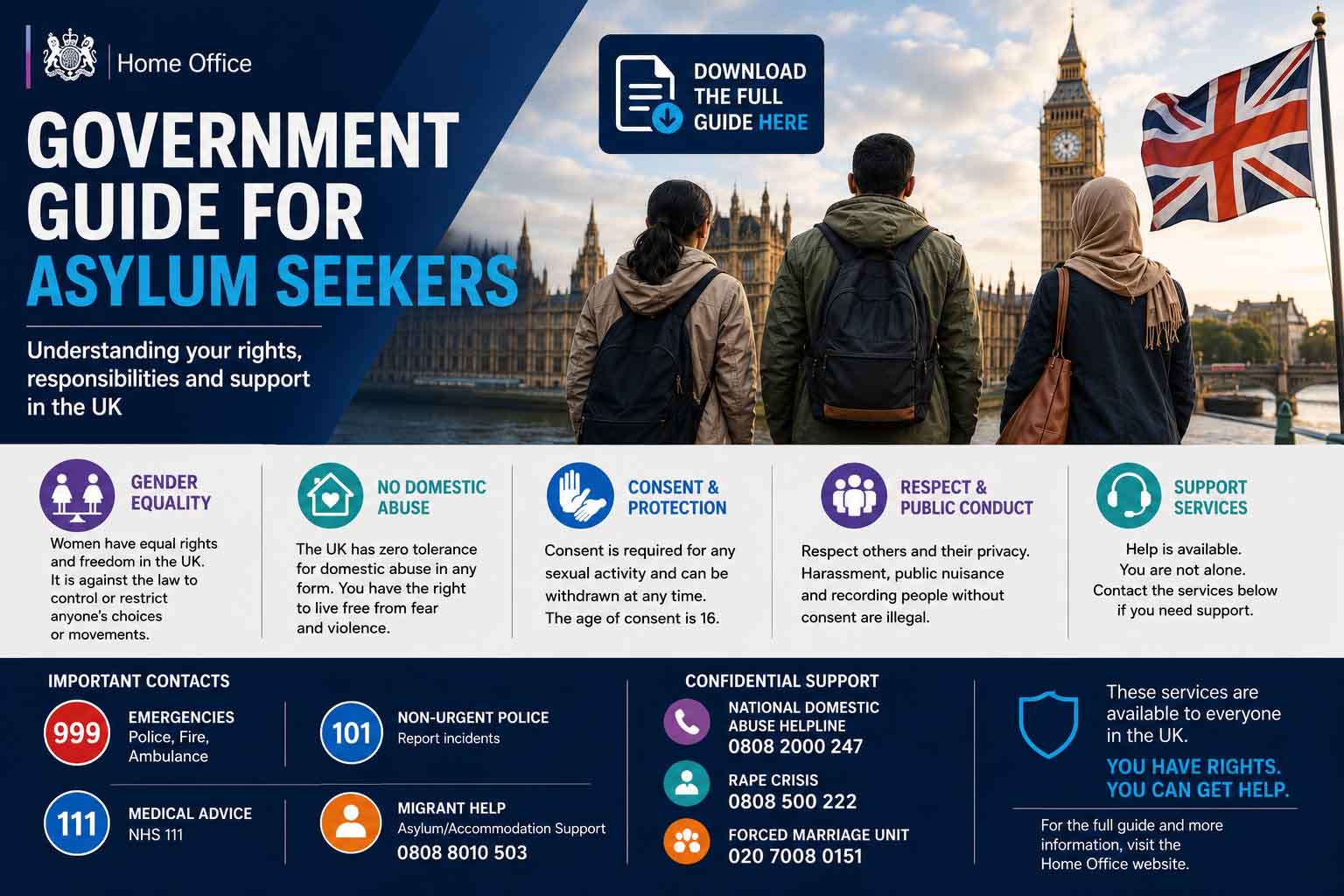
Government guide for asylum seekers
A Comprehensive Guide to the Home Office Code of Conduct for Asylum Seekers
The UK Home Office has issued a guide, “Understanding behaviours and expectations in the UK: a guide for asylum seekers,” outlining the legal boundaries and societal norms required for those in temporary accommodation, highlighting that these laws apply to all UK residents [1]. Non-compliance may result in police intervention, removal of support, and negative impacts on asylum claims [1].
1. Gender Equality and Individual Autonomy
In the UK, gender equality is a core principle, guaranteeing women equal rights and independence from male relatives [1]. Women possess the legal right to work, study, marry by choice, and move freely, while controlling behaviours (restricting movement, choice of clothing, or social interaction) are illegal [1].
2. Domestic Abuse and Statutory Sanctions
The UK operates a zero-tolerance policy on domestic abuse, defining it as coercive, threatening, or harmful behaviour against a partner or family member [1]. This includes physical, emotional, and economic abuse, as well as holding passports or legal documents [1]. Reporting such incidents to the police will not harm an asylum claim [1].
3. Sexual Offences, Consent, and Protection of Minors
Sexual contact requires explicit, ongoing consent, which can be withdrawn at any time [1]. Consent cannot be given if an individual is asleep or intoxicated [1]. Sexual activity without consent is legally classified as rape [1]. Furthermore, the age of consent is 16; sexual activity with anyone under this age is a serious criminal offence, with no exceptions [1].
4. Public Conduct, Harassment, and Privacy Laws
Public behaviour is governed by laws promoting mutual respect [1]. Harassment—including unwanted sexual comments, catcalling, or blocking paths—is prohibited [1]. Taking photos or videos of people without consent is also illegal, and distributing intimate images without permission is a serious criminal offence [1].
5. Emergency Infrastructure and Independent Support
Essential services are available for all residents:
- Emergencies (Police, Fire, Ambulance): 999 [1].
- Non-Urgent Police Reporting: 101 [1].
- Medical Advice: 111 [1].
- Asylum/Accommodation Support (Migrant Help): 0808 8010 503 [1].
- Confidential Support: Specialist helplines are available, including the National Domestic Abuse Helpline (0808 2000 247), Rape Crisis (0808 500 222), and the Forced Marriage Unit (020 7008 0151) [1].
Download the full guide HERE