

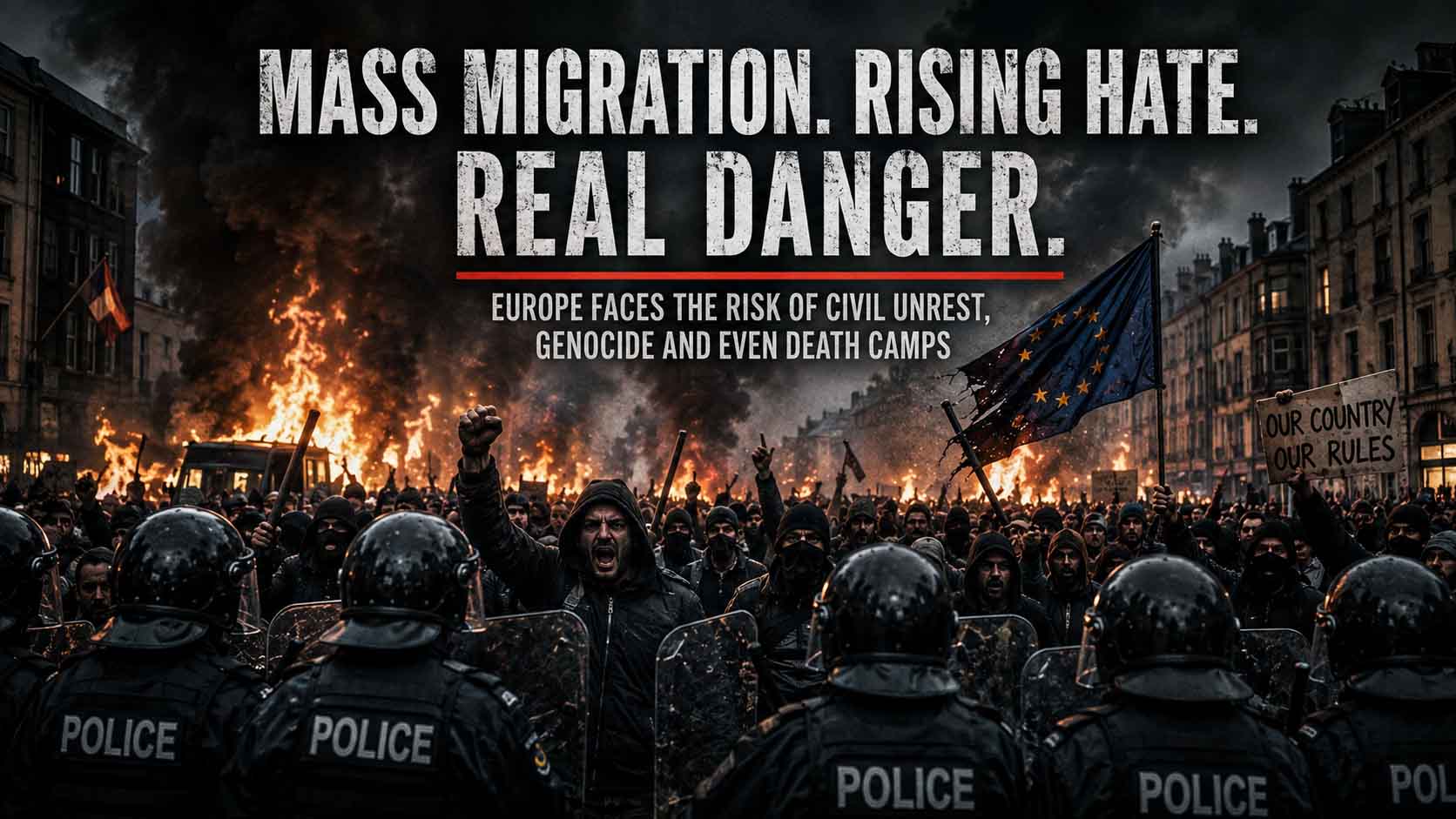
Could Europe’s Migration Crisis End in Genocide?
Europe is experiencing one of the most profound political debates of the modern era: how much migration can European societies absorb, and what happens when large sections of the population believe that immigration has become excessive, poorly managed or incompatible with their expectations for the future?
The question is no longer confined to immigration policy. It has become intertwined with housing, public services, national identity, crime, economic insecurity, cultural change and trust in political institutions.
And increasingly, there is another question that deserves serious consideration:
Could the bitterness surrounding mass migration eventually develop into something far more dangerous?
It would be irresponsible to suggest that Europe is inevitably heading towards the horrors of the 1930s, let alone genocide or the creation of death camps. Today’s Europe possesses democratic institutions, constitutional safeguards, independent courts, international alliances and human-rights frameworks that were either absent or considerably weaker during the interwar period.
But history also teaches us that political catastrophes rarely appear overnight.
They can begin with polarisation, fear, resentment, scapegoating and the gradual dehumanisation of political opponents or minority communities.
That is why the current situation deserves attention.
Migration has become a political fault line
Across Europe, immigration has moved from being a relatively specialised policy issue to one of the defining political questions of the age.
Public concern about immigration has contributed to the electoral growth of populist and nationalist parties, while established parties have increasingly adopted tougher positions on borders, asylum and deportation.
This does not necessarily mean that Europeans have suddenly become extremists.
There is an important distinction between opposition to mass immigration and hatred of immigrants.
A person can believe that immigration levels are too high, that asylum systems are being abused, that borders should be better controlled or that people without a legal right to remain should be removed without harbouring hatred towards migrants themselves.
Indeed, democratic societies depend upon being able to have precisely these arguments.
The danger comes when legitimate political disagreement begins to turn into collective hostility.
When people stop discussing policies and begin blaming entire ethnic, religious or national groups for society’s problems, the nature of the debate changes.
The danger of a cycle of escalation
One of the greatest risks is that Europe becomes trapped in a cycle of mutual radicalisation.
Large-scale migration can create pressure on housing, schools, healthcare and local government services. Where integration is unsuccessful, tensions can develop between established communities and newcomers.
A serious crime involving a migrant can then become a catalyst for anger far beyond the circumstances of the individual case.
Social media can accelerate this process enormously.
An isolated incident can be presented as evidence of a much wider conspiracy or invasion. Rumours can spread before the facts are established. Entire communities can subsequently be blamed for the actions of individuals.
But the process can work in the opposite direction too.
An attack on migrants or members of a minority community can lead to demands for retaliation. Political groups can exploit the incident to portray their opponents as collectively responsible.
The result can be a dangerous feedback loop:
Migration → social tension → political polarisation → provocative rhetoric → violence → retaliation → further polarisation.
Once such a cycle becomes established, it becomes considerably more difficult for politicians and institutions to control.
The 1930s comparison
The comparison with the 1930s should therefore be treated carefully.
Europe today is not Nazi Germany, and there is no evidence that European governments collectively are preparing for anything remotely comparable to the Holocaust.
The comparison nevertheless has value when used to examine how democratic societies can become destabilised.
The lesson of the 1930s is not simply that extremist governments can commit atrocities.
It is that democratic societies can gradually become polarised to the point where political opponents are regarded not as fellow citizens with different opinions, but as existential enemies.
Economic insecurity, national humiliation, political instability, propaganda, fear and scapegoating helped create an environment in which increasingly extreme solutions could gain legitimacy.
Modern Europe has many safeguards against such a development.
But safeguards work only when people continue to respect them.
Extremism is becoming more fragmented
There is also a worrying contemporary development that makes the situation harder to predict.
Europol’s 2026 terrorism assessment says that violence is increasingly being driven not only by traditional ideological commitment but also by personal grievance, identity, belonging and the search for recognition. Online communities can encourage individuals to move between extremist narratives, misogyny, nihilism, criminality and terrorist propaganda. Europol describes the resulting threat as more fragmented, adaptive and unpredictable.
This matters because political violence does not necessarily require a coherent mass movement.
A highly polarised society can produce individuals who radicalise themselves online and subsequently act alone.
That means the threshold between angry political rhetoric and physical violence can become dangerously blurred.
Europe is already attempting to respond
There is another important reason not to assume that Europe is sleepwalking towards disaster.
Governments are responding to public concern.
The European Union’s Migration and Asylum Pact entered its implementation phase in June 2026, introducing new arrangements covering external-border management, asylum procedures, reception, responsibility-sharing and returns.
Across Europe, governments are also debating tougher border controls, faster asylum decisions and more effective deportation procedures.
That political movement is significant.
If mainstream governments can demonstrate that migration is being controlled through lawful and effective means, some of the political pressure driving support for more extreme parties may diminish.
Conversely, if governments repeatedly promise control but appear incapable of delivering it, public frustration could intensify.
The real threat may be the loss of trust
Perhaps the greatest danger is therefore not migration itself.
It is the collapse of public confidence that democratic politics can manage the consequences of migration.
If citizens believe that their concerns are dismissed, they may increasingly turn towards parties promising radical solutions.
If migrants believe they are collectively regarded as unwanted or dangerous, integration can become harder.
If governments respond to unrest with increasingly authoritarian measures, civil liberties may come under pressure.
And if extremist movements on either side conclude that democratic politics can no longer deliver what they want, political violence becomes more conceivable.
This is how societies can enter a downward spiral.
The responsibility therefore falls on political leaders across the spectrum.
Governments must be prepared to acknowledge legitimate concerns about immigration without demonising migrants.
Opposition parties must be able to demand lower immigration and stronger borders without encouraging hatred against entire populations.
Migrants and migrant communities have responsibilities too: integration, respect for the law and rejection of extremism are essential to maintaining social cohesion.
And the media and social-media platforms have an equally important responsibility to distinguish verified facts from inflammatory rumours.
Europe still has a choice
There is nothing inevitable about political violence or societal breakdown.
Europe remains considerably more institutionally resilient than it was in the 1930s. Its democratic systems, courts, international alliances and economic interdependence provide powerful barriers against authoritarian collapse.
The European Union itself is attempting to adapt its migration system rather than simply ignoring the problem.
But institutions cannot compensate indefinitely for a society in which people lose faith in one another.
The greatest danger is not that Europeans disagree about immigration.
The greatest danger is that they stop believing that they can disagree peacefully.
Europe needs an honest debate about the scale and consequences of migration. That debate should include the economic benefits and costs, pressure on infrastructure and housing, integration, border security, asylum, deportation and the legitimate concerns of existing communities.
At the same time, opposition to mass migration must not become hatred of migrants, just as support for immigration must not require pretending that every consequence of mass migration is positive.
The historical warning is therefore not that Europe is destined to repeat the 1930s.
It is that political instability becomes dangerous when fear, resentment and dehumanisation begin to overwhelm democratic restraint.
Europe still has the opportunity to prevent that happening.
But doing so will require political leaders to take public concerns seriously, enforce immigration laws effectively, protect minorities from violence and maintain a political culture in which profound disagreements can still be settled through democratic means.
The alternative is a Europe in which each side increasingly sees the other not as political opponents, but as enemies.
That is the point at which a migration crisis can become something much more serious: a crisis of social cohesion, democratic legitimacy and ultimately political stability.