

The Rise of Islam in Europe
A Socio-Demographic Analysis of Europe’s Shifting Religious Landscape
The demographic architecture of Europe is undergoing a profound and visible transformation. Over the past several decades, the growth of the Muslim population across the continent has emerged as one of the most significant socio-cultural shifts in modern European history. Once characterized by small, localized communities or historic pockets in the Balkan regions, Islam has now become an integral component of the wider European social fabric. This professional analysis explores the current scale, geographical distribution, socioeconomic context, and future trajectory of Islam in Europe, unpacking empirical data from established research bodies while addressing common misconceptions.
The Contemporary Scale of European Islam
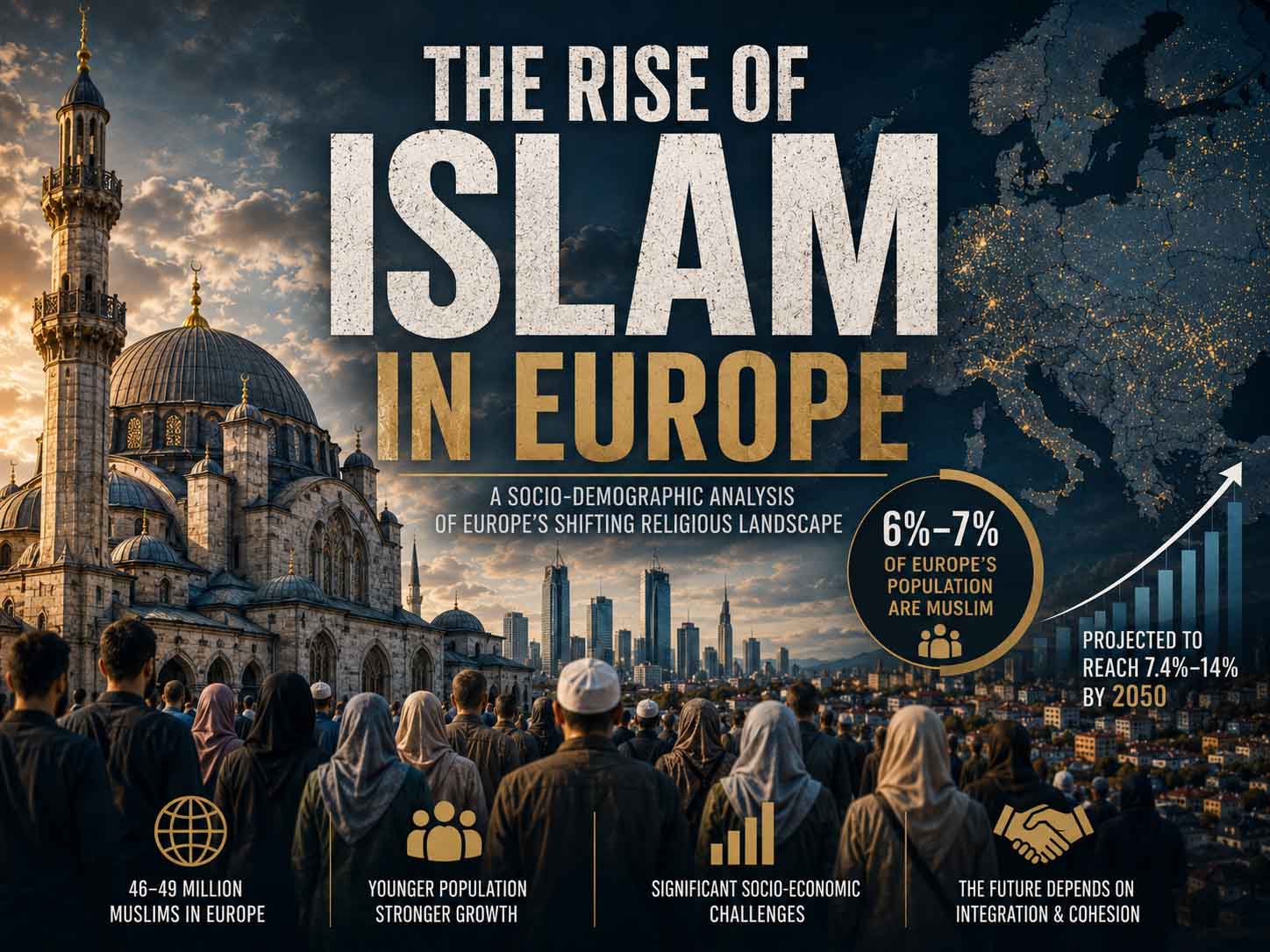
According to recent comprehensive demographic assessments, there are approximately 46 to 49 million Muslims currently residing across the European continent. Taken as a whole, this population accounts for roughly 6% to 7% of Europe’s total population. However, evaluating Europe as a singular monolithic entity obscures deep regional discrepancies. The presence of Islam on the continent is bifurcated into two distinct phenomena: historic, indigenous communities in Eastern and Southeastern Europe, and communities in Western and Northern Europe that have developed primarily through post-Second World War migration pathways.
Geographical Distribution and Regional Varieties
The concentration of Muslim communities across European borders varies markedly. To understand this structural distribution, demographic data can be divided into three clear categories: traditional Muslim-majority regions, nations hosting large minority populations in absolute numbers, and countries with smaller but growing urban communities.
1. Indigenous Muslim-Majority Nations
Southeastern Europe—specifically the Balkan peninsula—features long-standing, indigenous Muslim communities dating back centuries to the Ottoman era. Unlike Western Europe, these nations possess embedded cultural, legal, and architectural histories fundamentally tied to Islam.
| Country | Estimated Muslim Population | Proportion of National Population |
| Kosovo | 1.6 – 1.8 Million | 93% – 95% |
| Albania | 2.5 – 2.6 Million | 80% – 82% |
| Bosnia & Herzegovina | 1.8 – 2.0 Million | 50% – 51% |
| North Macedonia | 700,000 | 33% – 35% |
2. High-Density Minority Populations
The largest absolute volumes of Muslim populations reside within the economic and political powerhouses of Europe. In Eastern Europe, Russia stands as a unique case with a massive domestic Muslim populace. In Western Europe, nations such as France, Germany, and the United Kingdom host substantial communities born out of mid-20th-century labor recruitment initiatives and modern humanitarian refugee resettlements.
| Country | Estimated Muslim Population | Proportion of National Population |
| Russia | 14.0 – 25.0 Million | 10% – 17% |
| France | 6.0 – 6.7 Million | 9% – 10% |
| Germany | 5.0 – 5.5 Million | 6% – 7% |
| United Kingdom | 4.0 – 4.2 Million | 6% – 6.5% |
| Spain | 2.2 – 2.5 Million | 4.5% – 5.3% |
| Italy | 2.0 – 2.8 Million | 4% – 5% |
3. Medium and Low-Density Minority Populations
In Northern and Central Europe, Muslim communities are generally smaller in absolute figures but represent significant and highly visible percentages of urban metropolitan areas. Examples include Sweden (8.1%), Austria (7.9%), Belgium (6.5% – 7.5%), Switzerland (5.9%), and the Netherlands (5.6%). In these states, the Muslim population is heavily concentrated in major cities, profoundly impacting urban demographics and local integration discourse.
Socioeconomic Realities and Administrative Boundaries
The visibility of Muslim communities in Europe has generated considerable public debate regarding integration, economic contributions, and reliance on state infrastructure. However, objective analysis must navigate strict administrative and legal constraints regarding data collection.
| Methodological Note on Welfare and Religion European administrative bodies—including Eurostat, the UK Department for Work and Pensions, and Germany’s Federal Employment Agency—are legally prohibited from tracking social security distribution by religious affiliation. Consequently, claims that isolate precise welfare numbers for Muslims are structurally baseless and unverified. |
Despite the absence of direct state tracking, extensive proxy studies by institutions like the European Union Agency for Fundamental Rights (FRA) and the Bertelsmann Foundation shed light on the economic position of European Muslims. The data points to a complex reality marked by systemic disadvantages:
- Labour Market Discrepancies: Muslim populations across Western Europe face a disproportionate risk of poverty and structural unemployment. In several nations, the unemployment rate among surveyed Muslims is two to three times higher than the national average, driven by low localized educational attainment, language barriers, and documented hiring discrimination.
- Safety Net Reliance: Because of these compounding economic vulnerabilities, Muslim immigrants and their descendants utilize baseline social safety nets—such as housing assistance, child benefits, and basic unemployment allowances—at a higher statistical rate than native-born citizens in Western European countries.
- National Variations: Integration success varies by national economic design. The Bertelsmann Foundation noted that Germany’s structural labor demands have facilitated stronger employment integration for its Muslim population. Conversely, more rigid labor markets, such as France’s, show starker employment gaps between minority populations and the general public.
Demographic Trajectories and the Horizon to 2050
The demographic presence of Islam in Europe is uniquely poised for sustained expansion. Projections formulated by the Pew Research Center indicate that the Muslim share of the European population will inevitably increase over the next three decades, driven by three core engines: a significantly younger median age (34 years compared to the non-Muslim European average of 43), slightly higher localized fertility rates, and expected migration dynamics.
Depending on the volume of future migration, models estimate that the Muslim population will account for between 7.4% and 14% of Europe’s total population by the year 2050. In higher-migration models, nations like France, Germany, and the United Kingdom could see their internal Muslim populations reach between 11% and 18% of their national totals. This shifting demographic reality underscores the vital importance of fostering proactive social cohesion, building inclusive labor frameworks, and executing sustainable integration policy to ensure long-term stability and shared economic prosperity across the continent.