

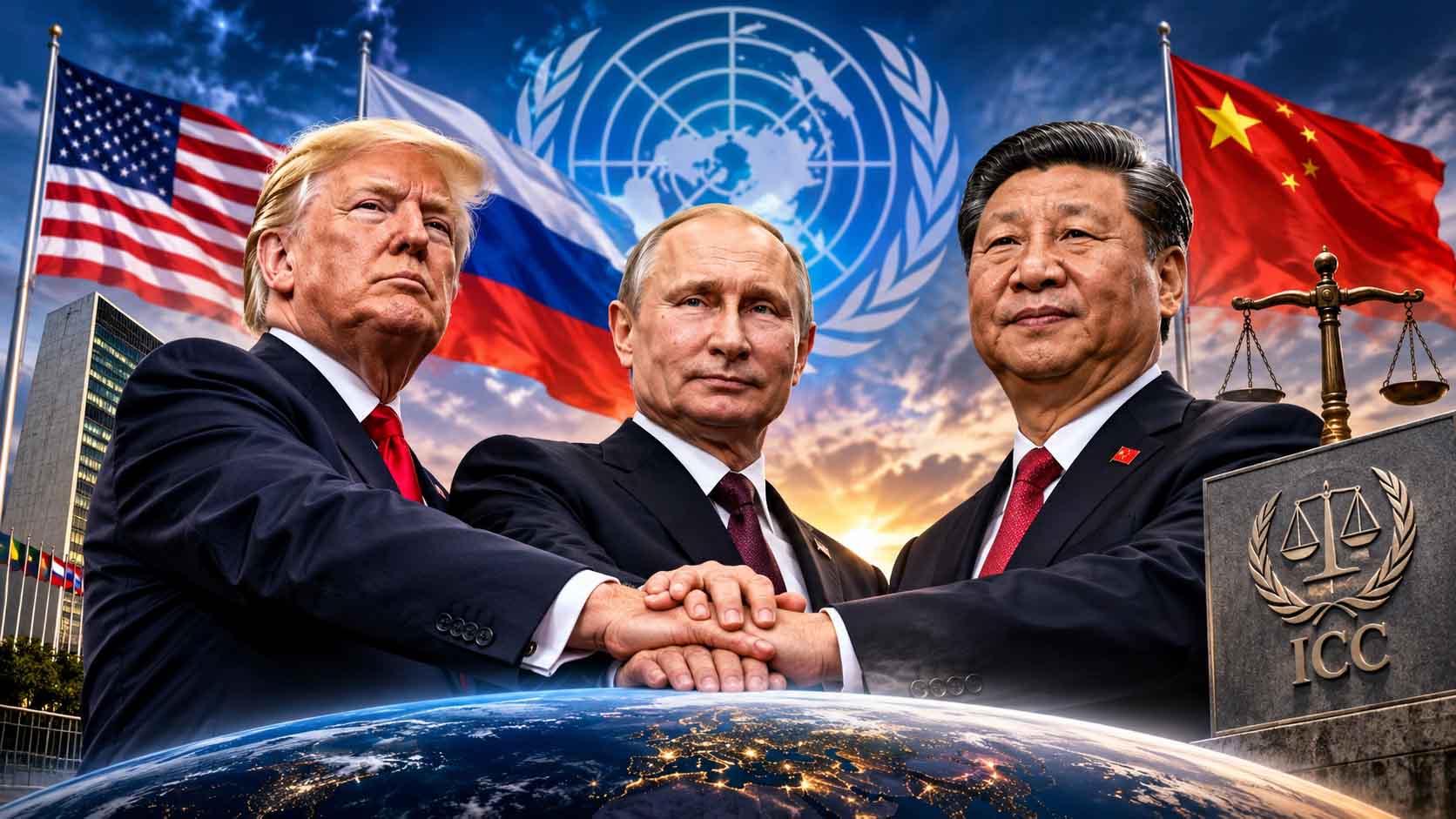
Trump, Putin and Xi’s Historic Summit
A Challenge to the United Nations, the International Criminal Court and the Existing World Order
The first-ever trilateral meeting between the leaders of the United States, Russia and China has produced a four-point declaration with potentially far-reaching implications for international politics. From reforming the United Nations and challenging the authority of the International Criminal Court to nuclear security and global energy supplies, the Shenzhen summit raises fundamental questions about who exercises power in the modern world.
By Antony Antoniou
On 19 November 2026, three of the world’s most powerful political leaders sat around the same table in Shenzhen, China, for a meeting that could prove to be an important moment in the evolution of international relations.
US President Donald Trump, Russian President Vladimir Putin and Chinese President Xi Jinping held their first-ever formal trilateral meeting at Kylin Villa. Lasting approximately 80 minutes, the discussions culminated in a joint four-point document entitled Declaration Toward Peace.
The declaration was notable not simply because of the extraordinary gathering of three global powers, but because of the issues on which they found common ground.
The leaders committed themselves to pursuing reform of the United Nations, increasing the production and supply of refined petroleum products, challenging what they described as abuses of jurisdiction by the International Criminal Court (ICC), and opening dialogue on reducing nuclear risks and preventing nuclear proliferation.
They also reaffirmed one of the most important principles of nuclear diplomacy: a nuclear war cannot be won and must never be fought.
While the declaration does not establish binding agreements or set out a detailed implementation programme, its political significance should not be underestimated. Three countries that collectively possess enormous military, economic and diplomatic influence have publicly identified areas where they believe the existing international system needs to change.
The White House+3
1. Reforming the United Nations: Is the post-war international system fit for purpose?
Perhaps the most significant long-term commitment in the declaration concerns the United Nations.
The United States, Russia and China are three of the five permanent members of the UN Security Council, alongside the United Kingdom and France. Their permanent membership and veto powers give them an extraordinary degree of influence over international security.
The declaration states that the three countries are committed to reforming the UN so that it can respond more effectively to global challenges and fulfil its fundamental mission of maintaining international peace and security.
It is a carefully worded commitment, but one that raises an important question: has the United Nations become an institution that struggles to deliver the very purpose for which it was established?
Created in 1945 following the devastation of the Second World War, the organisation was intended to prevent another global conflict, facilitate international cooperation and provide a framework for resolving disputes peacefully.
Yet, more than eight decades later, the Security Council frequently finds itself paralysed when dealing with conflicts involving its own permanent members or their allies.
Russia’s invasion of Ukraine has demonstrated the limitations of a system in which a permanent member can use its veto to obstruct action directed against itself. Similar disagreements over the Middle East have repeatedly exposed the political divisions that prevent the Council from reaching consensus.
Criticism of the UN’s structure is not new. Many countries have argued that its composition reflects the geopolitical realities of 1945 rather than those of the twenty-first century.
However, the Shenzhen declaration does not specify what reforms the three governments want. It does not propose changes to the permanent membership, the veto system or the balance of representation between developed and developing nations.
That distinction matters.
Reforming the United Nations to make it more effective is a widely shared objective. Reforming it in a way that gives the world’s most powerful governments greater freedom from international scrutiny would be a very different proposition.
The challenge will be ensuring that reform strengthens the organisation rather than simply redistributing power between the countries that already dominate it.
The White House+2
2. The International Criminal Court: A direct challenge to supranational authority
The declaration’s third point is arguably the most controversial and potentially consequential.
The three leaders have stated that the principle of state consent and respect for the immunity of state officials are of paramount importance. They have also agreed that the International Criminal Court and similar bodies must not abuse their jurisdiction.
This is significant because the ICC has increasingly become a source of tension between national governments and international legal institutions.
Established under the Rome Statute in 1998 and operational since 2002, the ICC was created to prosecute individuals accused of four categories of serious international crimes:
-
Genocide.
-
Crimes against humanity.
-
War crimes.
-
The crime of aggression, subject to specific jurisdictional conditions.
Its purpose is to ensure that individuals responsible for some of the world’s most serious atrocities cannot simply escape accountability because of their political position or the protection of their governments.
However, the court’s jurisdiction has long been controversial, particularly when it involves nationals of countries that have not signed or ratified the Rome Statute.
Neither the United States, Russia nor China is a party to the Rome Statute.
The three governments have therefore found common ground in questioning the extent to which an international court should exercise authority over officials from countries that have not accepted its jurisdiction.
There is, however, an important legal distinction.
The ICC can, under certain circumstances, investigate nationals of non-member states if alleged crimes were committed on the territory of a member state. It can also acquire jurisdiction through a United Nations Security Council referral.
Consequently, simply declining to become a member of the court does not provide complete immunity from prosecution.
International Criminal Court+3
Why Vladimir Putin’s position makes this particularly important
The political significance becomes clearer when considering Vladimir Putin’s relationship with the ICC.
In March 2023, the court issued an arrest warrant for the Russian president over alleged responsibility for the unlawful deportation and transfer of Ukrainian children from occupied territories to Russia.
The warrant has not resulted in Putin’s arrest, but it has created substantial diplomatic and legal complications for countries that are parties to the Rome Statute.
Russia rejects the court’s jurisdiction and considers the warrant illegitimate.
The United States has also adopted an increasingly confrontational position towards the institution.
Secretary of State Marco Rubio has been particularly outspoken, accusing the ICC of exceeding its authority and threatening American sovereignty.
In July 2026, Rubio declared that the US administration intended to dismantle the ICC, describing the campaign as an effort to remove what Washington considers an unaccountable supranational threat. In August, the administration announced further sanctions against senior ICC personnel, including the court’s president.
The Shenzhen declaration therefore represents something more substantial than three leaders simply expressing dissatisfaction with an international institution.
It places the United States, Russia and China behind a shared diplomatic position on state sovereignty, official immunity and the limits of international judicial authority.
The Guardian+3
The argument for and against international judicial power
There are two competing principles at the heart of this debate.
The first is national sovereignty: governments argue that their officials should not be subjected to the authority of international institutions unless there is a legitimate legal basis for doing so.
The second is international accountability: supporters of the ICC argue that national sovereignty should not become a shield for individuals accused of committing war crimes, genocide or crimes against humanity.
Both principles deserve serious consideration.
An international court must operate within the limits of its legal mandate. Equally, if powerful governments can simply disregard international accountability whenever it becomes politically inconvenient, the principle of equal justice risks becoming meaningless.
The question is not whether international institutions should be beyond criticism. They should not.
It is whether reform can make them more accountable, impartial and legally consistent without undermining their ability to protect victims and pursue justice.
That is the central debate now facing the international community.
3. Energy security: A potentially important development for the global economy
The second point of the declaration concerns the production and supply of refined petroleum products.
The three countries have committed themselves to increasing production and supply for the benefit of all nations, while reaffirming the importance of stable energy flows.
At first glance, this may appear less politically significant than the proposed changes to international institutions. In reality, it could have substantial economic implications.
Energy security has become one of the defining challenges of international politics.
The conflicts in Ukraine and the Middle East, economic sanctions, shipping disruptions and competition over energy resources have all contributed to uncertainty in international markets.
Russia remains a major producer of oil and petroleum products, while China is one of the world’s largest energy consumers and a major refining power. The United States is also a leading producer of oil and refined petroleum products.
Together, these three countries possess considerable influence over global energy markets.
An agreement to increase production and improve supplies could potentially contribute to greater availability and price stability, particularly for countries heavily dependent on imported fuel.
There is also an important geopolitical dimension.
Western sanctions imposed on Russia following its invasion of Ukraine have restricted aspects of its access to international markets. Any initiative that facilitates increased Russian petroleum production and distribution could raise questions about the future effectiveness of those restrictions.
However, the declaration does not explicitly announce the removal of sanctions, nor does it establish a mechanism for circumventing them.
It is therefore too early to interpret the commitment as a formal agreement to end energy sanctions.
What it does demonstrate is that energy cooperation remains an area where the interests of Washington, Moscow and Beijing can overlap, despite their wider political differences.
The White House+3
4. Nuclear weapons: The most important commitment may be the one that remains unfinished
Perhaps the most encouraging aspect of the summit concerns nuclear security.
The three leaders reaffirmed the principle that a nuclear war cannot be won and must never be fought.
They also agreed to engage in dialogue aimed at reducing nuclear risks and preventing the proliferation of nuclear weapons.
This is particularly important given the increasingly uncertain state of international arms control.
The United States and Russia possess the world’s two largest nuclear arsenals, while China’s nuclear capabilities have been expanding.
For decades, agreements between Washington and Moscow provided an important framework for limiting strategic nuclear weapons and maintaining a degree of transparency between the two countries.
However, that framework has weakened considerably.
The New START treaty, the last major bilateral agreement limiting American and Russian strategic nuclear forces, expired on 5 February 2026.
Its expiry removed legally binding limits on the two countries’ deployed strategic nuclear weapons, creating additional uncertainty at a time of heightened international tension.
Trump has expressed an interest in a new arms-control agreement that would also involve China.
Beijing has historically resisted joining negotiations on equal terms with Washington and Moscow, arguing that its nuclear arsenal is considerably smaller than those of the two established nuclear superpowers.
The Shenzhen declaration could provide an opening for a new diplomatic process.
However, it is important not to overstate what has been achieved.
There is no new nuclear disarmament treaty, no agreed reduction in warhead numbers and no timetable for negotiations.
The three countries have committed to dialogue, not disarmament.
Nevertheless, establishing communication between the world’s three largest nuclear powers is a worthwhile objective. Even relatively modest agreements on crisis communication, transparency and avoiding accidental escalation could have considerable value.
The question now is whether the three governments can translate their political commitment into a practical framework.
IISS+3
5. The geopolitical implications: Who really benefits from the summit?
Although Trump has presented the meeting as a historic diplomatic achievement, the potential benefits are not necessarily distributed equally.
For each of the three leaders, the summit serves a different strategic purpose.
Donald Trump: Establishing a new diplomatic legacy
Trump has consistently argued that international institutions have become inefficient, bureaucratic and insufficiently respectful of national sovereignty.
His willingness to engage directly with Putin and Xi reflects his preference for personal diplomacy and negotiations between national leaders rather than relying exclusively on established diplomatic structures.
The summit gives him an opportunity to position himself as a president capable of bringing together countries that have traditionally been regarded as geopolitical adversaries.
His most tangible achievement so far is securing a commitment to nuclear risk-reduction dialogue involving China and Russia.
However, the absence of concrete agreements on Ukraine, Iran and nuclear arms reductions means that the longer-term success of his approach remains unproven.
Vladimir Putin: Breaking through diplomatic isolation
For Putin, the meeting represents a considerable diplomatic opportunity.
Russia has faced extensive Western sanctions and international condemnation since launching its full-scale invasion of Ukraine in February 2022.
His appearance alongside the American and Chinese presidents reinforces his position as a leader who remains central to international diplomacy.
It also gives Moscow an opportunity to advance its arguments concerning sanctions, energy markets, state sovereignty and the jurisdiction of international institutions.
The ICC issue is particularly relevant given the outstanding arrest warrant against him.
The summit does not invalidate that warrant or provide Putin with immunity. Nevertheless, securing agreement from Washington and Beijing on the importance of state immunity and limits on international jurisdiction represents a significant political development for Moscow.
Xi Jinping: China’s growing influence on the world stage
China arguably benefits from the symbolism of the meeting more than either of the other participants.
Xi hosted the summit, bringing together the leaders of two other nuclear superpowers on Chinese soil.
The imagery reinforces China’s ambition to be recognised as an indispensable participant in decisions concerning global security and the international order.
It also demonstrates Beijing’s ability to maintain relationships with Washington and Moscow despite their respective tensions.
China has long advocated a greater role for itself and other developing countries in international institutions.
The declaration gives Xi another platform from which to promote that position.
The important consideration is that China and the United States remain strategic competitors, particularly over technology, trade, Taiwan and regional security. The summit has not removed those underlying tensions.
The Japan Institute of International Affairs+2
6. The uncomfortable question: What about Ukraine and Europe?
One of the most noticeable omissions from the four-point declaration is any reference to Ukraine.
Despite the fact that Russia’s war against Ukraine remains one of the most consequential conflicts in the world, the joint document contains no commitment to a ceasefire, territorial settlement or peace negotiations.
Putin indicated that the conflict had been discussed, but no breakthrough was announced.
The meeting also generated unease among European governments.
European leaders have repeatedly argued that decisions concerning Ukraine’s future must involve Ukraine itself and its European allies.
Their concern is understandable.
If the world’s three most powerful nuclear states begin negotiating changes to the international security system without meaningful consultation with other affected countries, there is a danger that smaller nations will find their interests marginalised.
The comparison with the 1945 Yalta Conference has inevitably emerged.
At Yalta, the leaders of the United States, Britain and the Soviet Union discussed the post-war settlement and the future political organisation of Europe.
The Shenzhen summit is not another Yalta. There is no evidence of an agreement to divide the world into spheres of influence.
Nevertheless, the historical comparison highlights a legitimate concern: international decisions made by a handful of powerful governments can have profound consequences for countries that are not represented at the negotiating table.
Reuters+3
7. Is this the beginning of a new international order?
The most interesting aspect of the Shenzhen summit may ultimately be what it represents rather than what it has immediately achieved.
For much of the post-war period, international relations have operated within a framework of institutions, treaties and agreements designed to regulate the behaviour of states.
The United Nations, international courts, arms-control agreements and multilateral organisations have all played a role in that system.
However, the effectiveness and legitimacy of these institutions have increasingly been questioned.
Critics argue that international organisations have become too bureaucratic, politically selective and disconnected from the national interests of the countries they are supposed to serve.
Supporters argue that, despite their imperfections, they provide essential safeguards against the unchecked exercise of power.
The declaration from Shenzhen brings these competing arguments into sharper focus.
It suggests that the United States, Russia and China are prepared to explore a different approach to international governance, one that places greater emphasis on state sovereignty, strategic cooperation between major powers and the limits of supranational authority.
Whether that approach produces a more effective international system or simply gives powerful governments greater freedom to pursue their own interests remains to be seen.
There is also a fundamental contradiction that should not be overlooked.
The three countries are united in their desire to reform international institutions, but they have very different political objectives.
Russia wants relief from international pressure and greater freedom to pursue its strategic interests. China wants greater influence over global governance. The United States wants to protect its sovereignty and maintain its international leadership.
Their agreement is therefore based on overlapping interests rather than a common vision of the future.
That distinction could become important when the discussions move beyond broad declarations and into practical negotiations.
Conclusion: A significant diplomatic opening, but the real test lies ahead
The meeting between Donald Trump, Vladimir Putin and Xi Jinping should not be dismissed as simply another diplomatic photo opportunity.
Bringing together the leaders of the world’s three largest nuclear powers and securing a joint declaration on international security, energy, nuclear risks and institutional reform is a significant achievement.
The agreement on UN reform deserves attention. So does the shared position on the jurisdiction of international courts. And, given the deteriorating arms-control environment, the commitment to discuss nuclear risks is particularly welcome.
However, there is a difference between challenging the existing international order and successfully creating something better.
International institutions must be capable of reform. They should be transparent, accountable and consistent in the application of their principles. No institution should be immune from scrutiny simply because of its international status.
But sovereignty must not become a convenient excuse for avoiding accountability, either.
Ultimately, the success of the Shenzhen declaration will depend on whether the three governments follow through with practical measures.
Will they produce meaningful proposals for UN reform? Will they establish a genuine nuclear risk-reduction process? Will energy cooperation translate into greater security and more stable supplies? And will the debate surrounding international judicial authority lead to a more consistent and legitimate system of international justice?
These are the questions that matter.
Trump has brought Putin and Xi to the table and secured an agreement that would have been difficult to imagine in previous years. That is diplomatically significant. Whether it becomes a turning point in international relations, however, will depend on what happens next.