

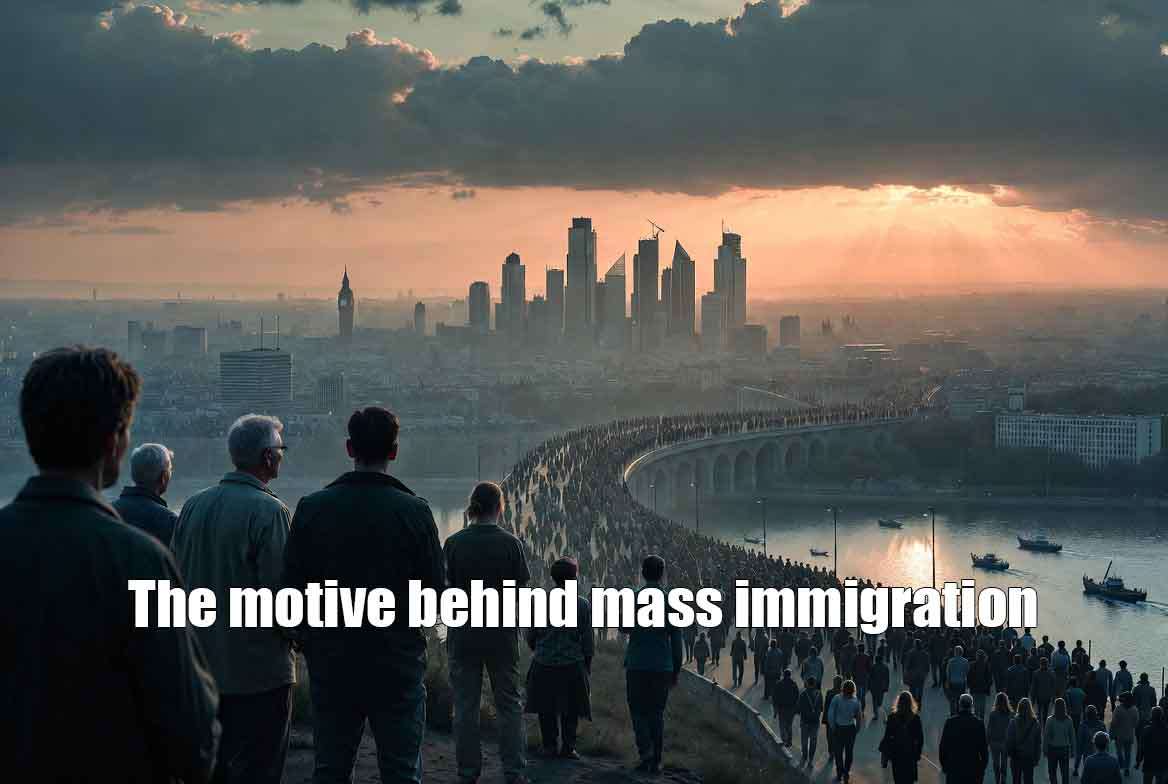
The motive behind mass immigration
Today’s population sacrificed for tomorrow’s dystopia
In the opening decades of the 21st century, Western nations—particularly those in Europe and North America—have experienced sustained high levels of net immigration on a scale unprecedented in peacetime history. In the United Kingdom alone, net migration reached a provisional 204,000 in the year ending June 2025, a sharp decline from the 649,000 recorded the previous year but still comparable to pre-pandemic averages and far above the levels of the early 2010s. Across the European Union, 4.2 million non-EU immigrants arrived in 2024, driving population growth amid natural decline. This is not accidental. Governments, supranational bodies and economic elites have pursued policies that actively facilitate large-scale inflows, even as public opinion in many countries registers deep unease or outright opposition.
The stated motives—demographic renewal, economic vitality and humanitarian duty—are presented as pragmatic necessities. Yet the subtitle of this article captures a more uncomfortable reality: today’s native populations are, in effect, being asked to bear the immediate social, cultural and fiscal costs of a transformation whose long-term benefits remain speculative and whose risks appear to point towards greater fragmentation, eroded social trust and strained national cohesion. This is not conspiracy but the logical outcome of choices made without sufficient regard for democratic consent or empirical outcomes. The result risks a dystopia of parallel societies, diminished public services and a hollowed-out sense of shared identity.
To understand the motive, one must examine the interplay of demography, economics, law, ideology and politics. The evidence suggests that while some drivers are defensible in isolation, the aggregate effect has been a deliberate acceleration of change that prioritises abstract aggregates—GDP, dependency ratios, global equity—over the lived experience of existing citizens.
The demographic imperative: filling the void left by low fertility
At the heart of the policy consensus lies a stark demographic fact. Fertility rates across Western nations have collapsed below the replacement level of 2.1 children per woman. OECD data show an average of around 1.5 in 2022, with many countries far lower: Italy at 1.2, South Korea (often cited as a cautionary parallel) at 0.7, and projections for 2025 confirming the trend across 37 of 38 OECD members. The United Nations World Population Prospects reinforce this: without migration, populations in most developed countries will shrink and age rapidly, with profound implications for pensions, healthcare and labour supply.
The UN Population Division’s 2000 “Replacement Migration” report laid out the arithmetic with clinical precision. To maintain the size of the working-age population (15–64) or the potential support ratio (workers per retiree), countries like Germany, Italy and the UK would require annual inflows in the hundreds of thousands—figures that, sustained over decades, would fundamentally alter the ethnic and cultural composition of the host society. The report itself noted the political and social impracticality of such volumes, yet its logic has underpinned policy ever since.
In the UK, the Office for Budget Responsibility has repeatedly modelled higher net migration as a short-term fiscal salve, reducing deficits by injecting working-age taxpayers. Similar analyses from the OECD and EU institutions frame immigration as the least painful way to sustain welfare states built on post-war baby-boom assumptions. Without it, governments face the unpalatable alternatives of raising retirement ages further, cutting benefits or increasing taxes on a shrinking native workforce.
Yet this framing treats population as a mere economic input. It ignores the cultural and social dimensions of rapid demographic change. Native birth rates have not collapsed in a vacuum; they reflect economic pressures, housing costs, changing gender roles and cultural shifts that immigration does not resolve and may exacerbate. Moreover, immigrants themselves eventually age, requiring yet more inflows to maintain ratios—a demographic Ponzi scheme that the UN report itself acknowledged could only postpone, not prevent, decline. Japan’s resistance to mass immigration, despite its own severe ageing, demonstrates that alternatives (automation, higher participation, pro-natal incentives) exist, albeit with trade-offs in growth.
The motive here is technocratic: sustain the fiscal model at all costs. But it sacrifices the right of existing populations to preserve a stable national demography. Today’s young Britons, French or Germans face not just higher taxes but competition for housing, school places and jobs in a society whose very character is being altered without their explicit consent.
Economic arguments: growth versus distribution
Proponents also invoke labour-market needs and aggregate GDP. Employers in healthcare, construction, agriculture and social care argue that native workers shun low-wage or undesirable roles. In the UK, non-EU migration has filled gaps, with Skilled Worker visas generating positive fiscal contributions—£16,300 net per main applicant in 2022/23 according to the Migration Advisory Committee. The Office for Budget Responsibility estimates that higher migration lowers borrowing in the short term by expanding the tax base.
Broader OECD studies find that migration’s fiscal impact is typically small—less than 1 per cent of GDP—though high-skilled inflows tilt positive while low-skilled ones impose net costs, particularly where welfare access is generous. Remittances benefit sending countries, and migrants often exhibit high entrepreneurship.
Yet these aggregates mask distributional effects. Low-skilled immigration can depress wages at the bottom of the labour market, increase inequality and strain infrastructure. In the UK and Europe, rapid inflows have coincided with acute housing shortages—Europe faces an estimated 9.6 million home deficit, with prices rising 5.7 per cent in early 2025 and rents 3.2 per cent. Non-UK citizens headed 22 per cent of homelessness assessments in England in 2023/24. Public services—NHS waiting lists, school overcrowding, transport—show visible pressure in high-migration areas.
The motive appears rooted in client politics: business lobbies gain cheap labour; universities revenue from international students; governments short-term fiscal relief. Native workers in affected sectors bear the cost. Studies, including those from the Migration Observatory, confirm that while overall economic effects are modest, the burdens fall disproportionately on lower-income natives and recent arrivals themselves.
Humanitarian obligations and legal frameworks
Post-1945 international law—the 1951 Refugee Convention, European Convention on Human Rights, EU directives—imposes obligations to process asylum claims. Conflicts in Syria, Afghanistan, Ukraine and sub-Saharan Africa generate genuine refugees. Western foreign policies have sometimes contributed to instability, creating moral claims.
Yet asylum systems are widely abused. Economic migrants exploit routes designed for persecution; smuggling networks thrive. In the UK, asylum claims reached 101,000 in the year ending December 2025, with processing backlogs and low removal rates. EU-wide, irregular arrivals, though down in some routes, remain significant, with return rates below 20 per cent.
Policymakers frame lax enforcement as compassion. Critics see it as ideological capture by NGOs and courts that prioritise individual claims over collective capacity. The motive is legal inertia plus virtue-signalling: upholding “values” while externalising costs to host communities.
Ideological drivers: multiculturalism, globalism and elite interests
Beneath economics and law lies ideology. Post-1960s elites embraced multiculturalism as moral atonement for colonialism and racism. Diversity became an unqualified good; national identity suspect. EU free-movement rules and UN compacts reinforced a post-national ethos. Business elites favour open borders for labour arbitrage; left-leaning academics and NGOs for equity and anti-nationalism.
Leaders have admitted failures—Angela Merkel in 2010 declared multiculturalism “utterly failed”; Sweden’s former prime minister conceded “parallel societies.” Yet policy inertia persists. Chain migration and family reunification amplify numbers. Some analysts detect a deliberate strategy to erode cultural homogeneity, rendering populations more amenable to supranational governance or diluting working-class resistance to globalisation.
The motive is not monolithic but converges: elites insulated from the consequences (private schools, gated communities) impose costs on the many. Public choice theory explains it as concentrated benefits (votes from immigrants, corporate donations) versus diffuse costs.
Public opinion: the democratic disconnect
Polls reveal the gap. A 2025 YouGov survey across seven European countries found majorities favouring large reductions in immigration and, in some cases, removal of recent arrivals. In the UK, immigration consistently tops voter concerns. Eurobarometer data show 65 per cent of Europeans worried about uncontrolled flows. US polls have fluctuated but hardened on illegal entries.
Despite this, mainstream parties long downplayed or dismissed concerns as “racist.” The rise of Reform UK, AfD, National Rally and others reflects backlash. The motive for ignoring voters? Short-term electoral calculus (immigrant blocs) and ideological conviction that the public must be led, not followed.
Social and cultural impacts: trust, cohesion and integration
Rapid, low-selection immigration strains social fabric. Robert Putnam’s research on diversity and “hunkering down” finds lower trust—not just inter-group but intra-group—in heterogeneous communities. European studies broadly corroborate this.
Integration varies. High-skilled, culturally proximate migrants assimilate well. Non-Western, particularly Muslim-majority inflows, show persistent gaps: higher welfare dependency, lower employment (especially women), value clashes on gender, secularism and free speech. Parallel societies in Malmö, Seine-Saint-Denis, Bradford and parts of Birmingham are documented realities. Crime data are nuanced: overall foreign-national conviction rates in the UK approximate population share after age/sex adjustment, but overrepresentation appears in certain offences (sexual, violent) in some jurisdictions.
The motive’s blind spot is assuming all cultures are equally assimilable under liberal democracy. Evidence suggests otherwise for groups from high-corruption, low-trust, theocratic societies.
Fiscal realities and economic trade-offs
While high-skilled migrants contribute positively, low-skilled inflows generate net costs, especially with generous welfare. UK studies show initial drains offset over lifetimes only under optimistic assumptions. Housing, education and NHS pressures are immediate and visible. The 2025 net-migration drop may ease some strains but risks labour shortages in care and construction.
Towards a dystopia?
Unchecked, the trajectory points to fragmented societies: ethnic enclaves with separate norms, eroded generalised trust, higher inequality, sporadic unrest (as in 2024 UK riots or French banlieue violence). National identity dilutes; political polarisation deepens. Public services creak; cultural confidence wanes. The “dystopia” is not apocalyptic collapse but gradual loss of the cohesive, high-trust societies that built the welfare states now strained.
Today’s populations—particularly working- and lower-middle-class natives—pay via higher rents, longer waits, cultural displacement and suppressed wages. Tomorrow’s “diverse” society may be richer in GDP but poorer in belonging.
Alternatives and the path forward
Solutions exist: selective, skills-based systems (Canada/Australia model); pro-natal policies (family allowances, housing subsidies); automation and training; enforcement of returns and border control. Denmark’s tightening shows integration improves with fewer, better-selected inflows. Japan proves low-migration ageing is survivable.
The true motive must shift from elite convenience to democratic legitimacy. Immigration policy should serve the interests of the existing citizenry—economic, cultural, social—while honouring genuine humanitarian duties. Numbers, selection and integration capacity matter. Without recalibration, the sacrifice of today’s population for an unproven, potentially dystopian tomorrow will only deepen resentment and instability.
Western governments face a choice: heed voters and evidence, or persist in a failed experiment. The data—demographic, economic, social—suggest the latter risks a future few would choose. The motive, ultimately, is a failure of courage: to confront trade-offs honestly rather than virtue-signal at the expense of the people they serve.