

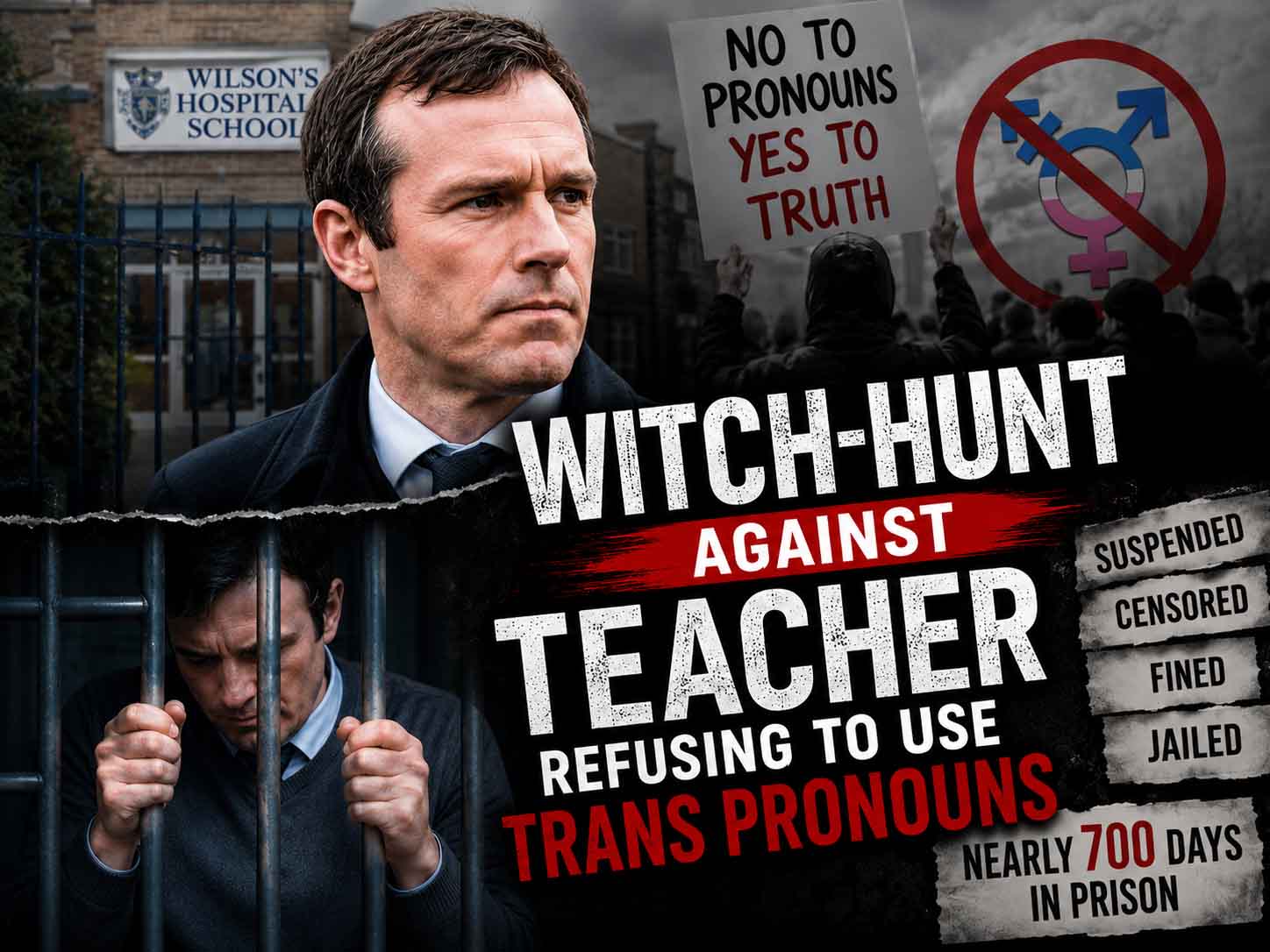
The Enoch Burke Case
Free Speech, Religious Conviction and Ireland’s Deepening Culture War
The long-running legal battle surrounding Irish teacher Enoch Burke has become one of the most divisive cultural and political controversies in modern Ireland. What began as a workplace dispute over transgender pronouns has evolved into a national debate about free speech, religious liberty, state authority and the limits of civil disobedience.
To supporters, Burke is a principled Christian teacher being punished for refusing to violate his beliefs. To critics, he is a man who has repeatedly ignored lawful court orders while deliberately turning his case into a political spectacle.
Few cases in recent years have exposed such deep divisions in Irish society.
Who is Enoch Burke?
Enoch Burke is a former history and German teacher at Wilson’s Hospital School, a Church of Ireland secondary school in County Westmeath.
The dispute began in 2022 after Burke publicly objected to a request that staff refer to a student by a new name and the pronouns “they/them”. Burke argued that complying would contradict his evangelical Christian beliefs and amount to compelled speech.
The school suspended Burke following escalating tensions and concerns about his conduct. However, rather than remaining away from the school during disciplinary proceedings, Burke repeatedly returned to the premises despite High Court injunctions ordering him not to do so.
That decision ultimately led to one of the most extraordinary contempt-of-court sagas in Irish legal history.
Imprisonment and Contempt of Court
Burke has now spent close to 700 days in prison across multiple periods of incarceration for contempt of court. Judges have consistently maintained that he was not jailed because of his views on transgender issues, but because he repeatedly breached court orders preventing him from entering school grounds.
In a widely quoted judgment, Irish courts stated that Burke “has the keys to his own prison”, meaning he could secure release by agreeing to comply with the injunction.
The courts have repeatedly drawn a distinction between Burke’s beliefs and his actions. Judges have emphasised that he is entitled to express religious objections to transgender ideology, but not entitled to ignore binding legal orders.
Nonetheless, many people — particularly conservative and religious commentators internationally — view the punishment as disproportionate.
For Burke’s supporters, the central issue is not trespass law but whether a teacher should lose his career and freedom for refusing to use preferred pronouns on grounds of conscience.
A Growing Political Flashpoint
The controversy has increasingly spilled beyond the courtroom and into public political life.
In recent weeks, members of the Burke family have confronted senior Irish politicians during public events in Galway, accusing the government of complicity in what they describe as ideological persecution. Footage circulating online shows heated exchanges involving Irish ministers and members of the Burke family.
Burke has also continued challenging the disciplinary process surrounding his dismissal. Reports indicate he recently objected to the appointment of a disciplinary appeals chairperson whom he alleged was not sufficiently independent due to links with the Church of Ireland.
Meanwhile, courts have become increasingly critical of disruptive behaviour by members of the Burke family during hearings. In 2026, Burke’s mother and sister were themselves jailed for contempt of court following repeated interruptions and confrontations during proceedings.
The case has therefore evolved into something larger than an employment dispute. It now sits at the intersection of religion, identity politics, judicial authority and public protest.
Public Opinion Remains Deeply Divided
Public reaction to the Burke case has been sharply polarised.
Supporters argue that the case represents a dangerous erosion of free expression and religious liberty in Western democracies. They contend that Burke’s refusal to use transgender pronouns was an act of conscience rather than discrimination, and that the severity of the state response demonstrates growing intolerance towards traditional Christian beliefs.
Some conservative activists have described Burke as a political prisoner or a victim of ideological persecution.
Critics, however, argue that Burke deliberately escalated the situation through repeated defiance of court rulings. Many point out that the courts never ordered him to change his beliefs, only to comply with workplace and legal processes. Irish online discussions frequently portray the saga as a self-inflicted crisis driven by Burke’s refusal to obey court orders.
The debate reflects broader tensions across Europe and the wider Western world over transgender rights, compelled language and the role of religion in public institutions.
Wider Questions Raised by the Case
The Burke controversy raises several difficult legal and moral questions that extend far beyond Ireland.
Can employees refuse workplace language policies on religious grounds?
Should governments and schools compel the use of preferred pronouns?
At what point does civil disobedience become contempt for the rule of law?
And how should democratic societies balance protections for transgender individuals with freedom of conscience and belief?
These questions remain unresolved, and the Burke case continues to attract international attention precisely because it touches on anxieties felt far beyond Irish borders.
Conclusion
Whether viewed as a principled dissenter or an obstinate rule-breaker, Enoch Burke has become a symbol of a much wider cultural conflict.
His supporters see a man destroyed professionally and imprisoned repeatedly for standing by his Christian convictions. His critics see a former teacher who repeatedly chose confrontation over compliance and transformed a disciplinary matter into an endless legal battle.
What is beyond dispute is that the case has exposed profound tensions within modern liberal democracies — tensions between freedom and authority, belief and policy, individual conscience and institutional rules.
And with legal appeals, public confrontations and political controversy continuing into 2026, the Enoch Burke saga shows little sign of ending soon.