

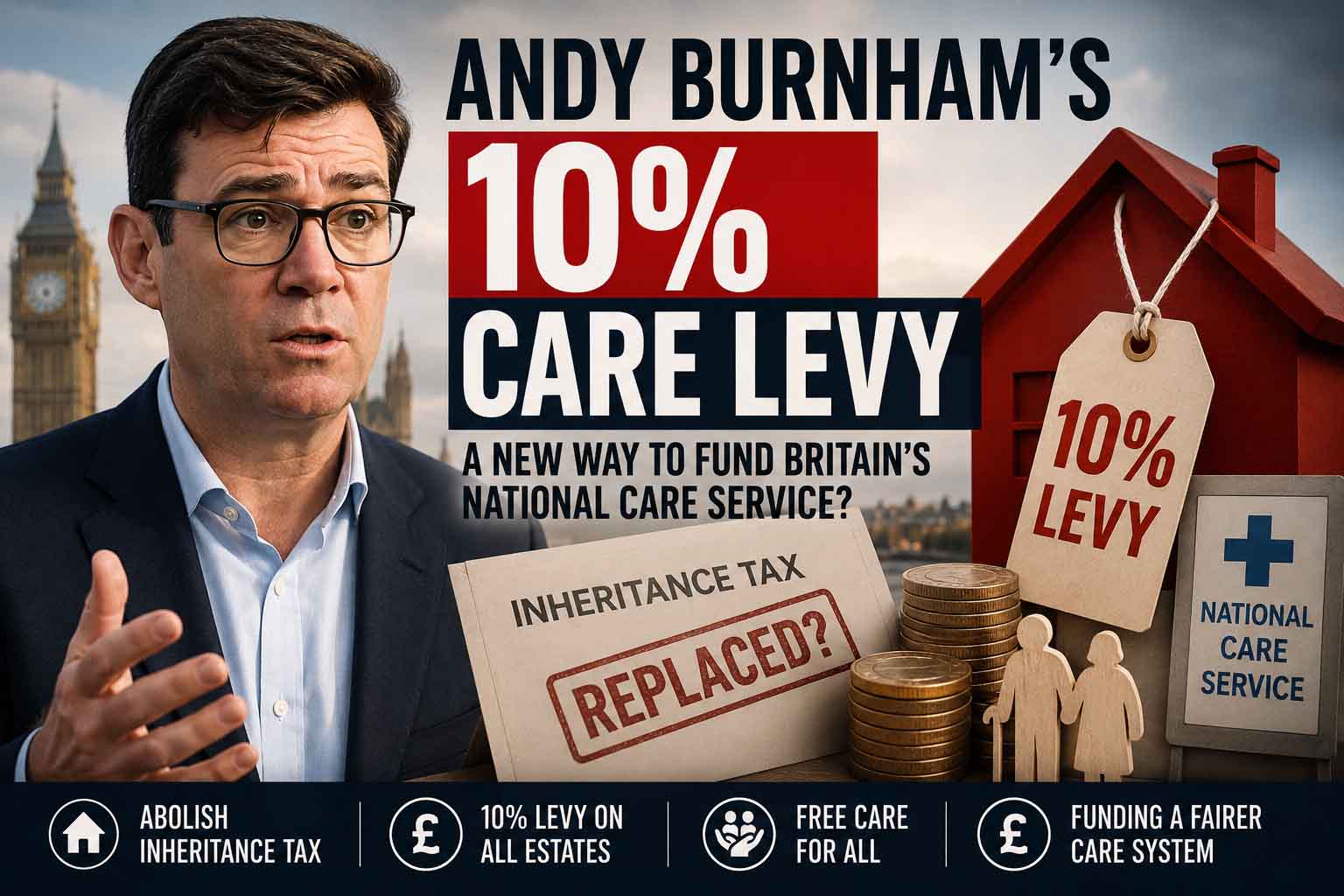
Andy Burnham’s 10% Care Levy
Would Britain Be Replacing One Death Tax with Another?
Andy Burnham’s renewed call for a National Care Service has reignited one of the most contentious debates in British politics: who should pay for social care?
At the heart of the discussion is a proposal that would fundamentally reshape how care is funded in England. Rather than relying on today’s means-tested system—where many elderly people are forced to spend much of their savings and, in some cases, sell their homes to pay for residential care—Burnham has suggested replacing the existing Inheritance Tax system with a universal levy on estates to fund free social care for everyone.
Supporters describe it as a fair and sustainable solution to Britain’s growing care crisis. Critics argue it would simply replace one unpopular “death tax” with another, potentially affecting millions more families than the current system.
The Current System
England’s social care system has long been criticised as confusing, unfair and financially unsustainable.
Unlike NHS healthcare, adult social care is generally means-tested. Individuals with significant assets are expected to contribute towards the cost of their care before the state steps in. For many families, this means that years of careful saving or the value of the family home can be substantially reduced by care fees.
This creates what many campaigners describe as a “care lottery”. Someone diagnosed with dementia may require years of expensive residential care, while another person who dies suddenly without requiring long-term care may leave their entire estate untouched.
Successive governments have acknowledged that the system requires reform, yet comprehensive solutions have repeatedly stalled because of the enormous cost involved.
Burnham’s Proposal
Andy Burnham has long argued that social care should operate on the same principle as the NHS: free at the point of need, regardless of an individual’s wealth.
To fund this, he has revived proposals for a National Care Service financed through a levy on estates after death.
Although the final details have yet to be confirmed, the proposal being discussed would broadly involve:
- Abolishing the current Inheritance Tax system.
- Introducing a flat 10% levy on estates after death.
- Applying the levy more broadly than current Inheritance Tax, potentially including family homes, savings and investments.
- Ring-fencing the revenue exclusively for funding adult social care.
- Making personal social care free at the point of use.
Under this model, individuals would no longer face the prospect of selling their home or exhausting their savings simply because they required long-term care.
A Fundamental Shift in Taxation
The proposal reflects a broader shift in fiscal thinking.
Rather than relying primarily on taxes on earned income such as Income Tax and National Insurance, Burnham has increasingly argued that Britain should raise more revenue from accumulated wealth and property.
This wider discussion includes potential reforms to:
- Council Tax.
- Stamp Duty.
- Capital Gains Tax.
- Land and property taxation.
- Inheritance Tax.
Supporters believe these changes would produce a fairer tax system by placing a greater share of the burden on accumulated wealth rather than employment income.
The Case in Favour
Advocates argue that Britain can no longer ignore the financial pressures created by an ageing population.
Life expectancy has increased significantly over recent decades, while conditions such as dementia require lengthy and often expensive care.
Supporters believe a universal care levy would:
- eliminate catastrophic care costs for families;
- prevent elderly people from being forced to sell their homes;
- spread financial risk across the entire population;
- create a dedicated and predictable funding stream for social care;
- simplify an increasingly unpopular inheritance tax system.
They also argue that everyone benefits from knowing that high-quality care will be available should they ever need it.
The Criticism
Opposition to the proposal is equally strong.
Critics argue that replacing Inheritance Tax with a universal estate levy would significantly expand the number of families paying tax after death.
Under the current system, only a relatively small proportion of estates pay Inheritance Tax because of various thresholds and allowances. A universal levy, by contrast, could apply to far more households.
Many also question the fairness of taxing assets that have already been accumulated from income which has been taxed throughout a person’s working life.
For those critics, the proposal represents a further transfer of wealth from families who have worked, saved and invested responsibly.
They argue that individuals who never require expensive social care would still lose part of their estate after death to fund care received by others.
Some also fear the policy could discourage saving, reduce the incentive to build wealth and make it more difficult for parents to pass assets to future generations.
A Political and Philosophical Divide
Ultimately, the debate extends well beyond taxation.
It reflects two fundamentally different views of the role of the state.
One perspective holds that accumulated wealth belongs primarily to individuals and their families, and that the government should take only what is necessary to fund essential services during a person’s lifetime.
The other argues that accumulated wealth represents the fairest source of funding for universal services because it protects individuals from catastrophic financial risks during their lives and reduces pressure on workers through lower taxes on earnings.
Neither argument is likely to persuade everyone.
What Happens Next?
Although Burnham has revived the proposal and placed social care reform firmly back on the political agenda, there is currently no published legislation confirming the final structure of any estate levy.
Important questions remain unanswered, including:
- Would there be exemptions for small estates?
- How would family farms and businesses be treated?
- Would pensions be included?
- What protections would exist for surviving spouses?
- Would the levy genuinely replace Inheritance Tax or operate alongside other taxes?
These details will determine both the political viability and the public acceptance of any future reform.
Conclusion
Britain’s social care system is widely regarded as being in need of reform. The challenge has never been identifying the problem but deciding who should pay for the solution.
Andy Burnham’s proposed care levy represents one of the most ambitious attempts yet to address that question. Supporters see it as a fair way of sharing the costs of an ageing society while guaranteeing universal care. Critics see it as a significant expansion of taxation on accumulated wealth, affecting families who have spent a lifetime building assets to pass on to future generations.
Whether viewed as a necessary modernisation or as an unacceptable extension of state taxation, the proposal is likely to become one of the defining fiscal and political debates of the coming years.