

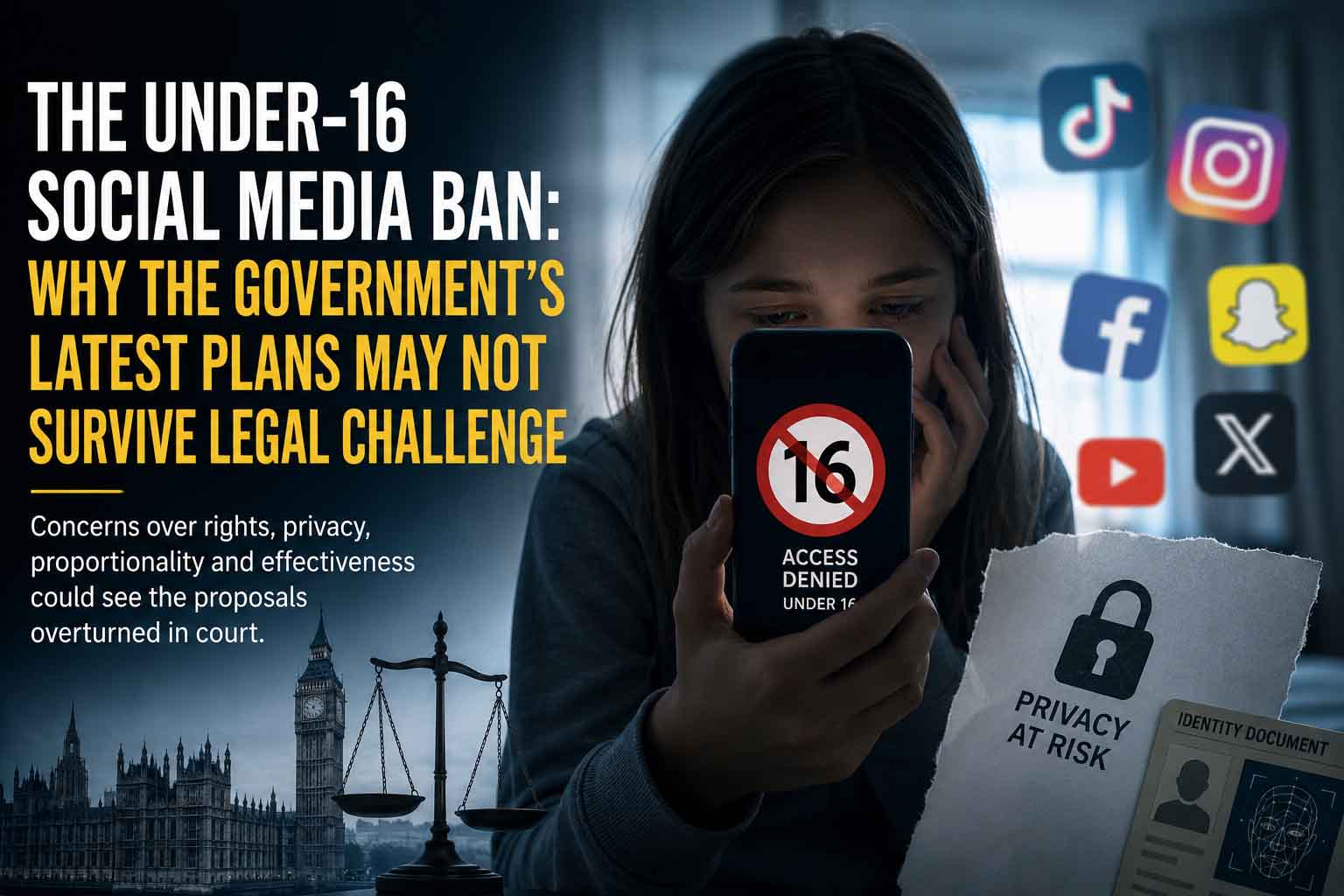
The Under-16 Social Media Ban
Why the Government’s Latest Online Safety Plans May Not Survive Legal Challenge
The Government’s proposed ban on social media access for under-16s has been presented as a landmark step towards protecting children online. Ministers argue that restricting access to platforms such as Instagram, TikTok, Snapchat, Facebook, YouTube and X will shield young people from harmful content, online predators and the addictive nature of modern social media.
Protecting children is undoubtedly a legitimate and worthwhile objective. Few would dispute that the online world presents genuine risks for young people. However, while the goal may command widespread public support, the means chosen to achieve it are already attracting significant legal, technical and human rights concerns.
Far from being a straightforward child-safety measure, the proposed restrictions raise serious questions about freedom of expression, privacy, proportionality and whether the policy can realistically achieve its stated aims.
A Generation Excluded from the Digital World
Perhaps the most significant criticism of the proposed ban is that it treats all young people in exactly the same way, regardless of maturity, circumstances or need.
Today’s teenagers use social media for far more than entertainment. It is where they communicate with friends, access educational content, engage in political discussion, follow current affairs and participate in modern society.
For many vulnerable young people, particularly those who are neurodiverse, disabled or socially isolated, online communities provide vital support networks that may not exist in the offline world. A blanket exclusion from major platforms risks cutting these individuals off from important sources of information, companionship and assistance.
The United Nations Convention on the Rights of the Child increasingly recognises that children are not merely passive subjects who require protection. They are rights-holders in their own right, entitled to freedom of expression, access to information, participation in society and protection of their privacy.
Critics argue that the proposed ban focuses almost exclusively on protection whilst paying insufficient attention to these competing rights.
Freedom of Expression Concerns
The proposal is also likely to face scrutiny under Article 10 of the European Convention on Human Rights, which protects freedom of expression and the right to receive and impart information.
While governments may lawfully restrict rights where there is a legitimate objective, such restrictions must be proportionate and no broader than necessary.
The proposed measures are notable for their breadth. Rather than targeting specific harmful content or particular online behaviours, they would exclude millions of young people from entire categories of digital services.
Courts have traditionally viewed blanket restrictions with scepticism, particularly where less restrictive alternatives exist.
Opponents of the policy argue that improved parental controls, enhanced moderation, age-appropriate design, digital literacy education and targeted safety features could achieve similar objectives without imposing such extensive limitations on young people’s rights.
The Privacy Problem
The proposed restrictions cannot function without robust age verification systems.
This creates an immediate dilemma. In order to determine whether someone is under 16, platforms will need to verify the age of users, potentially requiring the collection of identity documents, facial scans, biometric information or other sensitive personal data.
Supporters of the scheme argue that age verification is essential if online protections are to be effective. Critics counter that such systems create enormous databases of highly sensitive information that inevitably become attractive targets for cybercriminals.
Recent data breaches involving age-verification providers have demonstrated that these concerns are not merely theoretical. Unlike passwords, biometric data and identity documents cannot simply be changed when compromised.
The result is a paradox in which the Government seeks to improve children’s online safety by requiring the collection of additional personal data from millions of users.
A Policy That May Not Work
Even if privacy concerns are set aside, there remains a more fundamental question: can the restrictions actually be enforced?
Experience suggests the answer may be no.
The widespread availability of Virtual Private Networks (VPNs), encrypted communications tools and alternative platforms means that determined users can often circumvent age restrictions with relative ease.
Indeed, previous age-verification initiatives have produced significant increases in VPN usage, suggesting that many users simply seek alternative routes around the restrictions.
This presents a major legal problem for the Government.
Under human rights law, restrictions on fundamental rights must be necessary and proportionate. If a policy is easily bypassed and fails to achieve its intended objective, courts may question whether the interference with individual rights can be justified.
A measure that imposes substantial privacy and expression burdens whilst proving ineffective is unlikely to satisfy the strict proportionality tests applied by the courts.
The Digital Economy Act Warning
The Government has encountered similar difficulties before.
The Digital Economy Act 2017 introduced age-verification requirements for online pornography. However, after years of delays and mounting concerns over privacy, technical feasibility and enforcement, the scheme was ultimately abandoned.
Many of the criticisms that led to its collapse remain relevant today.
Questions surrounding data security, overseas enforcement, technological circumvention and the absence of privacy-preserving solutions continue to cast a shadow over the latest proposals.
Critics argue that the Government is attempting to revisit a model that has already demonstrated significant practical limitations.
A Question of Democratic Accountability
Another controversial aspect of the proposal is the Government’s intention to implement the measures through secondary legislation rather than introducing a new Act of Parliament.
While secondary legislation is a legitimate tool for implementing policy, it receives significantly less parliamentary scrutiny than primary legislation.
Given the substantial impact these restrictions may have on privacy, free expression and children’s rights, some legal commentators argue that Parliament should be given the opportunity to debate and scrutinise the proposals in full.
This procedural issue could become an important battleground if the regulations are challenged through judicial review.
Will the Courts Strike It Down?
It would be wrong to assume that the courts will automatically overturn the legislation.
Protecting children from harm is a recognised and legitimate objective under both domestic and international law. Governments are generally afforded a degree of discretion when designing measures intended to safeguard young people.
However, that discretion is not unlimited.
Courts will ultimately ask whether the measures are proportionate, whether less intrusive alternatives exist, whether privacy rights have been adequately protected and whether the restrictions genuinely achieve their intended purpose.
The strongest legal challenges are therefore unlikely to focus on the objective of child protection itself. Instead, they will concentrate on the methods chosen to achieve that objective.
Conclusion
The Government’s proposed under-16 social media ban reflects a growing desire to address genuine concerns about children’s online safety. Yet good intentions alone are not enough to guarantee sound legislation.
By restricting access to major digital platforms, requiring intrusive age-verification systems and imposing broad limitations on young people’s online participation, the policy raises serious questions about privacy, freedom of expression and proportionality.
The fundamental challenge for ministers will be demonstrating that these measures are not only well-intentioned, but also necessary, effective and compatible with the rights they inevitably restrict.
If they cannot do so, the courts may conclude that whilst protecting children is a legitimate aim, the Government has chosen the wrong tools to achieve it.
Frequently Asked Questions
1. Why is the Government proposing a social media ban for under-16s?
The Government argues that social media platforms can expose children to harmful content, cyberbullying, online predators and addictive algorithms. The proposed ban is intended to reduce these risks and create a safer online environment for young people. Supporters believe stronger protections are needed as existing safeguards have not adequately addressed these concerns.
2. Why do critics believe the ban could breach human rights laws?
Critics argue that a blanket ban may interfere with rights protected under the European Convention on Human Rights, particularly freedom of expression and access to information. They contend that excluding all under-16s from major social media platforms is disproportionate and that less restrictive alternatives could achieve similar safety objectives without limiting young people’s rights to the same extent.
3. How could age verification affect users’ privacy?
To enforce the ban, platforms would need reliable methods of verifying users’ ages. This could involve collecting government-issued identification, biometric data or facial scans. Opponents argue that such systems create large databases of sensitive personal information, increasing the risk of data breaches, identity theft and misuse of personal data.
4. Can young people easily bypass the proposed restrictions?
Many experts believe that determined users could circumvent the restrictions through VPNs, alternative platforms or other technological workarounds. Critics argue that if the measures are easily bypassed, they may fail to achieve their intended purpose while still imposing significant burdens on privacy and freedom of expression.
5. Is it likely that the courts will overturn the legislation?
There is no guarantee that the courts will strike down the measures. Protecting children online is a legitimate aim recognised by UK and international law. However, any challenge is likely to focus on whether the restrictions are proportionate, effective and necessary. If courts conclude that the measures are overly broad, intrusive or ineffective, parts of the legislation could potentially be amended or overturned.