

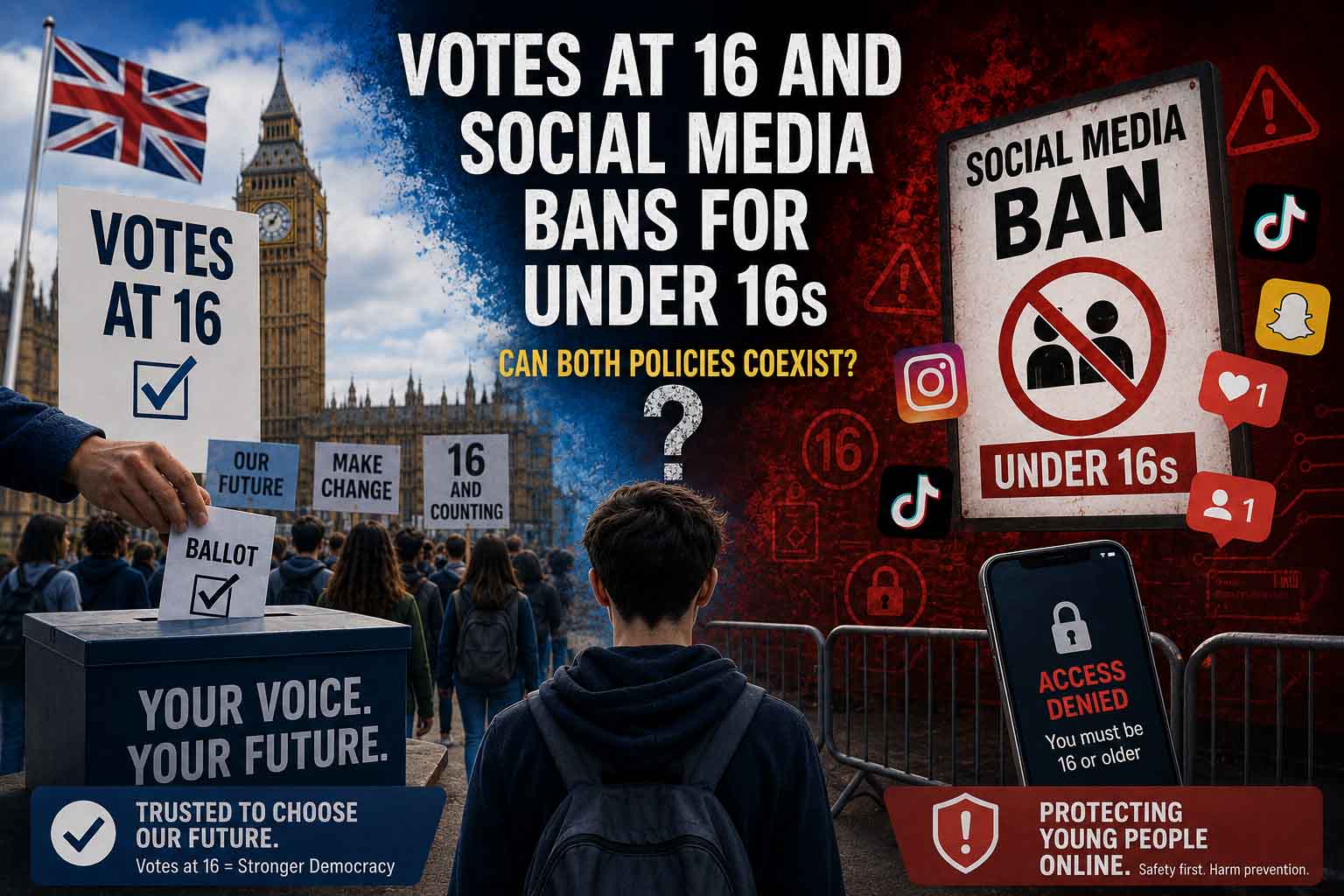
Votes at 16 and Social Media Bans for under 16s
Can Both Policies Coexist?
The UK Government’s decision to ban social media access for under-16s while simultaneously pursuing legislation to give 16 and 17-year-olds the right to vote has ignited a fierce political and cultural debate.
Supporters argue that the two policies address entirely different issues. Critics see a contradiction at the heart of government policy: if young people are considered mature enough to help choose the nation’s government, why are they considered too vulnerable to participate in online social networks?
The debate raises fundamental questions about responsibility, citizenship, free expression and the practical realities of life in a digital age.
The New Social Media Restrictions
The Government has announced that social media platforms will be prohibited from allowing under-16s to hold accounts, with additional restrictions placed on certain online features for older teenagers. The measures are intended to reduce exposure to harmful content, online grooming, addictive algorithms and other risks associated with modern social media platforms. The policy is expected to come into force in 2027, with age verification requirements playing a central role in enforcement.
Ministers argue that social media companies have failed to adequately protect children and that stronger intervention is required to safeguard young people’s mental health and wellbeing. Similar approaches have been adopted or proposed elsewhere, including Australia and several European countries.
Lowering the Voting Age
At the same time, Labour is progressing legislation to reduce the voting age to 16 across UK elections. The Government argues that many 16 and 17-year-olds already work, pay taxes and contribute to society, and therefore deserve a voice in the democratic process. The Representation of the People Bill seeks to extend voting rights before the next general election.
Supporters of votes at 16 point out that young people in Scotland and Wales already participate in certain elections, and that early engagement can encourage lifelong democratic participation.
The Contradiction Critics Highlight
For many observers, the tension between these two policies is obvious.
The argument runs as follows: voting is one of the most important responsibilities in a democracy. It requires citizens to evaluate political arguments, assess competing policies and make informed decisions that affect the future of the country.
Much of that political debate now takes place online.
Political parties campaign on social media. Journalists distribute news through social media. Politicians communicate directly with voters through social media.
Critics therefore ask how a government can simultaneously argue that 16-year-olds are mature enough to participate in national elections while suggesting that younger teenagers require protection from the very platforms where much political discussion occurs.
The issue becomes even more striking when considering that many of the arguments used to justify votes at 16 emphasise maturity, responsibility and civic engagement. These are the same qualities that opponents of social media restrictions argue should enable young people to make informed decisions about their online activity.
The Enforcement Challenge
Even supporters of stronger online protections acknowledge a significant practical problem: enforcement.
History suggests that young people are often highly effective at circumventing technological restrictions. Age limits on social media have existed for years, yet many children have routinely created accounts by entering false birth dates.
More sophisticated age verification systems may reduce this behaviour, but they are unlikely to eliminate it completely. VPNs, alternative devices, shared accounts and overseas platforms all provide potential workarounds. Research into age-verification systems has repeatedly found that many young people quickly identify and share methods of bypassing restrictions.
Some researchers have also observed increased interest in privacy tools and VPN services following online safety regulations and age-verification requirements.
Could Young People Simply Move Elsewhere?
Another concern is displacement.
If mainstream platforms become inaccessible, young people may not stop communicating online. Instead, they may migrate to encrypted messaging services, private groups or smaller platforms with less oversight.
Critics argue that this could unintentionally make online activity harder to monitor and potentially expose young people to greater risks. Public-facing social media platforms, despite their flaws, often have moderation systems, reporting mechanisms and regulatory scrutiny that smaller services may lack.
Parents and digital rights advocates have raised concerns that restrictions could drive activity underground rather than eliminate it altogether.
A Wider Debate About Modern Childhood
At its core, this debate is about more than social media or voting rights.
It reflects a broader uncertainty about how society defines adulthood in the twenty-first century.
Young people today can work, pay taxes, join political campaigns and, under proposed reforms, vote in national elections. Yet governments also increasingly seek to shield them from online risks that previous generations never faced.
The challenge for policymakers is balancing protection with personal responsibility.
Too much regulation risks becoming unenforceable and potentially counterproductive. Too little regulation risks leaving children exposed to genuine harms.
Conclusion
The Government’s twin policies of restricting social media access while expanding democratic participation illustrate the complexity of governing in the digital age.
Supporters see no contradiction, arguing that voting is a civic right whereas social media platforms are commercial products designed around engagement and profit.
Critics believe the policies send mixed messages about maturity and responsibility, questioning how 16-year-olds can be trusted with the ballot box while younger teenagers are deemed incapable of navigating online spaces.
Whether the new restrictions succeed will depend not only on legislation but also on enforcement, public acceptance and the willingness of young people to comply. If experience elsewhere is any guide, many will simply find alternative ways to connect online.
The real question may not be whether governments can ban social media for under-16s, but whether such bans can achieve their intended goals in an increasingly connected world.