

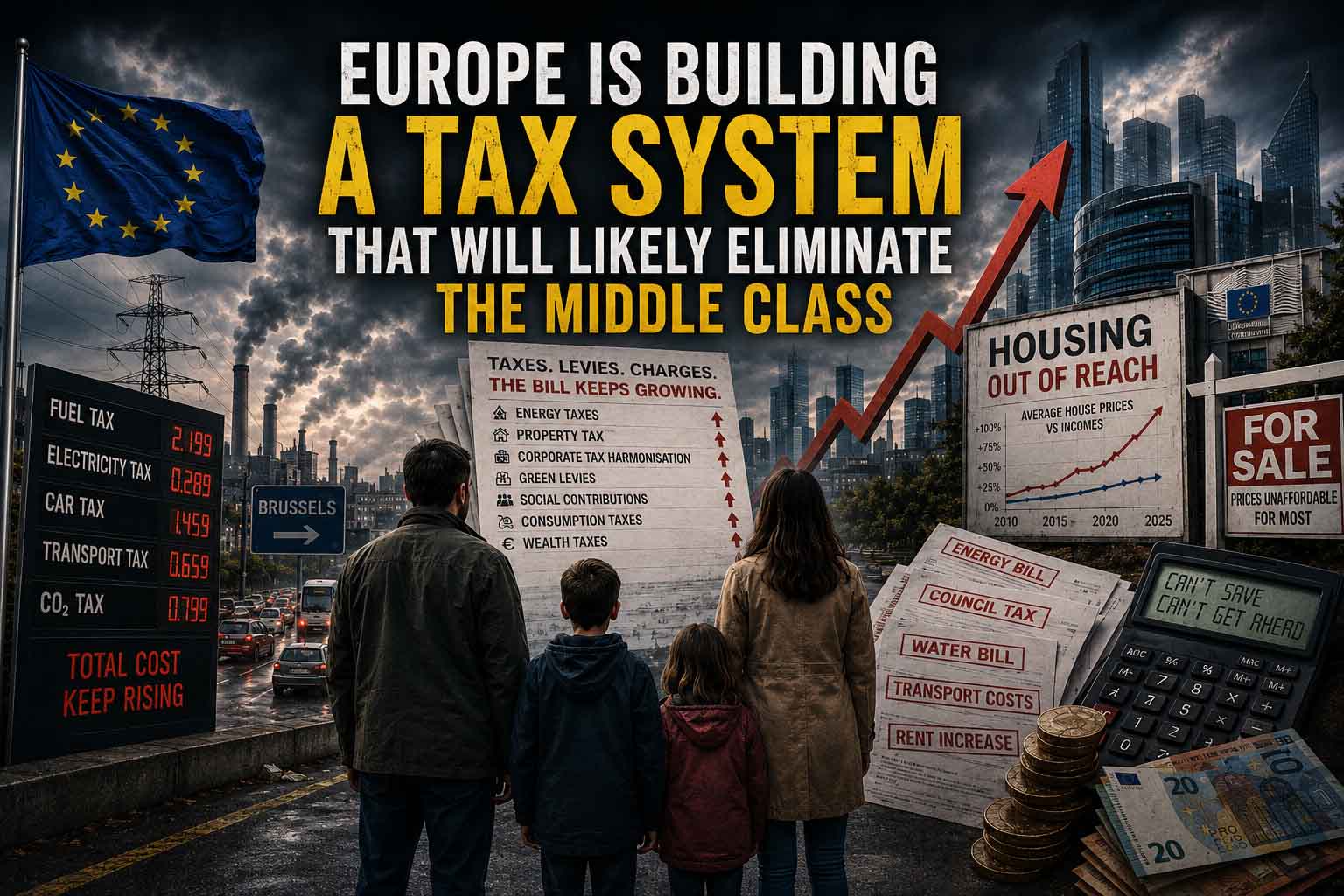
Europe Is Building a Tax System That Will Likely Eliminate the Middle Class
Introduction
A viral post published on X by Coinvo has reignited a long-running debate about taxation, economic freedom and the future of Europe’s middle class. The post argues that the European Union is constructing a comprehensive tax framework that will steadily erode disposable income, make home ownership increasingly difficult, discourage entrepreneurship and ultimately eliminate the middle class.
The claim is deliberately provocative. Yet it touches on genuine concerns shared by millions of Europeans who have experienced years of rising energy bills, increasing housing costs, stagnant wage growth, inflationary pressures and a growing tax burden.
The reality is more complex than the viral narrative suggests. The European Union is indeed pursuing greater tax coordination, stricter environmental taxation and new regulatory frameworks affecting housing, energy and business. However, whether these developments will destroy the middle class remains highly contested.
What is undeniable is that middle-income households across Europe face mounting financial pressure from multiple directions simultaneously.
The Growing Burden on European Households
For decades, Europe’s social model has been built around a balance between relatively high taxation and extensive public services. Citizens pay more in taxes than many of their counterparts elsewhere, but receive healthcare, education, infrastructure, pensions and social protections in return.
The challenge today is that many middle-class families increasingly feel that the costs are rising faster than the benefits.
Across much of Europe, workers face:
- Higher energy bills
- Rising transport costs
- Increasing housing expenses
- Growing tax compliance burdens
- Inflation that has outpaced wage growth in many sectors
While these pressures cannot all be attributed directly to Brussels, critics argue that EU-level policies increasingly contribute to the overall financial squeeze.
Energy Taxes and the Green Transition
One of the most controversial areas concerns energy taxation.
The European Commission has been pursuing reforms designed to align taxation with climate objectives. The proposed revision of the Energy Taxation Directive would restructure how fuels are taxed, placing greater emphasis on environmental impact and carbon emissions. Fossil fuels would generally face higher minimum tax rates while cleaner energy sources would receive more favourable treatment.
Supporters argue that such measures are necessary to reduce emissions, improve energy security and encourage investment in cleaner technologies.
Critics counter that the transition disproportionately affects ordinary households.
A family commuting to work, heating a home and paying electricity bills cannot simply eliminate energy consumption. As a result, increases in fuel and energy taxation often hit middle-income households hardest because they lack the financial flexibility available to wealthier individuals.
This concern has become particularly acute following the energy crises triggered by geopolitical tensions, supply disruptions and the economic consequences of the Russia-Ukraine conflict.
Many Europeans have already experienced sharp increases in household energy costs. Additional environmental levies risk being perceived as yet another burden placed on ordinary families.
Transport and Mobility Costs
Transport taxation is closely linked to energy policy.
European governments have increasingly promoted electric vehicles, low-emission zones and carbon reduction strategies. While these policies aim to address environmental concerns, they also create new costs.
Electric vehicles remain significantly more expensive than many conventional cars despite subsidies. Meanwhile, fuel taxes continue to represent a substantial portion of motoring costs.
For rural communities and suburban commuters, private transport is often a necessity rather than a luxury.
Critics argue that policymakers frequently underestimate how dependent millions of citizens remain on affordable mobility. Measures designed to discourage fossil fuel use can therefore function as indirect taxes on work, commuting and family life.
Supporters respond that the long-term goal is lower energy costs, cleaner air and reduced dependence on imported fuels.
The dispute ultimately centres on who bears the cost of the transition and whether middle-income households are being asked to shoulder too much of the burden.
Corporate Tax Harmonisation: Simplification or Centralisation?
Another major concern highlighted by Coinvo involves corporate tax harmonisation.
Historically, European countries have maintained significant control over their own tax systems. Different corporate tax rates have allowed countries to compete for investment and attract businesses.
The European Commission’s Business in Europe: Framework for Income Taxation (BEFIT) proposal seeks to establish a common framework for calculating corporate tax bases across the EU. According to the Commission, the objective is simplification, reduced compliance costs and a more level playing field for businesses operating across multiple member states.
Importantly, BEFIT does not create a single EU-wide corporate tax rate. Individual member states would still set their own rates.
Nevertheless, critics see the initiative as part of a broader trend towards tax centralisation.
Their concern is not necessarily the immediate impact of BEFIT itself, but the direction of travel. If tax bases become harmonised today, they argue, future pressure for rate harmonisation could follow.
Supporters reject this interpretation, arguing that reducing administrative complexity benefits businesses, encourages investment and strengthens European competitiveness. Recent Commission proposals under the 2026 Taxation Omnibus initiative are explicitly aimed at reducing bureaucracy and compliance costs for businesses.
The debate illustrates a recurring tension within the EU: balancing market integration against national sovereignty.
Housing: The Real Middle-Class Crisis
If there is one issue that genuinely threatens the middle class across Europe, it is housing.
Property prices have risen dramatically in many major cities and urban regions over the past two decades. Home ownership, once considered a realistic aspiration for middle-income earners, is increasingly out of reach for younger generations.
The causes are numerous:
- Housing shortages
- Planning restrictions
- Population growth
- Migration pressures
- Low interest rates during previous years
- Institutional investment in residential property
While housing policy largely remains a national responsibility, EU regulations increasingly influence building standards, environmental requirements and renovation obligations.
New energy-efficiency requirements are intended to reduce energy consumption and lower long-term household costs. The European Commission argues that improved building performance can reduce bills and create more affordable housing over time.
However, critics warn that mandatory upgrades can impose significant upfront costs on homeowners and landlords.
For a middle-class family already struggling with mortgage payments, additional renovation requirements may feel less like assistance and more like another financial obligation.
This tension between long-term environmental goals and short-term affordability lies at the heart of many disputes surrounding EU policy.
Is the Middle Class Actually Shrinking?
The most dramatic claim made by critics is that Europe’s middle class is being deliberately dismantled.
There is evidence that many middle-income households feel economically insecure despite remaining statistically middle class.
Several trends contribute to this perception:
- Slower real wage growth
- Rising housing costs
- Increasing energy expenses
- Greater wealth concentration
- Reduced affordability for younger generations
However, economists generally caution against simplistic explanations.
The challenges facing Europe’s middle class result from a combination of factors:
- Globalisation
- Demographic ageing
- Technological change
- Housing shortages
- Monetary policy
- Inflation
- Energy market disruptions
- National tax policies
- EU regulations
Attributing these developments solely to EU taxation would be an oversimplification.
Nonetheless, perceptions matter.
When citizens feel they are working harder while becoming less financially secure, trust in institutions inevitably declines.
The Political Consequences
The growing frustration among middle-income voters has already reshaped European politics.
Across the continent, parties sceptical of further European integration have gained support by arguing that Brussels is increasingly disconnected from everyday economic realities.
Many voters no longer judge policies based on environmental targets, fiscal frameworks or regulatory objectives alone.
Instead, they ask a simpler question:
“Will this make my life more affordable?”
When the answer appears to be no, resistance grows.
This explains why debates surrounding energy taxes, housing regulations and corporate tax coordination have become politically explosive.
They are no longer merely technical policy discussions. They have become symbolic battles over who bears the cost of Europe’s economic transformation.
Conclusion
The claim that the European Union is building a tax system that will eliminate the middle class is a powerful political slogan rather than an established economic fact.
The evidence does not support the notion of a deliberate strategy to destroy middle-income households. Many EU initiatives, including BEFIT and the Taxation Omnibus programme, are presented as attempts to simplify rules, improve competitiveness and reduce administrative burdens.
However, the concerns underlying the viral post should not be dismissed.
Middle-class Europeans are facing genuine economic pressures from housing costs, energy prices, taxation and declining affordability. Environmental policies, tax reforms and regulatory changes often impose costs that are felt most acutely by ordinary working families.
The real challenge for Europe is not whether it taxes too much or too little.
It is whether policymakers can pursue climate goals, economic competitiveness and social protection without placing an unsustainable burden on the very people who form the backbone of European society.
If Europe’s middle class continues to feel squeezed from every direction, the political consequences may ultimately prove more significant than any individual tax policy.