

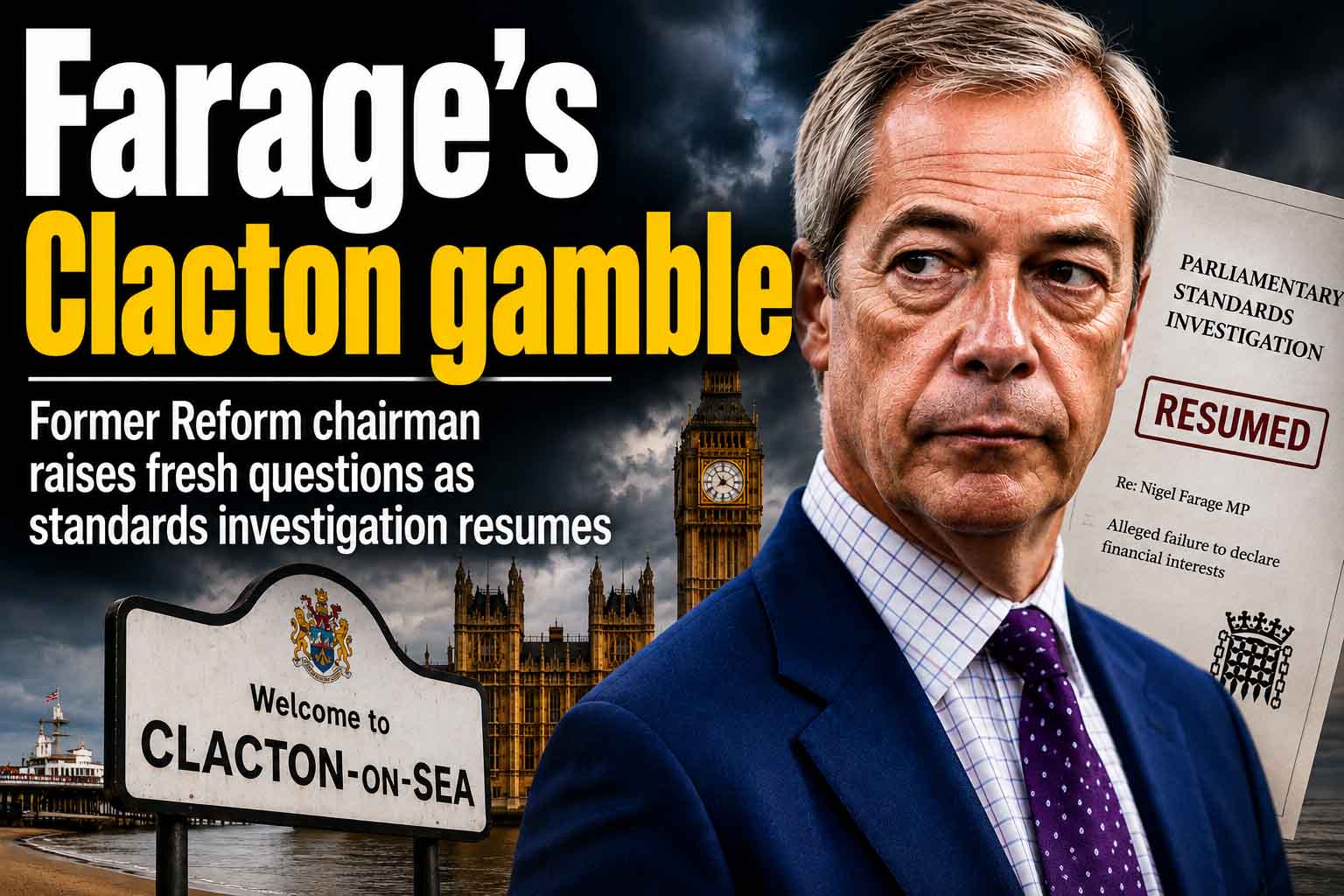
Farage’s Clacton gamble
Former Reform chairman raises fresh questions as standards investigation resumes
Nigel Farage has won the Clacton by-election with a commanding majority, but the result has failed to deliver the one outcome that would have most clearly justified his decision to resign his seat: an end to the parliamentary scrutiny of his finances.
Instead, within hours of his return to Parliament, the standards investigation into an undeclared £5 million gift and other financial support has resumed.
The development has given renewed significance to comments made by former Reform UK chairman David Bull on Times Radio, in which he discussed the possibility of Farage facing a recall petition if the standards process eventually resulted in a sufficiently lengthy suspension. Bull’s remarks have fuelled questions about the strategic thinking behind Farage’s decision to resign and force a by-election in the first place. (The Times)
The resignation that triggered the election
Farage resigned as MP for Clacton in July, triggering a by-election which he then contested himself.
At the time, the Reform UK leader presented the decision as an opportunity to return directly to voters and obtain a fresh mandate, amid what he described as unfair political and media scrutiny of his financial affairs.
The resignation had an immediate procedural consequence: the parliamentary standards investigation was paused while he was no longer an MP.
The subsequent election therefore became far more than a conventional by-election. Farage portrayed it as a battle between himself and what he characterised as an establishment determined to discredit him.
He has now won that battle at the ballot box.
But the standards process has not gone away.
The investigation is back
Farage was re-elected with 22,239 votes, representing roughly 63 per cent of the vote. His nearest challenger, the satirical candidate Count Binface, secured approximately 9,455 votes, or 27 per cent. Turnout was just 44.4 per cent. (The Independent)
Yet the significance of the result was immediately complicated by the announcement that the Parliamentary Commissioner for Standards had resumed the investigation into Farage.
The inquiry concerns allegations that Farage failed to properly declare financial gifts and support, including the £5 million gift from businessman Christopher Harborne. The investigation had been suspended following Farage’s resignation but automatically resumed once he returned to the Commons. (The Guardian)
This creates an extraordinary sequence of events:
Farage was investigated → Farage resigned → the investigation was paused → Farage forced a by-election → Farage won → Farage returned to Parliament → the investigation resumed.
The election has therefore changed Farage’s parliamentary mandate, but it has not resolved the underlying questions.
David Bull’s intervention
It is against that background that David Bull’s Times Radio interview takes on particular significance.
Bull is not simply a political commentator. He was chairman of Reform UK from June 2025 until his resignation in May 2026, giving his observations particular relevance when assessing the internal thinking of the party.
Discussing the possibility of a future suspension and recall petition, Bull indicated that he did not expect there to be another by-election in Clacton, even if Farage were suspended, because he believed Farage retained sufficient support locally to defeat a recall petition. The Times has independently reported Bull’s comments. (The Times)
That is important because a parliamentary suspension of sufficient length can potentially result in a recall petition. If at least 10 per cent of eligible voters sign such a petition, another by-election can be triggered.
Bull’s comments therefore put the mechanics of the recall process at the centre of the discussion.
They also raise an obvious question: was avoiding that potential process one of the considerations behind Farage’s decision to resign voluntarily and seek an immediate fresh mandate?
There is evidence that the possibility of another election was already troubling Farage before he resigned. Reports in early July said he was concerned that the standards process could ultimately lead to a recall petition and another contest in Clacton. (LBC)
That does not, by itself, prove that avoiding the investigation was the sole reason for his resignation. Farage gave his own political justification for the decision and clearly wanted to demonstrate that he retained the confidence of his constituents.
But the timing, the procedural consequences and Bull’s subsequent comments make the standards investigation an unavoidable part of the story.
A strategy that only partly worked
Farage can point to the result as evidence that the gamble paid off.
He won decisively, increasing his vote total from 21,225 at the 2024 general election to 22,239 in the by-election. His vote share also rose substantially, although the circumstances were very different: the main established political parties did not contest the by-election, leaving Farage facing a field dominated by independents, novelty candidates and Count Binface. (The Independent)
The result nevertheless gave Farage precisely the political image he had sought: a fresh electoral mandate from Clacton.
But it did not provide immunity from parliamentary standards rules.
That is the central irony.
The by-election temporarily halted the investigation because Farage was no longer an MP. His victory put him back into the Commons, and his return automatically brought the investigation back with him. (ITVX)
As The Independent observed, the by-election may ultimately have postponed rather than resolved the political crisis surrounding Farage. (The Independent)
What happens if there is a suspension?
The next stage could be considerably more consequential.
If the standards investigation ultimately finds that parliamentary rules were breached, the matter could eventually reach the House of Commons for consideration of a sanction.
A suspension of sufficient length could potentially trigger the recall mechanism.
That is precisely the scenario Bull was discussing when he expressed confidence that Farage would nevertheless survive another recall attempt because of his support in Clacton. (The Times)
There is an obvious political irony here.
Farage has just spent considerable political capital securing a fresh mandate from the electorate. Yet the very standards process that his resignation temporarily interrupted is now back on his doorstep.
Should the investigation ultimately lead to a recall petition, the question would no longer be whether Farage could win an election that he had voluntarily called.
It would be whether he could survive an election forced upon him by the consequences of the parliamentary process.
The £5 million remains the central issue
It is important to distinguish allegations from established wrongdoing.
The investigation concerns whether Farage complied with parliamentary rules governing the declaration of financial interests. The existence of the £5 million gift is not itself proof that Farage committed an offence or breached the rules.
Farage has disputed wrongdoing and has argued that the circumstances surrounding the gift did not require the declaration being alleged.
The purpose of the standards process is to establish whether the relevant parliamentary rules were followed.
That process must therefore be allowed to reach its conclusion before definitive claims of misconduct are made.
But politically, the controversy has already become significant.
The issue was sufficiently serious to contribute to Farage’s decision to resign, became the backdrop to a highly unusual by-election and has now returned to the headlines immediately after his re-election.
A political gamble with an unfinished ending
The most accurate assessment may therefore be that Farage’s Clacton strategy succeeded electorally but failed to resolve the underlying controversy.
He achieved an emphatic victory.
He demonstrated that he retains substantial support among Clacton voters.
He returned to Parliament with a fresh mandate.
But the standards investigation has followed him back through the doors of Westminster.
And David Bull’s intervention has added another layer to the story by highlighting the possibility that the recall mechanism could become relevant again if the standards process eventually results in a sufficiently serious sanction.
The claim that Bull has explicitly admitted that the only reason Farage called the by-election was to stop the investigation should therefore be treated cautiously. The evidence does not establish that as an undisputed fact.
What it does establish is more nuanced — and potentially more politically damaging.
Farage’s resignation interrupted the investigation, his by-election victory returned him to Parliament, and the investigation has now restarted.
If the original objective was to draw a line under the financial controversy, that objective has plainly not been achieved.
For Nigel Farage, the Clacton by-election may have answered one question — whether voters would return him to Parliament.
The much more difficult question is still waiting for him in Westminster:
what will the standards investigation conclude? (The Guardian)