

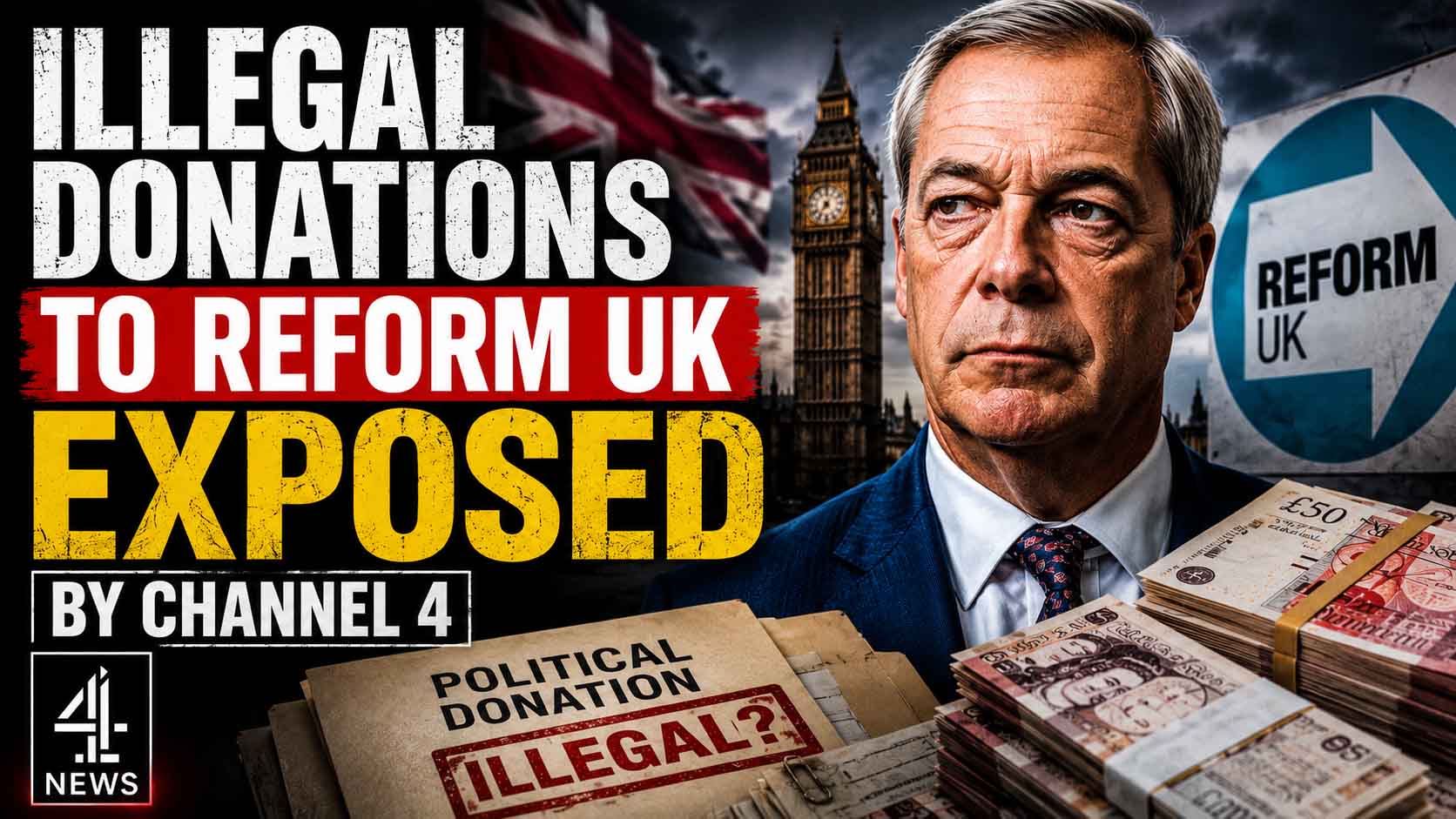
Illegal Donations to Reform UK Exposed by Channel 4
A Channel 4 undercover investigation has raised serious questions about Reform UK’s handling of political donations, foreign funding and undeclared support — with potentially significant consequences for the party and its leader, Nigel Farage.
An explosive investigation by Channel 4 News has placed Reform UK under renewed scrutiny after undercover reporters allegedly captured senior figures within the party discussing arrangements that could have allowed money originating in the United States to enter British politics while appearing to come from a permissible UK donor.
The investigation raises questions not only about the party’s financial controls, but about whether some senior Reform figures understood that proposed arrangements could breach Britain’s political-finance rules.
The allegations are particularly damaging because Reform has built much of its political appeal around challenging what it describes as a complacent and unaccountable political establishment.
The £32,500 question
At the centre of the investigation is £32,500 spent on three opinion polls.
According to Channel 4, an American company connected to the undercover operation paid for polling commissioned by Reform UK. The resulting polling was subsequently reported by major British newspapers without, Channel 4 alleges, the newspapers being told that Reform had commissioned the research or that it had been funded by the American company.
The three payments reportedly totalled £32,500.
This matters because political donations under British electoral law are not limited to envelopes of cash or direct bank transfers. The rules can also cover benefits provided to a political party, including goods and services and certain research or studies provided for its benefit.
The Electoral Commission requires political parties to establish that donations come from permissible sources and to report donations above the relevant thresholds.
Consequently, the central question is not simply who received the money?
It is also:
Who paid for the service, who commissioned it, who benefited from it and how was it recorded?
If the polling constituted a political donation, the identity and eligibility of the ultimate source of that benefit could become highly significant.
The alleged £500,000 arrangement
Even more serious are allegations concerning a proposed donation of £500,000.
Channel 4 reports that undercover journalists presented themselves as a wealthy American and his UK-based son. During conversations with senior Reform figures, they discussed the possibility of the son making a substantial donation to the party using money ultimately supplied by his American father.
The proposed arrangement was never completed and the £500,000 was not donated.
That is an important distinction.
However, the allegation is that senior Reform figures discussed how such an arrangement could be structured so that the UK-based individual appeared to be the donor, despite the money ultimately originating overseas.
If that account is substantiated, it raises an obvious question:
Was the purpose of the proposed structure to conceal the true source of the money?
British political-finance law places considerable importance on identifying the true source of political donations. A party cannot simply treat a person as the donor if that person is merely acting as a conduit for money from an impermissible source.
What did Nigel Farage know?
The investigation also puts Nigel Farage under uncomfortable scrutiny.
Farage met the undercover individuals and, according to Channel 4, discussed their support and thanked them.
However, it is important not to go further than the evidence currently allows.
The Channel 4 material does not automatically establish that Farage personally committed an offence, nor does it establish that he authorised an illegal donation.
The crucial questions for any subsequent investigation will be what Farage knew, when he knew it and whether he understood the true source and proposed structure of the funding.
That distinction matters.
Political responsibility and criminal liability are not the same thing.
If investigators were eventually able to demonstrate that Farage knowingly authorised or facilitated an unlawful funding arrangement, the consequences would be considerably more serious. At present, however, that conclusion would go beyond the evidence publicly established by the investigation.
Senior Reform figures also face questions
Perhaps the most damaging aspect of the Channel 4 investigation is that the allegations do not centre solely on Farage.
Senior Reform figures were reportedly recorded discussing funding arrangements and the potential treatment of political support.
Channel 4 reports comments suggesting that some projects could remain outside public records and that certain arrangements could potentially be carried out without attracting attention.
If accurately represented and subsequently corroborated, such comments would be extremely difficult to dismiss as a simple misunderstanding of complicated electoral regulations.
They could suggest an awareness of the distinction between what the law requires to be declared and what might remain undisclosed.
That is precisely the sort of evidence investigators would be expected to examine.
Foreign money and British elections
The underlying principle behind Britain’s political-donation rules is straightforward.
Political parties contesting British elections should not be financially controlled or influenced by foreign interests that are not entitled to participate in the UK’s political-finance system.
The rules therefore restrict donations to permissible sources and impose reporting and verification requirements on political parties.
This is not unique to Reform UK. The same rules apply to Britain’s other political parties.
The significance of the Channel 4 allegations is therefore not that Reform has somehow been singled out by unusual legislation.
It is that the investigation raises the possibility that individuals within the party may have discussed mechanisms designed to get around those rules.
That is a potentially serious matter.
A growing problem for Reform
The investigation also arrives at an extremely difficult time for Reform UK.
The party has rapidly transformed itself from a protest movement into a serious electoral force and is increasingly presenting itself as a potential party of government.
That creates a much higher standard of scrutiny.
Questions surrounding political donations are particularly sensitive for Nigel Farage because his political career has been built around arguments concerning transparency, accountability and the conduct of Britain’s political establishment.
Any suggestion that his own party has been willing to accept foreign-origin funding through questionable arrangements therefore carries a significant political cost.
It also risks reinforcing an increasingly damaging narrative: that Reform may have a problem with the way political money is raised, received and recorded.
What could happen next?
The Channel 4 allegations could now trigger scrutiny from the Electoral Commission and potentially the police.
The precise consequences will depend on what investigators establish.
If the £32,500 polling expenditure is determined to have constituted reportable political donations and the party failed to comply with the relevant rules, Reform could face regulatory consequences.
If investigators instead establish deliberate attempts to conceal the true source of political funding, the matter could become considerably more serious and potentially involve criminal offences.
For Nigel Farage personally, the position is less clear.
There is currently an important distinction between being the leader of a party whose officials are accused of wrongdoing and personally committing an offence.
Investigators would need evidence linking Farage himself to any unlawful conduct before personal criminal liability could properly be considered.
The bigger political question
Regardless of what happens legally, the political damage may already have been done.
Reform UK has spent years arguing that Britain’s political establishment cannot be trusted and that politicians should be held accountable for their actions.
Those arguments carry considerable political weight only if Reform is prepared to meet the same standards it demands of others.
The Channel 4 investigation therefore presents Reform with a serious credibility test.
Was this simply a case of inexperienced party officials misunderstanding complicated electoral regulations?
Or did senior figures knowingly explore ways of accepting foreign-origin financial support while avoiding the transparency requirements that apply to political donations?
That is ultimately what any investigation will have to establish.
For now, it would be wrong to declare Nigel Farage or Reform UK guilty of criminal wrongdoing when no such finding has been made.
But it would be equally wrong to dismiss the allegations as insignificant.
The reported evidence raises serious questions about Reform UK’s financial governance, its senior leadership and the way political donations are handled.
And if investigators establish that foreign money was deliberately channelled into British politics while concealing its true source, the consequences could extend far beyond an embarrassing news story.
They could become a genuine legal and political crisis for Reform UK.