

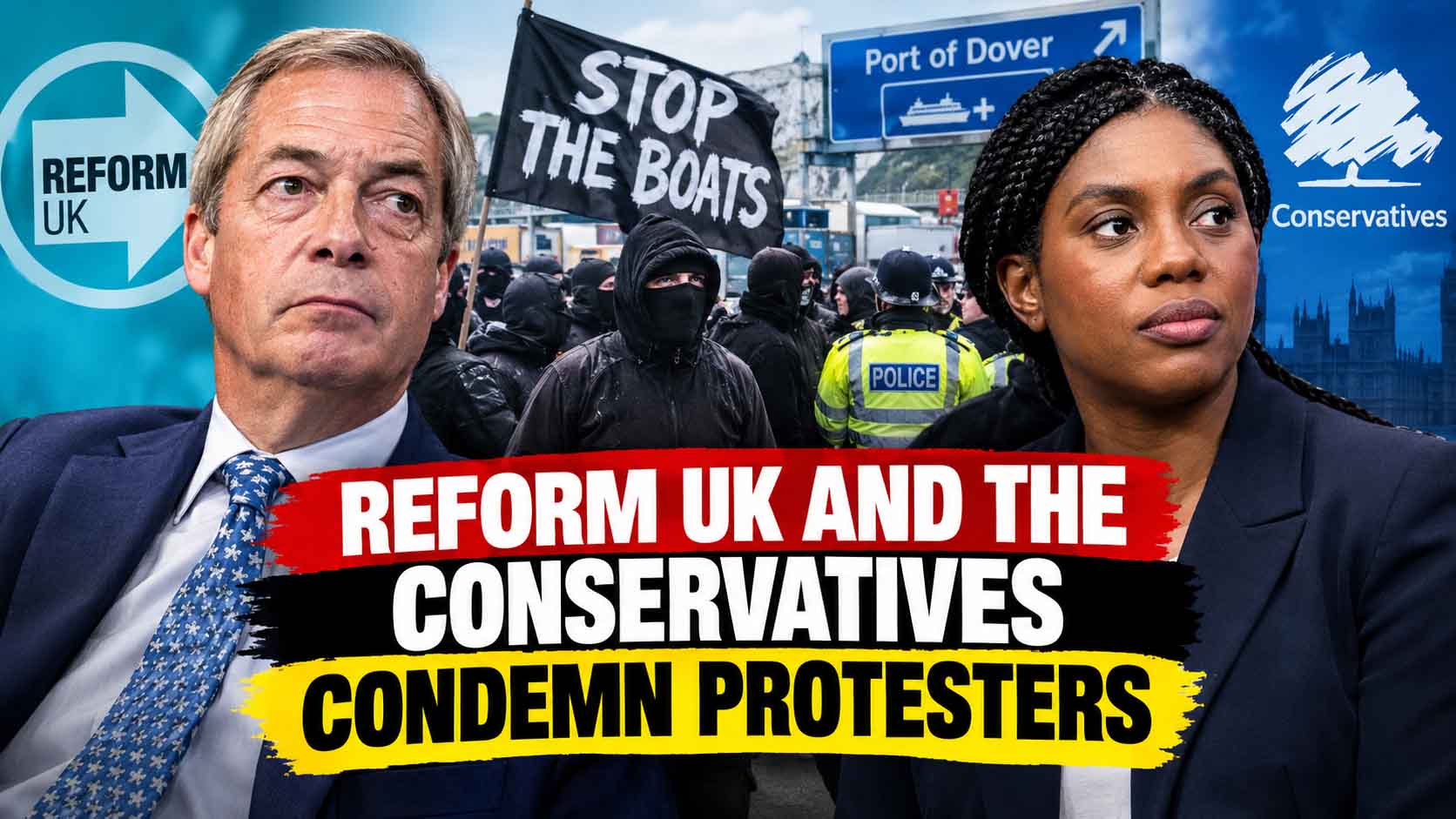
Reform UK and the Conservatives Condemn Protesters
The scenes witnessed in Dover and Portsmouth over the weekend have exposed an increasingly bitter fault line within Britain’s debate over immigration: how far can public anger over uncontrolled migration go before legitimate protest becomes intimidation and disorder?
The answer from senior figures in Reform UK has been unusually clear. Nigel Farage and Robert Jenrick have condemned the tactics employed by protesters who descended on the south coast, while Conservative politicians have likewise criticised the disruption and intimidation.
For a movement whose central political message is that Britain must regain control of its borders, the response is significant. Reform UK is attempting to distinguish between public anger over illegal immigration and forms of protest that it believes damage rather than advance that cause.
Dover brought to a standstill
On Saturday 5 September, hundreds of predominantly male protesters, many dressed in black and wearing balaclavas, descended on Dover and blocked roads leading to the Port of Dover.
The protest caused significant disruption to traffic serving one of Britain’s busiest international ferry terminals. National Highways reported congestion stretching for approximately four miles, while access to the port was temporarily blocked. By lunchtime, the protesters had dispersed and normal traffic flow had been restored. No arrests were made during the incident.
The demonstration was associated with Patriot Platform, a recently established anti-immigration network founded by Daniel Thomas, better known as Danny Tommo. Thomas is a prominent associate of Tommy Robinson and has described his organisation in terms of building a disciplined patriotic movement prepared to engage in what he calls “mass resistance”.
The organisation’s methods have attracted considerable attention because of the apparent coordination behind the Dover action. Although Kent Police described the event as a spontaneous protest, local politicians and subsequent reporting have questioned how an operation involving large numbers of people travelling to multiple locations could have taken place without more advance intelligence.
Whatever the explanation, the consequences for ordinary people were immediate. Residents, workers, freight operators and holidaymakers were caught up in the blockade.
That distinction matters.
A person can be profoundly angry about illegal immigration and still believe that blocking a major transport artery is unacceptable.
Farage: “disgusting”
Nigel Farage, the leader of Reform UK, was unequivocal in his criticism.
Speaking to GB News, Farage described the masked demonstration as “disgusting” and said that people taking part in political protests should not appear in balaclavas, regardless of whether they are on the political left or right.
Farage subsequently went further, arguing in The Telegraph that Britain should consider a much broader prohibition on full-face coverings in public.
His position is politically significant because it rejects the argument that anger over illegal immigration automatically justifies the methods used by protesters.
Farage has repeatedly made stopping small-boat crossings one of Reform UK’s central political objectives. His argument is essentially that the problem should be confronted through political power rather than street vigilantism.
As he put it in subsequent remarks, peaceful protest is legitimate, but masks and uniforms are not an acceptable way of conducting political demonstrations, with the ballot box providing the route to political change.
Jenrick: “completely disgraceful”
Robert Jenrick, who defected from the Conservatives to Reform UK in January 2026, took a similarly hard line.
Asked about the Dover blockade at Reform’s annual conference, Jenrick said he was “sick of people disrupting life in this country” and hoped the police would take whatever action was necessary to reopen the port.
He described the disruption as “completely disgraceful”, particularly because businesses and individuals were having their lives disrupted.
Jenrick’s position is particularly noteworthy given his political history. He was removed from the Conservative Party by Kemi Badenoch after evidence emerged that he was planning to defect to Reform, before joining Farage’s party and becoming one of its most senior figures.
His condemnation therefore cannot easily be dismissed as the response of a conventional Conservative politician defending the establishment. Jenrick is now part of the political movement campaigning most aggressively for a tougher approach to immigration.
His message is instead that a government can and should stop illegal immigration without protesters taking the law into their own hands.
Portsmouth escalates the confrontation
The following day, tensions moved west to Portsmouth.
A boat carrying approximately 140 people was brought ashore on the Hampshire coast, an unusual location compared with the more familiar arrival points around Kent. The arrival prompted a rapid mobilisation of protesters, with hundreds eventually gathering and attempting to prevent the migrants from being transported away for processing.
Unlike Dover, the Portsmouth confrontation escalated into clashes between protesters and police.
Police faced a crowd attempting to block the movement of coaches. Officers were confronted as they attempted to maintain access and control the situation, and reports said officers suffered minor injuries while emergency vehicles were damaged. A dispersal order was eventually used to clear the area during the early hours of Monday morning.
Hampshire’s Police and Crime Commissioner, Donna Jones, said people had the right to protest peacefully but described some of the behaviour as intimidating, particularly the presence of protesters wearing balaclavas. She also warned that the incident had placed substantial pressure on policing resources.
The government’s policing minister, Sarah Jones, went further, describing the behaviour as “intimidating and thuggish” and warning that peaceful protest must not become criminality or intimidation.
What about Zia Yusuf?
One of the more interesting developments was the confrontation between Patriot Platform founder Daniel Thomas and Reform UK’s home affairs spokesman Zia Yusuf.
Thomas interrupted Yusuf during a television interview in Portsmouth and warned that Farage needed to be “careful” about his language concerning the protesters.
But the available evidence does not support the claim that Yusuf endorsed the demonstrations as lawful “mass resistance”.
Instead, Yusuf explicitly told Thomas that there was no excuse for violence against police officers doing their jobs.
That is an important distinction. There may be disagreement within the wider anti-immigration movement over Farage’s condemnation of masked protesters, but the evidence currently available does not demonstrate a formal Reform UK split in which Yusuf defended violence or unlawful conduct.
Thomas, meanwhile, defended the use of masks by arguing that protesters did not want to be labelled far right and claimed the face coverings were not intended to intimidate.
And the Conservatives?
The Conservatives have also criticised the tactics employed in Dover, although the evidence needs to be presented accurately.
There is no strong evidence that Conservative leader Kemi Badenoch personally issued a prominent statement condemning the Dover or Portsmouth protests comparable with Farage’s comments.
However, Conservative politicians locally did condemn the disruption.
Chris Vinson, leader of the Conservative group on Dover District Council, described the demonstration as apparently related to illegal migration and said that encountering men dressed in black and wearing balaclavas while having one’s vehicle blocked was “extremely intimidating”.
That distinction matters because it would be misleading to attribute comments made by Conservative councillors to Badenoch personally.
Nevertheless, the broader political message from mainstream Conservative and Reform politicians has been similar: anger over illegal immigration does not provide a licence to intimidate members of the public or obstruct vital infrastructure.
The numbers complicate the picture
The protests also occurred against a backdrop of falling small-boat arrivals.
The latest official Home Office figures show that 33,374 people arrived in the UK by small boat in the year ending June 2026, down 23% from 43,309 in the previous year. The number of boats also fell by 33%.
More recent provisional figures indicate that the decline continued during 2026, although individual days can still produce very large arrivals.
Indeed, on 6 September alone, the Home Office recorded 625 arrivals in eight boats.
This illustrates the complexity of the situation. Overall numbers may be falling while individual incidents can still generate considerable political and public anger.
The Portsmouth arrival was particularly striking because of its unusual location and the size of the boat. The incident also raised questions about whether people smugglers are beginning to exploit alternative routes and landing points.
The political problem therefore has not disappeared simply because the annual figures have fallen.
Is this evidence of a “Uniparty”?
For some activists on the harder right, the response from Farage and Jenrick has produced an uncomfortable question.
If Reform UK exists to give political expression to people who believe successive governments have lost control of Britain’s borders, why should its leaders condemn people who take to the streets in anger over illegal immigration?
That argument underpins the increasingly common “Uniparty” accusation — the idea that Reform and the Conservatives may present themselves as political opponents while ultimately defending the same establishment system.
But the evidence from this weekend does not prove that thesis.
In fact, the differences between Reform and the Conservatives remain substantial, particularly over immigration policy. Reform continues to advocate significantly tougher measures, including ending small-boat arrivals and removing people who have no legal right to remain.
What the Dover and Portsmouth events demonstrate instead is a disagreement over methods.
Farage’s position is that Britain needs stronger immigration enforcement, but that political change must ultimately come through elections and government policy. The protesters’ position, at least in part, is that politicians have failed for too long and that direct action is therefore justified.
That is a genuine political dividing line.
A warning for Reform UK
The events present Reform UK with a difficult balancing act.
The party wants to harness widespread frustration over immigration without becoming associated with uncontrolled street disorder or organised vigilantism.
Farage therefore faces a strategic choice: condemn the methods while maintaining the strongest possible opposition to illegal immigration.
His statements suggest that this is precisely the route he intends to take.
The message is straightforward: stop the boats through government policy, not by blocking ports or attacking police officers.
That position may anger some of the activists who believe politicians have spent too long ignoring them. But politically, it allows Reform to argue that it represents a route from public anger to government.
The alternative would be to allow increasingly militant groups such as Patriot Platform to define the immigration debate on the streets.
That would carry considerable political risks.
The bigger question
The Dover and Portsmouth protests should not be interpreted as evidence that concern about illegal immigration is confined to the political fringe. Nor should the anger of people worried about Britain’s borders be dismissed simply because some protesters behaved unlawfully.
There is a legitimate debate about border security, asylum policy, the pace of removals and the government’s ability to prevent small boats crossing the Channel.
But there is an equally important democratic principle: political grievances do not confer a right to intimidate strangers, blockade essential infrastructure or attack police officers.
That appears to be the position now being asserted by Reform UK’s senior leadership.
Farage and Jenrick are attempting to draw a line between support for stopping the boats and support for the tactics used by the masked protesters.
Whether Reform can maintain that distinction while continuing to capitalise on Britain’s growing anger over immigration could prove politically important.
For the protesters themselves, however, the weekend has already sent another message: if they believe mainstream politicians are failing to act, they may increasingly attempt to take direct action themselves.
And that could make the next confrontation considerably more serious than the scenes witnessed in Dover and Portsmouth.